MonoMath CBSE
CBSE Maths › Class 10 PYQs › 2026

CBSE Class 10 Maths Basic 2026 Question Paper 430/4/2 with Solutions

All 44 questions from the CBSE Class 10 Mathematics Basic board paper, Set 430/4/2 (2026), with answers and step-by-step solutions. Total 80 marks. Tap “Show answer & solution” under any question.

Set 430/4/1Set 430/4/2Set 430/4/3Set 430/5/1Set 430/5/2Set 430/5/3
Q11 markMCQProbability

A card is drawn from a well shuffled deck of 52 cards. The probability of getting an ace or a ten is :

  1. (A)
  2. (B)
  3. (C)
  4. (D)
Show answer & solution
Answer: (B)
  1. There are 4 aces and 4 tens: 8 favourable cards.
  2. P = .
Also asked in: 2026 Basic 430/4/1

The distance between the points (– 5, 1) and (2, 2) is :

  1. (A) units
  2. (B) units
  3. (C) units
  4. (D) units
Show answer & solution
Answer: (C) units
  1. Distance = .
  2. units.
Q31 markMCQProbability

Probability of getting an irrational number at random from the numbers is :

  1. (A)0
  2. (B)
  3. (C)
  4. (D)1
Show answer & solution
Answer: (C)
  1. , , and 0 are rational.
  2. , and are irrational: 3 of 7 numbers.
  3. P(irrational) = .
Q41 markMCQPolynomials

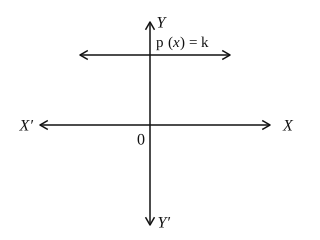
The graph of polynomial p() = k is shown here. Number of zeroes of polynomial p() is :

Diagram for CBSE 2026 Class 10 Maths question 4
  1. (A)0
  2. (B)1
  3. (C)2
  4. (D)infinitely many
Show answer & solution
Answer: (A) 0
  1. The zeroes are the x-coordinates where the graph meets the x-axis.
  2. The graph of p() = k is a horizontal line above the x-axis, so it never meets the x-axis.
  3. Number of zeroes = 0.

Chord AB subtends an angle of at the centre of the circle of radius 9 cm. The length of arc AB is :

  1. (A) cm
  2. (B) cm
  3. (C) cm
  4. (D) cm
Show answer & solution
Answer: (C) cm
  1. Arc length = .
  2. cm.
Also asked in: 2026 Basic 430/4/1
Q61 markMCQReal Numbers

7 × 29 × 23 + 1 is :

  1. (A)a prime number.
  2. (B)divisible by 23.
  3. (C)an odd number.
  4. (D)a composite number.
Show answer & solution
Answer: (D) a composite number.
  1. , so the number is 4670.
  2. 4670 is even, so it has factors other than 1 and itself.
  3. Hence it is a composite number.
Q71 markMCQCircles

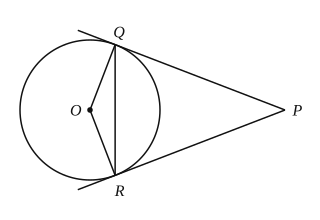
In the given figure, PQ and PR are two tangents drawn to a circle with centre O. If , then the measure of is :

Diagram for CBSE 2026 Class 10 Maths question 7
  1. (A)
  2. (B)
  3. (C)
  4. (D)
Show answer & solution
Answer: (A)
  1. OQ = OR (radii), so .
  2. (radius tangent).
  3. .

The value of is :

  1. (A)1
  2. (B)0
  3. (C)2
  4. (D)not defined
Show answer & solution
Answer: (A) 1
  1. .
  2. .
  3. Value = 1 – 0 = 1.
Q91 markMCQReal Numbers

HCF of two consecutive natural numbers is :

  1. (A)2
  2. (B)1
  3. (C)0
  4. (D)smaller number
Show answer & solution
Answer: (B) 1
  1. Any common factor of n and n + 1 also divides their difference, 1.
  2. So the HCF is 1.
Q101 markMCQTriangles

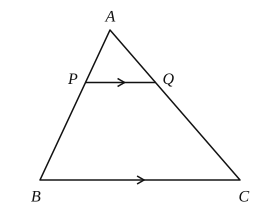
In the given figure, PQ BC. If AP : AB = 3 : 7 then, AQ : QC equals :

Diagram for CBSE 2026 Class 10 Maths question 10
  1. (A)3 : 7
  2. (B)3 : 10
  3. (C)7 : 3
  4. (D)3 : 4
Show answer & solution
Answer: (D) 3 : 4
  1. AP : AB = 3 : 7, so AP : PB = 3 : 4.
  2. By BPT, .
Q111 markMCQCircles

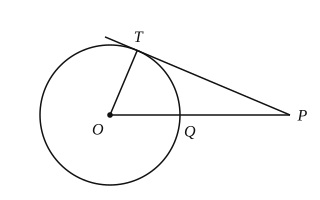
PT is tangent to the circle with centre O and radius 5 cm. OP intersects the circle at Q. If PQ = , then equals :

Diagram for CBSE 2026 Class 10 Maths question 11
  1. (A)
  2. (B)
  3. (C)
  4. (D)
Show answer & solution
Answer: (C)
  1. , so .
  2. .
  3. .

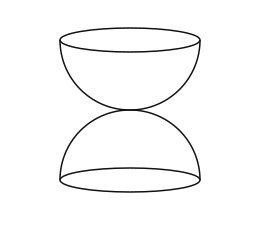
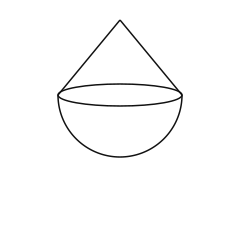
Two wooden solid hemispheres of same radii r, are joined at a point, as shown in the figure. The total surface area of the object is :

Diagram for CBSE 2026 Class 10 Maths question 12
  1. (A)
  2. (B)
  3. (C)
  4. (D)
Show answer & solution
Answer: (B)
  1. The hemispheres touch only at a point, so no surface is hidden.
  2. TSA of one solid hemisphere = curved surface + flat base = .
  3. Total = .
Q131 markMCQStatistics

While calculating mean of a grouped frequency distribution using step deviation method it was found that = 62, a = 47.5, h = 5. The value of is :

  1. (A)3
  2. (B)14.5
  3. (C)2.9
  4. (D)3.1
Show answer & solution
Answer: (C) 2.9
  1. .
  2. .
  3. .

term of an A.P. is 5n – 15. The common difference of the A.P. is :

  1. (A)5n
  2. (B)5
  3. (C)– 5
  4. (D)10
Show answer & solution
Answer: (B) 5
  1. .

A cone with slant height 10 cm and radius 6 cm is surmounted on a hemisphere of same radius. The height of the toy is :

Diagram for CBSE 2026 Class 10 Maths question 15
  1. (A)12 cm
  2. (B)16 cm
  3. (C)14 cm
  4. (D)10 cm
Show answer & solution
Answer: (C) 14 cm
  1. Height of cone = cm.
  2. Height of hemisphere = radius = 6 cm.
  3. Height of toy = 8 + 6 = 14 cm.

term of the A.P. , ... is :

  1. (A)
  2. (B)
  3. (C)
  4. (D)
Show answer & solution
Answer: (B)
  1. , .
  2. .

If , then the value of is :

  1. (A)
  2. (B)
  3. (C)2
  4. (D)
Show answer & solution
Answer: (D)
  1. .
  2. .

The value of k for which the equation has equal real roots, is :

  1. (A)5
  2. (B)
  3. (C)
  4. (D)0
Show answer & solution
Answer: (C)
  1. For equal roots, .
  2. .
  3. .
Q191 markAssertion–ReasonReal Numbers

Assertion (A) : can not end with the digit zero.
Reason (R) : Prime factorisation of is unique.

  1. (A)Both, Assertion (A) and Reason (R) are true and Reason (R) is correct explanation of Assertion (A).
  2. (B)Both, Assertion (A) and Reason (R) are true, but Reason (R) is not correct explanation for Assertion (A).
  3. (C)Assertion (A) is true, but Reason (R) is false.
  4. (D)Assertion (A) is false, but Reason (R) is true.
Show answer & solution
Answer: (A) Both, Assertion (A) and Reason (R) are true and Reason (R) is correct explanation of Assertion (A).
  1. A number ending in 0 must have both 2 and 5 as prime factors.
  2. , and by uniqueness of prime factorisation it has no other prime factor, so 5 never divides it.
  3. So A is true, R is true and R explains A.
Q201 markAssertion–ReasonProbability

Assertion (A) : The probability of an event can not be .
Reason (R) : for an event E.

  1. (A)Both, Assertion (A) and Reason (R) are true and Reason (R) is correct explanation of Assertion (A).
  2. (B)Both, Assertion (A) and Reason (R) are true, but Reason (R) is not correct explanation for Assertion (A).
  3. (C)Assertion (A) is true, but Reason (R) is false.
  4. (D)Assertion (A) is false, but Reason (R) is true.
Show answer & solution
Answer: (A) Both, Assertion (A) and Reason (R) are true and Reason (R) is correct explanation of Assertion (A).
  1. .
  2. Since every probability lies between 0 and 1, it cannot be a probability.
  3. So A is true, R is true and R explains A.
Q212 marksVery Short AnswerIntroduction to Trigonometry

If and , then find the value of (A + B).

Show answer & solution
Answer: A + B =
  1. , so .
  2. , so .
  3. .
Q222 marksVery Short AnswerPolynomials

If , are the zeroes of polynomial p() = . Find the value of .

Show answer & solution
Answer:
  1. , .
  2. .
OR
Q22 (OR) (OR)2 marksVery Short AnswerPolynomials

Form a quadratic polynomial whose zeroes are twice the zeroes of polynomial p() = .

Show answer & solution
Answer:
  1. For : , .
  2. New zeroes , : sum = 6, product = .
  3. Required polynomial: (or any non-zero multiple of it).
Q232 marksVery Short AnswerTriangles

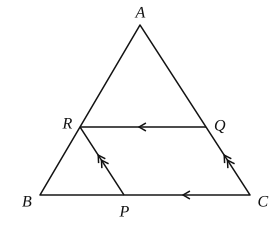
In the given figure, QR CB and RP AC. If BR = 10 cm, QA = 12 cm, BP = 12 cm and PC = 18 cm, then find the lengths of AR and QC.

Diagram for CBSE 2026 Class 10 Maths question 23
Show answer & solution
Answer: AR = 15 cm, QC = 8 cm
  1. In , RP AC, so by BPT .
  2. cm.
  3. QR CB, so .
  4. cm.
Q242 marksVery Short AnswerCoordinate Geometry

A (– 2, 3) and B (4, 1) are end points of the diameter of a semi-circle. The semi-circle intersects y-axis at point P. Find the co-ordinates of the point P.

Show answer & solution
Answer: P(0, 5) or P(0, – 1)
  1. Centre = midpoint of AB = (1, 2); radius = .
  2. Let P = (0, y). Then .
  3. or .
  4. So P is (0, 5) or (0, – 1), depending on which side of AB the semi-circle lies.
Also asked in: 2026 Basic 430/4/1
Q252 marksVery Short AnswerCircles

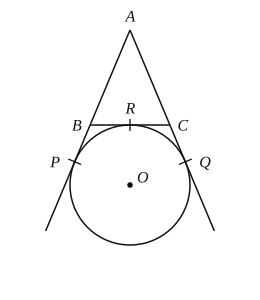
In the given figure, AP, AQ and BC are tangents to the circle with centre O. If AB = 6 cm, AC = 7 cm and BC = 5 cm, then what is the length of AP ?

Diagram for CBSE 2026 Class 10 Maths question 25
Show answer & solution
Answer: AP = 9 cm
  1. Tangents from an external point are equal: BP = BR, CQ = CR, AP = AQ.
  2. AP + AQ = (AB + BP) + (AC + CQ) = AB + AC + BR + CR = AB + AC + BC.
  3. 2AP = 6 + 7 + 5 = 18.
  4. AP = 9 cm.
OR
Q25 (OR) (OR)2 marksVery Short AnswerCircles

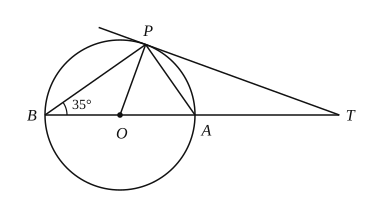
In the given figure, TP is tangent to a circle with centre O. Diameter BA when produced meets the tangent at T. If ABP = , then find the measure of PTA.

Diagram for CBSE 2026 Class 10 Maths question 25 (OR)
Show answer & solution
Answer:
  1. OB = OP (radii), so .
  2. Exterior angle: .
  3. (radius tangent).
  4. In : .
Q263 marksShort AnswerCircles

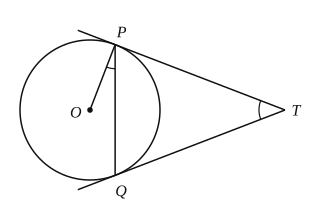
Two tangents TP and TQ are drawn to a circle with centre O, from an external point T.
Prove that .

Diagram for CBSE 2026 Class 10 Maths question 26
Show answer & solution
Answer: Proved.
  1. Let .
  2. TP = TQ (tangents from an external point), so is isosceles and .
  3. (radius tangent).
  4. .
  5. Hence .
Q273 marksShort AnswerReal Numbers

Prove that is an irrational number.

Show answer & solution
Answer: Proved.
  1. Suppose is rational: , where a, b are coprime integers, .
  2. Then , so 5 divides and hence 5 divides a (5 is prime).
  3. Write a = 5c. Then , so ; hence 5 divides b.
  4. So 5 divides both a and b, contradicting that they are coprime.
  5. Hence is irrational.
Q283 marksShort AnswerCoordinate Geometry

The vertices of a rhombus ABCD are A(– 3, – 4), B(5, – 3), C(1, 4) and D(– 7, 3). Find the length of both the diagonals. Hence, find area of the rhombus ABCD.

Show answer & solution
Answer: AC = units, BD = units, area = 60 sq. units
  1. AC = units.
  2. BD = units.
  3. Area = sq. units.
OR
Q28 (OR) (OR)3 marksShort AnswerCoordinate Geometry

The line segment joining the points A (– 5, 1) and B (7, 6) is trisected at the points P and Q such that P is nearer to A. If P lies on the line + y = k, then find the value of k.

Show answer & solution
Answer: k =
  1. P divides AB in the ratio 1 : 2.
  2. P = .
  3. P lies on : .
Q293 marksShort AnswerIntroduction to Trigonometry

Prove that .

Show answer & solution
Answer: Proved.
  1. Numerator = (using ).
  2. Denominator = (using ).
  3. LHS = = RHS.
OR
Q29 (OR) (OR)3 marksShort AnswerIntroduction to Trigonometry

Prove that .

Show answer & solution
Answer: Proved.
  1. Let , so .
  2. .
  3. .
  4. .
  5. Hence LHS = = RHS.
Q303 marksShort AnswerAreas Related to Circles

A chord of a circle of radius 14 cm subtends a right angle at the centre. Find the area of the corresponding (i) minor segment (ii) major segment.

Show answer & solution
Answer: (i) 56 (ii) 560
  1. Area of sector = .
  2. Area of right triangle formed = .
  3. (i) Minor segment = 154 – 98 = 56 .
  4. Area of circle = .
  5. (ii) Major segment = 616 – 56 = 560 .
Also asked in: 2026 Basic 430/4/1
Q313 marksShort AnswerProbability

Two dice are rolled together. Find the probability that at least one of the numbers obtained is a multiple of 3.

Show answer & solution
Answer:
  1. Total outcomes = 36.
  2. Outcomes with no multiple of 3: both numbers from {1, 2, 4, 5}, i.e. .
  3. Favourable outcomes = 36 – 16 = 20.
  4. P = .

The difference between two numbers is 12. The greater number is 6 less than twice the smaller one.
(i) Representing the above situation, frame two linear equations in two variables.
(ii) Show that the equations have unique solution.
(iii) Solve the equations and hence find the numbers.

Show answer & solution
Answer: (i) , (ii) unique solution (iii) 30 and 18
  1. (i) Let the greater number be x and the smaller be y: and , i.e. .
  2. (ii) , ; since , the lines intersect and there is a unique solution.
  3. (iii) Subtracting the second equation from the first: .
  4. Then .
  5. The numbers are 30 and 18.
OR
Q32 (OR) (OR)5 marksLong AnswerPair of Linear Equations in Two Variables

Solve the following equations graphically :
and

Show answer & solution
Answer: , y = 1
  1. For : points (0, 7), (7, 0), (6, 1).
  2. For : points (1, – 1), (6, 1), (– 4, – 3).
  3. Plot both lines on the same axes.
  4. The lines intersect at (6, 1).
  5. So , .
Q335 marksLong AnswerArithmetic Progressions

The third and ninth term of an A.P. are 4 and – 8 respectively.
(i) Which term of the A.P. is zero ?
(ii) Find the value of n if = – 36.

Show answer & solution
Answer: (i) 5th term (ii) n = 12
  1. and .
  2. Subtracting: , so and .
  3. (i) . The 5th term is zero.
  4. (ii) .
  5. .
  6. n = 12 (n cannot be negative).
Q345 marksLong AnswerTriangles

If a line is drawn parallel to one side of a triangle to intersect the other two sides in distinct points, then prove that the other two sides are divided in the same ratio.

Show answer & solution
Answer: Proved.
  1. Given: In , DE BC with D on AB and E on AC. To prove: .
  2. Construction: join BE and CD; draw EN AB and DM AC.
  3. ar(ADE) = AD × EN and ar(BDE) = DB × EN, so .
  4. Similarly ar(ADE) = AE × DM and ar(DEC) = EC × DM, so .
  5. and are on the same base DE and between the same parallels DE and BC, so ar(BDE) = ar(DEC).
  6. Hence .
OR
Q34 (OR) (OR)5 marksLong AnswerTriangles

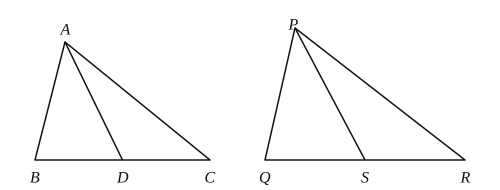
AD and PS are respectively, the medians of and . If , then prove that
(i)
(ii)

Diagram for CBSE 2026 Class 10 Maths question 34 (OR)
Show answer & solution
Answer: Proved.
  1. gives , and .
  2. D and S are midpoints, so DC = BC and SR = QR; hence .
  3. (i) In and : and , so (SAS similarity).
  4. (ii) Similarly BD = BC and QS = QR give with , so (SAS).
  5. Hence .

A statue, 2 m tall, stands on the top of a pedestal. From a point on the ground, the angle of elevation of the top of the statue is and from the same point the angle of elevation of the bottom of the statue is . Find the height of the pedestal and its distance from the point of observation on the ground. (use = 1.73)

Show answer & solution
Answer: Height of pedestal = m = 2.73 m; distance = 2.73 m
  1. Let the pedestal height be h m and its distance from the point be d m.
  2. .
  3. .
  4. m.
  5. Distance d = h = 2.73 m.
Q364 marksCase StudySurface Areas and Volumes

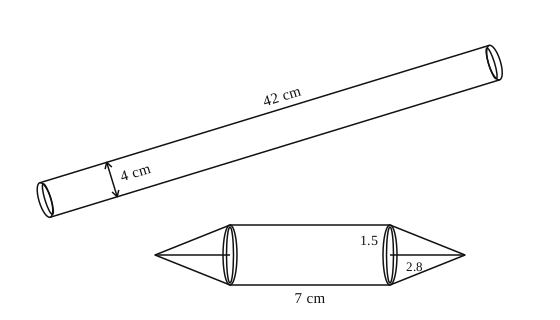
'Gilli Danda' is a very popular traditional game of India which is played with two wooden sticks – the larger one is called 'Danda' and smaller one 'Gilli'.
'Danda' – It is cylindrical in shape with diameter 4 cm and length 42 cm.
Gilli – It is cylindrical in middle with identical conical ends of same radius 1.5 cm and length 2.8 cm. The length of cylindrical part is 7 cm.
Based on the above, answer the following questions :
(i) Find the volume of wood used in making both the conical parts of Gilli. (1)
(ii) Find the volume of wood used in making cylindrical part of Gilli. (1)
(iii) (a) A cylindrical log of wood of radius 1.5 cm and length 14 cm is used to make Gilli. Find the volume of the wood scrapped. (2)
OR
(b) Find the total surface area of 'Danda'. (2)

Diagram for CBSE 2026 Class 10 Maths question 36
Show answer & solution
Answer: (i) 13.2 (ii) 49.5 (iii) (a) 36.3 (b)
  1. (i) Each cone: ; both cones = 13.2 .
  2. (ii) Cylinder: .
  3. (iii) (a) Volume of log = .
  4. Volume of Gilli = 13.2 + 49.5 = 62.7 .
  5. Wood scrapped = 99 – 62.7 = 36.3 .
  6. (iii) (b) Danda: r = 2 cm, h = 42 cm. TSA = .
Q374 marksCase StudyQuadratic Equations

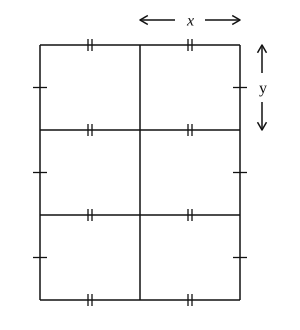
Observe the figure given above. It shows six identical rectangular enclosures made by using fencing wire mesh. These enclosures are used to protect baby animals in a zoo. Dimensions of each enclosure is feet × y feet. The total length of fencing required is 152 feet and area of each enclosure is 80 square feet.
Based on the above, answer the following questions :
(i) Write an expression for length of fencing required in terms of and y. (1)
(ii) Write the area of each enclosure in terms of . (1)
(iii) (a) Write the above equation in quadratic equation form and thus find the dimensions of each enclosure using factorisation method. (2)
OR
(b) Using above equation in quadratic form, solve the equation and find the dimensions of each enclosure using quadratic formula. (2)

Diagram for CBSE 2026 Class 10 Maths question 37
Show answer & solution
Answer: (i) (ii) Area = sq feet (iii) ; each enclosure is 10 feet × 8 feet (x = 9 feet, y = feet also satisfies)
  1. (i) The figure has 4 horizontal fences each of length 2x and 3 vertical fences each of length 3y.
  2. Fencing = .
  3. (ii) From (i), , so area = .
  4. (iii) (a) .
  5. , so or .
  6. If , ; if , .
  7. Each enclosure is 10 feet × 8 feet (the other solution gives 9 feet × feet).
  8. (iii) (b) or 9, giving the same dimensions.
Q384 marksCase StudyStatistics

CENTRAL POLLUTION CONTROL BOARD'S AIR QUALITY STANDARDS
AIR QUALITY INDEX (AQI) | CATEGORY
0-50 | Good
51-100 | Satisfactory
101-200 | Moderate
201-300 | Poor
301-400 | Very Poor
401-500 | Severe
The Air Quality Index (AQI) is a scale from 0 to 500 that indicates air quality, with higher numbers signifying more pollution and greater health concerns.
Mansi collected the daily data of AQI of her city for a month and presented it as given below :
AQI Range : 1 – 100 | 101 – 200 | 201 – 300 | 301 – 400 | 401 – 500
Number of Days : 3 | 9 | 12 | 4 | 2
(i) Convert the data to continuous frequency distribution. (1)
(ii) What is the quality of air in most of the days of the month ? (1)
(iii) (a) Using table formed in part (i), find mode of the data. (2)
OR
(b) Using table formed in part (i), find median of the data. (2)
Show answer & solution
Answer: (i) 0.5 – 100.5, 100.5 – 200.5, 200.5 – 300.5, 300.5 – 400.5, 400.5 – 500.5 with frequencies 3, 9, 12, 4, 2 (ii) Poor (iii) (a) Mode = (b) Median = 225.5
  1. (i) Subtract 0.5 from each lower limit and add 0.5 to each upper limit: 0.5 – 100.5 (3), 100.5 – 200.5 (9), 200.5 – 300.5 (12), 300.5 – 400.5 (4), 400.5 – 500.5 (2).
  2. (ii) The highest frequency (12 days) is in the class 201 – 300, which is the 'Poor' category.
  3. (iii) (a) Modal class 200.5 – 300.5: l = 200.5, , , , h = 100.
  4. Mode = .
  5. (iii) (b) n = 30, ; cumulative frequencies 3, 12, 24, 28, 30, so median class is 200.5 – 300.5 with cf = 12, f = 12.
  6. Median = .
← 2026 Basic 430/4/1 2026 Basic 430/4/3 →
Practise smarter: chapter-wise revision, formula sheets and step-by-step NCERT solutions on MonoMath CBSE →