CBSE Class 10 Maths Standard 2023 Question Paper 30/1/3 with Solutions
All 44 questions from the CBSE Class 10 Mathematics Standard board paper, Set 30/1/3 (2023),
with answers and step-by-step solutions. Total 80 marks. Tap “Show answer & solution” under any question.
The distribution below gives the marks obtained by 80 students on a test : Marks: Less than 10, Less than 20, Less than 30, Less than 40, Less than 50, Less than 60 Number of Students: 3, 12, 27, 57, 75, 80 The modal class of this distribution is :
(A)10 – 20
(B)20 – 30
(C)30 – 40
(D)50 – 60
Show answer & solution
Answer: (C) 30 – 40
Convert the cumulative frequencies to class frequencies:
A girl calculates that the probability of her winning the first prize in a lottery is 0.08. If 6000 tickets are sold, how many tickets has she bought ?
(A)40
(B)240
(C)480
(D)750
Show answer & solution
Answer: (C) 480
P(winning) = number of her tickets ÷ total tickets.
Assertion (A) : Point P(0, 2) is the point of intersection of y-axis with the line 3x+2y=4. Reason (R) : The distance of point P(0, 2) from x-axis is 2 units.
(A)Both Assertion (A) and Reason (R) are true and Reason (R) is the correct explanation of Assertion (A).
(B)Both Assertion (A) and Reason (R) are true but Reason (R) is not the correct explanation of Assertion (A).
(C)Assertion (A) is true but Reason (R) is false.
(D)Assertion (A) is false but Reason (R) is true.
Show answer & solution
Answer: (B) Both A and R are true but R is not the correct explanation of A.
On the y-axis x = 0, so 2y=4, y = 2. The line meets the y-axis at (0, 2). A is true.
Distance of (0, 2) from the x-axis = |y| = 2 units. R is true.
R does not explain why (0, 2) lies on the line, so R is not the correct explanation of A.
A bag contains 4 red, 3 blue and 2 yellow balls. One ball is drawn at random from the bag. Find the probability that drawn ball is (i) red (ii) yellow.
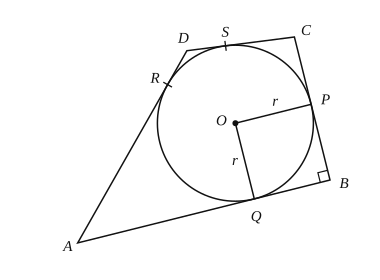
In the given figure, a circle is inscribed in a quadrilateral ABCD in which ∠B=90∘. If AD = 17 cm, AB = 20 cm and DS = 3 cm, then find the radius of the circle.
Show answer & solution
Answer: 6 cm
Tangents from an external point are equal: DR = DS = 3 cm.
AR = AD – DR = 17 – 3 = 14 cm, so AQ = AR = 14 cm.
BQ = AB – AQ = 20 – 14 = 6 cm.
In OQBP, ∠OQB=∠OPB=∠B=90∘ and BQ = BP, so OQBP is a square.
A room is in the form of cylinder surmounted by a hemi-spherical dome. The base radius of hemisphere is one-half the height of cylindrical part. Find total height of the room if it contains (211408) m3 of air. (Take π=722)
Show answer & solution
Answer: 6 m
Let the radius be r; height of cylinder h = 2r.
Volume =πr2(2r)+32πr3=38πr3.
38×722×r3=211408, so 21176r3=211408, r3=8, r = 2 m.
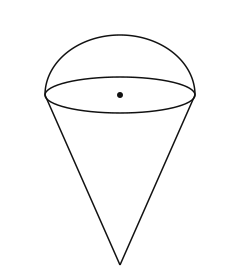
An empty cone is of radius 3 cm and height 12 cm. Ice-cream is filled in it so that lower part of the cone which is (61)th of the volume of the cone is unfilled but hemisphere is formed on the top. Find volume of the ice-cream. (Take π=3.14)
Show answer & solution
Answer: 150.72 cm3
Volume of cone =31πr2h=31×3.14×9×12=113.04 cm3.
Filled part of cone =65×113.04=94.2 cm3.
Volume of hemisphere =32πr3=32×3.14×27=56.52 cm3.
If (–5, 3) and (5, 3) are two vertices of an equilateral triangle, then find co-ordinates of the third vertex, given that origin lies inside the triangle. (Take 3=1.7)
Show answer & solution
Answer: (0, –5.5)
Let A(–5, 3), B(5, 3); AB = 10.
The third vertex C is equidistant from A and B, so it lies on x = 0: C(0, y).
AC2=25+(y−3)2=100, so (y−3)2=75, y=3±53.
Origin is inside the triangle, so C is below AB: y=3−53=3−8.5=−5.5.
Jaya scored 40 marks in a test getting 3 marks for each correct answer and losing 1 mark for each incorrect answer. Had 4 marks being awarded for each correct answer and 2 marks were deducted for each incorrect answer then Jaya again would have scored 40 marks. How many questions were there in the Test ?
Show answer & solution
Answer: 40 questions
Let x be the number of correct answers and y the number of incorrect answers.
3x−y=40 ... (1)
4x−2y=40, i.e. 2x−y=20 ... (2)
Subtract (2) from (1): x = 20; then y = 3(20) – 40 = 20.
A chord of a circle of radius 14 cm subtends an angle of 60∘ at the centre. Find the area of the corresponding minor segment of the circle. Also find the area of the major segment of the circle.
Show answer & solution
Answer: Minor segment =(3308−493) cm2 ≈ 17.89 cm2; major segment =(31540+493) cm2 ≈ 598.11 cm2
Area of sector =36060×722×14×14=3308 cm2 ≈ 102.67 cm2.
The triangle formed is equilateral (two radii with 60∘ between them): area =43×142=493 cm2 ≈ 84.87 cm2.
Minor segment =3308−493 ≈ 17.89 cm2.
Area of circle =722×142=616 cm2.
Major segment =616−(3308−493)=31540+493 ≈ 598.11 cm2.
The ratio of the 11th term to 17th term of an A.P. is 3 : 4. Find the ratio of 5th term to 21st term of the same A.P. Also, find the ratio of the sum of first 5 terms to that of first 21 terms.
250 logs are stacked in the following manner : 22 logs in the bottom row, 21 in the next row, 20 in the row next to it and so on (as shown by an example). In how many rows, are the 250 logs placed and how many logs are there in the top row ?
Show answer & solution
Answer: 20 rows; 3 logs in the top row
Rows form an A.P.: a = 22, d = –1.
Sn=2n[44+(n−1)(−1)]=250, so n(45−n)=500.
n2−45n+500=0, (n−20)(n−25)=0, n = 20 or 25.
For n = 25 the last row would have 22 – 24 = –2 logs, not possible. So n = 20.
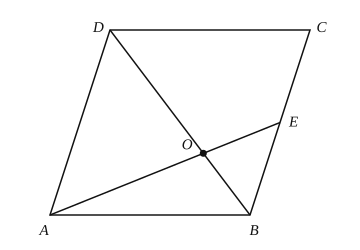
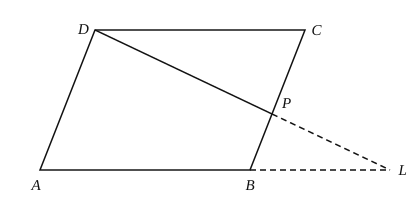
ABCD is a parallelogram, P is a point on side BC and DP when produced meets AB produced at L. Prove that (i) PLDP=BLDC (ii) DPDL=DCAL (iii) If LP : PD = 2 : 3 then find BP : BC.
Show answer & solution
Answer: (i) Proved. (ii) Proved. (iii) BP : BC = 2 : 5
(i) In △DPC and △LPB: ∠DPC=∠LPB (vertically opposite) and ∠DCP=∠LBP (alternate angles, DC∥AL). So △DPC∼△LPB (AA), giving PLDP=BLDC.
(ii) In △ALD and △CDP: ∠ALD=∠CDP (alternate angles, AL∥DC) and ∠DAL=∠PCD (opposite angles of a parallelogram). So △ALD∼△CDP (AA), giving DPDL=CDAL=DCAL.
(iii) From △DPC∼△LPB: PCBP=PDLP=32.
So BP = 2k, PC = 3k, BC = 5k, and BP : BC = 2 : 5.
An aeroplane when flying at a height of 3000 m from the ground passes vertically above another aeroplane at an instant when the angles of elevation of the two planes from the same point on the ground are 60∘ and 45∘ respectively. Find the vertical distance between the aeroplanes at that instant. Also, find the distance of first plane from the point of observation. (Take 3=1.73)
Show answer & solution
Answer: Vertical distance =1000(3−3) m = 1270 m; distance of first plane =20003 m = 3460 m
Let O be the observation point, C the point on the ground below the planes, A the first plane (AC = 3000 m) and B the second plane.
India meteorological department observes seasonal and annual rainfall every year in different sub-divisions of our country. It helps them to compare and analyse the results. The table given below shows sub-division wise seasonal (monsoon) rainfall (mm) in 2018 : Rainfall (mm): 200-400, 400-600, 600-800, 800-1000, 1000-1200, 1200-1400, 1400-1600, 1600-1800 Number of Sub-divisions: 2, 4, 7, 4, 2, 3, 1, 1 Based on the above information, answer the following questions : (I) Write the modal class. (1) (II) Find the median of the given data. (2) OR Find the mean rainfall in this season. (III) If sub-division having at least 1000 mm rainfall during monsoon season, is considered good rainfall sub-division, then how many sub-divisions had good rainfall ? (1)
Show answer & solution
Answer: (I) 600-800 (II) Median ≈ 771.43 mm; OR: Mean = 850 mm (III) 7
(I) Highest frequency is 7, for 600–800. Modal class = 600–800.
(II) N = 24, 2N=12. Cumulative frequencies: 2, 6, 13, 17, 19, 22, 23, 24. Median class 600–800.
Median =600+712−6×200=600+171.43=771.43 mm (approx.).
OR: Class marks 300, 500, 700, 900, 1100, 1300, 1500, 1700. ∑fixi=600+2000+4900+3600+2200+3900+1500+1700=20400.
Mean =2420400=850 mm.
(III) Sub-divisions with at least 1000 mm = 2 + 3 + 1 + 1 = 7.
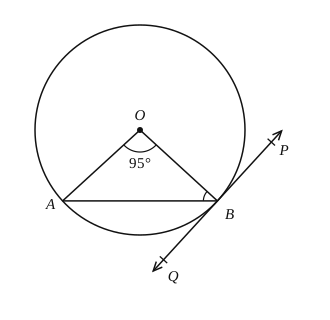
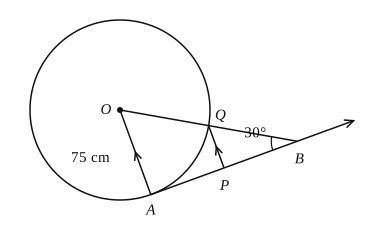
The discus throw is an event in which an athlete attempts to throw a discus. The athlete spins anti-clockwise around one and a half times through a circle, then releases the throw. When released, the discus travels along tangent to the circular spin orbit. In the given figure, AB is one such tangent to a circle of radius 75 cm. Point O is centre of the circle and ∠ABO=30∘. PQ is parallel to OA. Based on above information : (a) find the length of AB. (1) (b) find the length of OB. (1) (c) find the length of AP. (2) OR find the length of PQ.
Show answer & solution
Answer: (a) 753 cm (b) 150 cm (c) 2753 cm; OR: PQ = 37.5 cm
(a) OA ⊥ AB. tan30∘=ABOA, so AB=753 cm (≈ 129.9 cm).
(b) sin30∘=OBOA, so OB = 150 cm.
(c) Q lies on the circle, so OQ = 75 cm and QB = 150 – 75 = 75 cm; Q is the mid-point of OB.
PQ∥OA, so by the mid-point theorem (converse) P is the mid-point of AB.
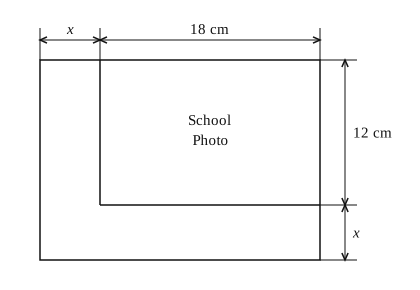
While designing the school year book, a teacher asked the student that the length and width of a particular photo is increased by x units each to double the area of the photo. The original photo is 18 cm long and 12 cm wide. Based on the above information, answer the following questions : (I) Write an algebraic equation depicting the above information. (1) (II) Write the corresponding quadratic equation in standard form. (1) (III) What should be the new dimensions of the enlarged photo ? (2) OR Can any rational value of x make the new area equal to 220 cm2 ?
Show answer & solution
Answer: (I) (18+x)(12+x)=2×18×12 (II) x2+30x−216=0 (III) 24 cm × 18 cm; OR: No, since x2+30x−4=0 has discriminant 916, not a perfect square, so x is irrational.
(I) Original area = 18 × 12 = 216 cm2. New area = (18+x)(12+x)=2×216=432.
(II) x2+30x+216=432, i.e. x2+30x−216=0.
(III) (x+36)(x−6)=0; x > 0, so x = 6. New dimensions: 18 + 6 = 24 cm by 12 + 6 = 18 cm.
OR: (18+x)(12+x)=220 gives x2+30x−4=0.
D=900+16=916, which is not a perfect square, so x is irrational. No rational x gives area 220 cm2.