MonoMath CBSE
CBSE Maths › Class 10 PYQs › 2024

CBSE Class 10 Maths Standard 2024 Question Paper 30/1/1 with Solutions

All 44 questions from the CBSE Class 10 Mathematics Standard board paper, Set 30/1/1 (2024), with answers and step-by-step solutions. Total 80 marks. Tap “Show answer & solution” under any question.

Set 30/1/1Set 30/1/2Set 30/1/3Set 30/2/1Set 30/2/2Set 30/2/3Set 30/3/1Set 30/3/2Set 30/3/3Set 30/4/1Set 30/4/2Set 30/4/3Set 30/5/1Set 30/5/2Set 30/5/3
Q11 markMCQPolynomials

If the sum of zeroes of the polynomial is , then value of is :

  1. (A)
  2. (B)2
  3. (C)
  4. (D)
Show answer & solution
Answer: (B) 2
  1. Sum of zeroes .
  2. , so .
Q21 markMCQProbability

If the probability of a player winning a game is 0.79, then the probability of his losing the same game is :

  1. (A)1.79
  2. (B)0.31
  3. (C)0.21%
  4. (D)0.21
Show answer & solution
Answer: (D) 0.21
  1. Winning and losing are complementary events.
  2. P(losing) .
Also asked in: 2024 Standard 30/1/2

If the roots of equation are real and equal, then which of the following relation is true ?

  1. (A)
  2. (B)
  3. (C)
  4. (D)
Show answer & solution
Answer: (C)
  1. Real and equal roots means discriminant .
  2. So , i.e. .

In an A.P., if the first term , th term and the sum of first terms , then is equal to :

  1. (A)22
  2. (B)24
  3. (C)23
  4. (D)26
Show answer & solution
Answer: (C) 23
  1. .
  2. , so .
Q51 markMCQReal Numbers

If two positive integers and can be expressed as and , where and are prime numbers, then LCM is :

  1. (A)
  2. (B)
  3. (C)
  4. (D)
Show answer & solution
Answer: (D)
  1. and .
  2. LCM takes the highest power of each prime factor: .

AD is a median of with vertices A, B and C. Length AD is equal to :

  1. (A) units
  2. (B) units
  3. (C) units
  4. (D)10 units
Show answer & solution
Answer: (A) units
  1. D is the mid-point of BC: .
  2. units.

If , then the value of is :

  1. (A)
  2. (B)
  3. (C)
  4. (D)
Show answer & solution
Answer: (C)
  1. .
  2. So .
Q81 markMCQProbability

From the data 1, 4, 7, 9, 16, 21, 25, if all the even numbers are removed, then the probability of getting at random a prime number from the remaining is :

  1. (A)
  2. (B)
  3. (C)
  4. (D)
Show answer & solution
Answer: (B)
  1. Removing the even numbers 4 and 16 leaves 1, 7, 9, 21, 25 (5 numbers).
  2. Only 7 is prime.
  3. Required probability .
Q91 markMCQStatistics

For some data with respective frequencies , the value of is equal to :

  1. (A)
  2. (B)1
  3. (C)
  4. (D)0
Show answer & solution
Answer: (D) 0
  1. .
  2. Since , .
  3. So the value is 0.
Q101 markMCQPolynomials

The zeroes of a polynomial are twice the zeroes of the polynomial . The value of is :

  1. (A)
  2. (B)
  3. (C)
  4. (D)10
Show answer & solution
Answer: (A)
  1. Sum of zeroes of is .
  2. Zeroes of are twice these, so their sum is .
  3. Sum of zeroes of is , so and .

If the distance between the points and is 15 units, then the values of are :

  1. (A)
  2. (B)
  3. (C)18, 5
  4. (D)
Show answer & solution
Answer: (B)
  1. Distance .
  2. So , giving or .

If , then value of is equal to :

  1. (A)
  2. (B)
  3. (C)0
  4. (D)
Show answer & solution
Answer: (A)
  1. , so .
  2. .

A solid sphere is cut into two hemispheres. The ratio of the surface areas of sphere to that of two hemispheres taken together, is :

  1. (A)1 : 1
  2. (B)1 : 4
  3. (C)2 : 3
  4. (D)3 : 2
Show answer & solution
Answer: (C) 2 : 3
  1. Surface area of sphere .
  2. Each solid hemisphere has total surface area , so two together .
  3. Ratio .
Q141 markMCQStatistics

The middle most observation of every data arranged in order is called :

  1. (A)mode
  2. (B)median
  3. (C)mean
  4. (D)deviation
Show answer & solution
Answer: (B) median
  1. The median is the middle observation when the data are arranged in order.

The volume of the largest right circular cone that can be carved out from a solid cube of edge 2 cm is :

  1. (A) cu cm
  2. (B) cu cm
  3. (C) cu cm
  4. (D) cu cm
Show answer & solution
Answer: (D) cu cm
  1. The largest cone has base diameter = edge = 2 cm, so cm, and height cm.
  2. Volume cu cm.
Q161 markMCQProbability

Two dice are rolled together. The probability of getting sum of numbers on the two dice as 2, 3 or 5, is :

  1. (A)
  2. (B)
  3. (C)
  4. (D)
Show answer & solution
Answer: (A)
  1. Total outcomes .
  2. Sum 2: (1, 1) — 1 outcome.
  3. Sum 3: (1, 2), (2, 1) — 2 outcomes.
  4. Sum 5: (1, 4), (2, 3), (3, 2), (4, 1) — 4 outcomes.
  5. Favourable , so probability .
Also asked in: 2024 Standard 30/1/3

The centre of a circle is at . If one end of a diameter is at , then the other end is at :

  1. (A)(0, 0)
  2. (B)(4, 0)
  3. (C)
  4. (D)
Show answer & solution
Answer: (C)
  1. The centre is the mid-point of the diameter. Let the other end be .
  2. gives ; gives .
  3. Other end .

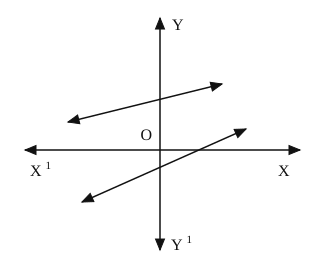
In the given figure, graphs of two linear equations are shown. The pair of these linear equations is :

Diagram for CBSE 2024 Class 10 Maths question 18
  1. (A)consistent with unique solution.
  2. (B)consistent with infinitely many solutions.
  3. (C)inconsistent.
  4. (D)inconsistent but can be made consistent by extending these lines.
Show answer & solution
Answer: (A) consistent with unique solution.
  1. The two lines in the figure have different slopes, so they are not parallel.
  2. Non-parallel lines intersect in exactly one point (here, when extended to the left).
  3. Hence the pair is consistent with a unique solution.
Q191 markAssertion–ReasonCircles

Assertion (A) : The tangents drawn at the end points of a diameter of a circle, are parallel.
Reason (R) : Diameter of a circle is the longest chord.

  1. (A)Both, Assertion (A) and Reason (R) are true and Reason (R) is correct explanation of Assertion (A).
  2. (B)Both, Assertion (A) and Reason (R) are true but Reason (R) is not correct explanation for Assertion (A).
  3. (C)Assertion (A) is true but Reason (R) is false.
  4. (D)Assertion (A) is false but Reason (R) is true.
Show answer & solution
Answer: (B) Both, Assertion (A) and Reason (R) are true but Reason (R) is not correct explanation for Assertion (A).
  1. A: Each tangent is perpendicular to the diameter at its end point, so both tangents are perpendicular to the same line and hence parallel. A is true.
  2. R: The diameter is the longest chord of a circle. R is true.
  3. A follows from the tangent being perpendicular to the radius, not from R. So R does not explain A.
Q201 markAssertion–ReasonPolynomials

Assertion (A) : If the graph of a polynomial touches -axis at only one point, then the polynomial cannot be a quadratic polynomial.
Reason (R) : A polynomial of degree can have at most zeroes.

  1. (A)Both, Assertion (A) and Reason (R) are true and Reason (R) is correct explanation of Assertion (A).
  2. (B)Both, Assertion (A) and Reason (R) are true but Reason (R) is not correct explanation for Assertion (A).
  3. (C)Assertion (A) is true but Reason (R) is false.
  4. (D)Assertion (A) is false but Reason (R) is true.
Show answer & solution
Answer: (D) Assertion (A) is false but Reason (R) is true.
  1. A: The graph of touches the -axis only at the origin, and is quadratic. So A is false.
  2. R: A polynomial of degree has at most zeroes. R is true.

Solve the following system of linear equations
and and verify your answer.

Show answer & solution
Answer: ,
  1. ... (1), ... (2)
  2. (1) : ; (2) : .
  3. Adding: , so .
  4. From (1): , so .
  5. Verification: and . Both equations hold.
Q222 marksVery Short AnswerProbability

In a pack of 52 playing cards one card is lost. From the remaining cards, a card is drawn at random. Find the probability that the drawn card is queen of heart, if the lost card is a black card.

Show answer & solution
Answer:
  1. After a black card is lost, 51 cards remain.
  2. The queen of hearts is red, so it is still in the pack: 1 favourable outcome.
  3. Required probability .
Q232 marksVery Short AnswerIntroduction to Trigonometry

Evaluate :

Show answer & solution
Answer: 4
OR
Q23 (OR) (OR)2 marksVery Short AnswerIntroduction to Trigonometry

If and , verify that :

Show answer & solution
Answer: Verified (both sides equal 1).
  1. LHS .
  2. RHS .
  3. LHS = RHS, hence verified.
Q242 marksVery Short AnswerTriangles

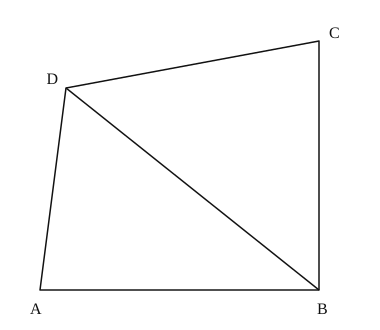
In the given figure, ABCD is a quadrilateral. Diagonal BD bisects and both.
Prove that :
(i)
(ii) AB = BC

Diagram for CBSE 2024 Class 10 Maths question 24
Show answer & solution
Answer: Proved.
  1. (i) In and :
  2. (BD bisects )
  3. (BD bisects )
  4. So (AA similarity).
  5. (ii) Corresponding sides are proportional: .
  6. Hence AB = BC.
Q252 marksVery Short AnswerReal Numbers

Prove that is an irrational number. It is given that is an irrational number.

Show answer & solution
Answer: Proved.
  1. Assume is rational, say , where is rational.
  2. Then .
  3. The right side is rational (rational numbers are closed under subtraction and division by a non-zero rational), so would be rational.
  4. This contradicts the fact that is irrational.
  5. Hence is irrational.
OR
Q25 (OR) (OR)2 marksVery Short AnswerReal Numbers

Show that the number is a composite number.

Show answer & solution
Answer: It equals , which has factors other than 1 and itself, so it is composite.
  1. .
  2. So the number has the factors 11 and 88 besides 1 and itself.
  3. Hence it is a composite number.
Q263 marksShort AnswerCoordinate Geometry

Find the ratio in which the point divides the line segment joining the points and . Also, find the value of .

Show answer & solution
Answer: Ratio ;
  1. Let the point divide the segment in the ratio .
  2. -coordinate: , so and .
  3. Ratio .
  4. .
OR
Q26 (OR) (OR)3 marksShort AnswerCoordinate Geometry

ABCD is a rectangle formed by the points A, B, C and D. P, Q, R and S are mid–points of sides AB, BC, CD and DA respectively. Show that diagonals of the quadrilateral PQRS bisect each other.

Show answer & solution
Answer: Mid-points of PR and QS are both , so the diagonals bisect each other.
  1. P (mid-point of AB) , Q (mid-point of BC) .
  2. R (mid-point of CD) , S (mid-point of DA) .
  3. Mid-point of PR .
  4. Mid-point of QS .
  5. The diagonals PR and QS have the same mid-point, so they bisect each other.
Q273 marksShort AnswerReal Numbers

In a teachers' workshop, the number of teachers teaching French, Hindi and English are 48, 80 and 144 respectively. Find the minimum number of rooms required if in each room the same number of teachers are seated and all of them are of the same subject.

Show answer & solution
Answer: 17 rooms
  1. The number of teachers per room must divide 48, 80 and 144; for the fewest rooms it is their HCF.
  2. , , , so HCF .
  3. Number of rooms .
Q283 marksShort AnswerIntroduction to Trigonometry

Prove that :

Show answer & solution
Answer: Proved.
  1. Let , so .
  2. LHS
  3. = RHS.

Three years ago, Rashmi was thrice as old as Nazma. Ten years later, Rashmi will be twice as old as Nazma. How old are Rashmi and Nazma now ?

Show answer & solution
Answer: Rashmi is 42 years and Nazma is 16 years old.
  1. Let the present ages of Rashmi and Nazma be and years.
  2. Three years ago: , so ... (1)
  3. Ten years later: , so ... (2)
  4. (2) (1): .
  5. From (2): .
  6. Rashmi is 42 years old and Nazma is 16 years old.
Q303 marksShort AnswerCircles

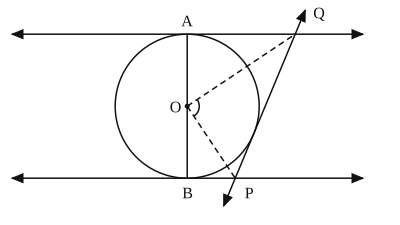
In the given figure, AB is a diameter of the circle with centre O. AQ, BP and PQ are tangents to the circle. Prove that .

Diagram for CBSE 2024 Class 10 Maths question 30
Show answer & solution
Answer: Proved.
  1. Let PQ touch the circle at C. Join OC.
  2. In and : OA = OC (radii), QA = QC (tangents from Q), OQ common. So (SSS) and .
  3. Similarly , so .
  4. AB is a diameter, so , i.e. .
  5. So , i.e. .
OR
Q30 (OR) (OR)3 marksShort AnswerCircles

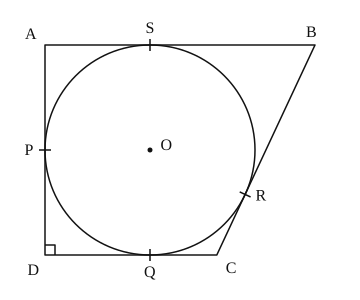
A circle with centre O and radius 8 cm is inscribed in a quadrilateral ABCD in which P, Q, R, S are the points of contact as shown. If AD is perpendicular to DC, BC = 30 cm and BS = 24 cm, then find the length DC.

Diagram for CBSE 2024 Class 10 Maths question 30 (OR)
Show answer & solution
Answer: DC = 14 cm
  1. Tangents from an external point are equal: BR = BS = 24 cm.
  2. CR = BC BR = 30 24 = 6 cm, so CQ = CR = 6 cm.
  3. In quadrilateral OPDQ, and (radius tangent), and OP = OQ = 8 cm, so OPDQ is a square.
  4. So DQ = 8 cm.
  5. DC = DQ + QC = 8 + 6 = 14 cm.
Q313 marksShort AnswerSurface Areas and Volumes

The difference between the outer and inner radii of a hollow right circular cylinder of length 14 cm is 1 cm. If the volume of the metal used in making the cylinder is 176 , find the outer and inner radii of the cylinder.

Show answer & solution
Answer: Outer radius = 2.5 cm, inner radius = 1.5 cm
  1. Let outer radius be and inner radius ; .
  2. Volume of metal .
  3. So , i.e. , giving .
  4. Solving and : cm, cm.
Q325 marksLong AnswerAreas Related to Circles

An arc of a circle of radius 21 cm subtends an angle of at the centre. Find :
(i) the length of the arc.
(ii) the area of the minor segment of the circle made by the corresponding chord.

Show answer & solution
Answer: (i) 22 cm (ii)
  1. (i) Arc length cm.
  2. (ii) Area of sector .
  3. The triangle formed by the two radii and the chord is equilateral (angle , two equal sides), so its area .
  4. Area of minor segment .
Q335 marksLong AnswerArithmetic Progressions

The sum of first and eighth terms of an A.P. is 32 and their product is 60. Find the first term and common difference of the A.P. Hence, also find the sum of its first 20 terms.

Show answer & solution
Answer: , , ; or , ,
  1. Let the first term be and the eighth term .
  2. and , so and are roots of , i.e. .
  3. Case 1: , : , . .
  4. Case 2: , : , . .
OR
Q33 (OR) (OR)5 marksLong AnswerArithmetic Progressions

In an A.P. of 40 terms, the sum of first 9 terms is 153 and the sum of last 6 terms is 687. Determine the first term and common difference of A.P. Also, find the sum of all the terms of the A.P.

Show answer & solution
Answer: First term = 5, common difference = 3, sum of all 40 terms = 2540
  1. , so ... (1)
  2. The last 6 terms are the 35th to 40th terms: sum , so ... (2)
  3. From (1), . Substituting: , so , , .
  4. .
Q345 marksLong AnswerTriangles

If a line is drawn parallel to one side of a triangle to intersect the other two sides in distinct points, then prove that the other two sides are divided in the same ratio.

Show answer & solution
Answer: Proved.
  1. Given: In , DE BC meets AB at D and AC at E.
  2. To prove: .
  3. Construction: Join BE and CD; draw EM AB and DN AC.
  4. .
  5. .
  6. and are on the same base DE and between the same parallels DE and BC, so ar(BDE) = ar(DEC).
  7. Hence .
OR
Q34 (OR) (OR)5 marksLong AnswerTriangles

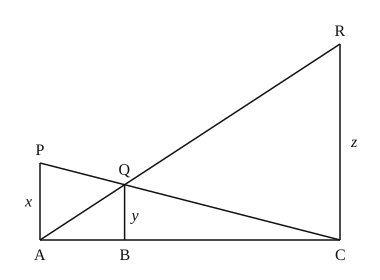
In the given figure PA, QB and RC are each perpendicular to AC. If AP = , BQ = and CR = , then prove that

Diagram for CBSE 2024 Class 10 Maths question 34 (OR)
Show answer & solution
Answer: Proved.
  1. In and : is common and , so (AA).
  2. So , i.e. ... (1)
  3. In and : is common and , so (AA).
  4. So , i.e. ... (2)
  5. Adding (1) and (2): .
  6. Dividing by : .

A pole 6m high is fixed on the top of a tower. The angle of elevation of the top of the pole observed from a point P on the ground is and the angle of depression of the point P from the top of the tower is . Find the height of the tower and the distance of point P from the foot of the tower. (Use )

Show answer & solution
Answer: Height of tower = 8.19 m; distance of P from the foot = 8.19 m
  1. Let the tower be BC of height m with foot B, and pole CD = 6 m; let PB = m.
  2. Angle of depression of P from C is , so and , giving .
  3. In : , so .
  4. m.
  5. Distance PB m.
Q364 marksCase StudyQuadratic Equations

A rectangular floor area can be completely tiled with 200 square tiles. If the side length of each tile is increased by 1 unit, it would take only 128 tiles to cover the floor.
(i) Assuming the original length of each side of a tile be units, make a quadratic equation from the above information. (1)
(ii) Write the corresponding quadratic equation in standard form. (1)
(iii) (a) Find the value of , the length of side of a tile by factorisation. (2)
OR (b) Solve the quadratic equation for , using quadratic formula. (2)

Show answer & solution
Answer: (i) (ii) (iii) (a) units OR (b) (rejecting )
  1. (i) Floor area is the same in both cases: .
  2. (ii) , so . Dividing by 8: .
  3. (iii) (a) .
  4. or ; length cannot be negative, so units.
  5. OR (b) , .
  6. , so or . Taking the positive value, units.
Q374 marksCase StudyStatistics

BINGO is game of chance. The host has 75 balls numbered 1 through 75. Each player has a BINGO card with some numbers written on it. The participant cancels the number on the card when called out a number written on the ball selected at random. Whosoever cancels all the numbers on his/her card, says BINGO and wins the game.
The table given below, shows the data of one such game where 48 balls were used before Tara said 'BINGO'.
Numbers announced: 0-15, 15-30, 30-45, 45-60, 60-75
Number of times: 8, 9, 10, 12, 9
Based on the above information, answer the following :
(i) Write the median class. (1)
(ii) When first ball was picked up, what was the probability of calling out an even number ? (1)
(iii) (a) Find median of the given data. (2)
OR (b) Find mode of the given data. (2)

Show answer & solution
Answer: (i) 30-45 (ii) (iii) (a) 40.5 OR (b) 51
  1. Cumulative frequencies: 8, 17, 27, 39, 48; , .
  2. (i) The cumulative frequency first exceeds 24 in the class 30-45, so the median class is 30-45.
  3. (ii) There are 37 even numbers from 1 to 75, so P(even) .
  4. (iii) (a) , , , . Median .
  5. OR (b) Modal class 45-60: , , , , .
  6. Mode .
Q384 marksCase StudyCircles

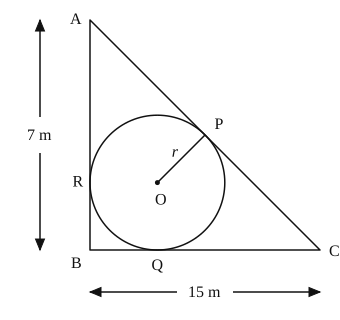
A backyard is in the shape of a triangle ABC with right angle at B. AB = 7 m and BC = 15 m. A circular pit was dug inside it such that it touches the walls AC, BC and AB at P, Q and R respectively such that AP = m.
Based on the above information, answer the following questions :
(i) Find the length of AR in terms of . (1)
(ii) Write the type of quadrilateral BQOR. (1)
(iii) (a) Find the length PC in terms of and hence find the value of . (2)
OR (b) Find and hence find the radius of circle. (2)

Diagram for CBSE 2024 Class 10 Maths question 38
Show answer & solution
Answer: (i) AR = m (ii) Square (iii) (a) PC = m, m OR (b) m, m
  1. (i) Tangents from A are equal: AR = AP = m.
  2. (ii) , (radius tangent) and OR = OQ = , so BQOR is a square.
  3. (iii) (a) BR = AB AR = , so BQ = BR = and CQ = . Hence PC = CQ = m.
  4. AC = AP + PC = , and AC .
  5. , so m.
  6. OR (b) As above, m.
  7. Since BQOR is a square, = BR = m.
← 2025 Basic 430/6/3 2024 Standard 30/1/2 →
Practise smarter: chapter-wise revision, formula sheets and step-by-step NCERT solutions on MonoMath CBSE →