CBSE Class 10 Maths Basic 2026 Question Paper 430/4/3 with Solutions
All 44 questions from the CBSE Class 10 Mathematics Basic board paper, Set 430/4/3 (2026),
with answers and step-by-step solutions. Total 80 marks. Tap “Show answer & solution” under any question.
While calculating mean of a grouped frequency distribution using step deviation method (u=hx−a) it was found that x = 62, a = 47.5, h = 5. The value of u is :
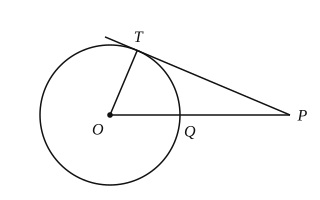
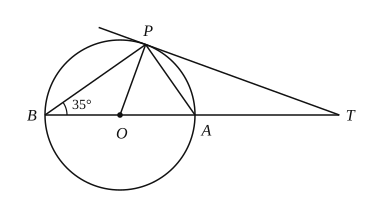
In the given figure, TP is tangent to a circle with centre O. Diameter BA when produced meets the tangent at T. If ∠ ABP = 35∘, then find the measure of ∠ PTA.
Two dice are rolled together. Find the probability that (i) in the obtained outcomes one number is twice the another. (ii) both the numbers obtained are greater than 4.
Show answer & solution
Answer: (i) 61 (ii) 91
Total outcomes = 36.
(i) Favourable: (1, 2), (2, 1), (2, 4), (4, 2), (3, 6), (6, 3), i.e. 6 outcomes; P = 366=61.
(ii) Both numbers from {5, 6}: (5, 5), (5, 6), (6, 5), (6, 6), i.e. 4 outcomes; P = 364=91.
The vertices of a rhombus ABCD are A(– 3, – 4), B(5, – 3), C(1, 4) and D(– 7, 3). Find the length of both the diagonals. Hence, find area of the rhombus ABCD.
Show answer & solution
Answer: AC = 45 units, BD = 65 units, area = 60 sq. units
The line segment joining the points A (– 5, 1) and B (7, 6) is trisected at the points P and Q such that P is nearer to A. If P lies on the line x + y = k, then find the value of k.
A straight road leads to foot of a tower whose shadow is found to be 40 m longer when sun's altitude is 30∘ than when it is 60∘. Find the height of the tower and length of shadow in both the situations. (Use 3 = 1.73)
Show answer & solution
Answer: Height = 203 m = 34.6 m; shadow = 20 m at 60∘ and 60 m at 30∘
Let the height of the tower be h m.
Shadow at 60∘: tan60∘h=3h; shadow at 30∘: tan30∘h=3h.
The difference between two numbers is 12. The greater number is 6 less than twice the smaller one. (i) Representing the above situation, frame two linear equations in two variables. (ii) Show that the equations have unique solution. (iii) Solve the equations and hence find the numbers.
Show answer & solution
Answer: (i) x−y=12, x−2y=−6 (ii) unique solution (iii) 30 and 18
(i) Let the greater number be x and the smaller be y: x−y=12 and x=2y−6, i.e. x−2y=−6.
(ii) a2a1=11=1, b2b1=−2−1=21; since a2a1=b2b1, the lines intersect and there is a unique solution.
(iii) Subtracting the second equation from the first: y=18.
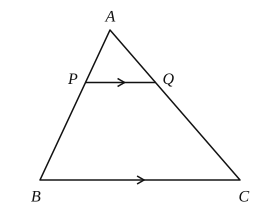
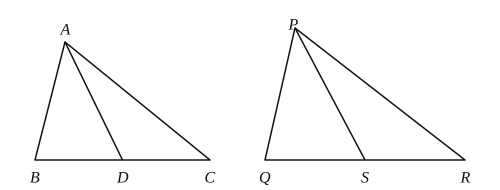
If a line is drawn parallel to one side of a triangle to intersect the other two sides in distinct points, then prove that the other two sides are divided in the same ratio.
Show answer & solution
Answer: Proved.
Given: In △ABC, DE ∥ BC with D on AB and E on AC. To prove: DBAD=ECAE.
Construction: join BE and CD; draw EN ⊥ AB and DM ⊥ AC.
ar(ADE) = 21 AD × EN and ar(BDE) = 21 DB × EN, so ar(BDE)ar(ADE)=DBAD.
Similarly ar(ADE) = 21 AE × DM and ar(DEC) = 21 EC × DM, so ar(DEC)ar(ADE)=ECAE.
△BDE and △DEC are on the same base DE and between the same parallels DE and BC, so ar(BDE) = ar(DEC).
CENTRAL POLLUTION CONTROL BOARD'S AIR QUALITY STANDARDS AIR QUALITY INDEX (AQI) | CATEGORY 0-50 | Good 51-100 | Satisfactory 101-200 | Moderate 201-300 | Poor 301-400 | Very Poor 401-500 | Severe The Air Quality Index (AQI) is a scale from 0 to 500 that indicates air quality, with higher numbers signifying more pollution and greater health concerns. Mansi collected the daily data of AQI of her city for a month and presented it as given below : AQI Range : 1 – 100 | 101 – 200 | 201 – 300 | 301 – 400 | 401 – 500 Number of Days : 3 | 9 | 12 | 4 | 2 (i) Convert the data to continuous frequency distribution. (1) (ii) What is the quality of air in most of the days of the month ? (1) (iii) (a) Using table formed in part (i), find mode of the data. (2) OR (b) Using table formed in part (i), find median of the data. (2)
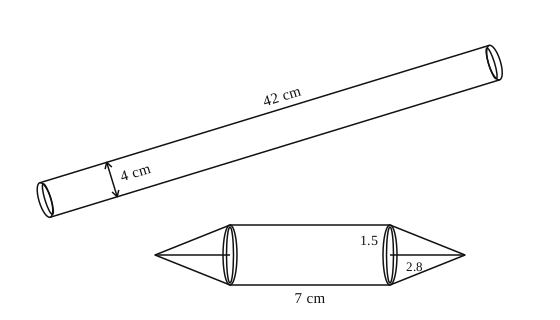
'Gilli Danda' is a very popular traditional game of India which is played with two wooden sticks – the larger one is called 'Danda' and smaller one 'Gilli'. 'Danda' – It is cylindrical in shape with diameter 4 cm and length 42 cm. Gilli – It is cylindrical in middle with identical conical ends of same radius 1.5 cm and length 2.8 cm. The length of cylindrical part is 7 cm. Based on the above, answer the following questions : (i) Find the volume of wood used in making both the conical parts of Gilli. (1) (ii) Find the volume of wood used in making cylindrical part of Gilli. (1) (iii) (a) A cylindrical log of wood of radius 1.5 cm and length 14 cm is used to make Gilli. Find the volume of the wood scrapped. (2) OR (b) Find the total surface area of 'Danda'. (2)
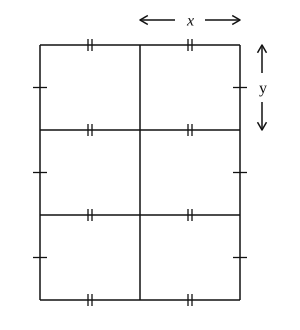
Observe the figure given above. It shows six identical rectangular enclosures made by using fencing wire mesh. These enclosures are used to protect baby animals in a zoo. Dimensions of each enclosure is x feet × y feet. The total length of fencing required is 152 feet and area of each enclosure is 80 square feet. Based on the above, answer the following questions : (i) Write an expression for length of fencing required in terms of x and y. (1) (ii) Write the area of each enclosure in terms of x. (1) (iii) (a) Write the above equation in quadratic equation form and thus find the dimensions of each enclosure using factorisation method. (2) OR (b) Using above equation in quadratic form, solve the equation and find the dimensions of each enclosure using quadratic formula. (2)
Show answer & solution
Answer: (i) 8x+9y=152 (ii) Area = x(9152−8x)=9152x−8x2 sq feet (iii) x2−19x+90=0; each enclosure is 10 feet × 8 feet (x = 9 feet, y = 980 feet also satisfies)
(i) The figure has 4 horizontal fences each of length 2x and 3 vertical fences each of length 3y.
Fencing = 8x+9y=152.
(ii) From (i), y=9152−8x, so area = xy=9152x−8x2.