CBSE Class 10 Maths Basic 2025 Question Paper 430/3/3 with Solutions
All 44 questions from the CBSE Class 10 Mathematics Basic board paper, Set 430/3/3 (2025),
with answers and step-by-step solutions. Total 80 marks. Tap “Show answer & solution” under any question.
The following table shows the marks scored by 23 students of a class. Marks: 0 – 10, 10 – 20, 20 – 30, 30 – 40, 40 – 50 Number of Students: 5, 3, 4, 8, 3 The lower limit of the modal class is :
(A)10
(B)20
(C)30
(D)40
Show answer & solution
Answer: (C) 30
The highest frequency is 8, for the class 30 – 40.
A pair of dice is thrown simultaneously. Let E denote the event that “The sum of numbers obtained on both dice is at least 9.” The number of outcomes in favour of event E is :
(A)4
(B)6
(C)10
(D)26
Show answer & solution
Answer: (C) 10
Sum 9: (3, 6), (4, 5), (5, 4), (6, 3), which is 4 outcomes.
Sum 10: (4, 6), (5, 5), (6, 4), which is 3 outcomes.
Sum 11: (5, 6), (6, 5), which is 2 outcomes. Sum 12: (6, 6), which is 1 outcome.
A vertical pole of height 10 m casts a shadow of 15 m on the ground and at the same time, a tower casts a shadow of 45 m on the ground. Find the height of the tower.
Show answer & solution
Answer: 30 m
At the same time the sun's rays make the same angle with the ground, so the pole–shadow triangle and the tower–shadow triangle are similar (AA).
A box contains 6 blue, 4 white and 8 red marbles. A marble is drawn at random from this box. Find the probability that the marble so drawn is : (i) white (ii) white or red (iii) not red
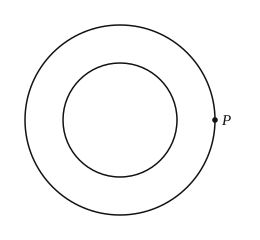
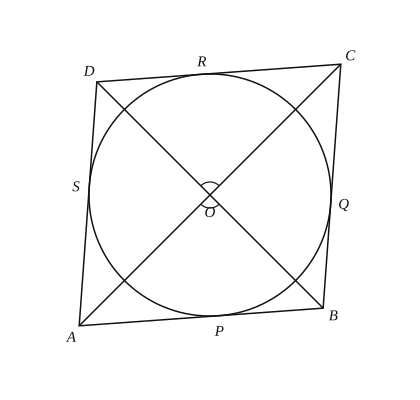
In the given figure, a circle is inscribed in a quadrilateral ABCD which touches the sides AB, BC, CD and DA at P, Q, R and S respectively. Prove that ∠AOB+∠COD=180∘.
Show answer & solution
Answer: Proved.
Join OP, OQ, OR, OS. In △OAP and △OAS: AP=AS (tangents from A), OP=OS (radii), OA common, so they are congruent (SSS) and ∠OAP=∠OAS.
Similarly OB, OC and OD bisect ∠B, ∠C and ∠D. Let ∠OAB=a, ∠OBA=b, ∠OCD=c, ∠ODC=d.
Then 2a+2b+2c+2d=∠A+∠B+∠C+∠D=360∘, so a+b+c+d=180∘.
In △AOB: ∠AOB=180∘−(a+b). In △COD: ∠COD=180∘−(c+d).
Find the value of k for which the following pair of linear equations will have infinitely many solutions : kx+3y−(k−3)=0 and 12x+ky−k=0 Hence, find any two solutions of the given pair of equations.
Show answer & solution
Answer:k=6; two solutions, e.g. (0,1) and (1,−1)
For infinitely many solutions: 12k=k3=kk−3.
12k=k3⇒k2=36⇒k=±6.
k3=kk−3⇒k−3=3⇒k=6. So k=6.
The equations become 6x+3y−3=0 and 12x+6y−6=0, both equivalent to 2x+y=1.
The following table shows the daily expenditure of 25 households of a locality. Daily Expenditure (in ₹): 500 – 750, 750 – 1000, 1000 – 1250, 1250 – 1500, 1500 – 1750 Number of Households: 4, 2x + 1, 12, x, 2 Find the value of x. Hence find the mean daily expenditure.
A charity trust decides to build a rectangular hall having an area of 300 m2. The length of the hall is one metre more than twice its width. Find the length and breadth of the hall.
Show answer & solution
Answer: Length = 25 m, breadth = 12 m
Let the breadth be x m; then the length is (2x+1) m.
Statement: If a line is drawn parallel to one side of a triangle to intersect the other two sides in distinct points, the other two sides are divided in the same ratio.
Given: In △ABC, DE∥BC with D on AB and E on AC. To prove: DBAD=ECAE.
Construction: Join BE and CD; draw EN⊥AB and DM⊥AC.
ar(△BDE)ar(△ADE)=21DB×EN21AD×EN=DBAD.
ar(△DEC)ar(△ADE)=21EC×DM21AE×DM=ECAE.
△BDE and △DEC are on the same base DE and between the same parallels DE and BC, so ar(△BDE)=ar(△DEC).
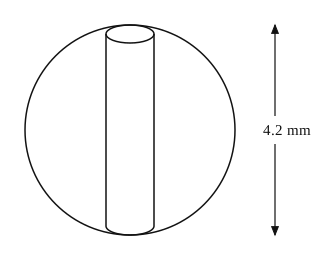
A necklace is made up of wooden beads. Each bead is in the form of a sphere of diameter 4.2 mm. A cylinder is hollowed out from each bead. If the radius of the cylinder is 1 mm, find the volume of wood left in each bead.
Show answer & solution
Answer: 25.608 mm3
Radius of sphere R=2.1 mm; the cylinder has radius r=1 mm and, as in the figure, height h=4.2 mm.
Volume of sphere =34πR3=34×722×2.1×2.1×2.1=38.808mm3.
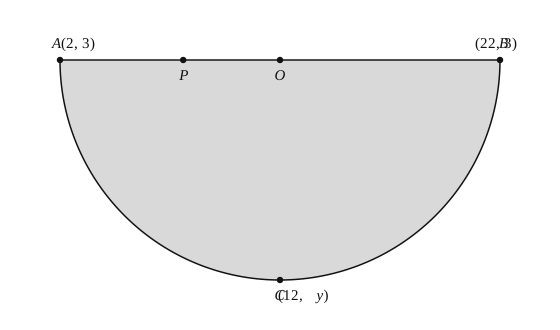
There is a semicircular park in Aman’s society. He wishes to plant saplings along the boundary of the park. There is a borewell at the centre O of the park along the diameter AB as shown in the figure below. Based on the above information, answer the following questions : (i) Find the coordinates of point O. (1) (ii) Find the radius of the semicircular park. (1) (iii) (a) One sapling is kept at point C(12, y). Find the coordinates of C. (2) OR (b) One sapling is kept at point P along AB so that PA = 31 PB. Find the coordinates of P. (2)
Show answer & solution
Answer: (i) O(12, 3) (ii) 10 units (iii) (a) C(12, −7) OR (b) P(7, 3)
A(2, 3), B(22, 3).
(i) O is the mid-point of AB: (22+22,23+3)=(12,3).
(ii) AB=22−2=20, so radius =10 units.
(iii) (a) C lies on the semicircle below AB with OC=10 and the same x-coordinate as O, so y=3−10=−7. C(12, −7).
(iii) (b) PA=31PB, so AP:PB=1:3. P=(41×22+3×2,41×3+3×3)=(7,3).
In a society, a yoga instructor was hired to train the people of the society to live a healthy lifestyle. Yoga sessions were held daily from 5 p.m. to 7 p.m. in the society park. On day one, 5 people joined the yoga session, on day two, 3 more people joined, on day three, another 3 people joined and in this manner every next day, 3 more people kept on joining. Based on the given information, answer the following questions : (i) On which day did 59 people join the yoga session ? (1) (ii) How many people joined the yoga session on the 31st day ? (1) (iii) (a) The yoga instructor was paid ₹100 for each person attending the yoga session. On which day would he earn ₹5,000 ? (2) OR (b) What was the total amount earned by the yoga instructor in 16 days ? (2)
Show answer & solution
Answer: (i) 19th day (ii) 95 (iii) (a) 16th day OR (b) ₹44,000
Number of people on day n forms an AP: 5, 8, 11, ... with a=5, d=3, so an=3n+2.
(i) 5+(n−1)×3=59⇒n−1=18⇒n=19. On the 19th day.
(ii) a31=5+30×3=95 people.
(iii) (a) ₹5,000 ÷ ₹100 = 50 people. 5+(n−1)×3=50⇒n=16. On the 16th day.
(iii) (b) Total attendance in 16 days =216(2×5+15×3)=8×55=440. Amount =440×₹100=₹44,000.
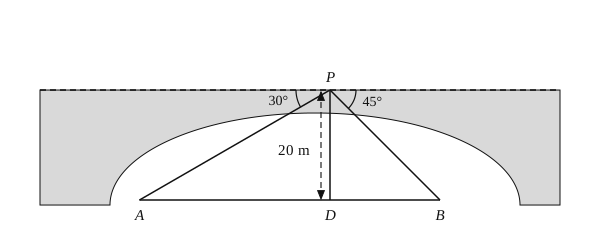
Two motorboats A and B are waiting at the opposite banks of a river in order to reach the opposite side. From a point P on the bridge, 20 m above the river, the angles of depression of the boats are 30∘ and 45∘ respectively, as shown in the figure given below. Both the boats leave at the same time at the speed of 10 m/s and 5 m/s, respectively Based on the above information, answer the following questions : (i) Find the distance travelled by boat A to reach point D in the river, vertically below the point P. (Use 3=1.73) (1) (ii) What is the width of the river ? (1) (iii) (a) Which boat will reach point D first, and how much earlier, than the other boat ? (2) OR (b) What is the distance between the two boats after 3 seconds ? (2)
Show answer & solution
Answer: (i) 34.6 m (ii) 54.6 m (iii) (a) Boat A, 0.54 s earlier OR (b) 9.6 m
PD = 20 m; angle of depression of A is 30∘, of B is 45∘, so ∠PAD=30∘ and ∠PBD=45∘.
(i) tan30∘=ADPD⇒AD=203=20×1.73=34.6 m.
(ii) tan45∘=DBPD⇒DB=20 m. Width =AD+DB=34.6+20=54.6 m.
(iii) (a) Time for A =1034.6=3.46 s; time for B =520=4 s. Boat A reaches D first, 4−3.46=0.54 s earlier.
(iii) (b) In 3 s, A travels 30 m and B travels 15 m towards each other. Distance between them =54.6−30−15=9.6 m.