CBSE Class 10 Maths Standard 2024 Question Paper 30/5/2 with Solutions
All 44 questions from the CBSE Class 10 Mathematics Standard board paper, Set 30/5/2 (2024),
with answers and step-by-step solutions. Total 80 marks. Tap “Show answer & solution” under any question.
One ticket is drawn at random from a bag containing tickets numbered 1 to 40. The probability that the selected ticket has a number which is a multiple of 7 is :
(A)71
(B)81
(C)51
(D)407
Show answer & solution
Answer: (B) 81
Multiples of 7 from 1 to 40: 7, 14, 21, 28, 35, i.e. 5 numbers.
Assertion (A) : ABCD is a trapezium with DC ∥ AB. E and F are points on AD and BC respectively, such that EF ∥ AB. Then EDAE=FCBF. Reason (R) : Any line parallel to parallel sides of a trapezium divides the non-parallel sides proportionally.
(A)Both Assertion (A) and Reason (R) are true and Reason (R) is the correct explanation of Assertion (A).
(B)Both Assertion (A) and Reason (R) are true, but Reason (R) is not the correct explanation of Assertion (A).
(C)Assertion (A) is true, but Reason (R) is false.
(D)Assertion (A) is false, but Reason (R) is true.
Show answer & solution
Answer: (A) Both Assertion (A) and Reason (R) are true and Reason (R) is the correct explanation of Assertion (A).
Join AC meeting EF at G. In △ADC, EG ∥ DC, so EDAE=GCAG (BPT).
In △CAB, GF ∥ AB, so GCAG=FCBF.
Hence EDAE=FCBF: R is true and A is exactly R applied to this trapezium, so R explains A.
A carton consists of 60 shirts of which 48 are good, 8 have major defects and 4 have minor defects. Nigam, a trader, will accept the shirts which are good but Anmol, another trader, will only reject the shirts which have major defects. One shirt is drawn at random from the carton. Find the probability that it is acceptable to Anmol.
Show answer & solution
Answer:1513
Anmol accepts all shirts except those with major defects: 60−8=52 shirts.
The first term of an A.P. is 5, the last term is 45 and the sum of all the terms is 400. Find the number of terms and the common difference of the A.P.
A jar contains 54 marbles, each of which is blue, green or white. The probability of selecting a blue marble at random from the jar is 31, and the probability of selecting a green marble at random is 94. How many white marbles does this jar contain ?
From a point on a bridge across the river, the angles of depressions of the banks on opposite sides of the river are 30∘ and 60∘ respectively. If the bridge is at a height of 4 m from the banks, find the width of the river.
Show answer & solution
Answer:3163 m (about 9.24 m)
Let P be the point on the bridge, PD = 4 m its height above the line of the banks, and A, B the banks on opposite sides of D.
Angles of depression equal the angles of elevation: ∠PAD=30∘, ∠PBD=60∘.
A tent is in the shape of a cylinder, surmounted by a conical top. If the height and diameter of the cylindrical part are 3.5 m and 6 m, and slant height of the top is 4.2 m, find the area of canvas used for making the tent. Also, find the cost of canvas of the tent at the rate of ₹ 500 per m2.
Show answer & solution
Answer: 105.6 m²; ₹ 52,800
Radius r=3 m, cylinder height h=3.5 m, slant height l=4.2 m.
Canvas = CSA of cylinder + CSA of cone =2πrh+πrl=πr(2h+l).
Activities like running or cycling reduce stress and the risk of mental disorders like depression. Running helps build endurance. Children develop stronger bones and muscles and are less prone to gain weight. The physical education teacher of a school has decided to conduct an inter school running tournament in his school premises. The time taken by a group of students to run 100 m, was noted as follows : Time (in seconds): 0–20, 20–40, 40–60, 60–80, 80–100 Number of students: 8, 10, 13, 6, 3 Based on the above, answer the following questions : (i) What is the median class of the above given data ? (1) (ii) (a) Find the mean time taken by the students to finish the race. (2) OR (b) Find the mode of the above given data. (2) (iii) How many students took time less than 60 seconds ? (1)
Show answer & solution
Answer: (i) 40–60 (ii) (a) 43 seconds OR (b) 46 seconds (iii) 31
Total n=40; cumulative frequencies: 8, 18, 31, 37, 40.
(i) 2n=20 lies in the class with cf 31, so the median class is 40–60.
(ii) (a) Class marks 10, 30, 50, 70, 90; ∑fixi=80+300+650+420+270=1720; mean =401720=43 seconds.
(ii) (b) Modal class 40–60: l=40, f1=13, f0=10, f2=6, h=20; mode =40+26−10−613−10×20=40+6=46 seconds.
Essel World is one of India’s largest amusement parks that offers a diverse range of thrilling rides, water attractions and entertainment options for visitors of all ages. The park is known for its iconic “Water Kingdom” section, making it a popular destination for family outings and fun-filled adventure. The ticket charges for the park are ₹ 150 per child and ₹ 250 per adult. On a day, the cashier of the park found that 300 tickets were sold and an amount of ₹ 55,000 was collected. Based on the above, answer the following questions : (i) If the number of children visited be x and the number of adults visited be y, then write the given situation algebraically. (1) (ii) (a) How many children visited the amusement park that day ? (2) OR (b) How many adults visited the amusement park that day ? (2) (iii) How much amount will be collected if 250 children and 100 adults visit the amusement park ? (1)
Show answer & solution
Answer: (i) x+y=300, 150x+250y=55000 (ii) (a) 200 children OR (b) 100 adults (iii) ₹ 62,500
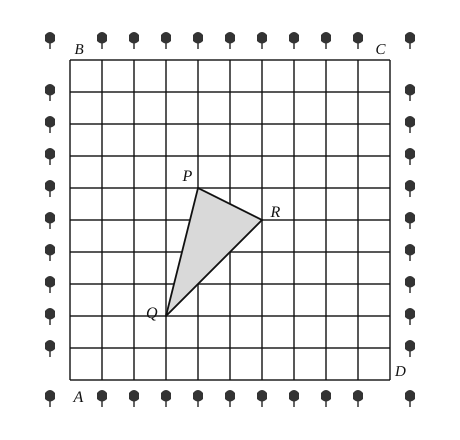
A garden is in the shape of a square. The gardener grew saplings of Ashoka tree on the boundary of the garden at the distance of 1 m from each other. He wants to decorate the garden with rose plants. He chose a triangular region inside the garden to grow rose plants. In the above situation, the gardener took help from the students of class 10. They made a chart for it which looks like the given figure. Based on the above, answer the following questions : (i) If A is taken as origin, what are the coordinates of the vertices of △PQR ? (1) (ii) (a) Find distances PQ and QR. (2) OR (b) Find the coordinates of the point which divides the line segment joining points P and R in the ratio 2 : 1 internally. (2) (iii) Find out if △PQR is an isosceles triangle. (1)
Show answer & solution
Answer: (i) P(4, 6), Q(3, 2), R(6, 5) (ii) (a) PQ = 17 m, QR = 32 m OR (b) (316,316) (iii) No, it is not isosceles
(i) Taking A as origin with AD along the x-axis and AB along the y-axis (1 unit = 1 m): P(4, 6), Q(3, 2), R(6, 5).
(ii) (a) PQ=(4−3)2+(6−2)2=17 m; QR=(6−3)2+(5−2)2=18=32 m.
(ii) (b) Point =(32×6+1×4,32×5+1×6)=(316,316).
(iii) PR=(6−4)2+(5−6)2=5. PQ, QR, PR = 17,18,5 are all different, so △PQR is not isosceles.