CBSE Class 10 Maths Standard 2026 Question Paper 30/2/3 with Solutions
All 44 questions from the CBSE Class 10 Mathematics Standard board paper, Set 30/2/3 (2026),
with answers and step-by-step solutions. Total 80 marks. Tap “Show answer & solution” under any question.
From a point on the ground, which is 60 m away from the foot of a vertical tower, the angle of elevation of the top of the tower is found to be 45∘. The height (in metres) of the tower is :
Assertion (A) : The surface area of the cuboid formed by joining two cubes of sides 4 cm each, end-to-end, is 160 cm2. Reason (R): The surface area of a cuboid of dimensions l×b×h is (lb+bh+hl).
(A)Both Assertion (A) and Reason (R) are true and Reason (R) is the correct explanation of the Assertion (A).
(B)Both Assertion (A) and Reason (R) are true, but Reason (R) is not the correct explanation of the Assertion (A).
(C)Assertion (A) is true, but Reason (R) is false.
(D)Assertion (A) is false, but Reason (R) is true.
Show answer & solution
Answer: (C) Assertion (A) is true, but Reason (R) is false.
The cuboid formed is 8 cm × 4 cm × 4 cm.
Surface area =2(lb+bh+hl)=2(32+16+32)=160cm2, so A is true.
The surface area of a cuboid is 2(lb+bh+hl), not (lb+bh+hl), so R is false.
The three vertices of a rhombus PQRS are P(2, -3), Q(6, 5) and R(-2, 1). Find the coordinates of the fourth vertex S and coordinates of the point where both the diagonals PR and QS intersect.
Show answer & solution
Answer: S(-6, -7); diagonals intersect at (0, -1)
Diagonals of a rhombus bisect each other.
Mid-point of PR =(22−2,2−3+1)=(0,−1); this is the point of intersection.
Let S = (x, y). Mid-point of QS = (0, -1): 26+x=0, 25+y=−1.
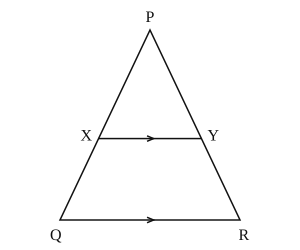
Prove that if a line is drawn parallel to one side of a triangle to intersect the other two sides in distinct points, then the other two sides are divided in the same ratio.
Show answer & solution
Answer: Proved.
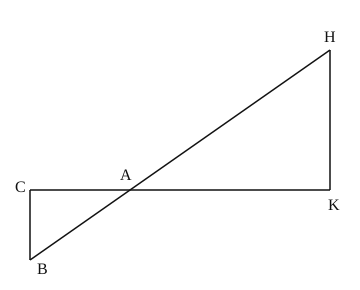
Given: In △ABC, DE ∥ BC meets AB at D and AC at E. To prove: DBAD=ECAE.
Construction: Join BE and CD; draw EN ⊥ AB and DM ⊥ AC.
ar(ADE)=21AD⋅EN and ar(BDE)=21DB⋅EN, so ar(BDE)ar(ADE)=DBAD.
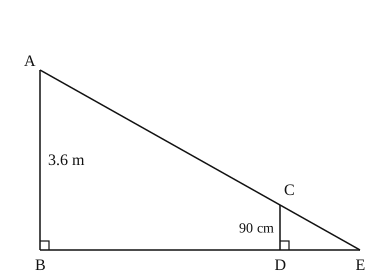
As shown in the given figure, a girl of height 90 cm is walking away from the base of a lamp post at a speed of 1.2 m/s. If the lamp is 3.6 m above the ground, find the length of her shadow after 4 seconds.
Show answer & solution
Answer: 1.6 m
Distance walked in 4 s: BD = 1.2 × 4 = 4.8 m. Let shadow DE = x m. CD = 90 cm = 0.9 m, AB = 3.6 m.
△ABE∼△CDE (AA: right angles at B and D, common ∠E).
An SBI health insurance agent found the following data for distribution of ages of 100 policy holders. The health insurance policies are given to persons of age 15 years and onwards, but less than 60 years.
Age (in yrs)
Number of policy holders
15 - 20
2
20 - 25
4
25 - 30
18
30 - 35
21
35 - 40
33
40 - 45
11
45 - 50
3
50 - 55
6
55 - 60
2
Find the modal age and median age of the policy holders.
Show answer & solution
Answer: Modal age ≈ 36.76 years; median age ≈ 35.76 years
Mode: modal class 35 - 40 (highest frequency 33); l = 35, f1=33, f0=21, f2=11, h = 5.
Mode =35+2(33)−21−1133−21×5=35+3412×5=35+1.76=36.76 years
Represent the following pair of linear equations graphically and hence comment on the condition of consistency of this pair : x - 5y = 6; 2x - 10y = 12
Show answer & solution
Answer: The lines coincide; the pair is consistent (dependent) with infinitely many solutions.
Points on x−5y=6: (6, 0), (1, -1), (-4, -2).
Points on 2x−10y=12: (6, 0), (1, -1), (11, 1).
Plotting, both equations give the same line (coincident lines).
Also a2a1=21, b2b1=−10−5=21, c2c1=126=21, all equal.
So the pair is consistent and dependent, with infinitely many solutions.
In a class test, the sum of Anamika's marks obtained in Maths and Science is 30. Had she got 2 marks more in Maths and 3 marks less in Science, the product of the marks would have been 210. Find the marks she got in the two subjects.
Show answer & solution
Answer: Maths 13, Science 17 or Maths 12, Science 18
The length of hypotenuse (in cm) of a right-angled triangle is 6 cm more than twice the length of its shortest side. If the length of its third side is 6 cm less than thrice the length of its shortest side, find the dimensions of the triangle.
Show answer & solution
Answer: 10 cm, 24 cm and 26 cm
Let the shortest side be x cm; hypotenuse = (2x + 6) cm; third side = (3x - 6) cm.
On a Sunday your parents took you to a fair. You could see lot of toys displayed and you wanted them to buy a Rubik's cube and a strawberry ice-cream for you. Based on the information given above, answer the following questions : (i) Find the length of the diagonal of Rubik's cube if each edge measures 6 cm. (1) (ii) Find the volume of Rubik's cube if the length of the edge is 7 cm. (1) (iii) (a) What is the curved surface area of hemisphere (ice-cream) if the base radius is 7 cm ? (2) OR (iii) (b) If two cubes of edges 4 cm are joined end-to-end, then find the surface area of the resulting cuboid. (2)
Show answer & solution
Answer: (i) 63 cm (ii) 343 cm3 (iii) (a) 308 cm2 OR (b) 160 cm2
(i) Diagonal of a cube =3a=63 cm
(ii) Volume =a3=73=343cm3
(iii)(a) CSA of hemisphere =2πr2=2×722×7×7=308cm2
Your elder brother wants to buy a car and plans to take a loan from a bank for his car. He repays his total loan of ₹ 1,18,000 by paying every month, starting with the first instalment of ₹ 1,000 and he increases the instalment by ₹ 100 every month. Based on the information given above, answer the following questions : (i) Find the amount paid by him in the 30th instalment. (1) (ii) If the total number of instalments is 40, what is the amount paid in the last instalment ? (1) (iii) (a) What amount does he still have to pay after the 30th instalment ? (2) OR (iii) (b) Find the ratio of the tenth instalment to the last instalment. (2)
Show answer & solution
Answer: (i) ₹ 3,900 (ii) ₹ 4,900 (iii) (a) ₹ 44,500 OR (b) 19 : 49
Instalments form an A.P. with a = 1000, d = 100.
(i) a30=1000+29×100=3900, i.e. ₹ 3,900
(ii) a40=1000+39×100=4900, i.e. ₹ 4,900
(iii)(a) S30=230[2(1000)+29(100)]=15×4900=73500
Amount still to pay = 118000 - 73500 = ₹ 44,500
(iii)(b) a10=1000+9×100=1900; last instalment = 4900
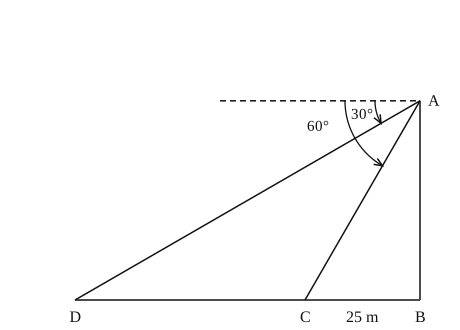
Tejas is standing at the top of a building and observes a car at an angle of depression of 30∘ as it approaches the base of the building at a uniform speed. 6 seconds later, the angle of depression increases to 60∘, and at that moment, the car is 25 m away from the building. Based on the information given above, answer the following questions : (i) What is the height of the building ? (1) (ii) What is the distance between the two positions of the car ? (1) (iii) (a) What would be the total time taken by the car to reach the foot of the building from the starting point ? (2) OR (iii) (b) What is the distance of the observer from the car when it makes an angle of 60∘ ? (2)
Show answer & solution
Answer: (i) 253 m (ii) 50 m (iii) (a) 9 seconds OR (b) 50 m
In the figure, AB is the building, C and D are the two positions of the car, CB = 25 m.
(i) In △ABC, tan60∘=CBAB, so AB=253 m.
(ii) In △ABD, tan30∘=DBAB, so DB=253×3=75 m. DC = 75 - 25 = 50 m.
(iii)(a) Speed =650=325 m/s. Time for the remaining 25 m =25÷325=3 s.