MonoMath CBSE
CBSE Maths › Class 10 PYQs › 2026

CBSE Class 10 Maths Standard 2026 Question Paper 30/1/3 with Solutions

All 44 questions from the CBSE Class 10 Mathematics Standard board paper, Set 30/1/3 (2026), with answers and step-by-step solutions. Total 80 marks. Tap “Show answer & solution” under any question.

Set 30/1/1Set 30/1/2Set 30/1/3Set 30/2/1Set 30/2/2Set 30/2/3Set 30/3/1Set 30/3/2Set 30/3/3Set 30/4/1Set 30/4/2Set 30/4/3Set 30/5/1Set 30/5/2Set 30/5/3
Q11 markMCQReal Numbers

For any natural number , ends with the digit :

  1. (A)0
  2. (B)6
  3. (C)3
  4. (D)2
Show answer & solution
Answer: (B) 6
  1. , , , ...
  2. Any power of a number ending in 6 also ends in 6, since ends in 6.
  3. So always ends with the digit 6.
Q21 markMCQPolynomials

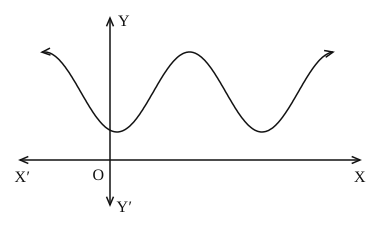
The graph of is given.
The number of zeroes of is :

Diagram for CBSE 2026 Class 10 Maths question 2
  1. (A)0
  2. (B)1
  3. (C)2
  4. (D)4
Show answer & solution
Answer: (A) 0
  1. The zeroes of are the -coordinates of the points where the graph meets the -axis.
  2. The given curve lies wholly above the -axis and never meets it.
  3. So has 0 zeroes.

If a pair of linear equations in two variables is represented by two coincident lines, then the pair of equations has :

  1. (A)a unique solution
  2. (B)two solutions
  3. (C)no solution
  4. (D)an infinite number of solutions
Show answer & solution
Answer: (D) an infinite number of solutions
  1. Coincident lines have every point in common.
  2. Every common point is a solution, so the pair has infinitely many solutions.

The common difference of the AP : is :

  1. (A)
  2. (B)1
  3. (C)
  4. (D)
Show answer & solution
Answer: (A)
  1. .
Also asked in: 2026 Standard 30/1/1
Q51 markMCQTriangles

If and are similar such that and cm, then EF is equal to :

  1. (A)4 cm
  2. (B)8 cm
  3. (C)12 cm
  4. (D)16 cm
Show answer & solution
Answer: (D) 16 cm
  1. Since , .
  2. , so .
  3. cm.
Also asked in: 2026 Standard 30/1/1

The mid-point of the line segment joining the points and lies on :

  1. (A)-axis
  2. (B)-axis
  3. (C)origin
  4. (D)neither -axis nor -axis
Show answer & solution
Answer: (A) -axis
  1. Mid-point .
  2. Its -coordinate is 0, so it lies on the -axis.

Given that , then is equal to :

  1. (A)
  2. (B)
  3. (C)
  4. (D)
Show answer & solution
Answer: (C)
  1. Take a right triangle with opposite side and hypotenuse .
  2. Adjacent side .
  3. .
Also asked in: 2026 Standard 30/1/1

If , then the value of is :

  1. (A)
  2. (B)
  3. (C)
  4. (D)
Show answer & solution
Answer: (B)
  1. .
  2. .

The string of a flying kite is tied to a point on the ground. The length of the string between the kite and the point on the ground is 80 m. The string makes an angle of with the ground. The height of the kite above the ground is :

  1. (A) m
  2. (B)40 m
  3. (C) m
  4. (D) m
Show answer & solution
Answer: (B) 40 m
  1. Let the height be . Then .
  2. m.
Q101 markMCQCircles

If TP and TQ are two tangents to a circle with centre O from an external point T so that , then is equal to :

  1. (A)
  2. (B)
  3. (C)
  4. (D)
Show answer & solution
Answer: (A)
  1. (radius tangent).
  2. In quadrilateral OPTQ, .
Q111 markMCQCircles

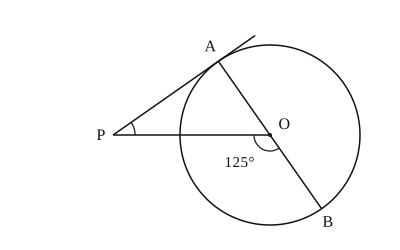
In the given figure, PA is a tangent from an external point P to a circle with centre O. If , then is equal to :

Diagram for CBSE 2026 Class 10 Maths question 11
  1. (A)
  2. (B)
  3. (C)
  4. (D)
Show answer & solution
Answer: (D)
  1. AOB is a straight line (diameter), so .
  2. (radius tangent).
  3. In , .

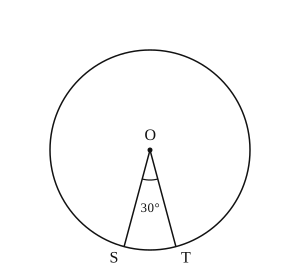
Shown in the given figure is a circle with centre O. The area of the minor sector is 7 cm. Area of circle is :

Diagram for CBSE 2026 Class 10 Maths question 12
  1. (A) cm
  2. (B) cm
  3. (C)84 cm
  4. (D) cm
Show answer & solution
Answer: (C) 84 cm
  1. The minor sector has angle , which is of the circle.
  2. Area of circle cm.

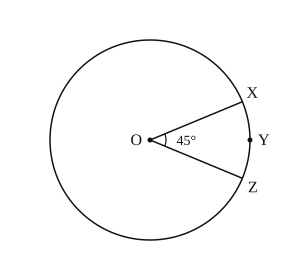
In the given figure, O is the centre of circle. XYZ is an arc of the circle subtending an angle of at the centre. If the radius of the circle is 32 cm, then the length of the arc XYZ is :

Diagram for CBSE 2026 Class 10 Maths question 13
  1. (A) cm
  2. (B) cm
  3. (C) cm
  4. (D) cm
Show answer & solution
Answer: (B) cm
  1. Arc length .
  2. cm.

The radius of a sphere (in cm) whose volume is cm, is :

  1. (A)3
  2. (B)
  3. (C)
  4. (D)
Show answer & solution
Answer: (A) 3
  1. cm.
Q151 markMCQStatistics

If the mean and mode of a data are 12 and 21 respectively, then its median is :

  1. (A)6
  2. (B)13.5
  3. (C)15
  4. (D)14
Show answer & solution
Answer: (C) 15
  1. Empirical relation: .
  2. .
  3. Median .
Q161 markMCQProbability

A die is thrown once. Probability of getting a number other than 3 is :

  1. (A)
  2. (B)
  3. (C)
  4. (D)1
Show answer & solution
Answer: (C)
  1. Total outcomes = 6.
  2. Numbers other than 3: 1, 2, 4, 5, 6, i.e. 5 outcomes.
  3. P = .
Also asked in: 2026 Standard 30/1/1
Q171 markMCQReal Numbers

The HCF of 960 and 432 is :

  1. (A)48
  2. (B)54
  3. (C)72
  4. (D)36
Show answer & solution
Answer: (A) 48
  1. and .
  2. HCF = product of the smallest powers of common primes = .
Q181 markMCQReal Numbers

The natural number 2 is :

  1. (A)a prime number
  2. (B)a composite number
  3. (C)prime as well as composite
  4. (D)neither prime nor composite
Show answer & solution
Answer: (A) a prime number
  1. 2 has exactly two factors, 1 and 2.
  2. So 2 is a prime number (the only even prime).
Q191 markAssertion–ReasonPolynomials

Assertion (A) : The polynomial has two zeroes.
Reason (R) : A quadratic polynomial can have at most two zeroes.

  1. (A)Both, Assertion (A) and Reason (R) are true and Reason (R) is the correct explanation of the Assertion (A).
  2. (B)Both, Assertion (A) and Reason (R) are true, but Reason (R) is not the correct explanation of the Assertion (A).
  3. (C)Assertion (A) is true, but Reason (R) is false.
  4. (D)Assertion (A) is false, but Reason (R) is true.
Show answer & solution
Answer: (B) Both, Assertion (A) and Reason (R) are true, but Reason (R) is not the correct explanation of the Assertion (A).
  1. , so the zeroes are and . A is true.
  2. A quadratic polynomial has at most two zeroes, so R is true.
  3. R only gives an upper limit; it does not show that this polynomial actually has two zeroes (that comes from the factorisation). So R does not explain A.
Q201 markAssertion–ReasonProbability

Assertion (A) : The probability that a leap year has 53 Mondays is .
Reason (R) : The probability that a non-leap year has 53 Mondays is .

  1. (A)Both, Assertion (A) and Reason (R) are true and Reason (R) is the correct explanation of the Assertion (A).
  2. (B)Both, Assertion (A) and Reason (R) are true, but Reason (R) is not the correct explanation of the Assertion (A).
  3. (C)Assertion (A) is true, but Reason (R) is false.
  4. (D)Assertion (A) is false, but Reason (R) is true.
Show answer & solution
Answer: (C) Assertion (A) is true, but Reason (R) is false.
  1. A leap year has 366 days = 52 weeks + 2 days.
  2. The 2 extra days can be (Sun, Mon), (Mon, Tue), ..., (Sat, Sun): 7 cases, 2 of which contain Monday. So P = ; A is true.
  3. A non-leap year has 365 days = 52 weeks + 1 day; the extra day is Monday in 1 of 7 cases, so P = , not . R is false.
Q212 marksVery Short AnswerCoordinate Geometry

Do the points P , Q and R form a triangle ? If so, name the type of triangle formed.

Show answer & solution
Answer: Yes; an isosceles triangle (, ).
  1. .
  2. .
  3. .
  4. The sum of any two sides exceeds the third (e.g. ; also P, Q lie on the -axis but R does not), so the points are not collinear and form a triangle.
  5. Since , it is an isosceles triangle.
Q222 marksVery Short AnswerIntroduction to Trigonometry

If , then find the value of .

Show answer & solution
Answer:
  1. Take opposite side 24k and adjacent side 7k.
  2. Hypotenuse .
  3. , .
  4. .
OR
Q22 (OR) (OR)2 marksVery Short AnswerIntroduction to Trigonometry

If , then find the value of .

Show answer & solution
Answer:
  1. .
Q232 marksVery Short AnswerCircles

Two concentric circles are of radii 5 cm and 4 cm. Find the length of the chord of the larger circle which touches the smaller circle.

Show answer & solution
Answer: 6 cm
  1. Let chord AB of the larger circle touch the smaller circle at P. Then and cm.
  2. The perpendicular from the centre bisects the chord, so .
  3. In right , cm.
  4. cm.
Also asked in: 2026 Standard 30/1/1
Q242 marksVery Short AnswerPolynomials

Find a quadratic polynomial whose zeroes are and .

Show answer & solution
Answer:
  1. Sum of zeroes .
  2. Product of zeroes .
  3. Required polynomial (or any non-zero multiple of it).
Q252 marksVery Short AnswerTriangles

In , . If , , and , then find the value of .

Show answer & solution
Answer:
  1. By BPT, .
  2. .
OR
Q25 (OR) (OR)2 marksVery Short AnswerTriangles

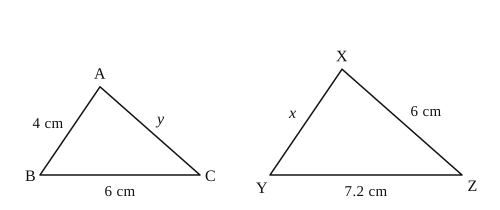
In the figure given above, , then find the values of and .

Diagram for CBSE 2026 Class 10 Maths question 25 (OR)
Show answer & solution
Answer: cm, cm
  1. Since , .
  2. .
  3. , so cm.
  4. , so cm.
Q263 marksShort AnswerIntroduction to Trigonometry

If , , then prove that :

Show answer & solution
Answer: Proved.
  1. From the given, and .
  2. So LHS RHS.
OR
Q26 (OR) (OR)3 marksShort AnswerIntroduction to Trigonometry

Prove that :

Show answer & solution
Answer: Proved.
  1. LHS .
  2. Since , LHS .
  3. RHS.
Q273 marksShort AnswerCircles

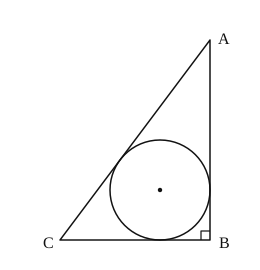
In the given figure, is a right triangle in which , cm and cm. Find the radius of the circle inscribed in the triangle ABC.

Diagram for CBSE 2026 Class 10 Maths question 27
Show answer & solution
Answer: 1 cm
  1. cm.
  2. Let the incircle (centre O, radius ) touch BC, CA, AB at P, Q, R. OPBR is a square, so .
  3. Tangent lengths: and .
  4. : , so and cm.
OR
Q27 (OR) (OR)3 marksShort AnswerCircles

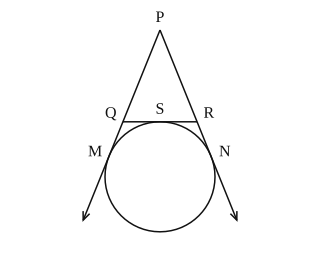
In the given figure, if a circle touches the side QR of at S and extended sides PQ and PR at M and N respectively, then prove that :

Diagram for CBSE 2026 Class 10 Maths question 27 (OR)
Show answer & solution
Answer: Proved.
  1. Tangents from an external point are equal: , , .
  2. Perimeter .
  3. Since , perimeter .
  4. So .
Q283 marksShort AnswerSurface Areas and Volumes

A right circular cylinder and a right circular cone have equal bases and equal heights. If their curved surface areas are in the ratio 8 : 5, then find the ratio between the radius of their bases to their height.

Show answer & solution
Answer: 3 : 4
  1. Let the common radius be and height ; slant height of the cone .
  2. , so and .
  3. , so and .
  4. .
Q293 marksShort AnswerProbability

Two different coins are tossed simultaneously. What is the probability of getting :
(i) at least one head ?
(ii) at most one tail ?
(iii) a head and a tail ?

Show answer & solution
Answer: (i) (ii) (iii)
  1. Outcomes: HH, HT, TH, TT (4 equally likely).
  2. (i) At least one head: HH, HT, TH. P = .
  3. (ii) At most one tail: HH, HT, TH. P = .
  4. (iii) A head and a tail: HT, TH. P = .
Q303 marksShort AnswerReal Numbers

Prove that is an irrational number.

Show answer & solution
Answer: Proved.
  1. Suppose is rational. Then , where , are coprime integers and .
  2. Squaring, , so 3 divides , hence 3 divides (3 is prime).
  3. Write . Then , so ; hence 3 divides and so 3 divides .
  4. Thus 3 divides both and , contradicting that they are coprime.
  5. So is irrational.
Q313 marksShort AnswerCoordinate Geometry

Find the ratio in which the -axis divides the line segment joining the points and . Also, find the point of intersection.

Show answer & solution
Answer: 5 : 1;
  1. Let the -axis divide the segment in the ratio .
  2. The point is .
  3. On the -axis, : , so . Ratio = 5 : 1.
  4. .
  5. Point of intersection .
Also asked in: 2026 Standard 30/1/1
Q325 marksLong AnswerTriangles

State and prove Basic Proportionality Theorem.

Show answer & solution
Answer: Proved.
  1. Statement: If a line is drawn parallel to one side of a triangle to intersect the other two sides in distinct points, the other two sides are divided in the same ratio.
  2. Given: In , , with D on AB and E on AC. To prove: .
  3. Construction: Join BE and CD; draw and .
  4. and , so .
  5. Similarly and , so .
  6. and are on the same base DE and between the same parallels DE and BC, so .
  7. Hence .
OR
Q32 (OR) (OR)5 marksLong AnswerTriangles

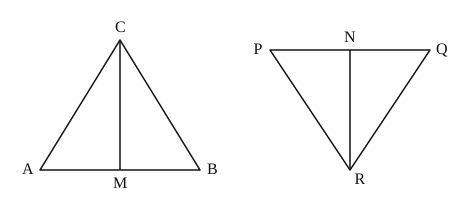
In the given figure, CM and RN are respectively the medians of and . If , then prove that :
(i)
(ii)

Diagram for CBSE 2026 Class 10 Maths question 32 (OR)
Show answer & solution
Answer: Proved.
  1. Since : , and .
  2. M and N are mid-points, so and ; hence .
  3. (i) In and : and .
  4. So (SAS similarity).
  5. (ii) In and : and .
  6. So (SAS similarity).
Q335 marksLong AnswerStatistics

The marks obtained by 80 students of class X in a mock test of Mathematics are given below in the table. Find median and the mode of the data :

MarksNumber of Students
0 and above80
10 and above77
20 and above72
30 and above65
40 and above55
50 and above43
60 and above28
70 and above16
80 and above10
90 and above8
100 and above0
Show answer & solution
Answer: Median = 52; Mode = 55
  1. Class frequencies (by subtraction): 0-10: 3, 10-20: 5, 20-30: 7, 30-40: 10, 40-50: 12, 50-60: 15, 60-70: 12, 70-80: 6, 80-90: 2, 90-100: 8 (total 80).
  2. Cumulative frequencies: 3, 8, 15, 25, 37, 52, 64, 70, 72, 80.
  3. Median: , so the median class is 50-60 with , , , .
  4. Median .
  5. Mode: modal class 50-60 with , , .
  6. Mode .

Draw the graph of the pair of linear equations and . Calculate the area of the triangle formed by the lines so drawn and the -axis.

Show answer & solution
Answer: Lines meet at ; vertices , , ; area = 6 sq. units
  1. , i.e. : points , , .
  2. , i.e. : points , , .
  3. Plotting, the lines intersect at and meet the -axis at and .
  4. Base on the -axis ; height .
  5. Area sq. units.
Q355 marksLong AnswerQuadratic Equations

A faster train takes one hour less than a slower train for a journey of 200 km. If the speed of the slower train is 10 km/hr less than that of the faster train, find the speeds of the two trains.

Show answer & solution
Answer: Slower train 40 km/hr, faster train 50 km/hr
  1. Let the speed of the slower train be km/hr; faster train km/hr.
  2. , so (speed cannot be negative).
  3. Slower train: 40 km/hr; faster train: 50 km/hr.
OR
Q35 (OR) (OR)5 marksLong AnswerQuadratic Equations

The sum of the areas of two squares is 640 m. If the difference in their perimeters is 64 m, find the sides of the two squares.

Show answer & solution
Answer: 24 m and 8 m
  1. Let the sides be m and m with .
  2. , so .
  3. :
  4. , i.e.
  5. , so (side cannot be negative).
  6. . The sides are 24 m and 8 m.
Q364 marksCase StudyAreas Related to Circles

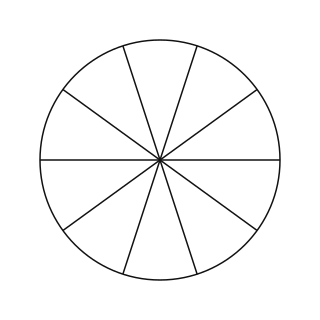
A brooch is crafted from silver wire in the shape of a circle with a diameter of 35 cm. The wire is also used to create 5 diameters, dividing the circle into 10 equal sectors as shown in figure.
Based on the above information, answer the following questions :
(i) What is the radius of circle ? (1)
(ii) What is the circumference of the brooch ? (1)
(iii) (a) What is the total length of silver wire required ? (2)
OR
(iii) (b) What is the area of each sector of the brooch ? (2)

Diagram for CBSE 2026 Class 10 Maths question 36
Show answer & solution
Answer: (i) 17.5 cm (ii) 110 cm (iii) (a) 285 cm OR (b) 96.25 cm
  1. (i) Radius cm.
  2. (ii) Circumference cm.
  3. (iii) (a) Wire = circumference + 5 diameters cm.
  4. (iii) (b) Each sector has central angle , i.e. of the circle.
  5. Area cm.
Q374 marksCase StudyArithmetic Progressions

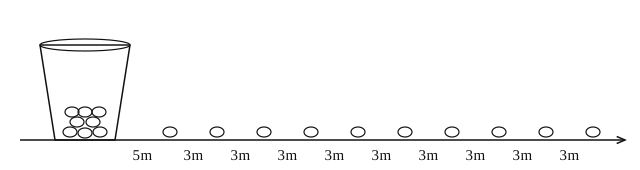
In a potato race, a bucket is placed at the starting point, which is 5 m from the first potato. The other potatoes are arranged 3 m apart in a straight line, with a total of 10 potatoes, as shown in the figure :
A competitor starts from the bucket, picks up the nearest potato, runs back to the bucket to drop it in, then returns to pick up the next potato. This process continues until all the potatoes are in the bucket.
Based on the above information, answer the following questions :
(i) What is the distance covered to pick up the first potato and drop it in bucket ? (1)
(ii) What is the distance covered to pick up the second potato and drop it in bucket ? (1)
(iii) (a) What is the total distance the competitor has to run ? (2)
OR
(iii) (b) If average speed of competitor is 5 m/s, then find the average time taken by competitor to put all the potatoes in the bucket. (2)

Diagram for CBSE 2026 Class 10 Maths question 37
Show answer & solution
Answer: (i) 10 m (ii) 16 m (iii) (a) 370 m OR (b) 74 s
  1. The potatoes are 5 m, 8 m, 11 m, ..., from the bucket; the 10th is m away.
  2. (i) Distance = m.
  3. (ii) Distance = m.
  4. The round-trip distances 10, 16, 22, ... form an AP with , , .
  5. (iii) (a) Total m.
  6. (iii) (b) Time s.

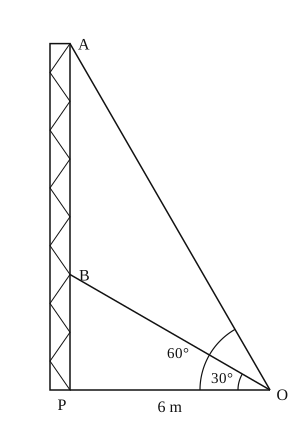
Radio towers are used for transmitting a range of communication services including radio and television. The tower will either act as an antenna itself or support one or more antennas on its structure. On a similar concept, a radio station tower was built in two sections 'A' and 'B'. Tower is supported by wires from a point 'O' (as shown in figure).
Distance between the base of the tower and point 'O' is 6 m. From point 'O', the angle of elevation of the top of the section 'B' is and the angle of elevation of the top of section 'A' is .
Based on the above information, answer the following questions :
(i) Find the length of the wire from the point 'O' to the top of section 'B'. (1)
(ii) Find the length of the wire from the point 'O' to the top of section 'A'. (1)
(iii) (a) Find the distance AB. (2)
OR
(iii) (b) Find the area of . (2)

Diagram for CBSE 2026 Class 10 Maths question 38
Show answer & solution
Answer: (i) m (ii) 12 m (iii) (a) m OR (b) m
  1. P is the base of the tower, m, , , .
  2. (i) , so m.
  3. (ii) , so m.
  4. (iii) (a) m and m.
  5. m.
  6. (iii) (b) Area of m.
← 2026 Standard 30/1/2 2026 Standard 30/2/1 →
Practise smarter: chapter-wise revision, formula sheets and step-by-step NCERT solutions on MonoMath CBSE →