CBSE Class 10 Maths Standard 2026 Question Paper 30/1/2 with Solutions
All 44 questions from the CBSE Class 10 Mathematics Standard board paper, Set 30/1/2 (2026),
with answers and step-by-step solutions. Total 80 marks. Tap “Show answer & solution” under any question.
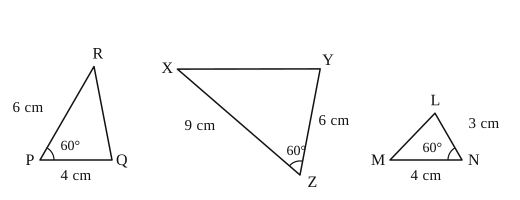
Shown below are three triangles. The measures of two adjacent sides and included angle are given for each triangle : Which of these triangles are similar ?
(A)△RPQ and △XZY
(B)△RPQ and △MNL
(C)△XZY and △MNL
(D)△RPQ, △XZY and △MNL are similar to one another
Show answer & solution
Answer: (A) △RPQ and △XZY
Each triangle has an included angle of 60∘, so compare the ratios of the sides containing it.
△RPQ: PR:PQ=6:4=3:2.
△XZY: ZX:ZY=9:6=3:2.
△MNL: NM:NL=4:3.
So ZXPR=ZYPQ=32 and ∠P=∠Z; by SAS, △RPQ∼△XZY. △MNL is not similar to either.
A car is moving away from the base of a 30 m high tower. The angle of elevation of the top of the tower from the car at an instant, when the car is 103 m away from the base of the tower, is :
Assertion (A) : The polynomial p(y)=y2+4y+3 has two zeroes. Reason (R) : A quadratic polynomial can have at most two zeroes.
(A)Both, Assertion (A) and Reason (R) are true and Reason (R) is the correct explanation of the Assertion (A).
(B)Both, Assertion (A) and Reason (R) are true, but Reason (R) is not the correct explanation of the Assertion (A).
(C)Assertion (A) is true, but Reason (R) is false.
(D)Assertion (A) is false, but Reason (R) is true.
Show answer & solution
Answer: (B) Both, Assertion (A) and Reason (R) are true, but Reason (R) is not the correct explanation of the Assertion (A).
y2+4y+3=(y+1)(y+3), so the zeroes are −1 and −3. A is true.
A quadratic polynomial has at most two zeroes, so R is true.
R only gives an upper limit; it does not show that this polynomial actually has two zeroes (that comes from the factorisation). So R does not explain A.
The coordinates of the centre of a circle are (x−7,2x). Find the value(s) of 'x', if the circle passes through the point (−9,11) and has radius 52 units.
Show answer & solution
Answer:x=3 or x=5
Distance of (−9,11) from the centre equals the radius.
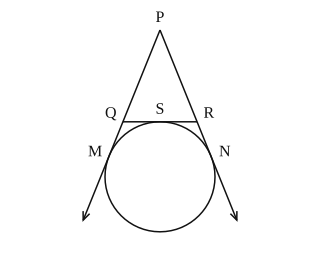
In the given figure, if a circle touches the side QR of △PQR at S and extended sides PQ and PR at M and N respectively, then prove that : PM=21(PQ+QR+PR)
Show answer & solution
Answer: Proved.
Tangents from an external point are equal: PM=PN, QM=QS, RN=RS.
A solid is in the form of a cylinder with hemispherical ends. The total height of the solid is 20 cm and the diameter of the cylinder is 7 cm. Find the total volume of the solid. (Use π=722)
Show answer & solution
Answer:64081 cm3 ≈ 680.17 cm3
Radius r=3.5 cm. Height of the cylindrical part h=20−2×3.5=13 cm.
Two dice of different colours are thrown at the same time. Write down all the possible outcomes. What is the probability that : (i) same number appears on both the dice ? (ii) different number appears on both the dice ?
Show answer & solution
Answer: 36 outcomes; (i) 61 (ii) 65
Outcomes are ordered pairs (a,b) with a,b∈{1,2,3,4,5,6}: (1, 1), (1, 2), ..., (6, 6), i.e. 6×6=36 outcomes.
(i) Same number: (1, 1), (2, 2), (3, 3), (4, 4), (5, 5), (6, 6), i.e. 6 outcomes. P = 366=61.
(ii) Different numbers: 36−6=30 outcomes. P = 3630=65.
Parthi and Alisha found a treasure that is exactly on the straight line joining their locations. Parthi's location is at point (−6,−5) and Alisha's location is at point (10,11). The distance from the treasure to Parthi's location is three times that of the distance to Alisha's location. Find the coordinates of the location of the treasure.
Show answer & solution
Answer:(6,7)
Let P(−6,−5), A(10,11) and treasure T on PA with TP=3TA.
So T divides PA internally in the ratio PT:TA=3:1.
A faster train takes one hour less than a slower train for a journey of 200 km. If the speed of the slower train is 10 km/hr less than that of the faster train, find the speeds of the two trains.
Statement: If a line is drawn parallel to one side of a triangle to intersect the other two sides in distinct points, the other two sides are divided in the same ratio.
Given: In △ABC, DE∥BC, with D on AB and E on AC. To prove: DBAD=ECAE.
Construction: Join BE and CD; draw EN⊥AB and DM⊥AC.
ar(ADE)=21AD⋅EN and ar(BDE)=21DB⋅EN, so ar(BDE)ar(ADE)=DBAD.
Similarly ar(ADE)=21AE⋅DM and ar(DEC)=21EC⋅DM, so ar(DEC)ar(ADE)=ECAE.
△BDE and △DEC are on the same base DE and between the same parallels DE and BC, so ar(BDE)=ar(DEC).
The monthly expenditure on fruits in 200 families of a Housing Society is given below. Find the value of x and also find the mode and mean expenditure on fruits.
Monthly Expenditure (in ₹)
No. of Families
1000-1500
24
1500-2000
40
2000-2500
33
2500-3000
28
3000-3500
x
3500-4000
22
4000-4500
16
4500-5000
7
Show answer & solution
Answer:x=30; mode ≈ ₹ 1847.83; mean = ₹ 2662.50
24+40+33+28+x+22+16+7=200, so 170+x=200 and x=30.
Mode: modal class 1500-2000 (highest frequency 40). l=1500, f1=40, f0=24, f2=33, h=500.
Two sections, A and B, of class X contributed a total of ₹ 1500 for the Uttarakhand flood victims. The contribution from X-A was ₹ 100 less than that of X-B. Graphically, find the amounts contributed by both sections.
Show answer & solution
Answer: X-A: ₹ 700, X-B: ₹ 800
Let X-A contribute ₹ x and X-B contribute ₹ y.
x+y=1500 and x=y−100, i.e. x−y=−100.
Points for x+y=1500: (0,1500), (1500,0), (700,800).
Points for x−y=−100: (0,100), (400,500), (700,800).
Plotting both lines, they intersect at (700,800).
So X-A contributed ₹ 700 and X-B contributed ₹ 800.
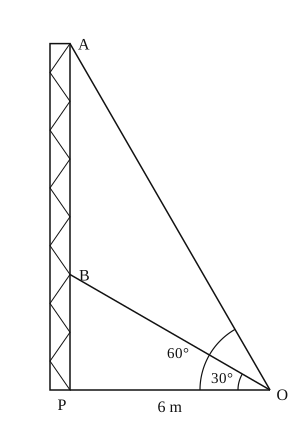
Radio towers are used for transmitting a range of communication services including radio and television. The tower will either act as an antenna itself or support one or more antennas on its structure. On a similar concept, a radio station tower was built in two sections 'A' and 'B'. Tower is supported by wires from a point 'O' (as shown in figure). Distance between the base of the tower and point 'O' is 6 m. From point 'O', the angle of elevation of the top of the section 'B' is 30∘ and the angle of elevation of the top of section 'A' is 60∘. Based on the above information, answer the following questions : (i) Find the length of the wire from the point 'O' to the top of section 'B'. (1) (ii) Find the length of the wire from the point 'O' to the top of section 'A'. (1) (iii) (a) Find the distance AB. (2) OR (iii) (b) Find the area of △OPB. (2)
Show answer & solution
Answer: (i) 43 m (ii) 12 m (iii) (a) 43 m OR (b) 63 m2
P is the base of the tower, OP=6 m, ∠BOP=30∘, ∠AOP=60∘, ∠OPA=90∘.
(i) cos30∘=OBOP, so OB=3/26=312=43 m.
(ii) cos60∘=OAOP, so OA=1/26=12 m.
(iii) (a) AP=6tan60∘=63 m and BP=6tan30∘=36=23 m.
AB=63−23=43 m.
(iii) (b) Area of △OPB=21×OP×BP=21×6×23=63 m2.
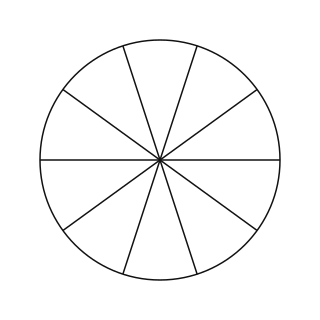
A brooch is crafted from silver wire in the shape of a circle with a diameter of 35 cm. The wire is also used to create 5 diameters, dividing the circle into 10 equal sectors as shown in figure. Based on the above information, answer the following questions : (i) What is the radius of circle ? (1) (ii) What is the circumference of the brooch ? (1) (iii) (a) What is the total length of silver wire required ? (2) OR (iii) (b) What is the area of each sector of the brooch ? (2)
Show answer & solution
Answer: (i) 17.5 cm (ii) 110 cm (iii) (a) 285 cm OR (b) 96.25 cm2
(i) Radius =235=17.5 cm.
(ii) Circumference =πd=722×35=110 cm.
(iii) (a) Wire = circumference + 5 diameters =110+5×35=285 cm.
(iii) (b) Each sector has central angle 36∘, i.e. 101 of the circle.
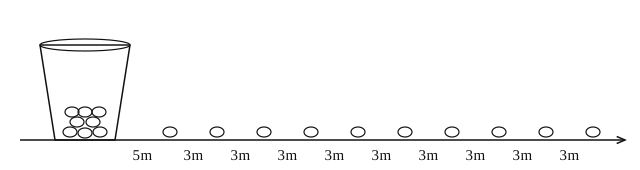
In a potato race, a bucket is placed at the starting point, which is 5 m from the first potato. The other potatoes are arranged 3 m apart in a straight line, with a total of 10 potatoes, as shown in the figure : A competitor starts from the bucket, picks up the nearest potato, runs back to the bucket to drop it in, then returns to pick up the next potato. This process continues until all the potatoes are in the bucket. Based on the above information, answer the following questions : (i) What is the distance covered to pick up the first potato and drop it in bucket ? (1) (ii) What is the distance covered to pick up the second potato and drop it in bucket ? (1) (iii) (a) What is the total distance the competitor has to run ? (2) OR (iii) (b) If average speed of competitor is 5 m/s, then find the average time taken by competitor to put all the potatoes in the bucket. (2)
Show answer & solution
Answer: (i) 10 m (ii) 16 m (iii) (a) 370 m OR (b) 74 s
The potatoes are 5 m, 8 m, 11 m, ..., from the bucket; the 10th is 5+9×3=32 m away.
(i) Distance = 2×5=10 m.
(ii) Distance = 2×8=16 m.
The round-trip distances 10, 16, 22, ... form an AP with a=10, d=6, n=10.