CBSE Class 10 Maths Standard 2024 Question Paper 30/3/1 with Solutions
All 44 questions from the CBSE Class 10 Mathematics Standard board paper, Set 30/3/1 (2024),
with answers and step-by-step solutions. Total 80 marks. Tap “Show answer & solution” under any question.
The probability of guessing the correct answer to a certain test question is 6x. If the probability of not guessing the correct answer to this question is 32, then the value of x is :
From a point on the ground, which is 30 m away from the foot of a vertical tower, the angle of elevation of the top of the tower is found to be 60∘. The height (in metres) of the tower is :
The mean of five observations is 15. If the mean of first three observations is 14 and that of the last three observations is 17, then the third observation is
(A)20
(B)19
(C)18
(D)17
Show answer & solution
Answer: (C) 18
Sum of all five = 5×15=75.
Sum of first three = 3×14=42; sum of last three = 3×17=51.
The third observation is counted in both: 42 + 51 = 75 + third observation.
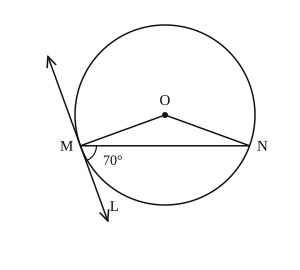
In the given figure, O is the centre of the circle. MN is the chord and the tangent ML at point M makes an angle of 70∘ with MN. The measure of ∠MON is :
Assertion (A) : The point which divides the line segment joining the points A (1, 2) and B(−1, 1) internally in the ratio 1 : 2 is (3−1,35) Reason (R) : The coordinates of the point which divides the line segment joining the points A (x1, y1) and B(x2, y2) in the ratio m1:m2 are (m1+m2m1x2+m2x1,m1+m2m1y2+m2y1)
(A)Both Assertion (A) and Reason (R) are true and Reason (R) is the correct explanation of the Assertion (A).
(B)Both Assertion (A) and Reason (R) are true, but Reason (R) is not the correct explanation of the Assertion (A).
(C)Assertion (A) is true, but Reason (R) is false.
(D)Assertion (A) is false, but Reason (R) is true.
Show answer & solution
Answer: (D) Assertion (A) is false, but Reason (R) is true.
Reason is the section formula, so R is true.
Using it with m1:m2=1:2: x=31(−1)+2(1)=31, y=31(1)+2(2)=35.
The point is (31,35), not (3−1,35), so A is false.
Assertion (A) : In a cricket match, a batsman hits a boundary 9 times out of 45 balls he plays. The probability that in a given ball, he does not hit the boundary is 54. Reason (R) : P(E) + P(not E) = 1
(A)Both Assertion (A) and Reason (R) are true and Reason (R) is the correct explanation of the Assertion (A).
(B)Both Assertion (A) and Reason (R) are true, but Reason (R) is not the correct explanation of the Assertion (A).
(C)Assertion (A) is true, but Reason (R) is false.
(D)Assertion (A) is false, but Reason (R) is true.
Show answer & solution
Answer: (A) Both Assertion (A) and Reason (R) are true and Reason (R) is the correct explanation of the Assertion (A).
P(boundary) = 459=51.
P(no boundary) = 1−51=54, so A is true.
R is true, and it is exactly the rule used to get A, so R explains A.
One card is drawn at random from a well shuffled deck of 52 cards. Find the probability that the card drawn (i) is queen of hearts; (ii) is not a jack.
Show answer & solution
Answer: (i) 521 (ii) 1312
Total outcomes = 52.
(i) There is 1 queen of hearts, so P = 521.
(ii) There are 4 jacks, so 48 cards are not jacks. P = 5248=1312.
Points A(−1, y) and B(5, 7) lie on a circle with centre O(2, −3y) such that AB is a diameter of the circle. Find the value of y. Also, find the radius of the circle.
The ratio of the 10th term to its 30th term of an A.P. is 1 : 3 and the sum of its first six terms is 42. Find the first term and the common difference of A.P.
In a flight of 2800 km, an aircraft was slowed down due to bad weather. Its average speed is reduced by 100 km/h and by doing so, the time of flight is increased by 30 minutes. Find the original duration of the flight.
Show answer & solution
Answer:321 hours (3 h 30 min)
Let the original speed be x km/h.
x−1002800−x2800=21.
2800×x(x−100)100=21⇒x2−100x−560000=0.
(x−800)(x+700)=0⇒x=800 (speed cannot be negative).
Original duration = 8002800=3.5 hours = 3 hours 30 minutes.
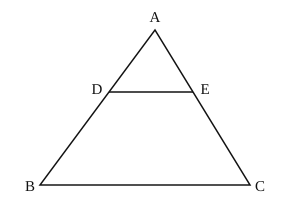
Statement: If a line is drawn parallel to one side of a triangle to intersect the other two sides in distinct points, the other two sides are divided in the same ratio.
Given: In △ABC, DE ∥ BC, with D on AB and E on AC. To prove: DBAD=ECAE.
Construction: Join BE and CD; draw EM ⊥ AB and DN ⊥ AC.
ar(ADE) = 21×AD×EM and ar(BDE) = 21×DB×EM, so ar(BDE)ar(ADE)=DBAD.
ar(ADE) = 21×AE×DN and ar(DEC) = 21×EC×DN, so ar(DEC)ar(ADE)=ECAE.
Triangles BDE and DEC are on the same base DE and between the same parallels DE and BC, so ar(BDE) = ar(DEC).
From a point on the ground, the angles of elevation of the bottom and the top of a transmission tower fixed at the top of a 20 m high building are 45∘ and 60∘ respectively. Find the height of the tower.
Show answer & solution
Answer:20(3−1) m ≈14.64 m
Let the point be P, the foot of the building B, its top C (BC = 20 m), and the top of the tower D (CD = h).
A solid iron pole consists of a solid cylinder of height 200 cm and base diameter 28 cm, which is surmounted by another cylinder of height 50 cm and radius 7 cm. Find the mass of the pole, given that 1 cm3 of iron has approximately 8 g mass.
Show answer & solution
Answer: 1047200 g = 1047.2 kg
Lower cylinder: r=14 cm, h=200 cm; volume = 722×142×200=123200 cm3.
Upper cylinder: r=7 cm, h=50 cm; volume = 722×72×50=7700 cm3.
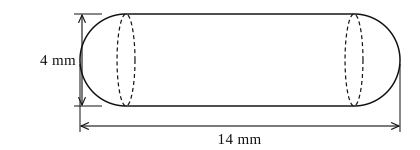
A medicine capsule is in the shape of a cylinder with two hemispheres stuck to each of its ends. The length of the entire capsule is 14 mm and the diameter of the capsule is 4 mm, find its surface area. Also, find its volume.
Show answer & solution
Answer: Surface area = 176 mm2; volume = 213344≈159.24 mm3
Radius r=2 mm; length of the cylindrical part = 14−2−2=10 mm.
Surface area = 2πrh+2×2πr2=2π(2)(10)+4π(2)2=40π+16π=56π.
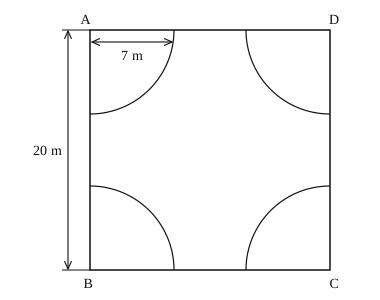
A stable owner has four horses. He usually tie these horses with 7 m long rope to pegs at each corner of a square shaped grass field of 20 m length, to graze in his farm. But tying with rope sometimes results in injuries to his horses, so he decided to build fence around the area so that each horse can graze. Based on the above, answer the following questions : (i) Find the area of the square shaped grass field. (1) (ii) Find the area of the total field in which these horses can graze. (2) OR If the length of the rope of each horse is increased from 7 m to 10 m, find the area grazed by one horse. (Use π = 3.14) (2) (iii) What is area of the field that is left ungrazed, if the length of the rope of each horse is 7 cm ? (1)
Show answer & solution
Answer: (i) 400 m2 (ii) 154 m2; OR 78.5 m2 (iii) 399.9846 m2 as printed (7 cm); 246 m2 if the rope is 7 m
(i) Area of the square = 20×20=400 m2.
(ii) Each horse grazes a quadrant of radius 7 m; four quadrants make one full circle: 722×72=154 m2.
OR: Area grazed by one horse = 41×3.14×102=78.5 m2.
(iii) With a 7 cm = 0.07 m rope, grazed area = 722×0.072=0.0154 m2, so ungrazed area = 400−0.0154=399.9846 m2.
If the rope is 7 m (as in the passage), ungrazed area = 400−154=246 m2.
Vocational training complements traditional education by providing practical skills and hands-on experience. While education equips individuals with a broad knowledge base, vocational training focuses on job-specific skills, enhancing employability thus making the student self-reliant. Keeping this in view, a teacher made the following table giving the frequency distribution of students/adults undergoing vocational training from the training institute. Age (in years): 15-19, 20-24, 25-29, 30-34, 35-39, 40-44, 45-49, 50-54 Number of participants: 62, 132, 96, 37, 13, 11, 10, 4 From the above answer the following questions : (i) What is the lower limit of the modal class of the above data ? (1) (ii) Find the median class of the above data. (2) OR Find the number of participants of age less than 50 years who undergo vocational training. (2) (iii) Give the empirical relationship between mean, median and mode. (1)
Show answer & solution
Answer: (i) 19.5 (modal class 20-24, i.e. 19.5-24.5) (ii) 20-24 (19.5-24.5); OR 361 (iii) 3 Median = Mode + 2 Mean
(i) Highest frequency is 132, so the modal class is 20-24. Making the classes continuous (subtract 0.5 / add 0.5), it is 19.5-24.5, with lower limit 19.5.
(ii) N = 62 + 132 + 96 + 37 + 13 + 11 + 10 + 4 = 365, so N/2 = 182.5.
Teaching Mathematics through activities is a powerful approach that enhances students’ understanding and engagement. Keeping this in mind, Ms. Mukta planned a prime number game for class 5 students. She announces the number 2 in her class and asked the first student to multiply it by a prime number and then pass it to second student. Second student also multiplied it by a prime number and passed it to third student. In this way by multiplying to a prime number, the last student got 173250. Now, Mukta asked some questions as given below to the students : (i) What is the least prime number used by students ? (1) (ii) How many students are in the class ? (2) OR What is the highest prime number used by students ? (2) (iii) Which prime number has been used maximum times ? (1)
Show answer & solution
Answer: (i) 3 (ii) 7; OR 11 (iii) 5
173250=2×86625=2×32×53×7×11.
The teacher's 2 accounts for the factor 2; the students multiplied by 3,3,5,5,5,7,11.
(i) Least prime used by students = 3.
(ii) Number of primes used = 2 + 3 + 1 + 1 = 7, so there are 7 students.
OR: Highest prime used = 11.
(iii) 5 is used the maximum number of times (three times).