CBSE Class 10 Maths Basic 2025 Question Paper 430/2/3 with Solutions
All 44 questions from the CBSE Class 10 Mathematics Basic board paper, Set 430/2/3 (2025),
with answers and step-by-step solutions. Total 80 marks. Tap “Show answer & solution” under any question.
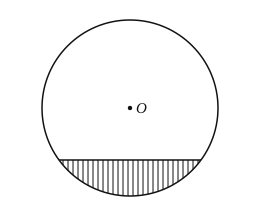
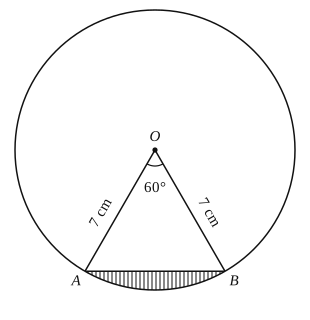
The area of a smaller circle is equal to the area of a sector of a larger circle with central angle 120∘. The radii of the smaller and larger circles are ‘r’ and ‘R’ respectively. Find r : R.
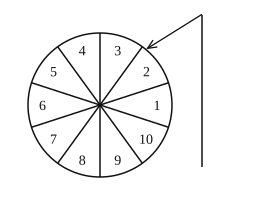
A game of chance consists of spinning a wheel which comes to rest at one of the numbers from 1 to 10 (as shown in the given figure) with equal probabilities. What is the probability that the wheel stops at (i) a prime number greater than 2 ? (ii) an odd number less than 9 ? (iii) a multiple of 4 ?
Show answer & solution
Answer: (i) 103 (ii) 52 (iii) 51
Total equally likely outcomes = 10.
(i) Primes greater than 2: 3, 5, 7. P =103.
(ii) Odd numbers less than 9: 1, 3, 5, 7. P =104=52.
State the “Fundamental Theorem of Arithmetic” and use it to find LCM of 36 and 54.
Show answer & solution
Answer: LCM = 108
Fundamental Theorem of Arithmetic: every composite number can be expressed (factorised) as a product of primes, and this factorisation is unique, apart from the order in which the prime factors occur.
36=22×32 and 54=2×33.
LCM = product of the greatest power of each prime factor =22×33=4×27=108.
Solve graphically the following pair of linear equations : 2x−y=2 and 4x−y=4 Also, write the coordinates of the points where the lines represented by these equations cut the y-axis.
Show answer & solution
Answer: Solution x=1, y=0; the lines cut the y-axis at (0, −2) and (0, −4).
2x−y=2⇒y=2x−2: points (0, −2), (1, 0), (2, 2).
4x−y=4⇒y=4x−4: points (0, −4), (1, 0), (2, 4).
Plot both lines; they intersect at (1, 0), so x=1, y=0.
Put x=0: the first line cuts the y-axis at (0, −2) and the second at (0, −4).
An academy offering cricket coaching bought 10 bats and 5 balls for ₹ 32,500. Later, the academy bought 2 bats and 8 balls for ₹ 10,000. If there is no change in the cost of the bat and of the ball, find the cost of 1 bat and 1 ball.
Show answer & solution
Answer: Cost of 1 bat = ₹ 3,000; cost of 1 ball = ₹ 500
Let a bat cost ₹ x and a ball ₹ y.
10x+5y=32500⇒2x+y=6500 ...(1)
2x+8y=10000⇒x+4y=5000 ...(2)
From (1), y=6500−2x. Substitute in (2): x+26000−8x=5000⇒7x=21000⇒x=3000.
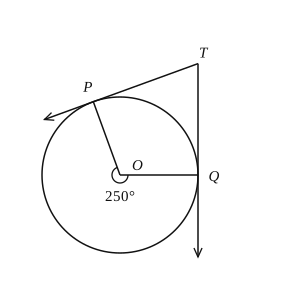
In the given figure, TP and TQ are tangents at points P and Q of the circle respectively. If reflex ∠POQ=250∘, find the measure of each angle of quadrilateral POQT.
Show answer & solution
Answer:∠POQ=110∘, ∠OPT=90∘, ∠OQT=90∘, ∠PTQ=70∘
∠POQ=360∘−250∘=110∘.
A tangent is perpendicular to the radius at the point of contact, so ∠OPT=∠OQT=90∘.
Sum of angles of quadrilateral POQT is 360∘: ∠PTQ=360∘−110∘−90∘−90∘=70∘.
The lengths of 40 leaves of a plant are measured, correct to the nearest millimetre and data obtained is represented in the following table : Length in (mm): 100–120, 120–140, 140–160, 160–180, 180–200 Number of leaves: 8, 9, 12, 5, 6 Find the median length (in mm) of the leaves.
A class teacher has the following absentees record of 30 students of a class. Number of days: 0–4, 4–8, 8–12, 12–16, 16–20, 20–24 Number of Absent students: 1, 8, x, 6, 5, y If the mean number of days a student was absent is 12, find the values of x and y.
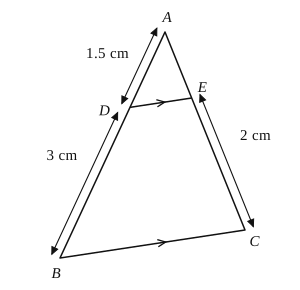
Statement: if a line is drawn parallel to one side of a triangle to intersect the other two sides in distinct points, the other two sides are divided in the same ratio.
Given: in △ABC, DE ∥ BC with D on AB and E on AC. To prove: DBAD=ECAE.
Construction: join BE and CD; draw EN ⊥ AB and DM ⊥ AC.
ar(ADE) =21AD⋅EN and ar(BDE) =21DB⋅EN, so ar(BDE)ar(ADE)=DBAD.
ar(ADE) =21AE⋅DM and ar(DEC) =21EC⋅DM, so ar(DEC)ar(ADE)=ECAE.
△BDE and △DEC are on the same base DE and between the same parallels DE and BC, so ar(BDE) = ar(DEC).
A spherical glass vessel has a cylindrical neck which is 7 cm long and 2 cm in diameter. The diameter of the spherical part is 14 cm. Find the capacity of the entire glass vessel. (Use π=722)
Show answer & solution
Answer:34378 cm3 (about 1459.33 cm3)
Sphere: radius R = 7 cm. Volume =34×722×73=34×22×49=34312 cm3.
Neck (cylinder): radius r = 1 cm, h = 7 cm. Volume =722×12×7=22 cm3.
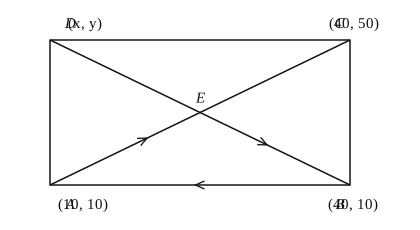
A field is in the form of a rectangle. The coordinates of the rectangular field ABCD are A(10, 10), B(40, 10), C(40, 50) and D(x, y). Anil and Anita, two friends decided to have a race. Anita started from point A and moved to point E along the diagonal AC, where E is the point of intersection of both the diagonals of ABCD. From point E, she moved to point B along the other diagonal DB and then moved back to point A along BA. While Anil started from point C and ran to point A via D along the boundary of the field. Based on the above information, answer the following questions : (i) Find the coordinates of point E. (1) (ii) Find the distance between the points B and C. (1) (iii) (a) Find the coordinates of point D and the distance BD. (2) OR (b) Find the total distance travelled by Anita. (2)
Show answer & solution
Answer: (i) E(25, 30) (ii) 40 units (iii) (a) D(10, 50), BD = 50 units OR (b) 80 units
(i) E is the mid-point of AC: E=(210+40,210+50)=(25,30).
(ii) BC =(40−40)2+(50−10)2=40 units.
(iii) (a) ABCD is a rectangle with AB horizontal and BC vertical, so D = (10, 50).
BD =(10−40)2+(50−10)2=900+1600=50 units.
OR (b) AC =302+402=50, so AE =25; diagonals of a rectangle are equal and bisect each other, so EB =25; BA =40−10=30.
Kite festival is a popular festival in India which takes place during Makar Sankranti. The festival is celebrated by people flying kites from their rooftops. Reena and Ravi are also flying kites to enjoy the festival. The height of Reena’s kite is 60 m above the ground. The string attached to the kite is temporarily tied to a point on the ground, and the inclination of the string with the ground is 30∘. Ravi is flying a kite from a 10 m high building. His kite is also flying 60 m above the ground and the length of the string used by Ravi is same as that of Reena’s. θ is the angle of elevation of Ravi’s kite from a point on the rooftop. Based on the above information, answer the following questions : (i) Find the length of string used by Reena. (1) (ii) Find the value of sinθ. (1) (iii) (a) If θ changes to 60∘, without changing the length of the string, what will be the height of Ravi’s kite above the ground ? (Use 3=1.7) (2) OR (b) What would have been the height of Ravi’s kite above the ground, if the string had an inclination of 30∘ with the ground, assuming that the length of the string does not change ? (2)
Show answer & solution
Answer: (i) 120 m (ii) sinθ=125 (iii) (a) 112 m OR (b) 70 m
(i) For Reena: sin30∘=L60⇒21=L60⇒L=120 m.
(ii) Ravi’s kite is 60−10=50 m above the rooftop and his string is 120 m long, so sinθ=12050=125.
(iii) (a) With θ=60∘: height above rooftop =120sin60∘=120×23=603=60×1.7=102 m.
Height above ground =102+10=112 m.
OR (b) With inclination 30∘: height above rooftop =120sin30∘=60 m.
A woman borrowed ₹ 10,00,000 from her friend and promised to return the borrowed money in monthly instalments beginning from the next month. After one month, she returned ₹ 10,000, the next month she returned ₹ 15,000, the third month she returned ₹ 20,000 and so on, thereby increasing the monthly instalment uniformly. Based on the above information, answer the following questions : (i) Find the amount of instalment paid in the tenth month. (1) (ii) In which instalment did she pay ₹ 40,000 ? (1) (iii) (a) If she returned ₹ 11,50,000 in all, how many instalments did she pay ? (2) OR (b) By which instalment has she returned a total amount of ₹ 3,25,000 ? (2)
Show answer & solution
Answer: (i) ₹ 55,000 (ii) 7th instalment (iii) (a) 20 instalments OR (b) by the 10th instalment
Instalments form an AP with a=10000, d=5000.
(i) a10=10000+9×5000=55000, i.e. ₹ 55,000.
(ii) 10000+(n−1)5000=40000⇒n−1=6⇒n=7: the 7th instalment.
(iii) (a) Sn=2n[20000+(n−1)5000]=1150000.
n(15000+5000n)=2300000⇒n2+3n−460=0⇒(n+23)(n−20)=0, so n=20 instalments.
OR (b) 2n[20000+(n−1)5000]=325000⇒n(15000+5000n)=650000.
n2+3n−130=0⇒(n+13)(n−10)=0, so n=10: by the 10th instalment.