CBSE Class 10 Maths Basic 2025 Question Paper 430/5/3 with Solutions
All 44 questions from the CBSE Class 10 Mathematics Basic board paper, Set 430/5/3 (2025),
with answers and step-by-step solutions. Total 80 marks. Tap “Show answer & solution” under any question.
A black card is lost from a deck of 52 playing cards. Rest of the cards are shuffled and one card is drawn at random from the available cards. The probability that drawn card is 'king of hearts', is
(A)521
(B)41
(C)511
(D)261
Show answer & solution
Answer: (C) 511
51 cards remain.
The king of hearts is a red card, so it is still in the deck.
Assertion (A) : When a hemisphere of same radius (r) is carved out from one side of a solid wooden cylinder, the total surface area of remaining solid is increased by 2πr2. Reason (R) : Curved surface area of hemisphere is 2πr2.
(A)Both Assertion (A) and Reason (R) are true and Reason (R) is the correct explanation of the Assertion (A).
(B)Both Assertion (A) and Reason (R) are true, but Reason (R) is not the correct explanation of the Assertion (A).
(C)Assertion (A) is true, but Reason (R) is false.
(D)Assertion (A) is false, but Reason (R) is true.
Show answer & solution
Answer: (D) Assertion (A) is false, but Reason (R) is true.
Carving out removes one circular face of area πr2 and adds the hemisphere's curved surface 2πr2.
Net increase =2πr2−πr2=πr2, not 2πr2, so A is false.
A bag contains 40 marbles out of which some are white and others are black. If the probability of drawing a black marble is 53, then find the number of white marbles.
In a pre-primary class, a teacher put cards numbered 20 to 59 in a bowl. A student picked up a card at random and read the number. Find the probability that the number read was (i) a prime number (ii) a perfect square.
Show answer & solution
Answer: (i) 409 (ii) 403
Total cards =59−20+1=40.
(i) Primes: 23, 29, 31, 37, 41, 43, 47, 53, 59, i.e. 9 cards. P =409.
(ii) Perfect squares: 25, 36, 49, i.e. 3 cards. P =403.
The traffic lights at three different road crossings change after every 45 seconds, 75 seconds and 60 seconds respectively. If they change together at 5.00 a.m., then at what time they will change together next ?
From each end of a solid cylinder of height 20 cm and base radius 7 cm, a cone of base radius 2.1 cm and height 5 cm is scooped out. Find the volume of the remaining solid.
The following table shows the ages of patients admitted in a hospital during a year : Age (in years): 5-15, 15-25, 25-35, 35-45, 45-55, 55-65 Number of Patients: 7, 10, 21, 22, 15, 5 Find 'mode' and 'median' of the above data.
Show answer & solution
Answer: Mode = 36.25 years; Median ≈35.91 years
Modal class 35-45: l=35, f1=22, f0=21, f2=15, h=10.
A statue 3 m tall, stands on the top of a pedestal. From a point on the ground, the angle of elevation of the top of the statue is 60∘ and from the same point the angle of elevation of the top of the pedestal is 30∘. Find the height of the pedestal and its distance from the point of observation on ground. (Use 3 = 1.73)
Show answer & solution
Answer: Height of pedestal = 1.5 m; distance = 233 m = 2.595 m
Let the height of the pedestal be h m and its distance from the point of observation be d m.
If a line is drawn parallel to one side of a triangle to intersect the other two sides in distinct points, then prove that the other two sides are divided in the same ratio.
Show answer & solution
Answer: Proved.
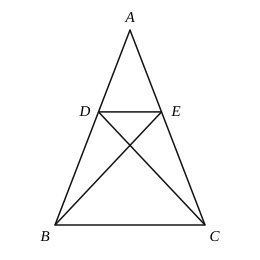
Given: In △ABC, DE ∥ BC with D on AB and E on AC. To prove: DBAD=ECAE.
Construction: join BE and CD; draw EM ⊥ AB and DN ⊥ AC.
ar(ADE) =21×AD×EM and ar(BDE) =21×DB×EM, so ar(BDE)ar(ADE)=DBAD.
ar(ADE) =21×AE×DN and ar(DEC) =21×EC×DN, so ar(DEC)ar(ADE)=ECAE.
△BDE and △DEC are on the same base DE and between the same parallels DE and BC, so ar(BDE) = ar(DEC).
It is given that sides AB and AC and median AD of △ABC are respectively proportional to sides PQ and PR and median PM of another △PQR. Show that △ABC∼△PQR.
Show answer & solution
Answer: Proved.
Given PQAB=PRAC=PMAD.
Produce AD to E with DE = AD and PM to N with MN = PM; join CE and RN.
△ABD≅△ECD (BD = DC, AD = DE, vertically opposite angles), so CE = AB and ∠BAD=∠CED.
Similarly RN = PQ and ∠QPM=∠RNM.
Now RNCE=PQAB=PRAC=PMAD=2PM2AD=PNAE.
So △AEC∼△PNR (SSS), giving ∠CAE=∠RPN and ∠CEA=∠RNP.
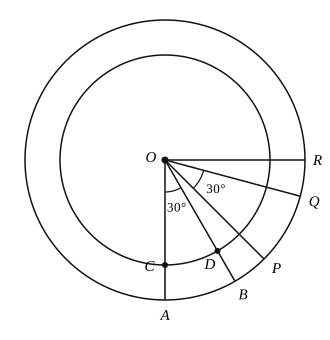
A farmer has put up a decorative windmill in his farm in which there are eight blades of equal width and equally placed in a circular arrangement. A circular wire goes through them. The diagram shows two blades OAB and OPQ in a quarter circle with centre O. ∠AOB=∠POQ=30∘, OA = 28 cm, OC = 21 cm. O is the centre of both the circles. (i) Determine the measure of ∠BOP. (1) (ii) Find length of arc CD. (1) (iii) (a) Find the area of region CABD. (2) OR (iii) (b) Find perimeter of region CABD. (2)
Show answer & solution
Answer: (i) 15∘ (ii) 11 cm (iii) (a) 6539 cm2≈89.83 cm2 OR (b) 3119 cm ≈39.67 cm
(i) The quarter circle AOR is 90∘; the two blades take 30∘+30∘=60∘. The blades are equally placed, so the remaining 30∘ is shared equally by ∠BOP and ∠QOR: ∠BOP=15∘ (check: 8 blades of 30∘ and 8 equal gaps of 15∘ make 360∘).
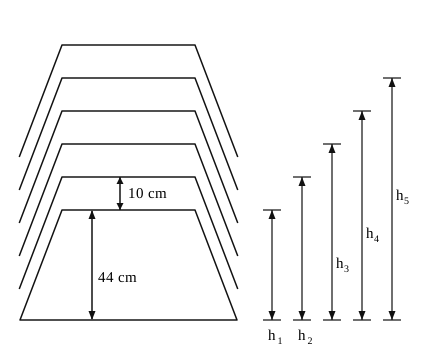
A tent house owner provides furniture on rent. He stacks chairs in his shop to save space. In the diagram, the height of seat of chair from ground is represented by h1, h2, h3, .... The height of first seat is 44 cm from ground level and gap between every two seats is 10 cm. (i) Write the values of h1, h2, h3, h4 and h5 in this order only. (1) (ii) Show that the above values form an A.P. Write its first term and common difference. (1) (iii) (a) If chairs can be stacked up to the maximum height of 160 cm, then find the maximum number of chairs in a stack. (2) OR (iii) (b) Is it possible to stack 15 chairs if maximum height of the stack can not be more than 180 cm ? Justify your answer. (2)
Show answer & solution
Answer: (i) 44, 54, 64, 74, 84 (cm) (ii) Yes, the common difference is constant (10 cm); first term = 44, common difference = 10 (iii) (a) 12 chairs OR (b) No, h15=184 cm > 180 cm
(i) h1=44, h2=54, h3=64, h4=74, h5=84 (in cm).
(ii) Each term exceeds the previous one by 10, a constant, so they form an A.P. with a=44, d=10.
(iii) (a) hn=44+(n−1)×10≤160 gives n−1≤11.6, so n≤12.6.
Maximum number of chairs =12 (seat height 154 cm; the 13th would be at 164 cm).
(iii) (b) h15=44+14×10=184 cm, which is more than 180 cm.
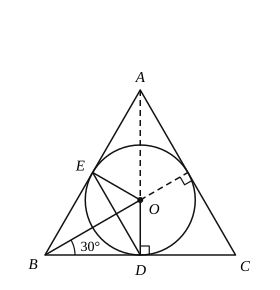
In a Fine Arts class, students were asked to design triangular tiles in geometric pattern. Neelima made a circular design inside an equilateral triangle ABC. The radius of the circle is 4 cm. Observe the diagram and answer the following questions : (i) Determine the length OB. (1) (ii) Is DE ∥ CA ? Give reason for your answer. (1) (iii) (a) Write all angles of quadrilateral OEBD and show that it is a cyclic quadrilateral. (2) OR (iii) (b) Find the perimeter of △ABC. (Use 3=1.73) (2)
Show answer & solution
Answer: (i) OB = 8 cm (ii) Yes, D and E are mid-points of BC and AB (iii) (a) ∠OEB=90∘, ∠EBD=60∘, ∠BDO=90∘, ∠DOE=120∘; cyclic since ∠E+∠D=180∘ OR (b) 243 cm = 41.52 cm
The circle touches BC at D and AB at E, so OD ⊥ BC, OE ⊥ AB and OD = OE = 4 cm.
(i) In right △ODB, ∠OBD=30∘: sin30∘=OBOD, so OB =1/24=8 cm.
(ii) Tangents from a point are equal: BD = BE, CD = CF, AE = AF (F the point of contact on CA). As AB = BC = CA, each tangent length is half a side, so D and E are mid-points of BC and BA.
By the mid-point theorem, DE ∥ CA. Yes.
(iii) (a) ∠OEB=90∘, ∠BDO=90∘, ∠EBD=60∘ (angle of equilateral triangle), ∠DOE=360∘−90∘−90∘−60∘=120∘.
∠OEB+∠ODB=180∘ (also ∠EBD+∠DOE=180∘): opposite angles are supplementary, so OEBD is cyclic.
(iii) (b) tan30∘=BDOD, so BD =43 cm and BC =2×BD=83 cm.