CBSE Class 10 Maths Basic 2025 Question Paper 430/1/1 with Solutions
All 44 questions from the CBSE Class 10 Mathematics Basic board paper, Set 430/1/1 (2025),
with answers and step-by-step solutions. Total 80 marks. Tap “Show answer & solution” under any question.
The class mark of the median class of the following data is : Class Interval: 10 – 25, 25 – 40, 40 – 55, 55 – 70, 70 – 85, 85 – 100 Frequency: 2, 3, 7, 6, 6, 6
(A)40
(B)55
(C)47.5
(D)62.5
Show answer & solution
Answer: (D) 62.5
n=30, so 2n=15.
Cumulative frequencies: 2, 5, 12, 18, 24, 30.
15 lies in the class 55 – 70, which is the median class.
The following distribution shows the number of runs scored by some batsmen in test matches : Runs Scored: 3000 – 4000, 4000 – 5000, 5000 – 6000, 6000 – 7000 Number of Batsmen: 5, 10, 9, 8 The lower limit of the modal class is :
(A)3000
(B)4000
(C)5000
(D)6000
Show answer & solution
Answer: (B) 4000
The highest frequency is 10, for the class 4000 – 5000.
So the modal class is 4000 – 5000 and its lower limit is 4000.
Assertion (A) : For any two natural numbers a and b, the HCF of a and b is a factor of the LCM of a and b. Reason (R) : HCF of any two natural numbers divides both the numbers.
(A)Both Assertion (A) and Reason (R) are true and Reason (R) is the correct explanation of Assertion (A).
(B)Both Assertion (A) and Reason (R) are true, but Reason (R) is not the correct explanation of Assertion (A).
(C)Assertion (A) is true, but Reason (R) is false.
(D)Assertion (A) is false, but Reason (R) is true.
Show answer & solution
Answer: (A) Both Assertion (A) and Reason (R) are true and Reason (R) is the correct explanation of Assertion (A).
R is true: the HCF is a common factor, so it divides both numbers.
The HCF divides a, and a divides the LCM, so the HCF divides the LCM. A is true.
This follows directly from R, so R correctly explains A.
Assertion (A) : The value of p for which the system of equations 4x+py+8=0 and 2x+2y+2=0 is consistent is 4. Reason (R) : The system of equations a1x+b1y=c1 and a2x+b2y=c2 is consistent with infinitely many solutions, if a2a1=b2b1=c2c1.
(A)Both Assertion (A) and Reason (R) are true and Reason (R) is the correct explanation of Assertion (A).
(B)Both Assertion (A) and Reason (R) are true, but Reason (R) is not the correct explanation of Assertion (A).
(C)Assertion (A) is true, but Reason (R) is false.
(D)Assertion (A) is false, but Reason (R) is true.
Show answer & solution
Answer: (D) Assertion (A) is false, but Reason (R) is true.
For p=4: a2a1=24=2, b2b1=24=2, c2c1=28=4.
Since a2a1=b2b1=c2c1, the lines are parallel and the system is inconsistent. So A is false.
R is the standard condition for infinitely many solutions, so R is true.
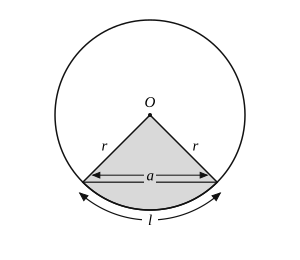
A chord of a circle of diameter 20 cm subtends an angle of 60∘ at the centre of the circle. Find the area of the corresponding minor segment of the circle. (Use π=3.14 and 3=1.73)
Show answer & solution
Answer: 9.08 cm² (approx.)
Radius r=10 cm.
Area of sector =36060×3.14×100=52.33 cm².
The triangle formed is equilateral (two sides 10 cm, included angle 60∘): area =43×100=41.73×100=43.25 cm².
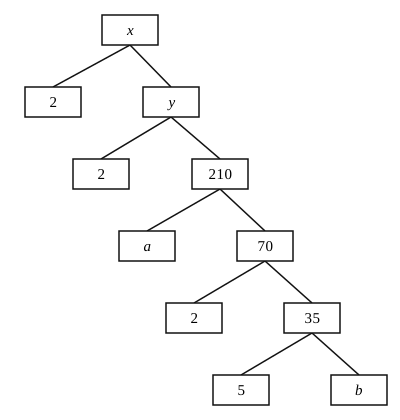
The factor tree of a number x is shown below : Find the values of x, y, a and b. Hence, write the product of the prime factors of the number x so obtained.
A lot consists of 200 pens of which 180 are good and the rest are defective. A customer will buy a pen if it is not defective. The shopkeeper draws a pen at random and gives it to the customer. What is the probability that the customer will not buy it ? Another lot of 100 pens containing 80 good pens is mixed with the previous lot of 200 pens. The shopkeeper now draws one pen at random from the entire lot and gives it to the customer. What is the probability that the customer will buy the pen ?
Show answer & solution
Answer:101; 1513
Defective pens in the first lot =200−180=20.
P(customer will not buy) =20020=101.
After mixing: total pens =300, good pens =180+80=260.
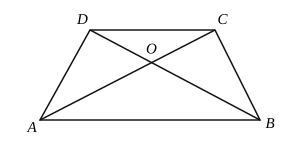
State “Basic Proportionality Theorem” and use it to prove the following : In a quadrilateral ABCD, diagonals AC and BD intersect each other at O such that BOAO=DOCO as shown in the given figure. Prove that ABCD is a trapezium.
Show answer & solution
Answer: Proved.
BPT: if a line is drawn parallel to one side of a triangle to intersect the other two sides in distinct points, it divides those two sides in the same ratio.
Proof of BPT: in △ABC let DE ∥ BC meet AB at D and AC at E. Join BE and CD and draw DM ⊥ AC, EN ⊥ AB.
ar(ADE) =21AD⋅EN and ar(BDE) =21DB⋅EN, so ar(BDE)ar(ADE)=DBAD; similarly ar(DEC)ar(ADE)=ECAE.
Triangles BDE and DEC are on the same base DE between the same parallels, so ar(BDE) = ar(DEC). Hence DBAD=ECAE.
Now in ABCD, draw OE ∥ AB meeting AD at E.
In △ABD, OE ∥ AB, so by BPT EDAE=ODBO.
Given BOAO=DOCO, i.e. COAO=DOBO. So EDAE=OCAO.
In △ADC, E and O divide AD and AC in the same ratio, so OE ∥ DC (converse of BPT).
Thus AB ∥ OE ∥ DC, so AB ∥ DC and ABCD is a trapezium.
A toy is in the form of a cone surmounted on a hemisphere. The cone and hemisphere have the same radii. The height of the conical part of the toy is equal to the diameter of its base. If the radius of the conical part is 5 cm, find the volume of the toy.
A cubical block is surmounted by a hemisphere of radius 3.5 cm. What is the smallest possible length of the edge of the cube so that the hemisphere can totally lie on the cube ? Find the total surface area of the solid so formed.
Show answer & solution
Answer: Edge = 7 cm; total surface area = 332.5 cm²
The base of the hemisphere (diameter 7 cm) must fit on a face, so the smallest edge is 7 cm.
TSA = surface of cube − base of hemisphere + CSA of hemisphere =6a2−πr2+2πr2=6a2+πr2.
The following data gives the information on the observed lifetime (in hours) of 200 electrical components : Lifetime (in hours): 0 – 20, 20 – 40, 40 – 60, 60 – 80, 80 – 100, 100 – 120 Number of electrical components: 10, 35, 50, 60, 30, 15 Find the mean lifetime (in hours) of the electrical components.
An injured bird was found on the roof of a building. The building is 15 m high. A fireman was called to rescue the bird. The fireman used an adjustable ladder to reach the roof. He placed the ladder in such a way that the ladder makes an angle of 60∘ with the ground in order to reach the roof. Based on the above information, answer the following questions : (i) Find the length of the ladder used by the fireman to reach the roof. (1) (ii) Find the distance of the point on the ground at which the ladder was fixed from the bottom of the building. (1) (iii) In order to avoid skidding, the fireman placed the ladder in such a way that the bottom of the ladder touches the base of the wall which is opposite to the building, making an angle of 30∘ with the ground. (a) Draw a neat diagram to represent the above situation and hence find the width of the road between the building and the wall. (2) OR (b) Find the length of the ladder used by the fireman in this case. (2)
Show answer & solution
Answer: (i) 103 m (ii) 53 m (iii) (a) 153 m OR (b) 30 m
(i) sin60∘=l15, so l=315×2=103 m.
(ii) tan60∘=d15, so d=315=53 m.
(iii) (a) Diagram: vertical building AB = 15 m, foot of the wall C on the ground, ladder AC with ∠ACB=30∘.
tan30∘=BCAB, so BC=153 m; the road is 153 m wide.
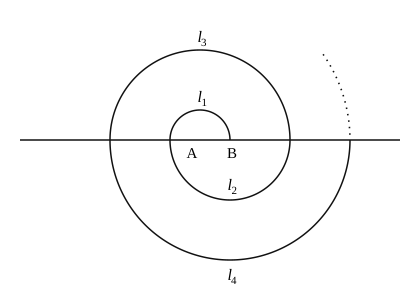
In a garden, saplings of rose flowers were planted at equal intervals to form a spiral pattern. The spiral is made up of successive semicircles, with centres alternatively at A and B, starting with centre at A, of radii 50 cm, 100 cm, 150 cm, ....... as shown in the figure given below. Spiral 1 has 10 flowers, Spiral 2 has 20 flowers, Spiral 3 has 30 flowers and so on. Based on the above information, answer the following questions : (i) What is the radius of the 13th spiral ? (1) (ii) If the radius of the nth spiral is 500 cm, find the value of n. (1) (iii) (a) Find the total number of saplings till the 11th spiral. (2) OR (b) Till which spiral, will there be a total of 450 saplings ? (2)
Show answer & solution
Answer: (i) 650 cm (ii) n=10 (iii) (a) 660 OR (b) 9th spiral
Radii form an AP: 50, 100, 150, ... with a=50, d=50; flowers form an AP 10, 20, 30, ...
(i) a13=50+12×50=650 cm.
(ii) 50+(n−1)50=500, so 50n=500 and n=10.
(iii) (a) S11=211[2×10+10×10]=211×120=660.
(iii) (b) 2n[20+(n−1)10]=450⇒5n(n+1)=450⇒n2+n−90=0⇒(n+10)(n−9)=0, so n=9.
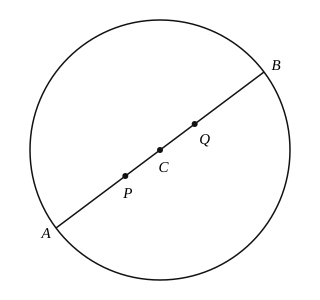
In a society, there is a circular park having two gates. The gates are placed at points A(10, 20) and B(50, 50), as shown in the figure below. Two fountains are installed at points P and Q on AB such that AP = PQ = QB. Based on the above information, answer the following questions : (i) Find the coordinates of the centre C. (1) (ii) Find the radius of the circular park. (1) (iii) (a) Find the coordinates of the point P. (2) OR (b) Find the distance of the fountain at Q from gate A. (2)
Show answer & solution
Answer: (i) C(30, 35) (ii) 25 units (iii) (a) P(370,30) OR (b) 3100 units
In the figure, AB passes through the centre C, so AB is a diameter.
(i) C is the mid-point of AB: (210+50,220+50)=(30,35).
(ii) AB=402+302=50, so radius =25 units.
(iii) (a) P divides AB in the ratio 1 : 2: P=(31×50+2×10,31×50+2×20)=(370,30).