MonoMath CBSE
CBSE Maths › Class 10 PYQs › 2025

CBSE Class 10 Maths Basic 2025 Question Paper 430/1/3 with Solutions

All 44 questions from the CBSE Class 10 Mathematics Basic board paper, Set 430/1/3 (2025), with answers and step-by-step solutions. Total 80 marks. Tap “Show answer & solution” under any question.

Set 430/1/1Set 430/1/2Set 430/1/3Set 430/2/1Set 430/2/2Set 430/2/3Set 430/3/1Set 430/3/2Set 430/3/3Set 430/4/1Set 430/4/2Set 430/4/3Set 430/5/1Set 430/5/2Set 430/5/3Set 430/6/1Set 430/6/2Set 430/6/3

The ratio of the area of a quadrant of a circle to the area of the same circle is :

  1. (A)1 : 2
  2. (B)2 : 1
  3. (C)1 : 4
  4. (D)4 : 1
Show answer & solution
Answer: (C) 1 : 4
  1. Area of quadrant , so the ratio is .

For which of the following solids is the lateral/curved surface area and total surface area the same ?

  1. (A)Cube
  2. (B)Cuboid
  3. (C)Hemisphere
  4. (D)Sphere
Show answer & solution
Answer: (D) Sphere
  1. A sphere has only a curved surface, so its CSA and TSA are both .
  2. Cube, cuboid and hemisphere all have flat faces in addition to the lateral/curved surface.
Q31 markMCQStatistics

The class mark of the median class of the following data is :
Class Interval: 10 – 25, 25 – 40, 40 – 55, 55 – 70, 70 – 85, 85 – 100
Frequency: 2, 3, 7, 6, 6, 6

  1. (A)40
  2. (B)55
  3. (C)47.5
  4. (D)62.5
Show answer & solution
Answer: (D) 62.5
  1. , so .
  2. Cumulative frequencies: 2, 5, 12, 18, 24, 30.
  3. 15 lies in the class 55 – 70, which is the median class.
  4. Class mark .
Q41 markMCQStatistics

The following distribution shows the number of runs scored by some batsmen in test matches :
Runs Scored: 3000 – 4000, 4000 – 5000, 5000 – 6000, 6000 – 7000
Number of Batsmen: 5, 10, 9, 8
The lower limit of the modal class is :

  1. (A)3000
  2. (B)4000
  3. (C)5000
  4. (D)6000
Show answer & solution
Answer: (B) 4000
  1. The highest frequency is 10, for the class 4000 – 5000.
  2. So the modal class is 4000 – 5000 and its lower limit is 4000.
Q51 markMCQProbability

In an experiment of throwing a pair of dice, the probability of not getting a doublet is :

  1. (A)
  2. (B)
  3. (C)
  4. (D)
Show answer & solution
Answer: (B)
  1. Total outcomes ; doublets: (1, 1), (2, 2), ..., (6, 6), i.e. 6 outcomes.
  2. P(doublet) .
  3. P(not a doublet) .
Q61 markMCQReal Numbers

If the HCF of two positive integers and is 1, then their LCM is :

  1. (A)
  2. (B)
  3. (C)
  4. (D)
Show answer & solution
Answer: (D)
  1. HCF × LCM = product of the numbers.
  2. , so LCM .
Q71 markMCQReal Numbers

is :

  1. (A)a rational number
  2. (B)an irrational number
  3. (C)an integer
  4. (D)a natural number
Show answer & solution
Answer: (B) an irrational number
  1. .
  2. is irrational, and a rational number plus an irrational number is irrational, so the value is irrational.

The discriminant of the quadratic equation is :

  1. (A)
  2. (B)49
  3. (C)7
  4. (D)
Show answer & solution
Answer: (B) 49
  1. Here , , .
  2. .

The equation is expressed as a quadratic equation in the form of . The value of is :

  1. (A)5
  2. (B)2
  3. (C)1
  4. (D)
Show answer & solution
Answer: (A) 5
  1. Multiply by : , i.e. .
  2. So , , .
  3. .

For a point where , the value of its [distance from x-axis distance from y-axis] is :

  1. (A)
  2. (B)
  3. (C)
  4. (D)
Show answer & solution
Answer: (B)
  1. Distance of from the x-axis ; from the y-axis (both positive).
  2. Required value .

The mid-point of a line segment divides the line segment in the ratio :

  1. (A)1 : 2
  2. (B)2 : 1
  3. (C)1 : 1
  4. (D) : 2
Show answer & solution
Answer: (C) 1 : 1
  1. The mid-point is equidistant from both ends, so it divides the segment in the ratio 1 : 1.
Q121 markMCQTriangles

Which of the following is not the criterion for similarity of triangles ?

  1. (A)AAA
  2. (B)SSS
  3. (C)SAS
  4. (D)RHS
Show answer & solution
Answer: (D) RHS
  1. The criteria for similarity of triangles are AAA (AA), SSS and SAS.
  2. RHS is a criterion for congruence, not for similarity.
Q131 markMCQTriangles

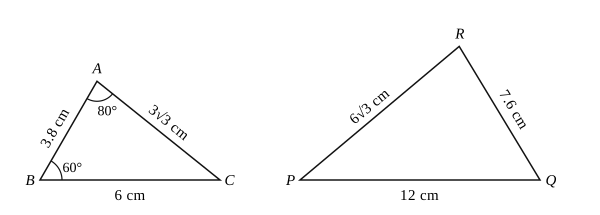
From the figures given below, which of the following is true about the measure of ?

Diagram for CBSE 2025 Class 10 Maths question 13
  1. (A)
  2. (B)
  3. (C)
  4. (D)The measure of cannot be determined
Show answer & solution
Answer: (C)
  1. , , .
  2. So (SSS), with .
  3. .
  4. Hence .
Q141 markMCQCircles

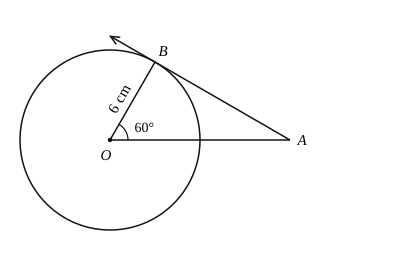
In the given figure, if AB is a tangent to the circle with centre O such that OB = 6 cm and , then the length of OA is :

Diagram for CBSE 2025 Class 10 Maths question 14
  1. (A)3 cm
  2. (B) cm
  3. (C) cm
  4. (D)12 cm
Show answer & solution
Answer: (D) 12 cm
  1. OB is the radius to the point of contact, so .
  2. In right : .
  3. cm.

Which of the following statements is false ?

  1. (A)
  2. (B)
  3. (C)
  4. (D)
Show answer & solution
Answer: (C)
  1. ; ; .
  2. but , so (C) is false.

The value of is :

  1. (A)more than 1
  2. (B)1
  3. (C)0
  4. (D)
Show answer & solution
Answer: (B) 1
  1. .

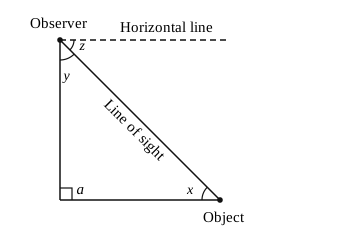
In the given figure, which of the following angles represents the angle of depression ?

Diagram for CBSE 2025 Class 10 Maths question 17
  1. (A)
  2. (B)
  3. (C)
  4. (D)
Show answer & solution
Answer: (C)
  1. The angle of depression is the angle between the horizontal line through the observer's eye and the line of sight to the object below, which is .

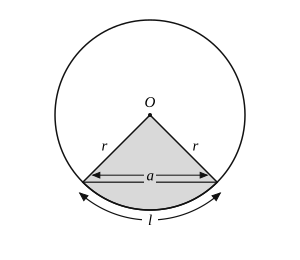
The perimeter of the shaded region in the given figure is :

Diagram for CBSE 2025 Class 10 Maths question 18
  1. (A)
  2. (B)
  3. (C)
  4. (D)
Show answer & solution
Answer: (C)
  1. The shaded region is the sector bounded by the two radii and the arc.
  2. Its perimeter = .
Q191 markAssertion–ReasonReal Numbers

Assertion (A) : For any two natural numbers a and b, the HCF of a and b is a factor of the LCM of a and b.
Reason (R) : HCF of any two natural numbers divides both the numbers.

  1. (A)Both Assertion (A) and Reason (R) are true and Reason (R) is the correct explanation of Assertion (A).
  2. (B)Both Assertion (A) and Reason (R) are true, but Reason (R) is not the correct explanation of Assertion (A).
  3. (C)Assertion (A) is true, but Reason (R) is false.
  4. (D)Assertion (A) is false, but Reason (R) is true.
Show answer & solution
Answer: (A) Both Assertion (A) and Reason (R) are true and Reason (R) is the correct explanation of Assertion (A).
  1. R is true: the HCF is a common factor, so it divides both numbers.
  2. The HCF divides , and divides the LCM, so the HCF divides the LCM. A is true.
  3. This follows directly from R, so R correctly explains A.

Assertion (A) : The value of p for which the system of equations and is consistent is 4.
Reason (R) : The system of equations and is consistent with infinitely many solutions, if .

  1. (A)Both Assertion (A) and Reason (R) are true and Reason (R) is the correct explanation of Assertion (A).
  2. (B)Both Assertion (A) and Reason (R) are true, but Reason (R) is not the correct explanation of Assertion (A).
  3. (C)Assertion (A) is true, but Reason (R) is false.
  4. (D)Assertion (A) is false, but Reason (R) is true.
Show answer & solution
Answer: (D) Assertion (A) is false, but Reason (R) is true.
  1. For : , , .
  2. Since , the lines are parallel and the system is inconsistent. So A is false.
  3. R is the standard condition for infinitely many solutions, so R is true.
Q212 marksVery Short AnswerAreas Related to Circles

From a circular sheet of radius 70 cm, a quadrant is cut. Find the area of the remaining sheet.

Show answer & solution
Answer: 11550 cm²
  1. Area of the sheet cm².
  2. Area of the quadrant cm².
  3. Remaining area cm².

Solve for and :

Show answer & solution
Answer: ,
  1. Multiply the first equation by 3 and the second by 5: and .
  2. Adding: , so .
  3. Then , so .
Q232 marksVery Short AnswerTriangles

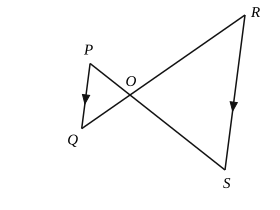
In the given figure, if PQ RS, then prove that .

Diagram for CBSE 2025 Class 10 Maths question 23
Show answer & solution
Answer: Proved.
  1. In and :
  2. (alternate angles, PQ RS, PS a transversal).
  3. (alternate angles, PQ RS, QR a transversal).
  4. Hence (AA similarity).
OR
Q23 (OR) (OR)2 marksVery Short AnswerTriangles

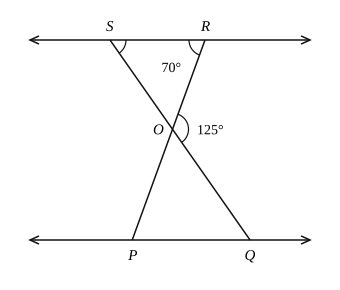
In the given figure, , and . Find the measures of and .

Diagram for CBSE 2025 Class 10 Maths question 23 (OR)
Show answer & solution
Answer: ,
  1. is an exterior angle of (S, O, Q are collinear).
  2. So , giving .
  3. Since , corresponding angles are equal: .
Q242 marksVery Short AnswerCircles

Two concentric circles are of radii 6 cm and 10 cm. Find the length of the chord of the larger circle which touches the smaller circle.

Show answer & solution
Answer: 16 cm
  1. Let the chord AB of the larger circle touch the smaller circle at P. Then OP AB and P is the mid-point of AB.
  2. In right : cm.
  3. cm.
Q252 marksVery Short AnswerIntroduction to Trigonometry

Find the values of A and B , if and .

Show answer & solution
Answer: ,
  1. , so .
  2. , so .
  3. Adding: , so ; then .
OR
Q25 (OR) (OR)2 marksVery Short AnswerIntroduction to Trigonometry

Prove that geometrically.

Show answer & solution
Answer: Proved.
  1. Take right-angled at B with .
  2. Then .
  3. Sides opposite equal angles are equal, so BC = AB.
  4. .
Q263 marksShort AnswerIntroduction to Trigonometry

Prove the following trigonometric identity :

Show answer & solution
Answer: Proved.
  1. LHS .
  2. .
  3. RHS .
  4. Hence LHS = RHS.
Q273 marksShort AnswerProbability

A lot consists of 200 pens of which 180 are good and the rest are defective. A customer will buy a pen if it is not defective. The shopkeeper draws a pen at random and gives it to the customer. What is the probability that the customer will not buy it ? Another lot of 100 pens containing 80 good pens is mixed with the previous lot of 200 pens. The shopkeeper now draws one pen at random from the entire lot and gives it to the customer. What is the probability that the customer will buy the pen ?

Show answer & solution
Answer: ;
  1. Defective pens in the first lot .
  2. P(customer will not buy) .
  3. After mixing: total pens , good pens .
  4. P(customer will buy) .
Q283 marksShort AnswerReal Numbers

Prove that is an irrational number.

Show answer & solution
Answer: Proved.
  1. Assume is rational: , where are coprime integers, .
  2. Then , so 3 divides , hence 3 divides (3 is prime).
  3. Write : , so ; hence 3 divides .
  4. So 3 is a common factor of and , contradicting that they are coprime.
  5. Hence is irrational.
OR
Q28 (OR) (OR)3 marksShort AnswerReal Numbers

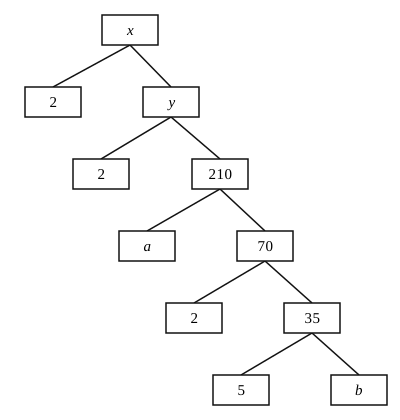
The factor tree of a number is shown below :
Find the values of , , and . Hence, write the product of the prime factors of the number so obtained.

Diagram for CBSE 2025 Class 10 Maths question 28 (OR)
Show answer & solution
Answer: , , , ;
  1. , so .
  2. , so .
  3. .
  4. .
  5. .
Q293 marksShort AnswerPolynomials

Determine a quadratic polynomial, sum and product of whose zeroes are and 24, respectively. Also, determine the zeroes of the polynomial so obtained.

Show answer & solution
Answer: ; zeroes and
  1. A quadratic polynomial is .
  2. .
  3. , so the zeroes are and .
  4. Check: , .

Solve the following system of equations graphically :
;

Show answer & solution
Answer: , (the lines intersect at (6, 0))
  1. For : points (0, 2), (3, 1), (6, 0).
  2. For : points (0, ), (3, ), (6, 0).
  3. Plot both lines on the same axes.
  4. They intersect at (6, 0), so , .
OR
Q30 (OR) (OR)3 marksShort AnswerPair of Linear Equations in Two Variables

and are complementary angles such that . Express the given information as a system of linear equations in two variables and hence solve it.

Show answer & solution
Answer: , ; ,
  1. Complementary: ... (1)
  2. gives ... (2)
  3. Substitute (2) in (1): , so .
  4. .
Q313 marksShort AnswerCircles

Prove that a rectangle circumscribing a circle is a square.

Show answer & solution
Answer: Proved.
  1. Let rectangle ABCD circumscribe a circle, touching AB, BC, CD, DA at P, Q, R, S.
  2. Tangents from an external point are equal: AP = AS, BP = BQ, CR = CQ, DR = DS.
  3. Adding: AB + CD = AD + BC.
  4. In a rectangle AB = CD and BC = AD, so 2AB = 2BC, i.e. AB = BC.
  5. A rectangle with adjacent sides equal is a square.
Q325 marksLong AnswerStatistics

A life insurance agent found the following data for the distribution of 100 policy holders on the basis of their ages.
Age (in years): 15 – 20, 20 – 25, 25 – 30, 30 – 35, 35 – 40, 40 – 45, 45 – 50, 50 – 55, 55 – 60
Number of policy holders: 2, 4, 18, 21, 33, 11, 3, 6, 2
Find the median age of the policy holders.

Show answer & solution
Answer: years ≈ 35.76 years
  1. Cumulative frequencies: 2, 6, 24, 45, 78, 89, 92, 98, 100; , .
  2. 50 lies in the class 35 – 40, so it is the median class: , , , .
  3. Median years.
Q335 marksLong AnswerQuadratic Equations

The difference of the squares of two positive numbers is 180. The square of the smaller number is 8 times the greater number. Find the two numbers.

Show answer & solution
Answer: 18 and 12
  1. Let the greater number be and the smaller . Then and .
  2. So .
  3. , so ().
  4. , so .
  5. The numbers are 18 and 12 (check: ).
OR
Q33 (OR) (OR)5 marksLong AnswerQuadratic Equations

Find the value(s) of k for which the equation has real and equal roots. Hence, find the roots of the equations so obtained.

Show answer & solution
Answer: ; for the roots are ; for the roots are
  1. For equal roots, , so and .
  2. Equal roots are .
  3. For : , so (twice).
  4. For : , so (twice).
Q345 marksLong AnswerTriangles

State the converse of “Basic Proportionality Theorem” and use it to prove the following :
Line segment joining mid-points of any two sides of a triangle is parallel to the third side.

Show answer & solution
Answer: Proved.
  1. Converse of BPT: if a line divides any two sides of a triangle in the same ratio, then the line is parallel to the third side.
  2. Proof of the converse: let line DE meet AB at D and AC at E with , and suppose DE is not parallel to BC.
  3. Draw DE' BC meeting AC at E'. By BPT, , so .
  4. Adding 1 to both sides: , so EC = E'C and E, E' coincide. Hence DE BC.
  5. Application: in , let D and E be the mid-points of AB and AC.
  6. Then AD = DB and AE = EC, so .
  7. By the converse of BPT, DE BC, i.e. the segment joining the mid-points is parallel to the third side.
Q355 marksLong AnswerSurface Areas and Volumes

A toy is in the form of a cone surmounted on a hemisphere. The cone and hemisphere have the same radii. The height of the conical part of the toy is equal to the diameter of its base. If the radius of the conical part is 5 cm, find the volume of the toy.

Show answer & solution
Answer: cm³ ≈ 523.81 cm³
  1. cm, height of cone cm.
  2. Volume of cone .
  3. Volume of hemisphere .
  4. Total cm³.
OR
Q35 (OR) (OR)5 marksLong AnswerSurface Areas and Volumes

A cubical block is surmounted by a hemisphere of radius 3.5 cm. What is the smallest possible length of the edge of the cube so that the hemisphere can totally lie on the cube ? Find the total surface area of the solid so formed.

Show answer & solution
Answer: Edge = 7 cm; total surface area = 332.5 cm²
  1. The base of the hemisphere (diameter 7 cm) must fit on a face, so the smallest edge is 7 cm.
  2. TSA = surface of cube base of hemisphere CSA of hemisphere .
  3. cm².
Q364 marksCase StudyCoordinate Geometry

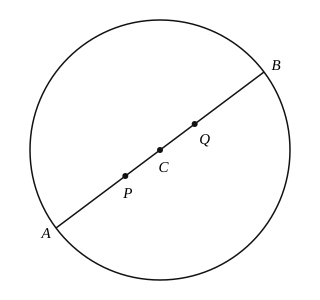
In a society, there is a circular park having two gates. The gates are placed at points A(10, 20) and B(50, 50), as shown in the figure below. Two fountains are installed at points P and Q on AB such that AP = PQ = QB.
Based on the above information, answer the following questions :
(i) Find the coordinates of the centre C. (1)
(ii) Find the radius of the circular park. (1)
(iii) (a) Find the coordinates of the point P. (2)
OR
(b) Find the distance of the fountain at Q from gate A. (2)

Diagram for CBSE 2025 Class 10 Maths question 36
Show answer & solution
Answer: (i) C(30, 35) (ii) 25 units (iii) (a) OR (b) units
  1. In the figure, AB passes through the centre C, so AB is a diameter.
  2. (i) C is the mid-point of AB: .
  3. (ii) , so radius units.
  4. (iii) (a) P divides AB in the ratio 1 : 2: .
  5. (iii) (b) units.

An injured bird was found on the roof of a building. The building is 15 m high. A fireman was called to rescue the bird. The fireman used an adjustable ladder to reach the roof. He placed the ladder in such a way that the ladder makes an angle of with the ground in order to reach the roof.
Based on the above information, answer the following questions :
(i) Find the length of the ladder used by the fireman to reach the roof. (1)
(ii) Find the distance of the point on the ground at which the ladder was fixed from the bottom of the building. (1)
(iii) In order to avoid skidding, the fireman placed the ladder in such a way that the bottom of the ladder touches the base of the wall which is opposite to the building, making an angle of with the ground.
(a) Draw a neat diagram to represent the above situation and hence find the width of the road between the building and the wall. (2)
OR
(b) Find the length of the ladder used by the fireman in this case. (2)

Show answer & solution
Answer: (i) m (ii) m (iii) (a) m OR (b) 30 m
  1. (i) , so m.
  2. (ii) , so m.
  3. (iii) (a) Diagram: vertical building AB = 15 m, foot of the wall C on the ground, ladder AC with .
  4. , so m; the road is m wide.
  5. (iii) (b) , so m.
Q384 marksCase StudyArithmetic Progressions

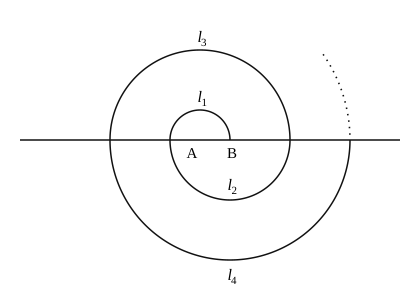
In a garden, saplings of rose flowers were planted at equal intervals to form a spiral pattern. The spiral is made up of successive semicircles, with centres alternatively at A and B, starting with centre at A, of radii 50 cm, 100 cm, 150 cm, ....... as shown in the figure given below. Spiral 1 has 10 flowers, Spiral 2 has 20 flowers, Spiral 3 has 30 flowers and so on.
Based on the above information, answer the following questions :
(i) What is the radius of the spiral ? (1)
(ii) If the radius of the spiral is 500 cm, find the value of . (1)
(iii) (a) Find the total number of saplings till the spiral. (2)
OR
(b) Till which spiral, will there be a total of 450 saplings ? (2)

Diagram for CBSE 2025 Class 10 Maths question 38
Show answer & solution
Answer: (i) 650 cm (ii) (iii) (a) 660 OR (b) 9th spiral
  1. Radii form an AP: 50, 100, 150, ... with , ; flowers form an AP 10, 20, 30, ...
  2. (i) cm.
  3. (ii) , so and .
  4. (iii) (a) .
  5. (iii) (b) , so .
← 2025 Basic 430/1/2 2025 Basic 430/2/1 →
Practise smarter: chapter-wise revision, formula sheets and step-by-step NCERT solutions on MonoMath CBSE →