MonoMath CBSE
CBSE Maths › Class 10 PYQs › 2025

CBSE Class 10 Maths Basic 2025 Question Paper 430/4/1 with Solutions

All 44 questions from the CBSE Class 10 Mathematics Basic board paper, Set 430/4/1 (2025), with answers and step-by-step solutions. Total 80 marks. Tap “Show answer & solution” under any question.

Set 430/1/1Set 430/1/2Set 430/1/3Set 430/2/1Set 430/2/2Set 430/2/3Set 430/3/1Set 430/3/2Set 430/3/3Set 430/4/1Set 430/4/2Set 430/4/3Set 430/5/1Set 430/5/2Set 430/5/3Set 430/6/1Set 430/6/2Set 430/6/3
Q11 markMCQReal Numbers

If HCF and LCM , then value of is :

  1. (A)3
  2. (B)6
  3. (C)20
  4. (D)10
Show answer & solution
Answer: (B) 6
  1. HCF × LCM = product of the two numbers.
  2. .

The distance between the points and is :

  1. (A)
  2. (B)
  3. (C)
  4. (D)
Show answer & solution
Answer: (A)
  1. Distance .
  2. .
Also asked in: 2025 Basic 430/4/3

If term of an A.P. is , then its common difference is :

  1. (A)
  2. (B)
  3. (C)5
  4. (D)6
Show answer & solution
Answer: (C) 5
  1. , so .
  2. .
Also asked in: 2025 Basic 430/4/2
Q41 markMCQPolynomials

One of the zeroes of the polynomial is . The value of is :

  1. (A)
  2. (B)
  3. (C)
  4. (D)
Show answer & solution
Answer: (D)
  1. .
Also asked in: 2025 Basic 430/4/3
Q51 markMCQProbability

Three coins are tossed together. The probability that only one coin shows tail, is :

  1. (A)
  2. (B)
  3. (C)
  4. (D)1
Show answer & solution
Answer: (B)
  1. Total outcomes .
  2. Exactly one tail: THH, HTH, HHT, i.e. 3 outcomes.
  3. Probability .

Two right circular cylinders of equal volumes have their heights in the ratio 1:2. The ratio of their radii is :

  1. (A)
  2. (B)1 : 2
  3. (C)1 : 4
  4. (D)
Show answer & solution
Answer: (A)
  1. Let the heights be and .
  2. , so .
  3. .

If , then is equal to :

  1. (A)
  2. (B)
  3. (C)
  4. (D)
Show answer & solution
Answer: (C)
  1. , so .
  2. .
Q81 markMCQCircles

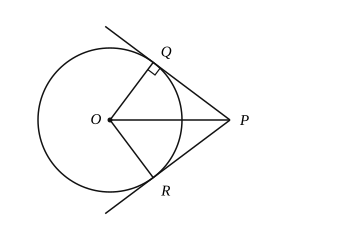
PQ and PR are tangents to the circle of radius 3 cm and centre O. If length of each tangent is 4 cm, then perimeter of OQP is :

Diagram for CBSE 2025 Class 10 Maths question 8
  1. (A)5 cm
  2. (B)12 cm
  3. (C)9 cm
  4. (D)8 cm
Show answer & solution
Answer: (B) 12 cm
  1. OQ PQ (radius tangent), so is right-angled at Q.
  2. cm.
  3. Perimeter cm.
Q91 markMCQPolynomials

are zeroes of the polynomial . The value of is :

  1. (A)
  2. (B)5
  3. (C)
  4. (D)
Show answer & solution
Answer: (D)
  1. , .
  2. .
Also asked in: 2025 Basic 430/4/2

The term of the A.P. : is :

  1. (A)
  2. (B)
  3. (C)
  4. (D)
Show answer & solution
Answer: (C)
  1. , .
  2. .

If , then is equal to :

  1. (A)
  2. (B)
  3. (C)
  4. (D)2
Show answer & solution
Answer: (A)
  1. .
  2. So .
Q121 markMCQProbability

A card is drawn at random from a well shuffled deck of 52 playing cards. The probability that drawn card shows number ‘9’ is :

  1. (A)
  2. (B)
  3. (C)
  4. (D)
Show answer & solution
Answer: (D)
  1. There are four 9s in a deck (one in each suit).
  2. Probability .

The length of arc subtending an angle of at the centre of the circle, is cm. The radius of the circle is :

  1. (A) cm
  2. (B)4 cm
  3. (C)8 cm
  4. (D) cm
Show answer & solution
Answer: (B) 4 cm
  1. Arc length .
  2. , so cm.
Also asked in: 2025 Basic 430/4/2

The value of for which lines and are parallel, is :

  1. (A)
  2. (B)
  3. (C)
  4. (D)
Show answer & solution
Answer: (C)
  1. For parallel lines, .
  2. , so .
  3. Check: , so the lines are parallel.

The curved surface area of a cone with base radius 7 cm, is 550 cm. The slant height of the cone is :

  1. (A)25 cm
  2. (B)14 cm
  3. (C)20 cm
  4. (D)24 cm
Show answer & solution
Answer: (A) 25 cm
  1. CSA .
  2. , so cm.

If , then is equal to :

  1. (A)
  2. (B)
  3. (C)
  4. (D)
Show answer & solution
Answer: (B)
  1. .
Also asked in: 2025 Basic 430/4/3
Q171 markMCQCircles

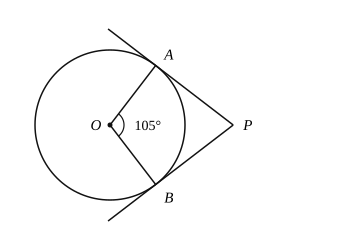
PA and PB are tangents to a circle with centre O. If then is equal to :

Diagram for CBSE 2025 Class 10 Maths question 17
  1. (A)
  2. (B)
  3. (C)
  4. (D)
Show answer & solution
Answer: (D)
  1. (radius tangent).
  2. In quadrilateral OAPB, .
  3. .
Q181 markMCQTriangles

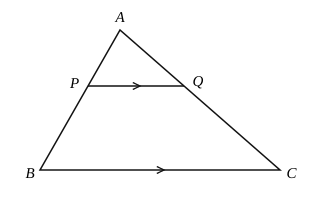
In ABC, PQ BC. It is given that AP = 2.4 cm, PB = 3.6 cm and BC = 5.4 cm. PQ is equal to :

Diagram for CBSE 2025 Class 10 Maths question 18
  1. (A)2.7 cm
  2. (B)1.8 cm
  3. (C)3.6 cm
  4. (D)2.16 cm
Show answer & solution
Answer: (D) 2.16 cm
  1. PQ BC, so (AA).
  2. cm.
  3. , so cm.
Q191 markAssertion–ReasonStatistics

Assertion (A) : Median marks of students in a class test is 16. It means half of the class got marks less than 16.
Reason (R) : Median divides the distribution in two equal parts.

  1. (A)Both, Assertion (A) and Reason (R) are true and Reason (R) is the correct explanation of Assertion (A).
  2. (B)Both, Assertion (A) and Reason (R) are true, but Reason (R) is not the correct explanation of Assertion (A).
  3. (C)Assertion (A) is true, but Reason (R) is false.
  4. (D)Assertion (A) is false, but Reason (R) is true.
Show answer & solution
Answer: (A) Both, Assertion (A) and Reason (R) are true and Reason (R) is the correct explanation of Assertion (A).
  1. The median is the middle value of the arranged data, so it divides the distribution into two equal parts: R is true.
  2. Hence median 16 means half the students scored below 16 (and half above): A is true.
  3. R explains A.
Q201 markAssertion–ReasonProbability

Assertion (A) : If E is an event such that , then .
Reason (R) :

  1. (A)Both, Assertion (A) and Reason (R) are true and Reason (R) is the correct explanation of Assertion (A).
  2. (B)Both, Assertion (A) and Reason (R) are true, but Reason (R) is not the correct explanation of Assertion (A).
  3. (C)Assertion (A) is true, but Reason (R) is false.
  4. (D)Assertion (A) is false, but Reason (R) is true.
Show answer & solution
Answer: (D) Assertion (A) is false, but Reason (R) is true.
  1. R is true: an event and its complement have probabilities adding to 1.
  2. , so A is false.
Q212 marksVery Short AnswerReal Numbers

Show that can not end with the digit 0, being a natural number. Write the prime number ‘’ which on multiplying with makes the product end with the digit 0.

Show answer & solution
Answer: has no factor 2, so it cannot end with 0; .
  1. A number ends with 0 only if its prime factorisation contains both 2 and 5.
  2. , which has no factor 2.
  3. By the uniqueness of prime factorisation, can never end with the digit 0.
  4. Multiplying by the prime 2 gives , which has both 2 and 5 and ends with 0. So .
Q222 marksVery Short AnswerCoordinate Geometry

Point P divides the line segment joining the points and in a certain ratio. Find the ratio and hence find the value of .

Show answer & solution
Answer: 8 : 5;
  1. Let P divide the segment in the ratio .
  2. -coordinate: , so ; the ratio is 8 : 5.
  3. .
Q232 marksVery Short AnswerProbability

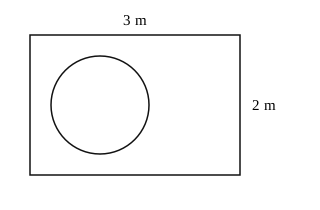
A coin is dropped at random on the rectangular region shown in the figure. What is the probability that it will land inside the circle with radius 0.7 m ?

Diagram for CBSE 2025 Class 10 Maths question 23
Show answer & solution
Answer: (about 0.257)
  1. Area of rectangle m.
  2. Area of circle m.
  3. P(coin lands inside the circle) .
OR
Q23 (OR) (OR)2 marksVery Short AnswerProbability

A die is thrown twice. What is the probability that (i) difference between two numbers obtained is 3 ? (ii) sum of the numbers obtained is 8 ?

Show answer & solution
Answer: (i) (ii)
  1. Total outcomes .
  2. (i) Difference 3: (1, 4), (4, 1), (2, 5), (5, 2), (3, 6), (6, 3), i.e. 6 outcomes. P .
  3. (ii) Sum 8: (2, 6), (6, 2), (3, 5), (5, 3), (4, 4), i.e. 5 outcomes. P .
Q242 marksVery Short AnswerCircles

Prove that the angle between the two tangents drawn from an external point to a circle is supplementary to the angle subtended by the line segment joining the points of contact at the centre.

Show answer & solution
Answer: Proved.
  1. Let PA and PB be tangents from an external point P to a circle with centre O, touching it at A and B.
  2. The radius is perpendicular to the tangent at the point of contact, so .
  3. In quadrilateral OAPB, .
  4. So .
  5. Hence and are supplementary.
OR
Q24 (OR) (OR)2 marksVery Short AnswerCircles

Prove that the tangents drawn at the ends of a diameter of a circle are parallel.

Show answer & solution
Answer: Proved.
  1. Let AB be a diameter of a circle with centre O, and let and be the tangents at A and B.
  2. The radius is perpendicular to the tangent at the point of contact, so OA and OB .
  3. Thus both and are perpendicular to the line AB, i.e. the angles they make with AB at A and at B are both (alternate angles equal).
  4. Hence .
Q252 marksVery Short AnswerTriangles

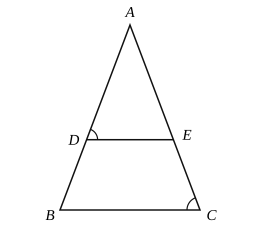
In the given figure and . Prove that is an isosceles triangle.

Diagram for CBSE 2025 Class 10 Maths question 25
Show answer & solution
Answer: Proved.
  1. Since , by the converse of the basic proportionality theorem, DE BC.
  2. So (corresponding angles).
  3. Given , hence .
  4. Sides opposite equal angles are equal, so AC = AB.
  5. Hence is isosceles.
Q263 marksShort AnswerPolynomials

Find the zeroes of the polynomial and verify the relationship between its zeroes and the coefficients.

Show answer & solution
Answer: Zeroes and ; relationship verified.
  1. .
  2. Zeroes: and .
  3. Sum and . Verified.
  4. Product and . Verified.
Q273 marksShort AnswerArithmetic Progressions

Find the sum of the A.P. .

Show answer & solution
Answer:
  1. , , last term .
  2. , so and .
  3. .
OR
Q27 (OR) (OR)3 marksShort AnswerArithmetic Progressions

If the sum of first terms of an A.P. is given by . Then, find its first term and common difference. Hence, find its term.

Show answer & solution
Answer: First term 5, common difference 2,
  1. .
  2. .
  3. , so and .
  4. .
Q283 marksShort AnswerReal Numbers

Prove that is an irrational number.

Show answer & solution
Answer: Proved.
  1. Suppose is rational. Then , where and are co-prime integers and .
  2. Squaring, , so 3 divides and hence 3 divides .
  3. Let . Then , so , and 3 divides , hence 3 divides .
  4. So 3 is a common factor of and , contradicting that they are co-prime.
  5. Hence is irrational.
Q293 marksShort AnswerCoordinate Geometry

If points A, B, C and D taken in order, form a parallelogram ABCD, then find the values of and . Hence, find lengths of sides of the parallelogram.

Show answer & solution
Answer: , ; AB = CD = units, BC = AD = units
  1. Diagonals of a parallelogram bisect each other, so the mid-points of AC and BD coincide.
  2. Mid-point of AC ; mid-point of BD .
  3. gives ; gives .
  4. AB units = CD.
  5. BC units = AD.
OR
Q29 (OR) (OR)3 marksShort AnswerCoordinate Geometry

A, B and C are vertices of ABC. Points P and Q lie on sides AB and AC respectively. Check whether .

Show answer & solution
Answer: Yes, .
  1. AP ; PB .
  2. So .
  3. AQ ; QC .
  4. So .
  5. Hence .
Q303 marksShort AnswerAreas Related to Circles

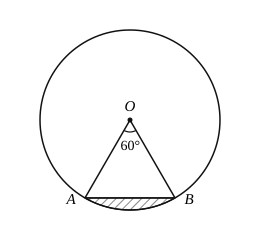
A chord of a circle of radius 10 cm subtends an angle of at the centre O. Find the area of the shaded region.
(Use and )

Diagram for CBSE 2025 Class 10 Maths question 30
Show answer & solution
Answer: 9.08 cm (approx.)
  1. The shaded region is the minor segment cut off by chord AB.
  2. Area of sector OAB cm.
  3. is equilateral (OA = OB, ), so its area cm.
  4. Area of shaded segment cm.
Also asked in: 2025 Basic 430/4/2
Q313 marksShort AnswerCircles

Prove that the opposite sides of a quadrilateral circumscribing a circle subtend supplementary angles at the centre of the circle.

Show answer & solution
Answer: Proved.
  1. Let ABCD circumscribe a circle with centre O, touching AB, BC, CD, DA at P, Q, R, S. Join OA, OB, OC, OD, OP, OQ, OR, OS.
  2. In and : OP = OS (radii), OA common, . So they are congruent (RHS) and .
  3. Similarly , , .
  4. The eight angles at O add to , so .
  5. Hence , and similarly .
Q325 marksLong AnswerQuadratic Equations

It is given that ;
(i) Show that the discriminant (D) of above equation is a perfect square.
(ii) Find the roots of the equation.

Show answer & solution
Answer: (i) (ii) ,
  1. (i) , , .
  2. , a perfect square.
  3. (ii) .
  4. Taking +: .
  5. Taking : .
OR
Q32 (OR) (OR)5 marksLong AnswerQuadratic Equations

Three consecutive positive integers are such that the sum of the square of smallest and product of other two is 67. Find the numbers, using quadratic equation.

Show answer & solution
Answer: 5, 6, 7
  1. Let the integers be , , .
  2. , i.e. .
  3. , so or .
  4. is a positive integer, so ; the numbers are 5, 6, 7.
  5. Check: .
Q335 marksLong AnswerStatistics

Find ‘mean’ and ‘mode’ of the following data :
Class: 15-20, 20-25, 25-30, 30-35, 35-40, 40-45
Frequency: 6, 16, 17, 4, 5, 2

Show answer & solution
Answer: Mean = 26.7; Mode =
  1. Class marks : 17.5, 22.5, 27.5, 32.5, 37.5, 42.5; .
  2. : 105, 360, 467.5, 130, 187.5, 85; .
  3. Mean .
  4. Modal class 25-30: , , , , .
  5. Mode .
Q345 marksLong AnswerTriangles

If a line is drawn parallel to one side of a triangle to intersect the other two sides in distinct points, then prove that the other two sides are divided in the same ratio.

Show answer & solution
Answer: Proved.
  1. Given: in , DE BC with D on AB and E on AC. To prove: .
  2. Join BE and CD. Draw EN AB and DM AC.
  3. ar(ADE) and ar(BDE) , so .
  4. ar(ADE) and ar(DEC) , so .
  5. Triangles BDE and DEC are on the same base DE and between the same parallels DE and BC, so ar(BDE) = ar(DEC).
  6. Hence .
OR
Q34 (OR) (OR)5 marksLong AnswerTriangles

In a ABC, P and Q are points on AB and AC respectively such that PQ BC. Prove that the median AD, drawn from A to BC, bisects PQ.

Show answer & solution
Answer: Proved.
  1. Let the median AD meet PQ at E. Then BD = DC.
  2. In and : is common and (corresponding angles, PQ BC). So (AA) and .
  3. Similarly , so .
  4. Hence ; since BD = CD, PE = QE.
  5. So AD bisects PQ.

From a point on the ground, the angle of elevation of the top of a pedestal is and that of the top of the flagstaff fixed on the pedestal is . If the length of the flagstaff is 5 m, then find the height of the pedestal and its distance from the point of observation on ground. (Use )

Show answer & solution
Answer: Height of pedestal = 2.5 m; distance = m
  1. Let the pedestal height be m and its distance from the point be m.
  2. , so .
  3. , so .
  4. , so m.
  5. m.

A telecommunication company came up with two plans– plan A and plan B for its customers.
The plans are represented by linear equations where ‘’ represents the time (in minutes) bought and ‘C’ represents the cost. The equations are :
Plan A :
Plan B :
Based on above information, answer the following questions :
(i) If you purchase plan B, how much initial amount you have to pay ? (1)
(ii) Charu purchased plan A. How many minutes she bought for ₹ 250 ? (1)
(iii) (a) At how many minutes, do both the plans charge the same amount? What is that amount? (2)
OR
(b) Which plan is better if you want to buy 60 minutes? Give reason for your answer. (2)

Show answer & solution
Answer: (i) ₹ 100 (ii) 37.5 minutes (iii) (a) 30 minutes, ₹ 200 OR (b) Plan B, as it costs ₹ 300 against ₹ 400 for plan A
  1. (i) Initial amount is the cost at : , so .
  2. (ii) , so minutes.
  3. (iii) (a) , so minutes; .
  4. (iii) (b) For : plan A, ; plan B, . Plan B is cheaper, so it is better.
Q374 marksCase StudySurface Areas and Volumes

Playing in a ball pool is good entertainment for kids. Suhana bought 600 new balls of diameter 7 cm to fill in the pool for her kids. The cuboidal box containing 600 balls has dimensions 42 cm × 91 cm × 50 cm ().
Based on above information, answer the following questions :
(i) Find the volume of one ball. (1)
(ii) 10 balls are painted with neon colours. Determine the area of painted surface. (1)
(iii) (a) Find the volume of empty space in the box. (2)
OR
(b) The lowermost layer of the balls covers the base of the box edge to edge when balls are placed evenly adjacent to each other. (A) How much area is covered by one ball? (B) How many balls are there in lowermost layer? (2)

Show answer & solution
Answer: (i) cm (ii) 1540 cm (iii) (a) 83300 cm OR (b) (A) 49 cm (B) 78
  1. Radius of a ball cm.
  2. (i) Volume cm.
  3. (ii) Surface area of one ball cm; for 10 balls cm.
  4. (iii) (a) Volume of box cm. Volume of 600 balls cm. Empty space cm.
  5. (iii) (b) (A) Each ball occupies a square of side equal to its diameter: cm. (B) Number of balls .
Q384 marksCase StudyIntroduction to Trigonometry

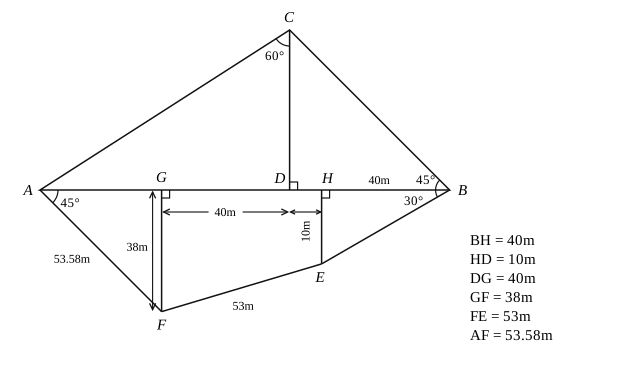
Rahim and Nadeem are two friends whose plots are adjacent to each other. Rahim’s son made a drawing of the plots with necessary details.
It is decided that Rahim will fence the triangular plot ABC and Nadeem will fence along the sides AF, FE and BE.
Observe the diagram carefully and answer the following questions :
(Use and )
(i) Find length BC. (1)
(ii) Find length AG. (1)
(iii) (a) Calculate perimeter of ABC. (2)
OR
(b) Calculate length of (AF + FE + EB). (2)

Diagram for CBSE 2025 Class 10 Maths question 38
Show answer & solution
Answer: (i) m (ii) 38 m (iii) (a) 298.5 m OR (b) 152.82 m (approx.)
  1. BD = BH + HD = 40 + 10 = 50 m; AB = AG + GD + DH + HB.
  2. (i) In right , , so m.
  3. (ii) In right , , so AG = GF = 38 m (check: AF m).
  4. (iii) (a) CD = BD = 50 m. In right , , so m. AB = 38 + 40 + 10 + 40 = 128 m.
  5. Perimeter m.
  6. (iii) (b) In right , , so m.
  7. AF + FE + EB m.
← 2025 Basic 430/3/3 2025 Basic 430/4/2 →
Practise smarter: chapter-wise revision, formula sheets and step-by-step NCERT solutions on MonoMath CBSE →