MonoMath CBSE
CBSE Maths › Class 10 PYQs › 2025

CBSE Class 10 Maths Basic 2025 Question Paper 430/5/2 with Solutions

All 44 questions from the CBSE Class 10 Mathematics Basic board paper, Set 430/5/2 (2025), with answers and step-by-step solutions. Total 80 marks. Tap “Show answer & solution” under any question.

Set 430/1/1Set 430/1/2Set 430/1/3Set 430/2/1Set 430/2/2Set 430/2/3Set 430/3/1Set 430/3/2Set 430/3/3Set 430/4/1Set 430/4/2Set 430/4/3Set 430/5/1Set 430/5/2Set 430/5/3Set 430/6/1Set 430/6/2Set 430/6/3

The point (, 0) divides the line segment joining the points (–4, 5) and (0, –10) in the ratio

  1. (A)1 : 3
  2. (B)2 : 1
  3. (C)1 : 1
  4. (D)1 : 2
Show answer & solution
Answer: (D) 1 : 2
  1. Let the ratio be .
  2. y-coordinate: , so and .
  3. Ratio .
Q21 markMCQProbability

A black card is lost from a deck of 52 playing cards. Rest of the cards are shuffled and one card is drawn at random from the available cards. The probability that drawn card is 'king of hearts', is

  1. (A)
  2. (B)
  3. (C)
  4. (D)
Show answer & solution
Answer: (C)
  1. 51 cards remain.
  2. The king of hearts is a red card, so it is still in the deck.
  3. P(king of hearts) .
Q31 markMCQReal Numbers

is

  1. (A)a negative integer
  2. (B)an irrational number
  3. (C)a rational number
  4. (D)a positive integer
Show answer & solution
Answer: (B) an irrational number
  1. .
  2. is irrational, so is irrational and is irrational.
Also asked in: 2025 Basic 430/5/1

The term of the A.P. : , , , ... is

  1. (A)
  2. (B)
  3. (C)
  4. (D)
Show answer & solution
Answer: (B)
  1. , .
  2. .

The roots of the equation are

  1. (A)rational and distinct
  2. (B)irrational and distinct
  3. (C)real and equal
  4. (D)not real
Show answer & solution
Answer: (B) irrational and distinct
  1. , so .
  2. The two roots are different and irrational.
Q61 markMCQCircles

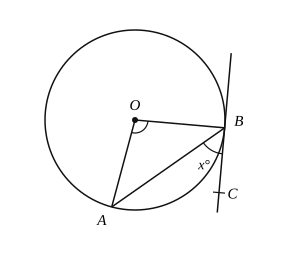
Tangent BC makes an angle of with the chord AB of circle centered at O. If , then value of is

Diagram for CBSE 2025 Class 10 Maths question 6
  1. (A)40
  2. (B)80
  3. (C)90
  4. (D)50
Show answer & solution
Answer: (D) 50
  1. OA = OB (radii), so .
  2. OB BC (radius tangent), so .
  3. , so .
Q71 markMCQCircles

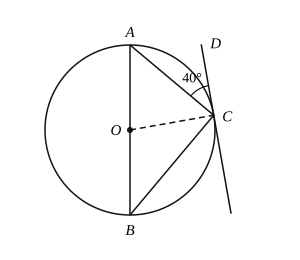
In the given figure, AB is diameter of the circle with centre O. CD is tangent to the circle so that . The value of is

Diagram for CBSE 2025 Class 10 Maths question 7
  1. (A)
  2. (B)
  3. (C)
  4. (D)
Show answer & solution
Answer: (B)
  1. OC is a radius and CD a tangent at C, so .
  2. .
  3. OA = OC, so .
  4. (angle in a semicircle).
  5. In : .
Q81 markMCQPolynomials

A quadratic polynomial having only zero (–2) is

  1. (A)
  2. (B)
  3. (C)
  4. (D)
Show answer & solution
Answer: (D)
  1. A quadratic with as its only zero must be .
  2. gives only.
Q91 markMCQCircles

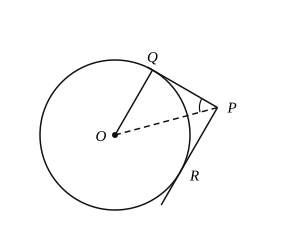
PQ and PR are tangents to a circle with centre O such that OQ = QP. The value of is equal to

Diagram for CBSE 2025 Class 10 Maths question 9
  1. (A)
  2. (B)
  3. (C)
  4. (D)
Show answer & solution
Answer: (A)
  1. (radius tangent).
  2. OQ = QP, so is an isosceles right triangle.
  3. .

If tan A = 1, then 3 sin A + cos A is equal to

  1. (A)
  2. (B)4
  3. (C)
  4. (D)
Show answer & solution
Answer: (C)
  1. gives .
  2. .
Also asked in: 2025 Basic 430/5/1
Q111 markMCQStatistics

Which of the following depends on all observations of a given data ?

  1. (A)Median
  2. (B)Mean
  3. (C)Range
  4. (D)Mode
Show answer & solution
Answer: (B) Mean
  1. Mean = (sum of all observations) / (number of observations), so every observation affects it.
  2. Median, mode and range depend only on particular observations.

The value of k for which roots of quadratic equation k( – 2) + 6 = 0 are real and equal, is

  1. (A)0 only
  2. (B)0, 6
  3. (C)6 only
  4. (D)–6 only
Show answer & solution
Answer: (C) 6 only
  1. The equation is .
  2. For real and equal roots, , so or .
  3. For the equation is not quadratic (it becomes ), so only.

An arc of length 22 cm subtends an angle of at the centre of the circle. If radius of circle is 36 cm, the value of is

  1. (A)35
  2. (B)40
  3. (C)60
  4. (D)30
Show answer & solution
Answer: (A) 35
  1. Arc length .
  2. .
  3. .
Also asked in: 2025 Basic 430/5/1
Q141 markMCQProbability

Two dice are rolled together. The probability that only one die shows number 4, is

  1. (A)
  2. (B)
  3. (C)
  4. (D)
Show answer & solution
Answer: (C)
  1. Total outcomes .
  2. First die 4, second not 4: 5 outcomes; second die 4, first not 4: 5 outcomes.
  3. Favourable , so probability .

The distance between the points (2, 3) and (–2, –3) is

  1. (A)
  2. (B)
  3. (C)
  4. (D)5
Show answer & solution
Answer: (C)
  1. Distance .
  2. .
Also asked in: 2025 Basic 430/5/1
Q161 markMCQPolynomials

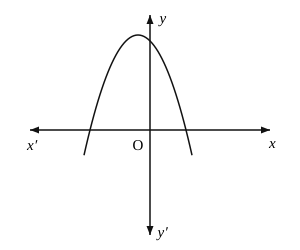
Observe the given graph of polynomial p(). The number of zeroes of p() is

Diagram for CBSE 2025 Class 10 Maths question 16
  1. (A)0
  2. (B)1
  3. (C)3
  4. (D)2
Show answer & solution
Answer: (D) 2
  1. The number of zeroes equals the number of points where the graph meets the -axis.
  2. The curve cuts the -axis at two points, so p() has 2 zeroes.
Q171 markMCQProbability

If E is an event such that P(E) = 1%, then P() is equal to

  1. (A)0.09
  2. (B)0.99
  3. (C)
  4. (D)0.90
Show answer & solution
Answer: (B) 0.99
  1. P(E) = 1% = 0.01, so P() .

The largest possible cone is just fitted inside a hollow cube of edge 25 cm. The radius of the base of the cone is

  1. (A)5 cm
  2. (B)12.5 cm
  3. (C)25 cm
  4. (D)10 cm
Show answer & solution
Answer: (B) 12.5 cm
  1. The base of the largest cone fits exactly on a face of the cube, so its diameter equals the edge, 25 cm.
  2. Radius cm.
Q191 markAssertion–ReasonIntroduction to Trigonometry

Assertion (A) : In a right angle triangle ABC, . Therefore the value of cos (A + C) is equal to 0.
Reason (R) : and .

  1. (A)Both Assertion (A) and Reason (R) are true and Reason (R) is the correct explanation of the Assertion (A).
  2. (B)Both Assertion (A) and Reason (R) are true, but Reason (R) is not the correct explanation of the Assertion (A).
  3. (C)Assertion (A) is true, but Reason (R) is false.
  4. (D)Assertion (A) is false, but Reason (R) is true.
Show answer & solution
Answer: (A) Both Assertion (A) and Reason (R) are true and Reason (R) is the correct explanation of the Assertion (A).
  1. and , so .
  2. , so A is true.
  3. R is true and is exactly the reason used.
Q201 markAssertion–ReasonSurface Areas and Volumes

Assertion (A) : When a hemisphere of same radius (r) is carved out from one side of a solid wooden cylinder, the total surface area of remaining solid is increased by .
Reason (R) : Curved surface area of hemisphere is .

  1. (A)Both Assertion (A) and Reason (R) are true and Reason (R) is the correct explanation of the Assertion (A).
  2. (B)Both Assertion (A) and Reason (R) are true, but Reason (R) is not the correct explanation of the Assertion (A).
  3. (C)Assertion (A) is true, but Reason (R) is false.
  4. (D)Assertion (A) is false, but Reason (R) is true.
Show answer & solution
Answer: (D) Assertion (A) is false, but Reason (R) is true.
  1. Carving out removes one circular face of area and adds the hemisphere's curved surface .
  2. Net increase , not , so A is false.
  3. CSA of a hemisphere , so R is true.
Q212 marksVery Short AnswerCoordinate Geometry

Establish a relation between and y such that point (, y) is equidistant from points (–2, 5) and (3, 9).

Show answer & solution
Answer: (i.e. )
  1. Let P(, y) be equidistant from A(–2, 5) and B(3, 9), so .
  2. .
  3. .
  4. , so .
Q222 marksVery Short AnswerCoordinate Geometry

Using distance formula, prove that the points (1, 5), (2, 3) and (3, 1) are collinear.

Show answer & solution
Answer: Proved.
  1. Let A(1, 5), B(2, 3), C(3, 1).
  2. , .
  3. .
  4. , so A, B, C are collinear.
Also asked in: 2025 Basic 430/5/1
Q232 marksVery Short AnswerReal Numbers

Prove that, for a natural number n, can not end with the digit 0. Which prime number must be multiplied with so that the resultant ends with the digit zero ?

Show answer & solution
Answer: Proved; the prime number is 5.
  1. A number ends with the digit 0 only if it is divisible by 10, i.e. its prime factorisation contains both 2 and 5.
  2. , which has no factor 5.
  3. By the uniqueness of prime factorisation (Fundamental Theorem of Arithmetic), has no other prime factors, so cannot end with 0.
  4. Multiplying by the prime 5 gives , which is divisible by 10, so it ends with 0. The required prime is 5.
Q242 marksVery Short AnswerIntroduction to Trigonometry

Evaluate : .

Show answer & solution
Answer:
  1. , , .
  2. .
Also asked in: 2025 Basic 430/5/1
OR
Q24 (OR) (OR)2 marksVery Short AnswerIntroduction to Trigonometry

Verify that for .

Show answer & solution
Answer: Verified (both sides equal ).
  1. LHS .
  2. .
  3. RHS .
  4. LHS = RHS, hence verified.
Also asked in: 2025 Basic 430/5/1
Q252 marksVery Short AnswerProbability

A bag contains 40 marbles out of which some are white and others are black. If the probability of drawing a black marble is , then find the number of white marbles.

Show answer & solution
Answer: 16
  1. Number of black marbles .
  2. Number of white marbles .
OR
Q25 (OR) (OR)2 marksVery Short AnswerProbability

In a pre-primary class, a teacher put cards numbered 20 to 59 in a bowl. A student picked up a card at random and read the number. Find the probability that the number read was (i) a prime number (ii) a perfect square.

Show answer & solution
Answer: (i) (ii)
  1. Total cards .
  2. (i) Primes: 23, 29, 31, 37, 41, 43, 47, 53, 59, i.e. 9 cards. P .
  3. (ii) Perfect squares: 25, 36, 49, i.e. 3 cards. P .
Q263 marksShort AnswerReal Numbers

Find the smallest number which when increased by 20, is exactly divisible by 72, 90 and 150.

Show answer & solution
Answer: 1780
  1. , , .
  2. LCM .
  3. The smallest number divisible by all three is 1800, so the required number is .
Q273 marksShort AnswerSurface Areas and Volumes

A spherical glass vessel has a cylindrical neck 7 cm long and 8 cm in diameter. The radius of spherical part is 10 cm. Find the volume of the vessel.

Show answer & solution
Answer: cm cm
  1. Volume of sphere .
  2. Volume of neck (cylinder, r = 4 cm, h = 7 cm) .
  3. Total cm.
OR
Q27 (OR) (OR)3 marksShort AnswerSurface Areas and Volumes

From each end of a solid cylinder of height 20 cm and base radius 7 cm, a cone of base radius 2.1 cm and height 5 cm is scooped out. Find the volume of the remaining solid.

Show answer & solution
Answer: 3033.8 cm
  1. Volume of cylinder cm.
  2. Volume of one cone cm.
  3. Two cones cm.
  4. Remaining volume cm.
Q283 marksShort AnswerTriangles

Point E lies on the extended side AD of parallelogram ABCD. BE intersects CD at F. Show that (i) (ii) .

Show answer & solution
Answer: Proved.
  1. ABCD is a parallelogram, so AD BC (hence AE BC) and .
  2. (i) In and : (vertically opposite angles).
  3. (alternate angles, DE BC with transversal DC).
  4. So (AA).
  5. (ii) In and : (opposite angles of a parallelogram).
  6. (alternate angles, AE BC with transversal BE).
  7. So (AA).
Also asked in: 2025 Basic 430/5/1
Q293 marksShort AnswerIntroduction to Trigonometry

Prove that : .

Show answer & solution
Answer: Proved.
  1. .
  2. .
  3. LHS .
  4. = RHS.
Q303 marksShort AnswerPolynomials

If , are zeroes of the polynomial , then form a quadratic polynomial in whose zeroes are and .

Show answer & solution
Answer: , or
  1. , .
  2. Sum of new zeroes .
  3. Product of new zeroes .
  4. Required polynomial , or (any non-zero multiple).
OR
Q30 (OR) (OR)3 marksShort AnswerPolynomials

Find zeroes of the polynomial and verify the relationship between zeroes and its coefficients.

Show answer & solution
Answer: Zeroes and ; relationship verified.
  1. .
  2. Zeroes: and .
  3. Sum and .
  4. Product and .
  5. Both relations hold.
Q313 marksShort AnswerQuadratic Equations

A rectangular field is 16 m long and 10 m wide. There is a path of equal width all around it, having an area of 120 sq.m. Find the width of the path.

Show answer & solution
Answer: 2 m
  1. Let the width of the path be m. The outer rectangle is m by m.
  2. Area of path .
  3. , so , i.e. .
  4. , so (width cannot be negative).
  5. Width of the path m.

From a point on the ground, the angle of elevation of the top of a tree observed by a person is . When moved back by 28 m, in the same line, the angle of elevation from another point on ground becomes . Find the height of the tree and its distance from the initial point. (Use = 1.73)

Show answer & solution
Answer: Height = m = 24.22 m; distance from the initial point = 14 m
  1. Let the height of the tree be m and its distance from the initial point be m.
  2. , so .
  3. , so .
  4. gives , so m.
  5. m.
Q335 marksLong AnswerStatistics

Find 'mean' and 'mode' of the following data :
Class: 10-25, 25-40, 40-55, 55-70, 70-85, 85-100
Number of Students: 12, 10, 15, 13, 8, 12

Show answer & solution
Answer: Mean ; Mode
  1. Class marks: 17.5, 32.5, 47.5, 62.5, 77.5, 92.5; take , , : –2, –1, 0, 1, 2, 3.
  2. : –24, –10, 0, 13, 16, 36; , .
  3. Mean (approx.).
  4. Modal class 40-55: , , , , .
  5. Mode (approx.).
OR
Q33 (OR) (OR)5 marksLong AnswerStatistics

The following table shows the ages of patients admitted in a hospital during a year :
Age (in years): 5-15, 15-25, 25-35, 35-45, 45-55, 55-65
Number of Patients: 7, 10, 21, 22, 15, 5
Find 'mode' and 'median' of the above data.

Show answer & solution
Answer: Mode = 36.25 years; Median years
  1. Modal class 35-45: , , , , .
  2. Mode .
  3. Cumulative frequencies: 7, 17, 38, 60, 75, 80; , .
  4. Median class 35-45: , , , .
  5. Median (approx.).

The sum of a 2-digit number and the number obtained by reversing the order of its digits, is 121. The two digits differ by 3.
(i) Represent the above information in the form of pair of linear equations.
(ii) Show that the equations have unique solution.
(iii) Solve the equations and find the number.

Show answer & solution
Answer: (i) , (tens digit , units digit ) (ii) , so unique solution (iii) 74 (or 47 if the units digit is the larger one)
  1. (i) Let the tens digit be and the units digit be . The number is and the reversed number is .
  2. gives , i.e. .
  3. The digits differ by 3: (taking the tens digit as the larger).
  4. (ii) and ; since , the pair has a unique solution.
  5. (iii) Adding: , so and . The number is 74.
  6. (If instead , then , and the number is 47.)
Q355 marksLong AnswerTriangles

If a line is drawn parallel to one side of a triangle to intersect the other two sides in distinct points, then prove that the other two sides are divided in the same ratio.

Show answer & solution
Answer: Proved.
  1. Given: In , DE BC with D on AB and E on AC. To prove: .
  2. Construction: join BE and CD; draw EM AB and DN AC.
  3. ar(ADE) and ar(BDE) , so .
  4. ar(ADE) and ar(DEC) , so .
  5. and are on the same base DE and between the same parallels DE and BC, so ar(BDE) = ar(DEC).
  6. Hence .
OR
Q35 (OR) (OR)5 marksLong AnswerTriangles

It is given that sides AB and AC and median AD of are respectively proportional to sides PQ and PR and median PM of another . Show that .

Show answer & solution
Answer: Proved.
  1. Given .
  2. Produce AD to E with DE = AD and PM to N with MN = PM; join CE and RN.
  3. (BD = DC, AD = DE, vertically opposite angles), so CE = AB and .
  4. Similarly RN = PQ and .
  5. Now .
  6. So (SSS), giving and .
  7. Then .
  8. Adding: .
  9. With , (SAS).
Q364 marksCase StudyArithmetic Progressions

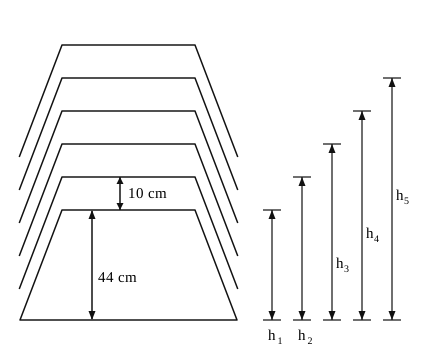
A tent house owner provides furniture on rent. He stacks chairs in his shop to save space.
In the diagram, the height of seat of chair from ground is represented by , , , .... The height of first seat is 44 cm from ground level and gap between every two seats is 10 cm.
(i) Write the values of , , , and in this order only. (1)
(ii) Show that the above values form an A.P. Write its first term and common difference. (1)
(iii) (a) If chairs can be stacked up to the maximum height of 160 cm, then find the maximum number of chairs in a stack. (2)
OR
(iii) (b) Is it possible to stack 15 chairs if maximum height of the stack can not be more than 180 cm ? Justify your answer. (2)

Diagram for CBSE 2025 Class 10 Maths question 36
Show answer & solution
Answer: (i) 44, 54, 64, 74, 84 (cm) (ii) Yes, the common difference is constant (10 cm); first term = 44, common difference = 10 (iii) (a) 12 chairs OR (b) No, cm > 180 cm
  1. (i) , , , , (in cm).
  2. (ii) Each term exceeds the previous one by 10, a constant, so they form an A.P. with , .
  3. (iii) (a) gives , so .
  4. Maximum number of chairs (seat height 154 cm; the 13th would be at 164 cm).
  5. (iii) (b) cm, which is more than 180 cm.
  6. So 15 chairs cannot be stacked.
Q374 marksCase StudyCircles

In a Fine Arts class, students were asked to design triangular tiles in geometric pattern.
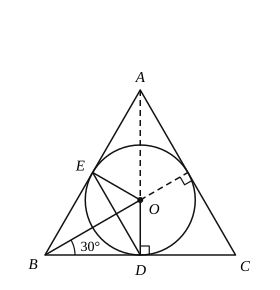
Neelima made a circular design inside an equilateral triangle ABC. The radius of the circle is 4 cm. Observe the diagram and answer the following questions :
(i) Determine the length OB. (1)
(ii) Is DE CA ? Give reason for your answer. (1)
(iii) (a) Write all angles of quadrilateral OEBD and show that it is a cyclic quadrilateral. (2)
OR
(iii) (b) Find the perimeter of . (Use ) (2)

Diagram for CBSE 2025 Class 10 Maths question 37
Show answer & solution
Answer: (i) OB = 8 cm (ii) Yes, D and E are mid-points of BC and AB (iii) (a) , , , ; cyclic since OR (b) cm = 41.52 cm
  1. The circle touches BC at D and AB at E, so OD BC, OE AB and OD = OE = 4 cm.
  2. (i) In right , : , so OB cm.
  3. (ii) Tangents from a point are equal: BD = BE, CD = CF, AE = AF (F the point of contact on CA). As AB = BC = CA, each tangent length is half a side, so D and E are mid-points of BC and BA.
  4. By the mid-point theorem, DE CA. Yes.
  5. (iii) (a) , , (angle of equilateral triangle), .
  6. (also ): opposite angles are supplementary, so OEBD is cyclic.
  7. (iii) (b) , so BD cm and BC cm.
  8. Perimeter cm.
Q384 marksCase StudyAreas Related to Circles

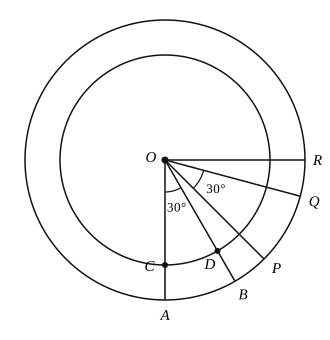
A farmer has put up a decorative windmill in his farm in which there are eight blades of equal width and equally placed in a circular arrangement. A circular wire goes through them.
The diagram shows two blades OAB and OPQ in a quarter circle with centre O. , OA = 28 cm, OC = 21 cm.
O is the centre of both the circles.
(i) Determine the measure of . (1)
(ii) Find length of arc CD. (1)
(iii) (a) Find the area of region CABD. (2)
OR
(iii) (b) Find perimeter of region CABD. (2)

Diagram for CBSE 2025 Class 10 Maths question 38
Show answer & solution
Answer: (i) (ii) 11 cm (iii) (a) cm cm OR (b) cm cm
  1. (i) The quarter circle AOR is ; the two blades take . The blades are equally placed, so the remaining is shared equally by and : (check: 8 blades of and 8 equal gaps of make ).
  2. (ii) Arc CD cm.
  3. (iii) (a) Area CABD = sector OAB – sector OCD cm.
  4. (iii) (b) Arc AB cm; CA = BD = 28 – 21 = 7 cm.
  5. Perimeter cm.
← 2025 Basic 430/5/1 2025 Basic 430/5/3 →
Practise smarter: chapter-wise revision, formula sheets and step-by-step NCERT solutions on MonoMath CBSE →