CBSE Class 10 Maths Standard 2025 Question Paper 30/1/2 with Solutions
All 44 questions from the CBSE Class 10 Mathematics Standard board paper, Set 30/1/2 (2025),
with answers and step-by-step solutions. Total 80 marks. Tap “Show answer & solution” under any question.
A piece of wire 20 cm long is bent into the form of an arc of a circle of radius π60 cm. The angle subtended by the arc at the centre of the circle is :
Assertion (A) : If we join two hemispheres of same radius along their bases, then we get a sphere. Reason (R) : Total Surface Area of a sphere of radius r is 3πr2.
(A)Both Assertion (A) and Reason (R) are true and Reason (R) is the correct explanation of the Assertion (A).
(B)Both Assertion (A) and Reason (R) are true, but Reason (R) is not the correct explanation of the Assertion (A).
(C)Assertion (A) is true, but Reason (R) is false.
(D)Assertion (A) is false, but Reason (R) is true.
Show answer & solution
Answer: (C) Assertion (A) is true, but Reason (R) is false.
Two hemispheres of the same radius joined along their circular bases form a complete sphere. Assertion is true.
The surface area of a sphere of radius r is 4πr2, not 3πr2 (3πr2 is the total surface area of a solid hemisphere). Reason is false.
Assertion (A) : The probability of selecting a number at random from the numbers 1 to 20 is 1. Reason (R) : For any event E, if P(E) = 1, then E is called a sure event.
(A)Both Assertion (A) and Reason (R) are true and Reason (R) is the correct explanation of the Assertion (A).
(B)Both Assertion (A) and Reason (R) are true, but Reason (R) is not the correct explanation of the Assertion (A).
(C)Assertion (A) is true, but Reason (R) is false.
(D)Assertion (A) is false, but Reason (R) is true.
Show answer & solution
Answer: (A) Both Assertion (A) and Reason (R) are true and Reason (R) is the correct explanation of the Assertion (A).
When a number is selected from 1 to 20, it is certain that the number selected is one of the numbers 1 to 20, so this is a sure event and its probability is 1. Assertion is true.
Reason states the definition of a sure event: if P(E)=1, E is a sure event. Reason is true.
The assertion holds because the event is a sure event, so R correctly explains A.
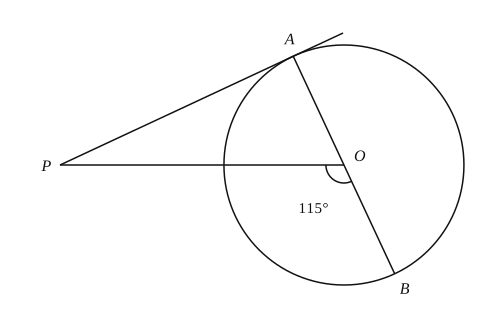
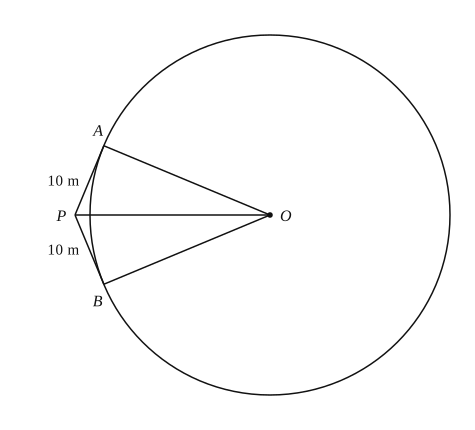
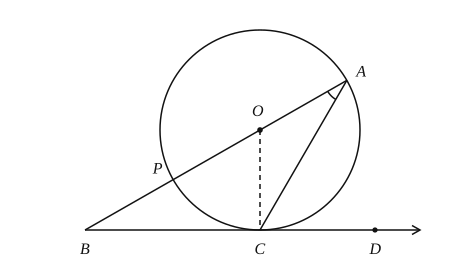
A person is standing at P outside a circular ground at a distance of 26 m from the centre of the ground. He found that his distances from the points A and B on the ground are 10 m (PA and PB are tangents to the circle). Find the radius of the circular ground.
Show answer & solution
Answer:24 m
OA⊥PA (radius is perpendicular to tangent at point of contact), so △OAP is right-angled at A.
The coordinates of the centre of a circle are (2a,a−7). Find the value(s) of 'a' if the circle passes through the point (11,−9) and has diameter 102 units.
Show answer & solution
Answer:a=3 or a=5
Radius =52, so (radius)2=50.
Distance from centre (2a,a−7) to (11,−9) equals the radius:
Three sets of Physics, Chemistry and Mathematics books have to be stacked in such a way that all the books are stored subject-wise and the height of each stack is the same. The number of Physics books is 144, the number of Chemistry books is 180 and the number of Mathematics books is 192. Assuming that the books are of same thickness, determine the number of stacks of Physics, Chemistry and Mathematics books.
Show answer & solution
Answer: Physics: 12 stacks, Chemistry: 15 stacks, Mathematics: 16 stacks (12 books in each stack)
For the least number of stacks of equal height, the number of books in each stack is the HCF of 144, 180 and 192.
The following frequency distribution gives the monthly consumption of electricity of 68 consumers of a locality. Find the mean and mode of the data : Monthly Consumption (in units): 65 – 85, 85 – 105, 105 – 125, 125 – 145, 145 – 165, 165 – 185, 185 – 205 Number of Consumers: 4, 5, 13, 20, 14, 8, 4
Show answer & solution
Answer: Mean =137171≈137.06 units; Mode =1351310≈135.77 units
Class marks xi: 75, 95, 115, 135, 155, 175, 195. Take assumed mean a=135, h=20, ui=20xi−135: −3,−2,−1,0,1,2,3.
Vijay invested certain amounts of money in two schemes A and B, which offer interest at the rate of 8% per annum and 9% per annum, respectively. He received ₹ 1,860 as the total annual interest. However, had he interchanged the amounts of investments in the two schemes, he would have received ₹ 20 more as annual interest. How much money did he invest in each scheme ?
Show answer & solution
Answer: Scheme A: ₹ 12,000; Scheme B: ₹ 10,000
Let the amounts in schemes A and B be ₹ x and ₹ y.
1008x+1009y=1860, i.e. 8x+9y=186000 ... (1)
After interchanging: 1009x+1008y=1880, i.e. 9x+8y=188000 ... (2)
Adding: 17(x+y)=374000, so x+y=22000 ... (3)
Subtracting (1) from (2): x−y=2000 ... (4)
From (3) and (4): x=12000, y=10000.
Check: 960+900=1860 and 1080+800=1880.
He invested ₹ 12,000 in scheme A and ₹ 10,000 in scheme B.
A two-digit number is such that the product of its digits is 12. When 36 is added to this number, the digits interchange their places. Find the number.
Show answer & solution
Answer:26
Let the tens digit be x and the units digit be y; the number is 10x+y.
(10y+x)−(10x+y)=36, so 9(y−x)=36 and y=x+4.
xy=12: x(x+4)=12, i.e. x2+4x−12=0.
(x+6)(x−2)=0, so x=2 (a digit cannot be negative) and y=6.
A student scored a total of 32 marks in class tests in Mathematics and Science. Had he scored 2 marks less in Science and 4 marks more in Mathematics, the product of his marks would have been 253. Find his marks in the two subjects.
Show answer & solution
Answer: Mathematics 19, Science 13; or Mathematics 7, Science 25
Let the marks in Mathematics be x; then Science =32−x.
(x+4)(32−x−2)=253, i.e. (x+4)(30−x)=253.
30x−x2+120−4x=253, so x2−26x+133=0.
(x−7)(x−19)=0, so x=7 or x=19.
If x=19: Mathematics 19, Science 13 (check: 23×11=253).
If x=7: Mathematics 7, Science 25 (check: 11×23=253).
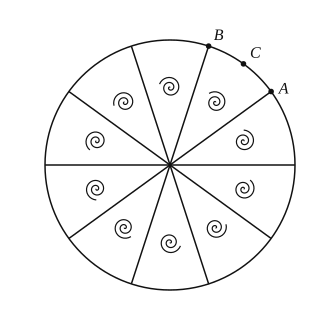
A brooch is a decorative piece often worn on clothing like jackets, blouses or dresses to add elegance. Made from precious metals and decorated with gemstones, brooches come in many shapes and designs. One such brooch is made with silver wire in the form of a circle with diameter 35 mm. The wire is also used in making 5 diameters which divide the circle into 10 equal sectors as shown in the figure. Based on the above given information, answer the following questions : (i) Find the central angle of each sector. (1) (ii) Find the length of the arc ACB. (1) (iii) (a) Find the area of each sector of the brooch. (2) OR (iii) (b) Find the total length of the silver wire used. (2)
Show answer & solution
Answer: (i) 36∘ (ii) 11 mm (iii) (a) 96.25 mm2 OR (iii) (b) 285 mm
Radius r=235=17.5 mm; circumference =2×722×17.5=110 mm.
(i) Central angle of each sector =10360∘=36∘.
(ii) Arc ACB is the arc of one sector: length =36036×110=11 mm.
(iii) (a) Area of each sector =36036×722×(17.5)2=101×962.5=96.25 mm2.
(iii) (b) Wire = circumference +5 diameters =110+5×35=110+175=285 mm.
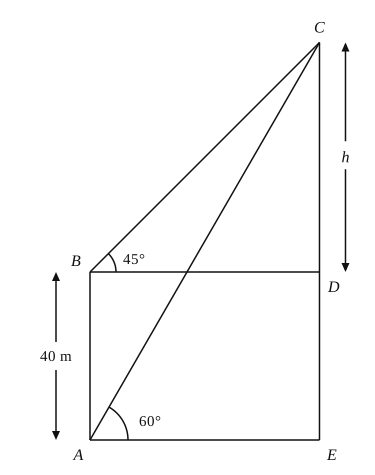
Amrita stood near the base of a lighthouse, gazing up at its towering height. She measured the angle of elevation to the top and found it to be 60∘. Then, she climbed a nearby observation deck, 40 metres higher than her original position and noticed the angle of elevation to the top of lighthouse to be 45∘. Based on the above given information, answer the following questions : (i) If CD is h metres, find the distance BD in terms of 'h'. (1) (ii) Find distance BC in terms of 'h'. (1) (iii) (a) Find the height CE of the lighthouse [Use 3=1.73] (2) OR (iii) (b) Find distance AE, if AC = 100 m. (2)
Show answer & solution
Answer: (i) BD=h m (ii) BC=h2 m (iii) (a) CE=20(3+3)=94.6 m OR (iii) (b) AE=50 m
A is the original position, B the deck (AB=40 m), CE the lighthouse, BD∥AE, DE=40 m, CD=h.
(i) In right △BDC: tan45∘=BDCD, so BD=h m.
(ii) BC=BD2+CD2=h2+h2=h2 m.
(iii) (a) AE=BD=h and CE=h+40. In right △AEC: tan60∘=hh+40=3.
h(3−1)=40, so h=3−140=20(3+1)=20×2.73=54.6 m.
CE=h+40=54.6+40=94.6 m.
(iii) (b) In right △AEC: cos60∘=ACAE, so AE=100×21=50 m.
A school is organizing a charity run to raise funds for a local hospital. The run is planned as a series of rounds around a track, with each round being 300 metres. To make the event more challenging and engaging, the organizers decide to increase the distance of each subsequent round by 50 metres. For example, the second round will be 350 metres, the third round will be 400 metres and so on. The total number of rounds planned is 10. Based on the information given above, answer the following questions : (i) Write the fourth, fifth and sixth term of the Arithmetic Progression so formed. (1) (ii) Determine the distance of the 8th round. (1) (iii) (a) Find the total distance run after completing all 10 rounds. (2) OR (iii) (b) If a runner completes only the first 6 rounds, what is the total distance run by the runner ? (2)
Show answer & solution
Answer: (i) 450 m, 500 m, 550 m (ii) 650 m (iii) (a) 5250 m OR (iii) (b) 2550 m
AP: a=300, d=50.
(i) a4=300+3(50)=450, a5=500, a6=550 (metres).
(ii) a8=300+7(50)=650 m.
(iii) (a) S10=210[2(300)+9(50)]=5(600+450)=5250 m.
(iii) (b) S6=26[2(300)+5(50)]=3(600+250)=2550 m.