CBSE Class 10 Maths Standard 2025 Question Paper 30/2/2 with Solutions
All 44 questions from the CBSE Class 10 Mathematics Standard board paper, Set 30/2/2 (2025),
with answers and step-by-step solutions. Total 80 marks. Tap “Show answer & solution” under any question.
Assertion (A) : The pair of linear equations px+3y+59=0 and 2x+6y+118=0 will have infinitely many solutions if p=1. Reason (R) : If the pair of linear equations px+3y+19=0 and 2x+6y+157=0 has a unique solution, then p=1.
(A)Both Assertion (A) and Reason (R) are true and Reason (R) is the correct explanation of the Assertion (A).
(B)Both Assertion (A) and Reason (R) are true, but Reason (R) is not the correct explanation of the Assertion (A).
(C)Assertion (A) is true, but Reason (R) is false.
(D)Assertion (A) is false, but Reason (R) is true.
Show answer & solution
Answer: (B) Both Assertion (A) and Reason (R) are true, but Reason (R) is not the correct explanation of the Assertion (A).
A: with p=1, 21=63=11859=21, so infinitely many solutions; A is true
R: unique solution needs 2p=63, i.e. p=1; R is true
R is about a different pair and the unique-solution condition, so it does not explain A
Assertion (A) : Common difference of the AP : 5,1,−3,−7,… is 4. Reason (R) : Common difference of the AP : a1,a2,a3,…,an is obtained by d=an−an−1.
(A)Both Assertion (A) and Reason (R) are true and Reason (R) is the correct explanation of the Assertion (A).
(B)Both Assertion (A) and Reason (R) are true, but Reason (R) is not the correct explanation of the Assertion (A).
(C)Assertion (A) is true, but Reason (R) is false.
(D)Assertion (A) is false, but Reason (R) is true.
Show answer & solution
Answer: (D) Assertion (A) is false, but Reason (R) is true.
Common difference =1−5=−4, not 4, so A is false
d=an−an−1 is the correct definition, so R is true
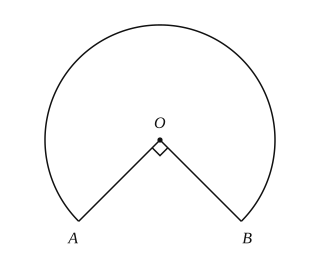
In the given figure, the shape of the top of a table is that of a sector of a circle with centre O and ∠AOB=90∘. If AO=OB=42 cm, then find the perimeter of the top of the table.
Show answer & solution
Answer: 282 cm
The table top is the major sector, with angle 360∘−90∘=270∘
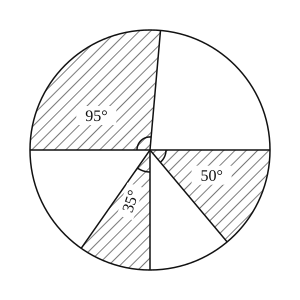
In the given figure, three sectors of a circle of radius 5 cm, making angles 35∘, 50∘ and 95∘ at the centre are shaded. Find the area of the shaded region. [Use π=722]
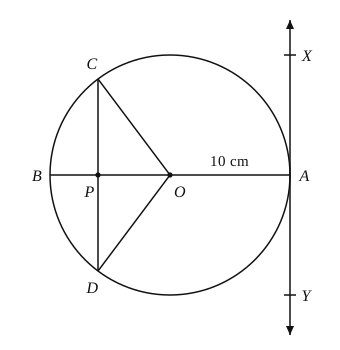
At point A on the diameter AB of a circle of radius 10 cm, tangent XAY is drawn to the circle. Find the length of the chord CD parallel to XY at a distance of 16 cm from A.
Show answer & solution
Answer: 16 cm
OA⊥XY and CD∥XY, so the diameter AB is perpendicular to CD; let it meet CD at P
AP=16 cm, so OP=16−10=6 cm
In right △OPC: CP=OC2−OP2=100−36=8 cm
The perpendicular from the centre bisects the chord, so CD=2×8=16 cm
A sum of ₹ 2,000 is invested at 7% per annum simple interest. Calculate the interests at the end of 1st, 2nd and 3rd year. Do these interests form an AP ? If so, find the interest at the end of the 27th year.
Show answer & solution
Answer: ₹ 140, ₹ 280, ₹ 420; yes, they form an AP; interest at the end of the 27th year = ₹ 3,780
Interest for one year =1002000×7×1=₹140
Interest at end of years 1, 2, 3: ₹ 140, ₹ 280, ₹ 420
Differences are equal (140), so they form an AP with a=140, d=140
The length of the hour hand of a clock is 10 cm. Find the area of the minor sector swept by the hour hand of the clock between 5 a.m. to 8 a.m. Also, find the area of the major sector.
Show answer & solution
Answer: Minor sector =7550≈78.57 cm2; major sector =71650≈235.71 cm2
The hour hand turns 30∘ per hour; from 5 a.m. to 8 a.m. is 3 hours, so angle =90∘
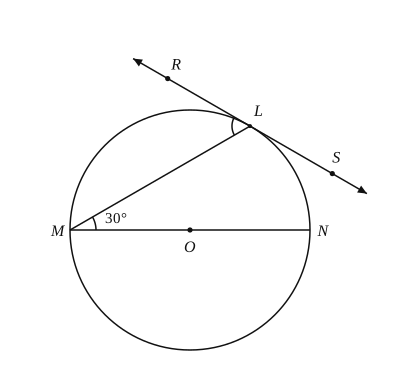
Prove that the angle between the two tangents drawn from an external point to a circle is supplementary to the angle subtended by the line-segment joining the points of contact at the centre.
Show answer & solution
Answer: Proved.
Let PA and PB be tangents from an external point P to a circle with centre O, touching it at A and B.
The radius is perpendicular to the tangent at the point of contact, so ∠OAP=∠OBP=90∘
In quadrilateral OAPB, ∠OAP+∠APB+∠OBP+∠AOB=360∘
90∘+∠APB+90∘+∠AOB=360∘
∠APB+∠AOB=180∘, so the angle between the tangents is supplementary to ∠AOB.
The time taken by a person to travel an upward distance of 150 km was 221 hours more than the time taken in the downward return journey. If he returned at a speed of 10 km/h more than the speed while going up, find the speeds in each direction.
Show answer & solution
Answer: Upward speed 20 km/h; downward speed 30 km/h
Let the upward speed be x km/h; downward speed =x+10 km/h
x150−x+10150=25
x(x+10)1500=25, so x2+10x−600=0
(x+30)(x−20)=0, so x=20 (speed cannot be negative)
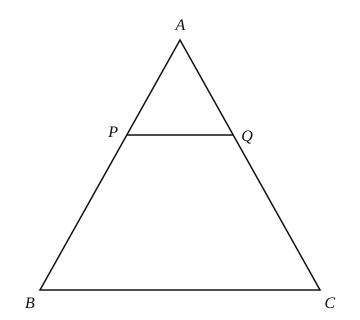
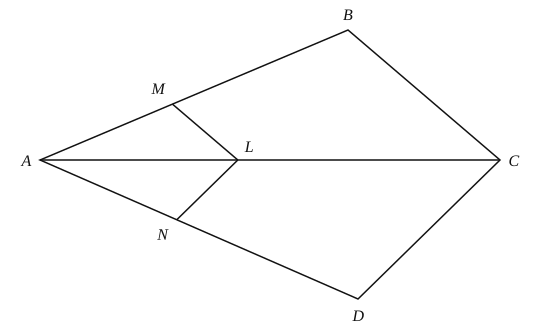
Prove that a line drawn parallel to one side of a triangle to intersect the other two sides in distinct points divides the other two sides in the same ratio. Hence, in the figure given below, prove that MBAM=NDAN where LM∥CB and LN∥CD.
Show answer & solution
Answer: Proved.
Theorem (BPT): In △PQR, let ST∥QR with S on PQ and T on PR. To prove SQPS=TRPT.
Join QT and RS. Draw TN⊥PQ and SM⊥PR.
ar(△PST)=21×PS×TN and ar(△QST)=21×SQ×TN, so ar(△QST)ar(△PST)=SQPS
Similarly ar(△RTS)ar(△PST)=TRPT
△QST and △RTS are on the same base ST and between the same parallels ST and QR, so ar(△QST)=ar(△RTS)
Hence SQPS=TRPT.
Application: In △ABC, LM∥CB, so by BPT MBAM=LCAL
The angle of elevation of an airborne helicopter from a point A on the ground is 45∘. After a flight of 15 seconds, the angle of elevation of the helicopter changes to 30∘. If the helicopter is flying at a constant height of 2000 m, find the speed of the helicopter. (Take 3=1.732)
Show answer & solution
Answer: 97.6 m/s
Initial horizontal distance from A: tan45∘=x12000, so x1=2000 m
Later: tan30∘=x22000, so x2=20003 m
Distance flown =20003−2000=2000(3−1)=2000×0.732=1464 m
A girl 1.5 m tall is standing at some distance from a 30 m high tower. The angle of elevation from her eye to the top of the tower increases from 30∘ to 60∘ as she walks towards the tower. Find the distance she walked towards the tower.
Show answer & solution
Answer:193 m ≈32.91 m
Height of tower above her eye level =30−1.5=28.5 m
Initial distance: tan30∘=d128.5, so d1=28.53 m
Final distance: tan60∘=d228.5, so d2=328.5 m
Distance walked =28.53−328.5=328.5×2=357=193≈32.91 m
Rahul is a lucky charm for his cricket team. He has a jar of cards with numbers from 10 to 74. Before each match, he draws a card from the jar. If the card bears an even number, the team wins. If the number is even and divisible by 5, they win by a big margin. If the number is an odd number less than 30, they win by a small margin. And if the number is a prime number between 50 and 74, they lose. Answer the following questions if Rahul draws a card today : (i) What is the probability that Rahul draws a card with an even number ? (1) (ii) What is the probability that Rahul draws a card with an odd number less than 30 ? (1) (iii) (a) What is the probability that Rahul draws a card with a prime number between 50 and 74 ? (2) OR (iii) (b) What is the probability that Rahul draws a card with an even number divisible by 5 ? (2)
Show answer & solution
Answer: (i) 6533 (ii) 132 (iii) (a) 656; OR (b) 657
Total cards: 10 to 74, i.e. 74−10+1=65
(i) Even numbers 10, 12, ..., 74: 274−10+1=33; P =6533
(ii) Odd numbers less than 30: 11, 13, ..., 29, i.e. 10 numbers; P =6510=132
(iii) (a) Primes between 50 and 74: 53, 59, 61, 67, 71, 73, i.e. 6; P =656
(iii) (b) Even numbers divisible by 5 are multiples of 10: 10, 20, ..., 70, i.e. 7; P =657
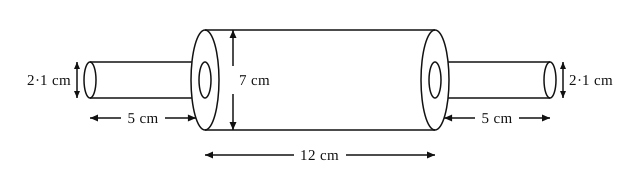
A skilled carpenter decided to craft a special rolling pin for the local baker. He carefully joined three cylindrical pieces of wood – two small ones on the ends and one larger in the centre to create a perfect tool. The baker loved the rolling pin, as it rolled out the smoothest dough for breads and pastries. The length of the bigger cylindrical part is 12 cm and diameter is 7 cm and the length of each smaller cylindrical part is 5 cm and diameter is 2.1 cm. Based on the above information, answer the following questions : (i) Find the volume of the bigger cylindrical part. (1) (ii) Find the curved surface area of the bigger cylindrical part. (1) (iii) (a) Find the ratio of the volume of the bigger cylindrical part to the total volume of the two smaller (identical) cylindrical parts. (2) OR (iii) (b) Find the sum of the curved surface areas of the two identical smaller cylindrical parts. (2)
Show answer & solution
Answer: (i) 462 cm3 (ii) 264 cm2 (iii) (a) 40:3; OR (b) 66 cm2
(i) Bigger part: r=3.5 cm, h=12 cm; V=722×3.5×3.5×12=462 cm3
(ii) CSA =2×722×3.5×12=264 cm2
(iii) (a) Each smaller part: r=1.05 cm, h=5 cm; V=722×1.05×1.05×5=17.325 cm3
Two smaller parts: 34.65 cm3
Ratio =462:34.65=40:3
(iii) (b) CSA of one smaller part =2×722×1.05×5=33 cm2
A school is organizing a grand cultural event to show the talent of its students. To accommodate the guests, the school plans to rent chairs and tables from a local supplier. It finds that rent for each chair is ₹ 50 and for each table is ₹ 200. The school spends ₹ 30,000 for renting the chairs and tables. Also, the total number of items (chairs and tables) rented are 300. If the school rents ‘x’ chairs and ‘y’ tables, answer the following questions : (i) Write down the pair of linear equations representing the given information. (1) (ii) (a) Find the number of chairs and number of tables rented by the school. (2) OR (ii) (b) If the school wants to spend a maximum of ₹ 27,000 on 300 items (tables and chairs), then find the number of chairs and tables it can rent. (2) (iii) What is maximum number of tables that can be rented in ₹ 30,000 if no chairs are rented ? (1)
Show answer & solution
Answer: (i) x+y=300 and 50x+200y=30000 (ii) (a) 200 chairs and 100 tables; OR (b) 220 chairs and 80 tables (iii) 150 tables
(i) Number of items: x+y=300; cost: 50x+200y=30000, i.e. x+4y=600
(ii) (a) Subtract: (x+4y)−(x+y)=600−300, so 3y=300, y=100; x=200
200 chairs and 100 tables
(ii) (b) x+y=300 and 50x+200y=27000, i.e. x+4y=540