CBSE Class 10 Maths Standard 2025 Question Paper 30/4/1 with Solutions
All 44 questions from the CBSE Class 10 Mathematics Standard board paper, Set 30/4/1 (2025),
with answers and step-by-step solutions. Total 80 marks. Tap “Show answer & solution” under any question.
The number of red balls in a bag is 10 more than the number of black balls. If the probability of drawing a red ball at random from this bag is 53, then the total number of balls in the bag is :
A 30 m long rope is tightly stretched and tied from the top of pole to the ground. If the rope makes an angle of 60∘ with the ground, the height of the pole is :
On the top face of the wooden cube of side 7 cm, hemispherical depressions of radius 0.35 cm are to be formed by taking out the wood. The maximum number of depressions that can be formed is :
The cumulative frequency for calculating median is obtained by adding the frequencies of all the :
(A)classes up to the median class
(B)classes following the median class
(C)classes preceding the median class
(D)all classes
Show answer & solution
Answer: (C) classes preceding the median class
In the median formula, cf is the cumulative frequency of the class preceding the median class, i.e. the sum of frequencies of all classes before the median class.
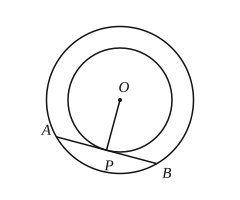
In the adjoining figure, AB is the chord of the larger circle touching the smaller circle. The centre of both the circles is O. If AB=2r and OP=r, then the radius of larger circle is :
(A)2r
(B)3r
(C)22r
(D)2r
Show answer & solution
Answer: (D) 2r
AB touches the smaller circle at P, so OP⊥AB.
The perpendicular from the centre bisects the chord: AP=22r=r
Assertion (A) : 4n ends with digit 0 for some natural number n. Reason (R) : For a number 'x' having 2 and 5 as its prime factors, xn always ends with digit 0 for every natural number n.
(A)Both, Assertion (A) and Reason (R) are true and Reason (R) is correct explanation of Assertion (A).
(B)Both, Assertion (A) and Reason (R) are true but Reason (R) is not the correct explanation of Assertion (A).
(C)Assertion (A) is true but Reason (R) is false.
(D)Assertion (A) is false but Reason (R) is true.
Show answer & solution
Answer: (D) Assertion (A) is false but Reason (R) is true.
4n=22n has only the prime factor 2; to end in 0 it must have 5 as a factor. So A is false.
If 2 and 5 are prime factors of x, then 10∣x, so 10∣xn and xn ends in 0. So R is true.
Assertion (A) : Tangents drawn at the end points of a diameter of a circle are always parallel to each other. Reason (R) : The lengths of tangents drawn to a circle from a point outside the circle are always equal.
(A)Both, Assertion (A) and Reason (R) are true and Reason (R) is correct explanation of Assertion (A).
(B)Both, Assertion (A) and Reason (R) are true but Reason (R) is not the correct explanation of Assertion (A).
(C)Assertion (A) is true but Reason (R) is false.
(D)Assertion (A) is false but Reason (R) is true.
Show answer & solution
Answer: (B) Both, Assertion (A) and Reason (R) are true but Reason (R) is not the correct explanation of Assertion (A).
A: each tangent is perpendicular to the same diameter, so the two tangents are parallel. A is true.
R is a true theorem (equal tangent lengths), but it is not the reason for A, which uses tangent ⊥ radius.
A 1.5 m tall boy is walking away from the base of a lamp post which is 12 m high, at the speed of 2.5 m/sec. Find the length of his shadow after 3 seconds.
Show answer & solution
Answer:1415 m (about 1.07 m)
Distance walked in 3 s =2.5×3=7.5 m
Let the shadow be s m. The boy and the lamp post are both vertical, so the two right triangles formed with the tip of the shadow are similar (AA).
Find the coordinates of the point C which lies on the line AB produced such that AC=2BC, where coordinates of points A and B are (−1,7) and (4,−3) respectively.
Show answer & solution
Answer:C(9,−13)
C lies on AB produced beyond B and AC=2BC, so AB=AC−BC=BC: B is the mid-point of AC.
Two friends Anil and Ashraf were born in the December month in the year 2010. Find the probability that : (i) they share same date of birth. (ii) they have different dates of birth.
Show answer & solution
Answer: (i) 311 (ii) 3130
December has 31 days. Whatever Anil's date is, Ashraf's date can be any of 31 equally likely days.
Let x and y be two distinct prime numbers and p=x2y3, q=xy4, r=x5y2. Find the HCF and LCM of p, q and r. Further check if HCF(p,q,r)×LCM(p,q,r)=p×q×r or not.
The monthly incomes of two persons are in the ratio 9 : 7 and their monthly expenditures are in the ratio 4 : 3. If each saved ₹ 5,000, express the given situation algebraically as a system of linear equations in two variables. Hence, find their respective monthly incomes.
Show answer & solution
Answer:9x−4y=5000, 7x−3y=5000; incomes ₹ 45,000 and ₹ 35,000
Let incomes be ₹ 9x and ₹ 7x, expenditures ₹ 4y and ₹ 3y.
9x−4y=5000 ... (1), 7x−3y=5000 ... (2)
(1) ×3: 27x−12y=15000; (2) ×4: 28x−12y=20000
Subtract: x=5000; then 4y=45000−5000=40000, y=10000
P(x,y), Q(−2,−3) and R(2,3) are the vertices of a right triangle PQR right angled at P. Find the relationship between x and y. Hence, find all possible values of x for which y=2.
The sides of a right triangle are such that the longest side is 4 m more than the shortest side and the third side is 2 m less than the longest side. Find the length of each side of the triangle. Also, find the difference between the numerical values of the area and the perimeter of the given triangle.
Show answer & solution
Answer: Sides 6 m, 8 m, 10 m; difference = 0 (area 24, perimeter 24)
Let shortest side =x m; longest =x+4; third side =x+2
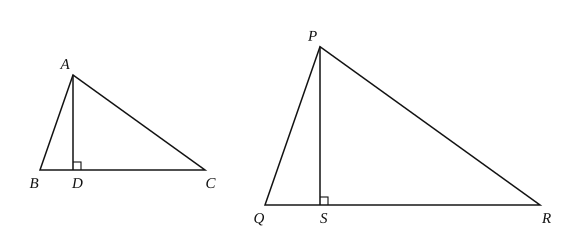
The corresponding sides of △ABC and △PQR are in the ratio 3 : 5. AD⊥BC and PS⊥QR as shown in the following figures : (i) Prove that △ADC∼△PSR (ii) If AD=4 cm, find the length of PS. (iii) Using (ii) find ar(△ABC) : ar(△PQR)
Show answer & solution
Answer: (i) Proved. (ii) PS=320 cm (iii) 9:25
(i) △ABC∼△PQR (sides proportional), so ∠C=∠R.
In △ADC and △PSR: ∠ADC=∠PSR=90∘ and ∠C=∠R, so △ADC∼△PSR (AA).
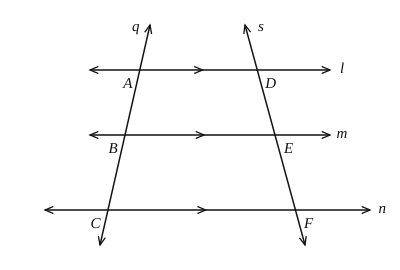
State basic proportionality theorem. Use it to prove the following : If three parallel lines l, m, n are intersected by transversals q and s as shown in the adjoining figure, then BCAB=EFDE.
Show answer & solution
Answer: Statement given; Proved.
BPT: If a line is drawn parallel to one side of a triangle to intersect the other two sides in distinct points, the other two sides are divided in the same ratio.
Proof of BPT: In △ABC let DE∥BC with D on AB, E on AC. Join BE and CD; draw EN⊥AB, DM⊥AC.
ar(BDE)ar(ADE)=21DB⋅EN21AD⋅EN=DBAD and ar(DEC)ar(ADE)=ECAE
△BDE and △DEC are on the same base DE between the same parallels DE and BC, so ar(BDE) = ar(DEC). Hence DBAD=ECAE.
Application: Join AF, cutting line m at G.
In △ACF, BG∥CF (as m∥n), so by BPT BCAB=GFAG ... (1)
In △FAD, GE∥AD (as m∥l), so by BPT GAFG=EDFE, i.e. GFAG=EFDE ... (2)
A wooden cubical die is formed by forming hemispherical depressions on each face of the cube such that face 1 has one depression, face 2 has two depressions and so on. The sum of number of hemispherical depressions on opposite faces is always 7. If the edge of the cubical die measures 5 cm and each hemispherical depression is of diameter 1.4 cm, find the total surface area of the die so formed.
Show answer & solution
Answer:182.34 cm2
Total depressions =1+2+3+4+5+6=21; radius r=0.7 cm
Each depression removes a circle of area πr2 and adds a hemispherical surface 2πr2: net gain πr2
The following table shows the number of patients of different age group who were discharged from the hospital in a particular month : Age (in years): 5-15, 15-25, 25-35, 35-45, 45-55, 55-65, Total Number of Patients Discharged: 6, 11, 21, 23, 14, 5, 80 Find the 'mean' and the 'mode' of the above data.
Show answer & solution
Answer: Mean =35.375 years; Mode =35+1120≈36.82 years
Class marks: 10, 20, 30, 40, 50, 60
∑fixi=60+220+630+920+700+300=2830; ∑fi=80
Mean =802830=35.375
Modal class 35-45: l=35, f1=23, f0=21, f2=14, h=10
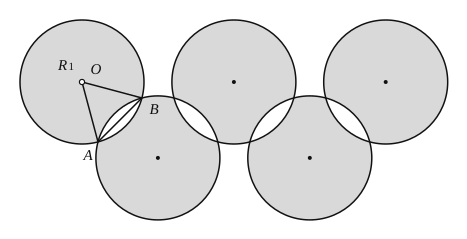
The Olympic symbol comprising five interlocking rings represents the union of the five continents of the world and the meeting of athletes from all over the world at the Olympic games. In order to spread awareness about Olympic games, students of Class-X took part in various activities organised by the school. One such group of students made 5 circular rings in the school lawn with the help of ropes. Each circular ring required 44 m of rope. Also, in the shaded regions as shown in the figure, students made rangoli showcasing various sports and games. It is given that △OAB is an equilateral triangle and all unshaded regions are congruent. Based on above information, answer the following questions : (i) Find the radius of each circular ring. (1) (ii) What is the measure of ∠AOB ? (1) (iii) (a) Find the area of shaded region R1. (2) OR (iii) (b) Find the length of rope around the unshaded regions. (2)
Show answer & solution
Answer: (i) 7 m (ii) 60∘ (iii) (a) (3308+2493) m2≈145.1 m2 OR (iii) (b) 3176 m ≈58.67 m
(i) 2πr=44⇒r=44×447=7 m
(ii) △OAB is equilateral, so ∠AOB=60∘
(iii)(a) Each unshaded region (lens) is made of two congruent segments with chord AB = 7 m subtending 60∘.
Segment area =36060×722×49−43×49=377−4493
Lens area =3154−2493
R1 = circle − lens =154−3154+2493=3308+2493≈102.67+42.44=145.1 m2
(iii)(b) Each lens is bounded by two arcs of 60∘: length =2×36060×44=344 m
There are 4 unshaded regions: total =4×344=3176≈58.67 m
Cable cars at hill stations are one of the major tourist attractions. On a hill station, the length of cable car ride from base point to top most point on the hill is 5000 m. Poles are installed at equal intervals on the way to provide support to the cables on which car moves. The distance of first pole from base point is 200 m and subsequent poles are installed at equal interval of 150 m. Further, the distance of last pole from the top is 300 m. Based on above information, answer the following questions using Arithmetic Progression : (i) Find the distance of 10th pole from the base. (1) (ii) Find the distance between 15th pole and 25th pole. (1) (iii) (a) Find the time taken by cable car to reach 15th pole from the top if it is moving at the speed of 5m/sec and coming from top. (2) OR (iii) (b) Find the total number of poles installed along the entire journey. (2)
Show answer & solution
Answer: (i) 1550 m (ii) 1500 m (iii) (a) 480 seconds (8 minutes) OR (iii) (b) 31
Distances of poles from base: 200, 350, 500, ... AP with a=200, d=150
(i) a10=200+9×150=1550 m
(ii) a25−a15=10×150=1500 m
(iii)(b) Last pole is at 5000−300=4700 m: 200+(n−1)150=4700⇒n−1=30⇒n=31 poles
(iii)(a) Counting from the top, the poles are at 300, 450, 600, ... m from the top (a=300, d=150).
15th pole from top is at 300+14×150=2400 m from the top
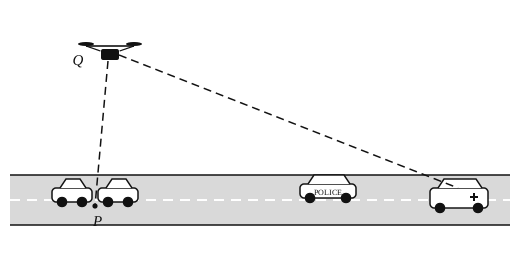
A drone was used to facilitate movement of an ambulance on the straight highway to a point P on the ground where there was an accident. The ambulance was travelling at the speed of 60 km/h. The drone stopped at a point Q, 100 m vertically above the point P. The angle of depression of the ambulance was found to be 30∘ at a particular instant. Based on above information, answer the following questions : (i) Represent the above situation with the help of a diagram. (1) (ii) Find the distance between the ambulance and the site of accident (P) at the particular instant. (Use 3=1.73) (1) (iii) (a) Find the time (in seconds) in which the angle of depression changes from 30∘ to 45∘. (2) OR (iii) (b) How long (in seconds) will the ambulance take to reach point P from a point T on the highway such that angle of depression of the ambulance at T is 60∘ from the drone ? (2)
Show answer & solution
Answer: (i) Right triangle QPA with QP = 100 m vertical, ambulance at A on the highway, angle of depression 30∘ at Q (ii) 173 m (iii) (a) 4.38 s OR (iii) (b) 23≈3.46 s
(i) Draw QP = 100 m vertical with P on the highway; ambulance at A on the highway; ∠ of depression from Q to A =30∘, so ∠QAP=30∘.
(ii) tan30∘=PAQP⇒PA=1003=173 m
Speed =60 km/h =360060×1000=350 m/s
(iii)(a) At 45∘: distance from P =100 m. Distance covered =173−100=73 m