CBSE Class 10 Maths Standard 2025 Question Paper 30/5/3 with Solutions
All 44 questions from the CBSE Class 10 Mathematics Standard board paper, Set 30/5/3 (2025),
with answers and step-by-step solutions. Total 80 marks. Tap “Show answer & solution” under any question.
An observer 1.8 m tall stands away from a chimney at a distance of 38.2 m along the ground. The angle of elevation of top of chimney from the eyes of observer is 45∘. The height of chimney above the ground is
(A)38.2 m
(B)36.4 m
(C)40 m
(D)(38.2)2 m
Show answer & solution
Answer: (C) 40 m
Height of chimney above eye level =38.2tan45∘=38.2 m
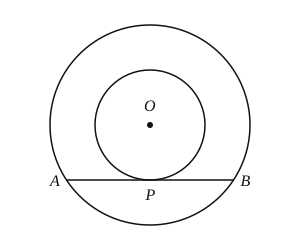
In the adjoining figure, the sum of radii of two concentric circles is 16 cm. The length of chord AB which touches the inner circle at P is 16 cm. The difference of the radii of the given circles is
(A)8 cm
(B)4 cm
(C)2 cm
(D)3 cm
Show answer & solution
Answer: (B) 4 cm
Let radii be R (outer) and r (inner). OP⊥AB and P is the midpoint of AB, so AP=8 cm.
Following data shows the marks obtained by 100 students in a class test : Marks obtained: 20, 29, 28, 33, 42, 38, 43, 25 Number of students: 6, 28, 24, 15, 2, 4, 1, 20 The median will be the average of which two observations ?
(A)29 and 33
(B)25 and 28
(C)28 and 29
(D)33 and 38
Show answer & solution
Answer: (C) 28 and 29
Arrange marks in ascending order with cumulative frequencies:
A bag contains red coloured, blue coloured and green coloured balls in the ratio 2 : 3 : 4. A ball is drawn at random from the given bag. The probability that the ball so drawn being not of blue colour is
Assertion (A) : For an A.P., 3,6,9, ..., 198, 10th term from the end is 168. Reason (R) : If 'a' and 'l' are the first term and last term of an A.P. with common difference 'd', then nth term from the end of the given A.P. is l−(n−1)d.
(A)Both Assertion (A) and Reason (R) are true and Reason (R) is the correct explanation of Assertion (A).
(B)Both Assertion (A) and Reason (R) are true, but Reason (R) is not the correct explanation of (A).
(C)Assertion (A) is true, but Reason (R) is false.
(D)Assertion (A) is false, but Reason (R) is true.
Show answer & solution
Answer: (D) Assertion (A) is false, but Reason (R) is true.
R is the standard result: nth term from the end =l−(n−1)d. R is true.
Here l=198, d=3: 10th term from the end =198−9×3=171=168. A is false.
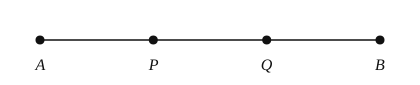
The coordinates of the end points of the line segment AB are A(−2,−2) and B(2,−4). P is the point on AB such that BP=74AB. Find the coordinates of point P.
From a pack of 52 cards, all aces and all kings are removed. A card is drawn at random from the remaining cards. Find the probability that the card so drawn is (i) a face card. (ii) a card of red colour.
Show answer & solution
Answer: (i) 112 (ii) 21
Remaining cards =52−8=44.
(i) Face cards left (jacks and queens) =8. P=448=112
The cost of 2 kg apples and 1 kg of grapes on a day was found to be ₹ 320. The cost of 4 kg apples and 2 kg grapes was found to be ₹ 600. If cost of 1 kg of apples and 1 kg of grapes is ₹ x and ₹ y respectively, represent the given situation algebraically as a system of equations and check whether the system so obtained is consistent or not.
Show answer & solution
Answer:2x+y=320, 4x+2y=600; the system is inconsistent.
Find a relation between x and y such that P(x,y) is equidistant from the points A(3,5) and B(7,1). Hence, write the coordinates of the points on x-axis and y-axis which are equidistant from points A and B.
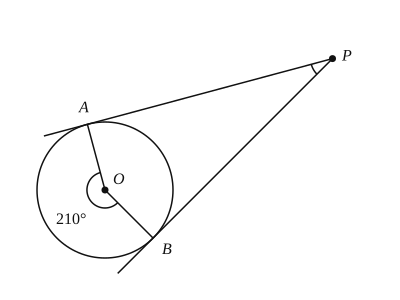
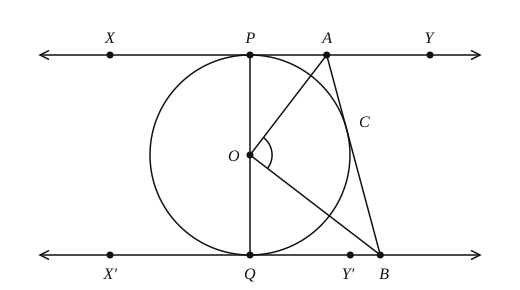
In the adjoining figure, XY and X′Y′ are parallel tangents to a circle with centre O. Another tangent AB touches the circle at C intersecting XY at A and X′Y′ at B. Prove that AB subtends right angle at the centre of the circle; or ∠AOB=90∘.
Show answer & solution
Answer: Proved.
Let XY touch the circle at P and X′Y′ at Q. Join OC.
In △OPA and △OCA: OP=OC (radii), AP=AC (tangents from A), OA common. So the triangles are congruent (SSS) and ∠OAP=∠OAC, i.e. ∠OAB=21∠PAB.
Similarly △OQB≅△OCB, so ∠OBA=21∠QBA.
XY∥X′Y′ and AB is a transversal, so ∠PAB+∠QBA=180∘ (co-interior angles).
State true or false for each of the following statements and justify in each case : (i) 2×3×5×7+7 is a composite number. (ii) 2×3×5×7+1 is a composite number.
Show answer & solution
Answer: (i) True (ii) False
(i) 2×3×5×7+7=7(2×3×5+1)=7×31=217.
It has factors other than 1 and itself, so it is composite. True.
(ii) 2×3×5×7+1=211.
211 is not divisible by any prime ≤211 (2, 3, 5, 7, 11, 13), so 211 is prime. False.
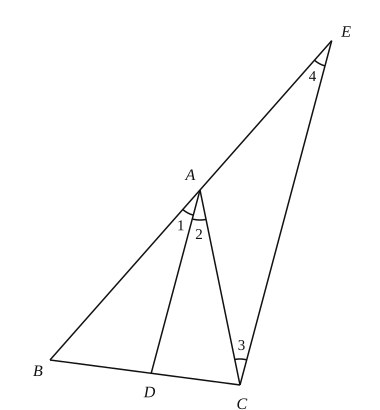
State the basic proportionality theorem. Use the theorem to do the following : In △ABC, AD is the angle bisector of angle A. BA is produced to E such that CE∥AD. Prove that DCBD=ACBA.
Show answer & solution
Answer: BPT: If a line is drawn parallel to one side of a triangle to intersect the other two sides in distinct points, the other two sides are divided in the same ratio. DCBD=ACBA proved.
BPT: If a line is drawn parallel to one side of a triangle to intersect the other two sides in distinct points, the other two sides are divided in the same ratio.
AD bisects ∠A: ∠1=∠2 (where ∠1=∠BAD, ∠2=∠DAC).
CE∥AD with transversal AC: ∠2=∠3 (alternate angles, ∠3=∠ACE).
CE∥AD with transversal BE: ∠1=∠4 (corresponding angles, ∠4=∠AEC).
So ∠3=∠4, hence AE=AC (sides opposite equal angles in △ACE).
From one of the faces of a solid wooden cube of side 14 cm, maximum number of hemispheres of diameter 1.4 cm are scooped out. Find the total number of hemispheres that can be scooped out. Also, find the total surface area of the remaining solid.
Show answer & solution
Answer: 100 hemispheres; total surface area =1330 cm2
Along one edge: 1.414=10 hemispheres, so on one face 10×10=100 hemispheres.
Radius r=0.7 cm.
Surface area of cube =6×142=1176 cm2
Each hemisphere removes a circle πr2 and adds a curved surface 2πr2: net gain πr2=722×0.49=1.54 cm2
Total surface area =1176+100×1.54=1176+154=1330 cm2
From a solid cylinder of height 24 cm and radius 5 cm, two cones of height 12 cm and radius 5 cm are hollowed out. Find the volume and surface area of the remaining solid.
Show answer & solution
Answer: Volume =400π=78800≈1257.14 cm3; surface area =370π=78140≈1162.86 cm2
The following table gives the daily income of 50 cab drivers of a particular city : Income (₹): 500 - 600, 600 - 700, 700 - 800, 800 - 900, 900 - 1000 No. of Drivers: 12, 14, 8, 6, 10 Find the mean income and the modal income.
Find the value(s) of p for which the quadratic equation given as (p+4)x2−(p+1)x+1=0 has real and equal roots. Also, find the roots of the equation(s) so obtained.
Passenger boarding stairs, sometimes referred to as boarding ramps, stair cars or aircraft steps, provide a mobile means to travel between the aircraft doors and the ground. Larger aircraft have door sills 5 to 20 feet (1 foot = 30 cm) high. Stairs facilitate safe boarding and de-boarding. An aircraft has a door sill at a height of 15 feet above the ground. A stair car is placed at a horizontal distance of 15 feet from the plane. Based on given information, answer the questions given in part (i) and (ii). (i) Find the angle at which stairs are inclined to reach the door sill 15 feet high above the ground. (1) (ii) Find the length of stairs used to reach the door sill. (1) Further, answer any one of the following questions : (iii) (a) If the 20 feet long stairs is inclined at an angle of 60∘ to reach the door sill, then find the height of the door sill above the ground. (use 3=1.732) (2) OR (iii) (b) What should be the shortest possible length of stairs to reach the door sill of the plane 20 feet above the ground, if the angle of elevation cannot exceed 30∘ ? Also, find the horizontal distance of base of stair car from the plane. (2)
Show answer & solution
Answer: (i) 45∘ (ii) 152 feet (iii)(a) 103=17.32 feet OR (iii)(b) 40 feet; horizontal distance 203≈34.64 feet
(i) tanθ=1515=1⇒θ=45∘
(ii) Length =152+152=152 feet
(iii)(a) Height =20sin60∘=20×23=103=17.32 feet
(iii)(b) Length =sinθ20 is least when θ is largest, i.e. θ=30∘: length =1/220=40 feet
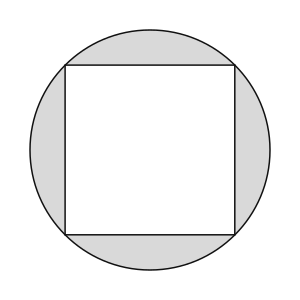
A farmer has a circular piece of land. He wishes to construct his house in the form of largest possible square within the land as shown below. The radius of circular piece of land is 35 m. Based on given information, answer the following questions : (i) Find the length of wire needed to fence the entire land. (1) (ii) Find the length of each side of the square land on which house will be constructed. (1) (iii) (a) The farmer wishes to grow grass on the shaded region around the house. Find the cost of growing the grass at the rate of ₹ 50 per square metre. (2) OR (iii) (b) Find the ratio of area of land on which house is built to remaining area of circular piece of land. (2)
Show answer & solution
Answer: (i) 220 m (ii) 352 m (iii)(a) ₹ 70000 OR (iii)(b) 7 : 4
(i) Length of wire =2πr=2×722×35=220 m
(ii) Diagonal of square = diameter = 70 m, so side =270=352 m
(iii)(a) Area of circle =722×352=3850 m2; area of square =(352)2=2450 m2
Shaded area =3850−2450=1400 m2; cost =1400×50= ₹ 70000
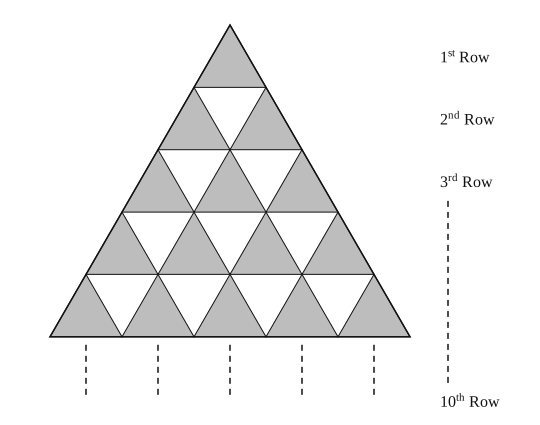
In an equilateral triangle of side 10 cm, equilateral triangles of side 1 cm are formed as shown in the figure below, such that there is one triangle in the first row, three triangles in the second row, five triangles in the third row and so on. Based on given information, answer the following questions using Arithmetic Progression. (i) How many triangles will be there in bottom most row ? (1) (ii) How many triangles will be there in fourth row from the bottom ? (1) (iii) (a) Find the total number of triangles of side 1 cm each till 8th row. (2) OR (iii) (b) How many more number of triangles are there from 5th row to 10th row than in first 4 rows ? Show working. (2)
Show answer & solution
Answer: (i) 19 (ii) 13 (iii)(a) 64 OR (iii)(b) 68
Rows form an A.P. 1, 3, 5, ... with a=1, d=2; there are 10 rows.
(i) a10=1+9×2=19
(ii) Fourth row from the bottom is the 7th row: a7=1+6×2=13