CBSE Class 10 Maths Standard 2025 Question Paper 30/6/3 with Solutions
All 44 questions from the CBSE Class 10 Mathematics Standard board paper, Set 30/6/3 (2025),
with answers and step-by-step solutions. Total 80 marks. Tap “Show answer & solution” under any question.
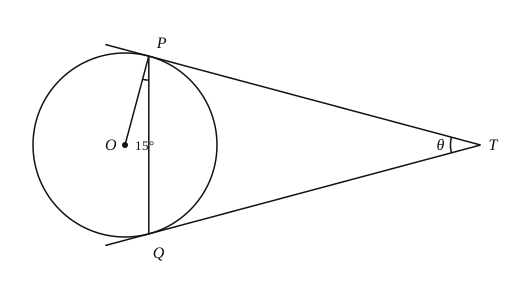
For a circle with centre O and radius 5 cm, which of the following statements is true ? P : Distance between every pair of parallel tangents is 5 cm. Q : Distance between every pair of parallel tangents is 10 cm. R : Distance between every pair of parallel tangents must be between 5 cm and 10 cm. S : There does not exist a point outside the circle from where length of tangent is 5 cm.
(A)P
(B)Q
(C)R
(D)S
Show answer & solution
Answer: (B) Q
Parallel tangents touch the circle at the two ends of a diameter.
So the distance between them equals the diameter =2×5=10 cm. Q is true; P and R are false.
S is false: a point at distance 52 cm from O has tangent length 50−25=5 cm.
A peacock sitting on the top of a tree of height 10 m observes a snake moving on the ground. If the snake is 103 m away from the base of the tree, then angle of depression of the snake from the eye of the peacock is
(A)30∘
(B)45∘
(C)60∘
(D)90∘
Show answer & solution
Answer: (A) 30∘
Angle of depression = angle of elevation of the peacock from the snake =θ.
If a cone of greatest possible volume is hollowed out from a solid wooden cylinder, then the ratio of the volume of remaining wood to the volume of cone hollowed out is
(A)1 : 1
(B)1 : 3
(C)2 : 1
(D)3 : 1
Show answer & solution
Answer: (C) 2 : 1
The largest cone has the same radius r and height h as the cylinder.
In an experiment of throwing a die, Assertion (A) : Event E1 : getting a number less than 3 and Event E2 : getting a number greater than 3 are complementary events. Reason (R) : If two events E and F are complementary events, then P(E)+P(F)=1.
(A)Both Assertion (A) and Reason (R) are true and Reason (R) is correct explanation of Assertion (A).
(B)Both Assertion (A) and Reason (R) are true, but Reason (R) is not the correct explanation of Assertion (A).
(C)Assertion (A) is true, but Reason (R) is false.
(D)Assertion (A) is false, but Reason (R) is true.
Show answer & solution
Answer: (D) Assertion (A) is false, but Reason (R) is true.
E1={1,2}, E2={4,5,6}. Together they miss the outcome 3.
P(E1)+P(E2)=62+63=65=1, so they are not complementary. A is false.
R is the definition-property of complementary events, so R is true.
A bag contains balls numbered 2 to 91 such that each ball bears a different number. A ball is drawn at random from the bag. Find the probability that (i) it bears a 2– digit number (ii) it bears a multiple of 1.
Show answer & solution
Answer: (i) 4541 (ii) 1
Total balls =91−2+1=90
(i) 2-digit numbers: 10 to 91, i.e. 82 balls. P=9082=4541
(ii) Every number is a multiple of 1, so all 90 balls qualify. P=9090=1
In a pair of supplementary angles, the greater angle exceeds the smaller by 50∘. Express the given situation as a system of linear equations in two variables and hence obtain the measure of each angle.
Show answer & solution
Answer:x+y=180, x−y=50; angles are 115∘ and 65∘
Let the greater angle be x∘ and the smaller be y∘.
If the points A(6,1), B(p,2), C(9,4) and D(7,q) are the vertices of a parallelogram ABCD, then find the values of p and q. Hence, check whether ABCD is a rectangle or not.
Show answer & solution
Answer:p=8, q=3; ABCD is not a rectangle
Diagonals of a parallelogram bisect each other: midpoint of AC = midpoint of BD.
Midpoint of AC =(215,25); midpoint of BD =(2p+7,22+q)
p+7=15⇒p=8; 2+q=5⇒q=3
AC=32+32=32; BD=(7−8)2+(3−2)2=2
Diagonals are not equal, so ABCD is not a rectangle.
Let p, q and r be three distinct prime numbers. Check whether p⋅q⋅r+q is a composite number or not. Further, give an example for 3 distinct primes p, q, r such that (i) p⋅q⋅r+1 is a composite number. (ii) p⋅q⋅r+1 is a prime number.
Show answer & solution
Answer: Composite, since pqr+q=q(pr+1). (i) e.g. 3⋅5⋅7+1=106=2×53 (ii) e.g. 2⋅3⋅5+1=31
p⋅q⋅r+q=q(pr+1)
Both factors q≥2 and pr+1≥7 exceed 1, so the number has a factor other than 1 and itself: it is composite.
If a line drawn parallel to one side of triangle intersecting the other two sides in distinct points divides the two sides in the same ratio, then it is parallel to third side. State and prove the converse of the above statement.
Show answer & solution
Answer: Statement: If a line is drawn parallel to one side of a triangle to intersect the other two sides in distinct points, the other two sides are divided in the same ratio (Basic Proportionality Theorem). Proved.
Statement (BPT): In △ABC, if DE∥BC with D on AB and E on AC, then DBAD=ECAE.
Construction: Join BE and CD; draw EN⊥AB and DM⊥AC.
ar(ADE)=21AD⋅EN, ar(BDE)=21DB⋅EN, so ar(BDE)ar(ADE)=DBAD
ar(ADE)=21AE⋅DM, ar(DEC)=21EC⋅DM, so ar(DEC)ar(ADE)=ECAE
△BDE and △DEC are on the same base DE between the parallels DE and BC, so ar(BDE)=ar(DEC).
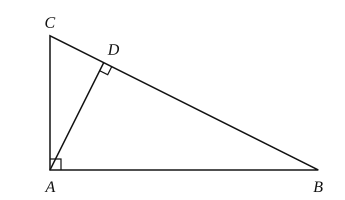
In the adjoining figure, △CAB is a right triangle, right angled at A and AD⊥BC. Prove that △ADB∼△CDA. Further, if BC=10 cm and CD=2 cm, find the length of AD.
Show answer & solution
Answer: Proved; AD = 4 cm
In △ADB and △CDA: ∠ADB=∠CDA=90∘
∠DAB=90∘−∠DAC and, in △ADC, ∠DCA=90∘−∠DAC, so ∠DAB=∠DCA
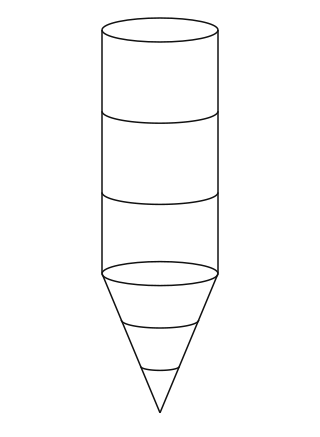
Fermentation tanks are designed in the form of cylinder mounted on a cone as shown below : The total height of the tank is 3.3 m and height of conical part is 1.2 m. The diameter of the cylindrical as well as conical part is 1 m. Find the capacity of the tank. If the level of liquid in the tank is 0.7 m from the top, find the surface area of the tank in contact with liquid.
Show answer & solution
Answer: Capacity =2855 m3≈1.96 m3; surface area in contact =70451 m2≈6.44 m2
r=0.5 m; cone height h=1.2 m; cylinder height H=3.3−1.2=2.1 m
The population of lions was noted in different regions across the world in the following table : Number of lions: 0 – 100, 100 – 200, 200 – 300, 300 – 400, 400 – 500, 500 – 600, 600 – 700, 700 – 800, 800 – 900, 900 – 1000 Number of regions: 2, 5, 9, 12, x, 20, 15, 9, y, 2 Total: 100 If the median of the given data is 525, find the values of x and y.
Show answer & solution
Answer:x=17, y=9
2+5+9+12+x+20+15+9+y+2=100⇒x+y=26
2N=50; median 525 lies in class 500 – 600: l=500, f=20, h=100, cf=28+x
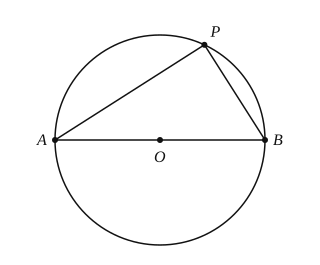
There is a circular park of diameter 65 m as shown in the following figure, where AB is a diameter. An entry gate is to be constructed at a point P on the boundary of the park such that distance of P from A is 35 m more than the distance of P from B. Find distance of point P from A and B respectively.
The Statue of Unity situated in Gujarat is the world's largest Statue which stands over a 58 m high base. As part of the project, a student constructed an inclinometer and wishes to find the height of Statue of Unity using it. He noted following observations from two places : Situation – I : The angle of elevation of the top of Statue from Place A which is 803 m away from the base of the Statue is found to be 60∘. Situation – II : The angle of elevation of the top of Statue from a Place B which is 40 m above the ground is found to be 30∘ and entire height of the Statue including the base is found to be 240 m. Based on given information, answer the following questions : (i) Represent the Situation – I with the help of a diagram. (1) (ii) Represent the Situation – II with the help of a diagram. (1) (iii) (a) Calculate the height of Statue excluding the base and also find the height including the base with the help of Situation – I. (2) OR (iii) (b) Find the horizontal distance of point B (Situation – II) from the Statue and the value of tanα, where α is the angle of elevation of top of base of the Statue from point B. (2)
Show answer & solution
Answer: (i) Right triangle: vertical side = total height (statue + base), horizontal side 803 m from A, angle 60∘ at A (ii) B at 40 m above ground; horizontal line from B to statue; angle 30∘ to the top; height of top above B's level =240−40=200 m (iii) (a) 182 m excluding base, 240 m including base OR (iii) (b) 2003 m; tanα=10033
(i) Draw the statue with base as a vertical line PQ (Q at ground), A on the ground with AQ=803 m and ∠PAQ=60∘.
(ii) Draw B at height 40 m above the ground, a horizontal line from B meeting the statue's vertical line at M, and ∠PBM=30∘; PM=240−40=200 m.
(iii) (a) tan60∘=803PQ⇒PQ=803×3=240 m (including base)
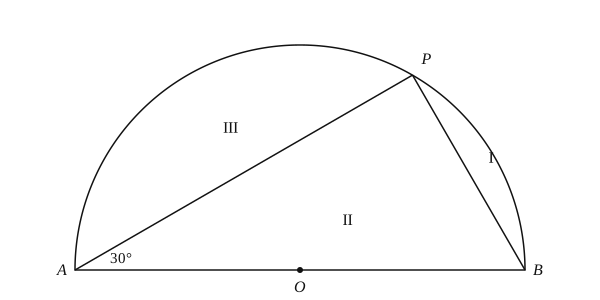
Anurag purchased a farmhouse which is in the form of a semicircle of diameter 70 m. He divides it into three parts by taking a point P on the semicircle in such a way that ∠PAB=30∘ as shown in the following figure, where O is the centre of semicircle. In part I, he planted saplings of Mango tree, in part II, he grew tomatoes and in part III, he grew oranges. Based on given information, answer the following questions. (i) What is the measure of ∠POA ? (1) (ii) Find the length of wire needed to fence entire piece of land. (1) (iii) (a) Find the area of region in which saplings of Mango tree are planted. (2) OR (iii) (b) Find the length of wire needed to fence the region III. (2)
Show answer & solution
Answer: (i) 120∘ (ii) 180 m (iii) (a) (31925−412253) m2≈111.24 m2 OR (iii) (b) (3220+353) m ≈133.96 m
(i) ∠POB=2∠PAB=60∘ (angle at centre), so ∠POA=180∘−60∘=120∘.
(ii) r=35 m. Fence = semicircular arc + diameter =722×35+70=110+70=180 m.
(iii) (a) Part I is the segment cut off by chord PB, with ∠POB=60∘.
Sector area =36060×722×352=31925≈641.67 m2
△POB is equilateral: area =43×352=412253≈530.43 m2
Area of part I ≈641.67−530.43=111.24 m2
(iii) (b) Region III is bounded by chord AP and arc AP, with ∠AOP=120∘.
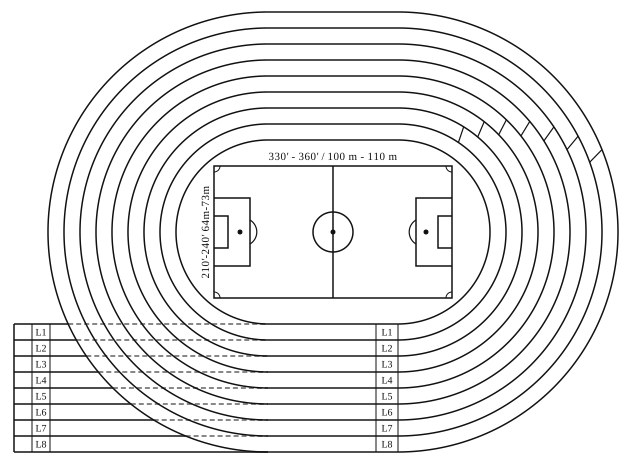
In order to organise, Annual Sports Day, a school prepared an eight lane running track with an integrated football field inside the track area as shown below : The length of innermost lane of the track is 400 m and each subsequent lane is 7.6 m longer than the preceding lane. Based on given information, answer the following questions, using concept of Arithmetic Progression. (i) What is the length of the 6th lane ? (1) (ii) How long is the 8th lane than that of 4th lane ? (1) (iii) (a) While practicing for a race, a student took one round each in first six lanes. Find the total distance covered by the student. (2) OR (iii) (b) A student took one round each in lane 4 to lane 8. Find the total distance covered by the student. (2)
Show answer & solution
Answer: (i) 438 m (ii) 30.4 m (iii) (a) 2514 m OR (iii) (b) 2190 m
a=400, d=7.6
(i) a6=400+5×7.6=438 m
(ii) a8−a4=4d=4×7.6=30.4 m
(iii) (a) S6=26[2×400+5×7.6]=3×838=2514 m
(iii) (b) a4=422.8, a8=453.2; sum of 5 lanes =25(422.8+453.2)=25×876=2190 m