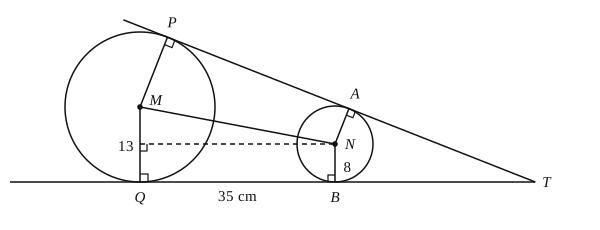
In the given figure, TP and TQ are tangents to a circle with centre M, touching another circle with centre N at A and B respectively. It is given that MQ = 13 cm, NB = 8 cm, BQ = 35 cm and TP = 80 cm. (i) Name the quadrilateral MQBN. (1) (ii) Is MN parallel to PA ? Justify your answer. (1) (iii) Find length TB. (1) (iv) Find length MN. (2)
Show answer & solution
Answer: (i) Trapezium (ii) No (iii) TB = 45 cm (iv) MN = 252 cm
(i) MQ⊥QT and NB⊥QT, so MQ∥NB; MQBN is a trapezium (right trapezium).
(ii) MP⊥PA and NA⊥PA, so MP∥NA. If also MN∥PA, MPAN would be a parallelogram and MP = NA; but MP = 13 cm = NA = 8 cm. So MN is not parallel to PA.
(iii) Tangents from T: TQ = TP = 80 cm, so TB = TQ − BQ = 80 − 35 = 45 cm.
(iv) Draw NL⊥MQ. Then LQ = NB = 8, ML = 13 − 8 = 5 cm and NL = BQ = 35 cm.
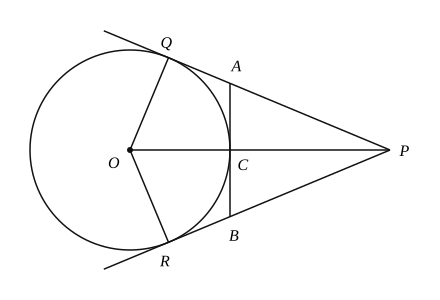
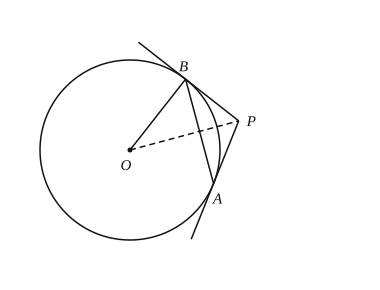
PQ and PR are two tangents to a circle with centre O and radius 5 cm. AB is another tangent to the circle at C which lies on OP. If OP = 13 cm, then find the length AB and PA.
Show answer & solution
Answer: AB = 320 cm, PA = 326 cm
OQ⊥PQ, so PQ=OP2−OQ2=169−25=12 cm.
C lies on OP and OC = 5 cm, so PC = 13 − 5 = 8 cm. AB⊥OP at C.
Let AC = x. Tangents from A are equal, so AQ = AC = x and PA = 12 − x.
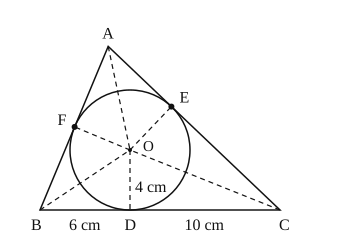
The given figure shows a circle with centre O and radius 4 cm circumscribed by △ABC. BC touches the circle at D such that BD = 6 cm, DC = 10 cm. Find the length of AE.
Show answer & solution
Answer: AE =1164 cm (about 5.82 cm)
Tangents from an external point are equal: BF = BD = 6, CE = CD = 10, AE = AF = x (say).
Sides: BC = 16, CA = x+10, AB = x+6; semi-perimeter s=x+16.
Area =21×r× perimeter =4(x+16).
By Heron: Area =s(s−a)(s−b)(s−c)=(x+16)(x)(6)(10).
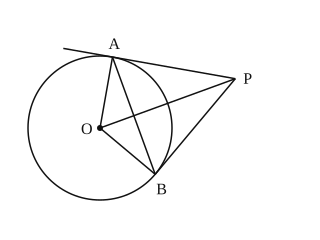
PA and PB are tangents drawn to a circle with centre O. If ∠AOB=120∘ and OA = 10 cm, then (i) Find ∠OPA. (1) (ii) Find the perimeter of △OAP. (3) (iii) Find the length of chord AB. (1)
Show answer & solution
Answer: (i) ∠OPA=30∘ (ii) (30+103) cm (about 47.3 cm) (iii) AB =103 cm
(i) ∠OAP=∠OBP=90∘, so ∠APB=360∘−90∘−90∘−120∘=60∘. OP bisects ∠APB, so ∠OPA=30∘.
(ii) In right △OAP: sin30∘=OPOA, so OP = 20 cm; tan30∘=APOA, so AP =103 cm.
Perimeter =10+20+103=(30+103) cm.
(iii) △AOB is isosceles with OA = OB = 10 and ∠AOB=120∘. The perpendicular from O to AB bisects AB and ∠AOB.
Prove that the parallelogram circumscribing a circle is a rhombus. Also, find area of the rhombus, if radius of circle is 3 cm and length of one side of the rhombus is 10 cm.
Show answer & solution
Answer: Proved; area of the rhombus = 60 cm2.
Let parallelogram ABCD touch the circle at P, Q, R, S on AB, BC, CD, DA.
Tangents from an external point are equal: AP=AS, BP=BQ, CR=CQ, DR=DS.
Adding, AB+CD=AD+BC.
In a parallelogram AB=CD and AD=BC, so 2AB=2BC, i.e. AB=BC.
So all sides are equal and ABCD is a rhombus.
The distance between opposite sides of the rhombus equals the diameter of the circle =6 cm.
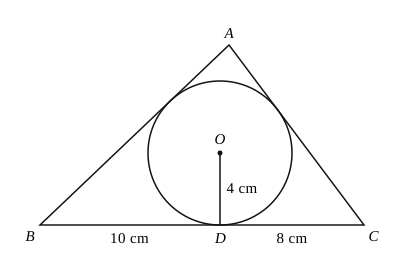
A triangle ABC is drawn to circumscribe a circle of radius 4 cm such that the segments BD and DC are of lengths 10 cm and 8 cm respectively. Find the lengths of the sides AB and AC, if it is given that area △ABC=90 cm2.
Show answer & solution
Answer: AB = 14.5 cm, AC = 12.5 cm
Tangents from an external point are equal. Let the tangent length from A be x.
Then AB = x + 10, AC = x + 8, BC = 18 cm.
Area △ABC = area OBC + area OCA + area OAB =21×4×(AB+BC+CA).
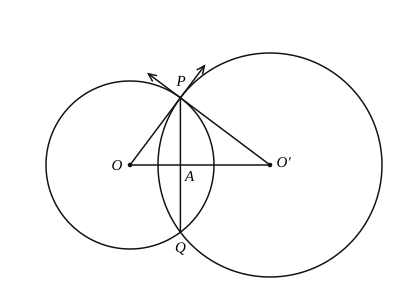
Two circles with centres O and O′ of radii 6 cm and 8 cm, respectively intersect at two points P and Q such that OP and O′P are tangents to the two circles. Find the length of the common chord PQ.
Show answer & solution
Answer: PQ = 9.6 cm
O′P is tangent to the circle with centre O at P, so OP ⊥ O′P; ∠OPO′=90∘.
OO′=62+82=10 cm.
The common chord PQ is perpendicular to OO′ and bisected by it at A.
Area of △OPO′: 21×OP×O′P=21×OO′×PA, so PA=106×8=4.8 cm.
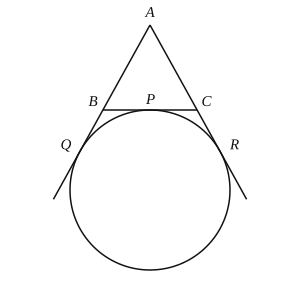
A circle touches the side BC of a △ABC at a point P and touches AB and AC when produced at Q and R respectively. Show that AQ = 21 (Perimeter of △ABC).
Show answer & solution
Answer: Proved.
Tangents from an external point are equal:
AQ = AR, BQ = BP, CP = CR.
Perimeter of △ABC = AB + BC + CA = AB + BP + PC + CA
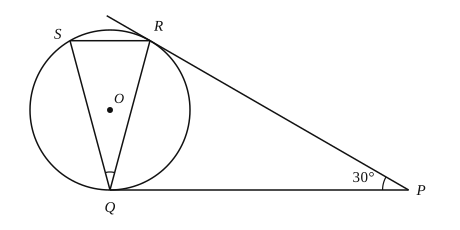
In the given figure, tangents PQ and PR are drawn to a circle such that ∠RPQ=30∘. A chord RS is drawn parallel to the tangent PQ. Find the measure of ∠RQS.
Show answer & solution
Answer:∠RQS=30∘
PQ = PR (tangents from P), so ∠PQR=∠PRQ=2180∘−30∘=75∘.
RS ∥ PQ, so ∠SRQ=∠RQP=75∘ (alternate angles).
OQ ⊥ PQ and RS ∥ PQ, so OQ ⊥ RS; the perpendicular from the centre bisects the chord RS, so Q is equidistant from R and S, i.e. QR = QS.