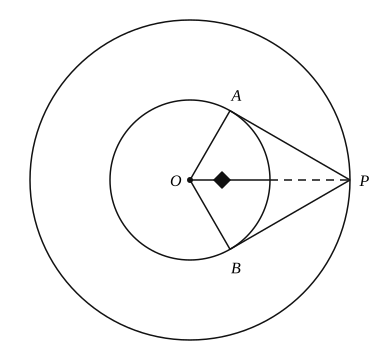
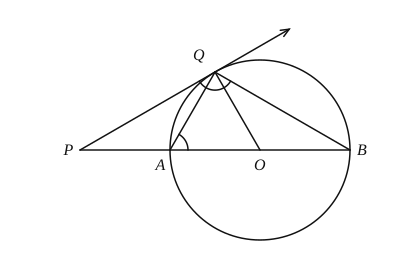
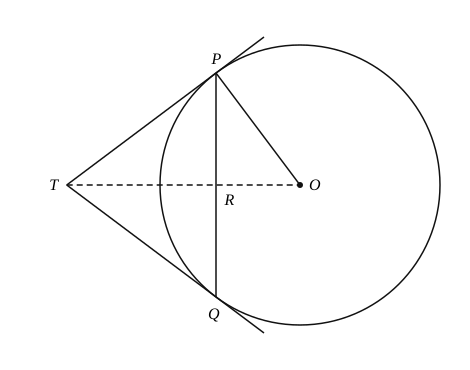
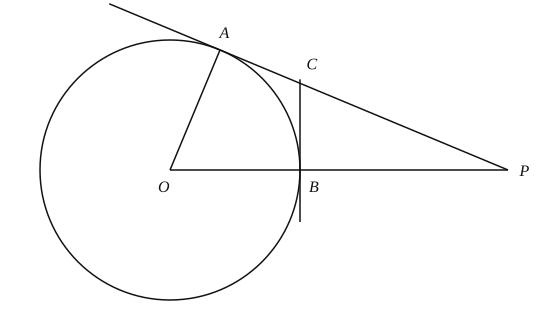
In a circular museum hall of radius 14 m, some statues are displayed. Statues are kept inside the inner concentric circle of radius 7 m. One such statue lying in sector OAB, is fenced along line segments OA, AP, PB and BO where P is a point on outer circle. Based on above information, answer the following questions : (i) Find m∠AOP. (1) (ii) Prove that △OAP≅△OBP. (1) (iii) (a) Find the length of fencing required to protect the statue. (Take 3 = 1.73) (2) OR (b) Find area of quadrilateral OAPB. (Take 3 = 1.73)
Show answer & solution
Answer: (i) 60∘ (ii) Proved (iii) (a) 38.22 m OR (b) 84.77 m2
(i) PA is a tangent to the inner circle, so ∠OAP=90∘. OA = 7 m, OP = 14 m.
cos∠AOP=OPOA=147=21, so ∠AOP=60∘.
(ii) In △OAP and △OBP: OA = OB (radii), PA = PB (tangents from an external point), OP is common. So △OAP≅△OBP (SSS).
(iii)(a) AP=142−72=147=73 m = PB
Fencing =OA+AP+PB+BO=7+73+73+7=14+143=14+24.22=38.22 m
(iii)(b) Area of OAPB =2×21×OA×AP=7×73=493=49×1.73=84.77 m2
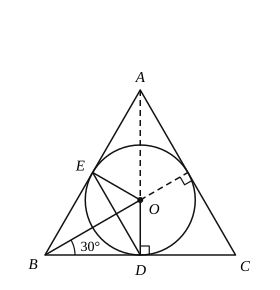
In a Fine Arts class, students were asked to design triangular tiles in geometric pattern. Neelima made a circular design inside an equilateral triangle ABC. The radius of the circle is 4 cm. Observe the diagram and answer the following questions : (i) Determine the length OB. (1) (ii) Is DE ∥ CA ? Give reason for your answer. (1) (iii) (a) Write all angles of quadrilateral OEBD and show that it is a cyclic quadrilateral. (2) OR (iii) (b) Find the perimeter of △ABC. (Use 3=1.73) (2)
Show answer & solution
Answer: (i) OB = 8 cm (ii) Yes, D and E are mid-points of BC and AB (iii) (a) ∠OEB=90∘, ∠EBD=60∘, ∠BDO=90∘, ∠DOE=120∘; cyclic since ∠E+∠D=180∘ OR (b) 243 cm = 41.52 cm
The circle touches BC at D and AB at E, so OD ⊥ BC, OE ⊥ AB and OD = OE = 4 cm.
(i) In right △ODB, ∠OBD=30∘: sin30∘=OBOD, so OB =1/24=8 cm.
(ii) Tangents from a point are equal: BD = BE, CD = CF, AE = AF (F the point of contact on CA). As AB = BC = CA, each tangent length is half a side, so D and E are mid-points of BC and BA.
By the mid-point theorem, DE ∥ CA. Yes.
(iii) (a) ∠OEB=90∘, ∠BDO=90∘, ∠EBD=60∘ (angle of equilateral triangle), ∠DOE=360∘−90∘−90∘−60∘=120∘.
∠OEB+∠ODB=180∘ (also ∠EBD+∠DOE=180∘): opposite angles are supplementary, so OEBD is cyclic.
(iii) (b) tan30∘=BDOD, so BD =43 cm and BC =2×BD=83 cm.
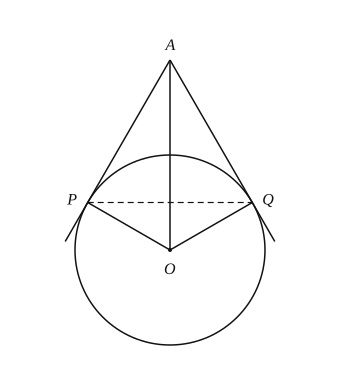
The picture given below shows a circular mirror hanging on the wall with a cord. The diagram represents the mirror as a circle with centre O. AP and AQ are tangents to the circle at P and Q respectively such that AP = 30 cm and ∠PAQ=60∘. Based on the above information, answer the following questions : (i) Find the length PQ. (1) (ii) Find m ∠POQ. (1) (iii) (a) Find the length OA. (2) OR (b) Find the radius of the mirror. (2)
Show answer & solution
Answer: (i) 30 cm (ii) 120∘ (iii) (a) 203 cm OR (b) 103 cm
(i) AP = AQ (tangents from A) and ∠PAQ=60∘, so △APQ is equilateral and PQ = 30 cm.
(ii) ∠OPA=∠OQA=90∘, so ∠POQ=360∘−90∘−90∘−60∘=120∘.
(iii) (a) OA bisects ∠PAQ, so ∠OAP=30∘. cos30∘=OAAP, so OA=2330=203 cm.
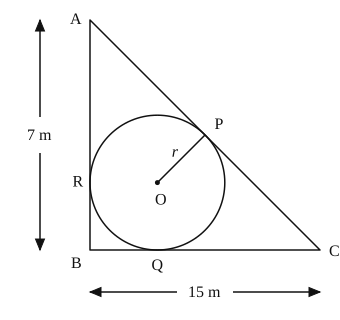
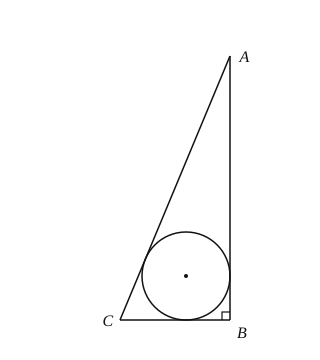
A backyard is in the shape of a triangle ABC with right angle at B. AB = 7 m and BC = 15 m. A circular pit was dug inside it such that it touches the walls AC, BC and AB at P, Q and R respectively such that AP = x m. Based on the above information, answer the following questions : (i) Find the length of AR in terms of x. (1) (ii) Write the type of quadrilateral BQOR. (1) (iii) (a) Find the length PC in terms of x and hence find the value of x. (2) OR (b) Find x and hence find the radius r of circle. (2)
Show answer & solution
Answer: (i) AR = x m (ii) Square (iii) (a) PC = (8+x) m, x=2274−8≈4.28 m OR (b) x≈4.28 m, r=222−274≈2.72 m
(i) Tangents from A are equal: AR = AP = x m.
(ii) ∠B=90∘, ∠ORB=∠OQB=90∘ (radius ⊥ tangent) and OR = OQ = r, so BQOR is a square.
(iii) (a) BR = AB − AR = 7−x, so BQ = BR = 7−x and CQ = 15−(7−x)=8+x. Hence PC = CQ = (8+x) m.
AC = AP + PC = 2x+8, and AC =72+152=274.
2x+8=274, so x=2274−8≈216.55−8≈4.28 m.
OR (b) As above, x=2274−8≈4.28 m.
Since BQOR is a square, r = BR = 7−x=222−274≈2.72 m.
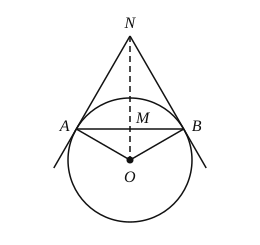
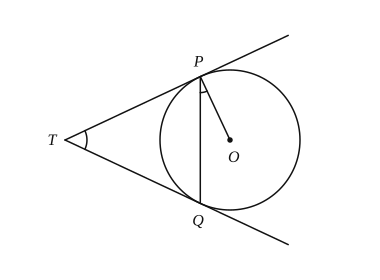
Circles play an important part in our life. When a circular object is hung on the wall with a cord at nail N, the cords NA and NB work like tangents. Observe the figure, given that ∠ANO=30∘ and OA = 5 cm. Based on the above, answer the following questions : (i) Find the distance AN. (1) (ii) Find the measure of ∠AOB. (1) (iii) (a) Find the total length of cords NA, NB and the chord AB. (2) OR (iii) (b) If ∠ANO is 45∘, then name the type of quadrilateral OANB. Justify your answer. (2)
Show answer & solution
Answer: (i) 53 cm (ii) 120∘ (iii) (a) 153 cm ≈ 25.98 cm OR (iii) (b) Square
(i) OA⊥AN (radius ⊥ tangent). In right △OAN, tan30∘=ANOA, so AN=53 cm
(ii) ∠ANB=2×30∘=60∘; in quadrilateral OANB, ∠AOB=360∘−90∘−90∘−60∘=120∘
(iii) (a) NA = NB = 53 cm and ∠ANB=60∘, so △ANB is equilateral and AB = 53 cm
Total length = 3×53=153 cm ≈ 25.98 cm
(iii) (b) If ∠ANO=45∘, then ∠ANB=90∘, ∠OAN=∠OBN=90∘, so ∠AOB=90∘
Also tan45∘=ANOA=1 gives AN = OA, and NA = NB, OA = OB, so all four sides are equal (5 cm).
All angles are right angles and all sides are equal, so OANB is a square.
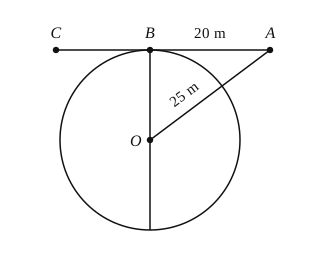
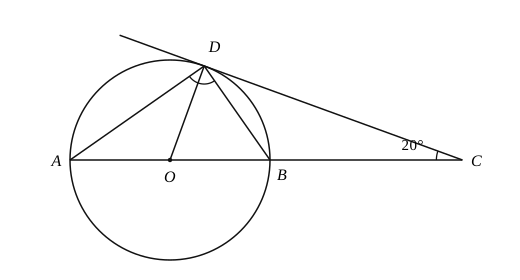
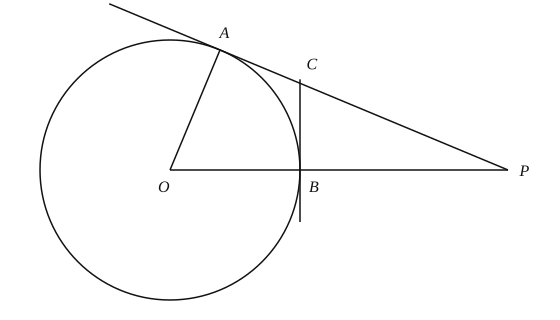
People of a circular village Dharamkot want to construct a road nearest to it. The road cannot pass through the village. But the people want the road at a shortest distance from the centre of the village. Suppose the road starts from A which is outside the circular village (as shown in the figure) and touch the boundary of the circular village at B such that AB = 20 m. Also the distance of the point A from the centre O of the village is 25 m. Based on the above information, answer the following questions : (i) If B is the mid-point of AC, then find the distance AC. (1) (ii) Find the shortest distance of the road from the centre of the village. (1) (iii) Find the circumference of the village. (2) OR (iii) Find the area of the village. (2)
Show answer & solution
Answer: (i) 40 m (ii) 15 m (iii) 7660 m ≈94.29 m OR (iii) 74950 m2≈707.14 m2
(i) AC=2×AB=40 m.
(ii) The road AC touches the circle at B, so OB ⊥ AC and OB is the shortest distance. OB=252−202=225=15 m.
(iii) Radius = 15 m. Circumference =2×722×15=7660≈94.29 m.
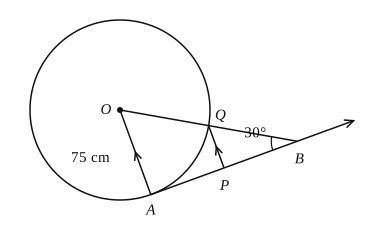
The discus throw is an event in which an athlete attempts to throw a discus. The athlete spins anti-clockwise around one and a half times through a circle, then releases the throw. When released, the discus travels along tangent to the circular spin orbit. In the given figure, AB is one such tangent to a circle of radius 75 cm. Point O is centre of the circle and ∠ABO=30∘. PQ is parallel to OA. Based on above information : (a) find the length of AB. (1) (b) find the length of OB. (1) (c) find the length of AP. (2) OR find the length of PQ.
Show answer & solution
Answer: (a) 753 cm (b) 150 cm (c) 2753 cm; OR: PQ = 37.5 cm
(a) OA ⊥ AB. tan30∘=ABOA, so AB=753 cm (≈ 129.9 cm).
(b) sin30∘=OBOA, so OB = 150 cm.
(c) Q lies on the circle, so OQ = 75 cm and QB = 150 – 75 = 75 cm; Q is the mid-point of OB.
PQ∥OA, so by the mid-point theorem (converse) P is the mid-point of AB.
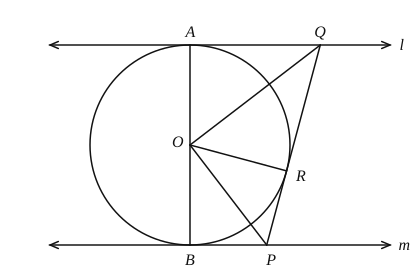
In Figure 3, the tangent l is parallel to the tangent m drawn at points A and B respectively to a circle centred at O. PQ is a tangent to the circle at R. Prove that ∠POQ=90∘.
Show answer & solution
Answer: Proved.
Join OR. OA⊥l and OB⊥m; since l∥m, A, O, B are collinear (AB is a diameter).
In △OAQ and △ORQ: OA=OR (radii), QA=QR (tangents from Q), OQ common
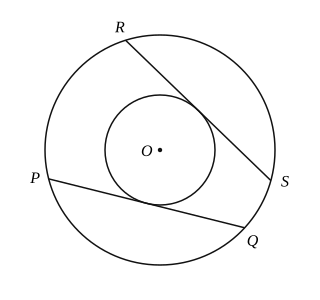
In Figure 5, two concentric circles are drawn with centre O. PQ and RS are two chords of the larger circle which are tangents to the smaller circle. Prove that PQ = RS.
Show answer & solution
Answer: Proved.
Let PQ touch the smaller circle at M and RS touch it at N; let the radii be R (larger) and r (smaller).
OM ⊥ PQ and ON ⊥ RS (radius is perpendicular to the tangent at the point of contact), and OM = ON = r.
The perpendicular from the centre to a chord bisects it, so PQ = 2PM and RS = 2RN.
In right △OMP: PM=OP2−OM2=R2−r2; similarly in right △ONR: RN=R2−r2
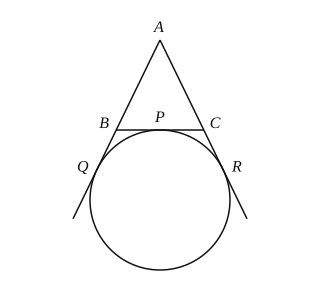
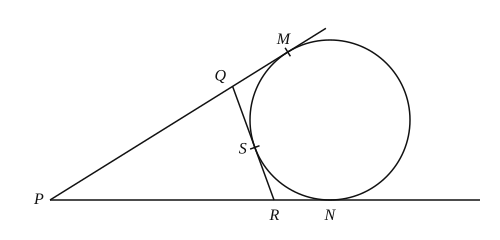
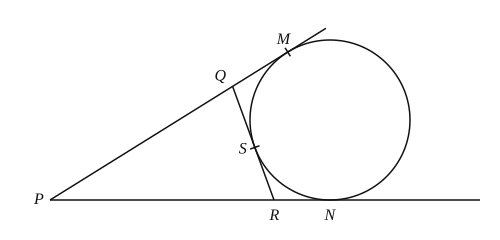
If a circle is touching the side BC of △ABC at P and is touching AB and AC produced at Q and R respectively (see the figure). Prove that AQ =21 (perimeter of △ABC).
Show answer & solution
Answer: Proved.
Tangents from an external point are equal: AQ = AR, BQ = BP, CP = CR.
Perimeter of △ABC = AB + BC + CA = AB + BP + PC + CA.
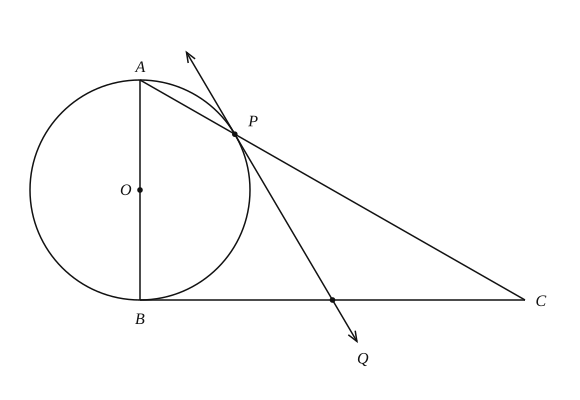
In Figure 1, a triangle ABC with ∠B=90∘ is shown. Taking AB as diameter, a circle has been drawn intersecting AC at point P. Prove that the tangent drawn at point P bisects BC.
Show answer & solution
Answer: Proved.
Let the tangent at P meet BC at Q. Join BP.
Since ∠ABC=90∘, BC ⊥ AB at B, the end of the diameter, so BC is tangent to the circle at B.
QB and QP are tangents from Q, so QB = QP and hence ∠QBP=∠QPB.
∠APB=90∘ (angle in a semicircle), so ∠BPC=90∘.
In △BPC: ∠QCP=90∘−∠QBP and ∠QPC=90∘−∠QPB.
So ∠QCP=∠QPC, giving QP = QC.
Hence QB = QP = QC, i.e. Q is the midpoint of BC: the tangent at P bisects BC.
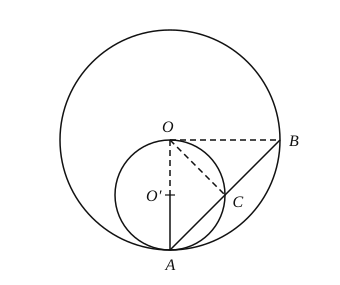
In Figure 3, two circles with centres at O and O′ of radii 2r and r respectively, touch each other internally at A. A chord AB of the bigger circle meets the smaller circle at C. Show that C bisects AB.
Show answer & solution
Answer: Proved.
The circles touch internally at A, so O, O′ and A are collinear and OA=2r is a radius of the bigger circle.
Since O′A=r and OA=2r, O lies on the smaller circle and OA is a diameter of the smaller circle.
C lies on the smaller circle, so ∠OCA=90∘ (angle in a semicircle). Hence OC⊥AB.
AB is a chord of the bigger circle with centre O, and the perpendicular from the centre to a chord bisects the chord.
In Figure 4, O is centre of a circle of radius 5 cm. PA and BC are tangents to the circle at A and B respectively. If OP = 13 cm, then find the length of tangents PA and BC.
Show answer & solution
Answer: PA = 12 cm, BC = 310 cm
OA⊥PA, so in right △OAP: PA=OP2−OA2=169−25=12 cm.
B lies on OP with OB=5 cm, so PB=13−5=8 cm, and BC⊥OP (tangent at B).
Let BC=x. Tangents from C are equal, so CA=CB=x and PC=12−x.
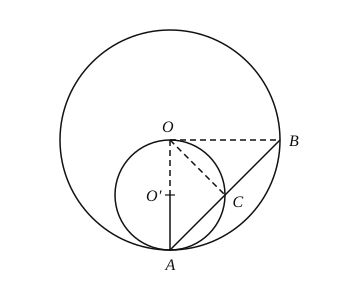
In Figure 4, two circles with centres at O and O′ of radii 2r and r respectively, touch each other internally at A. A chord AB of the bigger circle meets the smaller circle at C. Show that C bisects AB.
Show answer & solution
Answer: Proved.
The circles touch internally at A, so O, O′ and A are collinear and OA=2r is a radius of the bigger circle.
Since O′A=r and OA=2r, O lies on the smaller circle and OA is a diameter of the smaller circle.
C lies on the smaller circle, so ∠OCA=90∘ (angle in a semicircle). Hence OC⊥AB.
AB is a chord of the bigger circle with centre O, and the perpendicular from the centre to a chord bisects the chord.
In Figure 5, O is centre of a circle of radius 5 cm. PA and BC are tangents to the circle at A and B respectively. If OP = 13 cm, then find the length of tangents PA and BC.
Show answer & solution
Answer: PA = 12 cm, BC = 310 cm
OA⊥PA, so in right △OAP: PA=OP2−OA2=169−25=12 cm.
B lies on OP with OB=5 cm, so PB=13−5=8 cm, and BC⊥OP (tangent at B).
Let BC=x. Tangents from C are equal, so CA=CB=x and PC=12−x.
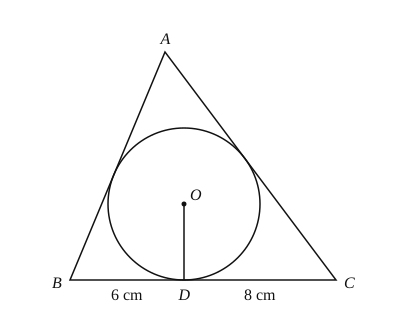
In Fig. 3, a triangle ABC is drawn to circumscribe a circle of radius 4 cm such that the segments BD and DC into which BC is divided by the point of contact D are of lengths 6 cm and 8 cm respectively. If the area of △ABC is 84 cm2, find the lengths of sides AB and AC.
Show answer & solution
Answer: AB = 13 cm, AC = 15 cm
Let the circle touch AB at F and AC at E, and let AF = AE = x cm (equal tangents from A).
BF = BD = 6 cm and CE = CD = 8 cm.
So AB = x+6, AC = x+8, BC = 14.
Area of △ABC = area OBC + area OCA + area OAB =21×4×(AB+BC+CA)