CBSE Class 10 Maths Standard 2023 Question Paper 30/6/1 with Solutions
All 44 questions from the CBSE Class 10 Mathematics Standard board paper, Set 30/6/1 (2023),
with answers and step-by-step solutions. Total 80 marks. Tap “Show answer & solution” under any question.
A bag contains 5 pink, 8 blue and 7 yellow balls. One ball is drawn at random from the bag. What is the probability of getting neither a blue nor a pink ball ?
3 chairs and 1 table cost ₹ 900; whereas 5 chairs and 3 tables cost ₹ 2,100. If the cost of 1 chair is ₹ x and the cost of 1 table is ₹ y, then the situation can be represented algebraically as
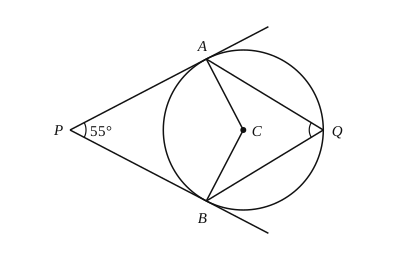
In the given figure, PA and PB are tangents from external point P to a circle with centre C and Q is any point on the circle. Then the measure of ∠AQB is
(A)6221∘
(B)125∘
(C)55∘
(D)90∘
Show answer & solution
Answer: (A) 6221∘
CA ⊥ PA and CB ⊥ PB, so in quadrilateral PACB, ∠ACB=180∘−55∘=125∘.
The angle subtended by arc AB at a point Q on the remaining part of the circle is half the angle at the centre.
Statement A (Assertion) : If 5+7 is a root of a quadratic equation with rational co-efficients, then its other root is 5−7. Statement R (Reason) : Surd roots of a quadratic equation with rational co-efficients occur in conjugate pairs.
(A)Both Assertion (A) and Reason (R) are true; and Reason (R) is the correct explanation of Assertion (A).
(B)Both Assertion (A) and Reason (R) are true; but Reason (R) is not the correct explanation of Assertion (A).
(C)Assertion (A) is true but Reason (R) is false.
(D)Assertion (A) is false but Reason (R) is true.
Show answer & solution
Answer: (A) Both A and R are true and R is the correct explanation of A.
By the quadratic formula, roots with rational coefficients are 2a−b±D, so irrational (surd) roots occur in conjugate pairs. R is true.
Hence if 5+7 is a root, 5−7 is the other root. A is true and follows from R.
A line intersects y-axis and x-axis at point P and Q, respectively. If R(2, 5) is the mid-point of line segment PQ, then find the coordinates of P and Q.
Show answer & solution
Answer: P(0, 10) and Q(4, 0)
Let P = (0, b) on the y-axis and Q = (a, 0) on the x-axis.
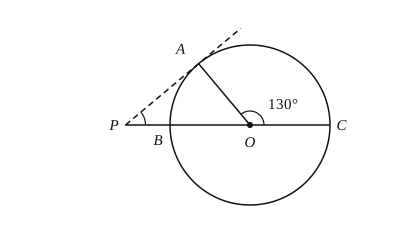
In the given figure, PA is a tangent to the circle drawn from the external point P and PBC is the secant to the circle with BC as diameter. If ∠AOC=130∘, then find the measure of ∠APB, where O is the centre of the circle.
Show answer & solution
Answer:∠APB=40∘
∠AOB=180∘−∠AOC=180∘−130∘=50∘ (linear pair).
OA ⊥ PA (radius is perpendicular to tangent), so ∠OAP=90∘.
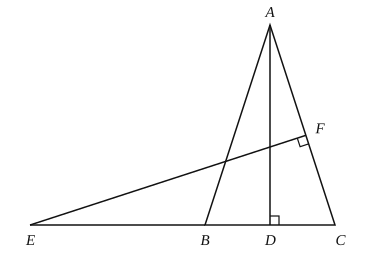
In the given figure, E is a point on the side CB produced of an isosceles triangle ABC with AB = AC. If AD ⊥ BC and EF ⊥ AC, then prove that △ABD∼△ECF.
Show answer & solution
Answer: Proved.
AB = AC, so ∠ABC=∠ACB (angles opposite equal sides).
In a circle of radius 21 cm, an arc subtends an angle of 60∘ at the centre. Find the area of the sector formed by the arc. Also, find the length of the arc.
Show answer & solution
Answer: Area of sector = 231 cm2; length of arc = 22 cm
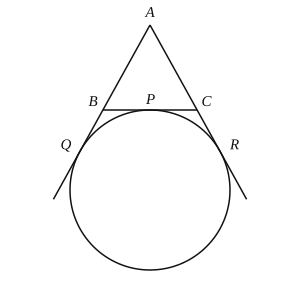
A circle touches the side BC of a △ABC at a point P and touches AB and AC when produced at Q and R respectively. Show that AQ = 21 (Perimeter of △ABC).
Show answer & solution
Answer: Proved.
Tangents from an external point are equal:
AQ = AR, BQ = BP, CP = CR.
Perimeter of △ABC = AB + BC + CA = AB + BP + PC + CA
A solid is in the shape of a right-circular cone surmounted on a hemisphere, the radius of each of them being 7 cm and the height of the cone is equal to its diameter. Find the volume of the solid.
Show answer & solution
Answer:143731 cm3 (about 1437.33 cm3)
r = 7 cm, height of cone h = 14 cm.
Volume of cone =31πr2h=31×722×49×14=32156 cm3
Volume of hemisphere =32πr3=32×722×343=32156 cm3
The ratio of the 11th term to the 18th term of an A.P. is 2 : 3. Find the ratio of the 5th term to the 21st term. Also, find the ratio of the sum of first 5 terms to the sum of first 21 terms.
250 apples of a box were weighed and the distribution of masses of the apples is given in the following table : Mass (in grams): 80 – 100, 100 – 120, 120 – 140, 140 – 160, 160 – 180 Number of apples: 20, 60, 70, x, 60 (i) Find the value of x and the mean mass of the apples. (3) (ii) Find the modal mass of the apples. (2)
Show answer & solution
Answer: (i) x = 40, mean mass = 134.8 g (ii) modal mass = 125 g
(i) 20 + 60 + 70 + x + 60 = 250, so x = 40.
Class marks: 90, 110, 130, 150, 170.
∑fixi=1800+6600+9100+6000+10200=33700
Mean =25033700=134.8 g
(ii) Modal class is 120 – 140 (frequency 70); l=120, f1=70, f0=60, f2=40, h=20.
A coaching institute of Mathematics conducts classes in two batches I and II and fees for rich and poor children are different. In batch I, there are 20 poor and 5 rich children, whereas in batch II, there are 5 poor and 25 rich children. The total monthly collection of fees from batch I is ₹ 9000 and from batch II is ₹ 26,000. Assume that each poor child pays ₹ x per month and each rich child pays ₹ y per month. Based on the above information, answer the following questions : (i) Represent the information given above in terms of x and y. (1) (ii) Find the monthly fee paid by a poor child. (2) OR Find the difference in the monthly fee paid by a poor child and a rich child. (iii) If there are 10 poor and 20 rich children in batch II, what is the total monthly collection of fees from batch II ? (1)
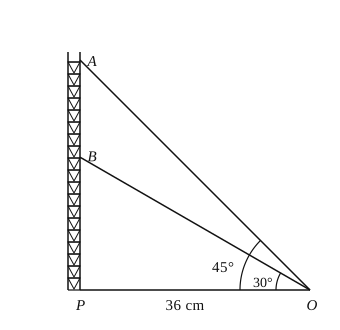
Radio towers are used for transmitting a range of communication services including radio and television. The tower will either act as an antenna itself or support one or more antennas on its structure. On a similar concept, a radio station tower was built in two Sections A and B. Tower is supported by wires from a point O. Distance between the base of the tower and point O is 36 cm. From point O, the angle of elevation of the top of the Section B is 30∘ and the angle of elevation of the top of Section A is 45∘. Based on the above information, answer the following questions : (i) Find the length of the wire from the point O to the top of Section B. (1) (ii) Find the distance AB. (2) OR Find the area of △OPB. (iii) Find the height of the Section A from the base of the tower. (1)
Show answer & solution
Answer: (i) 243 cm (ii) AB = 12(3−3) cm; OR: 2163 cm2 (iii) 36 cm
(i) In right △OPB, cos30∘=OBOP, so OB=2336=372=243 cm.
(ii) PB=36tan30∘=336=123 cm and PA=36tan45∘=36 cm.
“Eight Ball” is a game played on a pool table with 15 balls numbered 1 to 15 and a “cue ball” that is solid and white. Of the 15 numbered balls, eight are solid (non-white) coloured and numbered 1 to 8 and seven are striped balls numbered 9 to 15. The 15 numbered pool balls (no cue ball) are placed in a large bowl and mixed, then one ball is drawn out at random. Based on the above information, answer the following questions : (i) What is the probability that the drawn ball bears number 8 ? (ii) What is the probability that the drawn ball bears an even number ? OR What is the probability that the drawn ball bears a number, which is a multiple of 3 ? (iii) What is the probability that the drawn ball is a solid coloured and bears an even number ?
Show answer & solution
Answer: (i) 151 (ii) 157; OR: 31 (iii) 154
Total outcomes = 15.
(i) Only one ball bears 8: P = 151.
(ii) Even numbers: 2, 4, 6, 8, 10, 12, 14, i.e. 7 balls: P = 157.
OR: Multiples of 3: 3, 6, 9, 12, 15, i.e. 5 balls: P = 155=31.
(iii) Solid coloured balls are 1 to 8; even ones: 2, 4, 6, 8, i.e. 4 balls: P = 154.