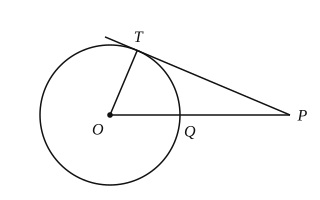
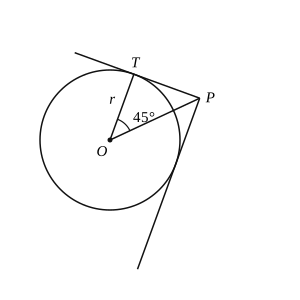
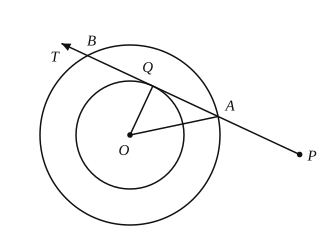
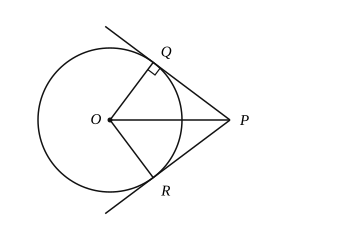
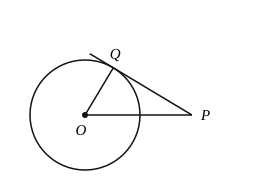
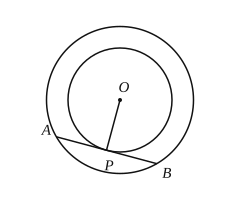
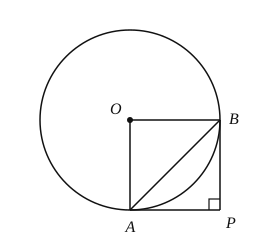
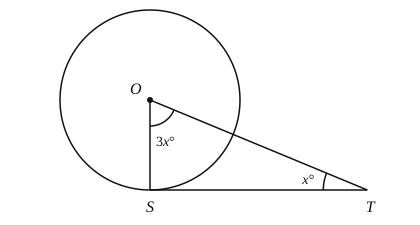
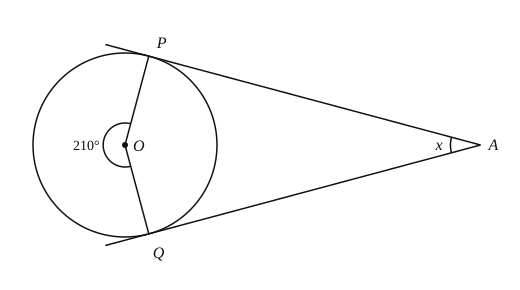
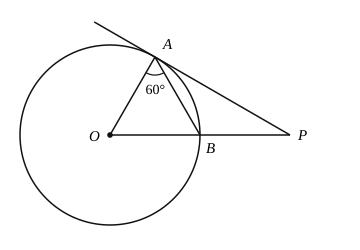
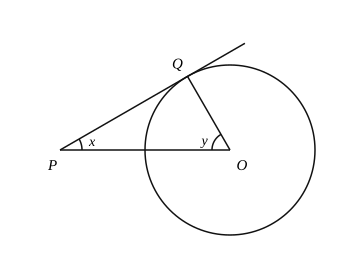
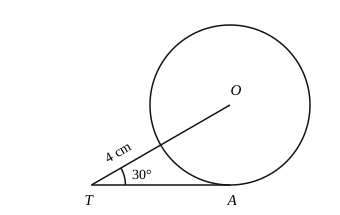
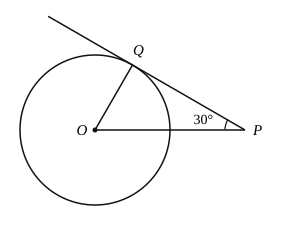
From an external point P, a tangent PT has been drawn to a circle with centre at O and radius 3 cm, intersecting its concentric circle at A and B. If AB = 8 cm and OA = AP, the length PQ equals.
(A)8 cm
(B)10 cm
(C)9 cm
(D)12 cm
Show answer & solution
Answer: (C) 9 cm
PT touches the inner circle at Q, so OQ⊥AB and OQ = 3 cm.
The perpendicular from the centre bisects the chord AB of the outer circle: AQ = 4 cm.
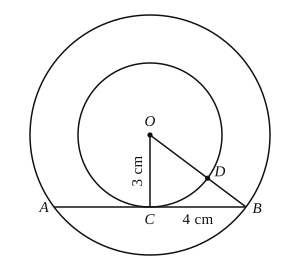
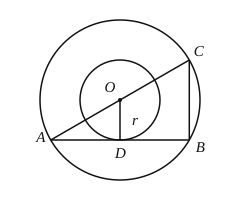
In the given figure, chord AB of the larger circle touches the smaller circle at C. If both the circles have the same centre O, then the length of BD is :
(A)1 cm
(B)2 cm
(C)3 cm
(D)4 cm
Show answer & solution
Answer: (B) 2 cm
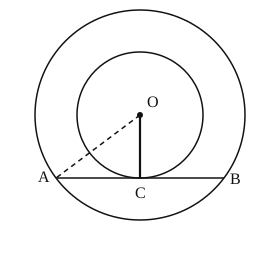
AB touches the smaller circle at C, so OC⊥AB (radius ⊥ tangent).
In two concentric circles centred at O, a chord AB of the larger circle touches the smaller circle at C. If OA = 3.5 cm, OC = 2.1 cm, then AB is equal to
(A)5.6 cm
(B)2.8 cm
(C)3.5 cm
(D)4.2 cm
Show answer & solution
Answer: (A) 5.6 cm
OC ⊥ AB (radius ⊥ tangent), and the perpendicular from the centre bisects the chord, so AB = 2AC.
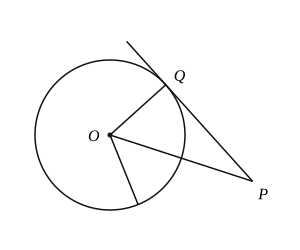
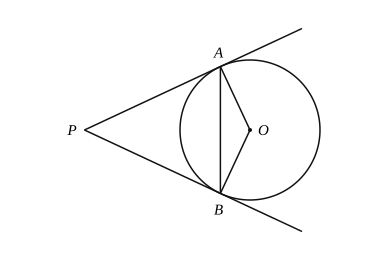
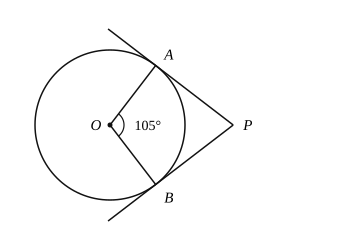
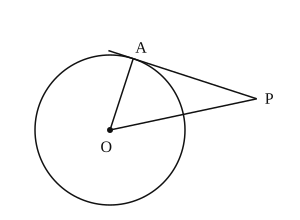
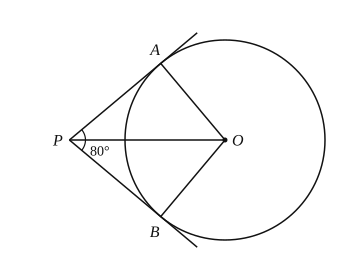
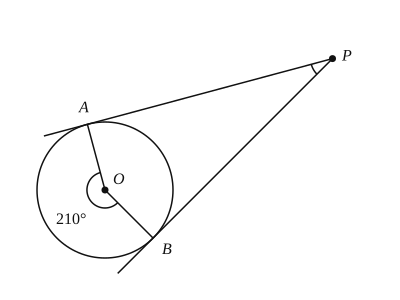
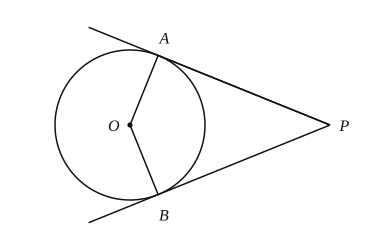
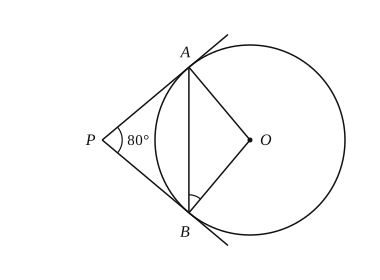
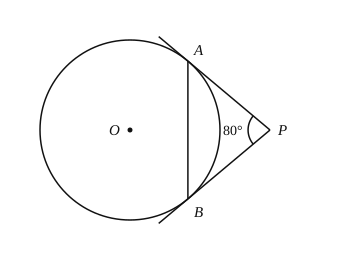
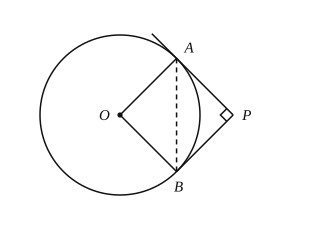
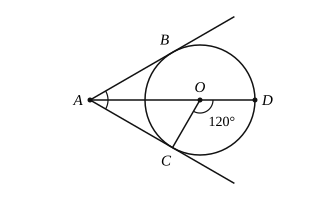
If tangents PA and PB drawn from an external point P to the circle with centre O are inclined to each other at an angle of 80∘ as shown in the given figure, then the measure of ∠POA is :
Assertion (A) : If two tangents are drawn to a circle from an external point, then they subtend equal angles at the centre of the circle. Reason (R): A parallelogram circumscribing a circle is a rhombus.
(A)Both Assertion (A) and Reason (R) are true and Reason (R) is the correct explanation of the Assertion (A).
(B)Both Assertion (A) and Reason (R) are true, but Reason (R) is not the correct explanation of the Assertion (A).
(C)Assertion (A) is true, but Reason (R) is false.
(D)Assertion (A) is false, but Reason (R) is true.
Show answer & solution
Answer: (B) Both Assertion (A) and Reason (R) are true, but Reason (R) is not the correct explanation of the Assertion (A).
If PA, PB are tangents from P to a circle with centre O, △OAP≅△OBP (RHS), so ∠AOP=∠BOP. A is true.
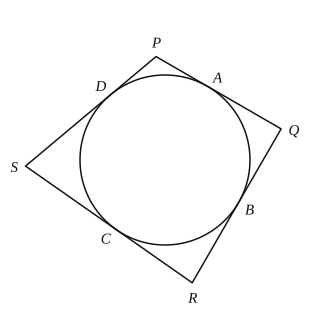
For a parallelogram ABCD circumscribing a circle, equal tangent lengths give AB+CD=AD+BC, so 2AB=2AD and it is a rhombus. R is true.
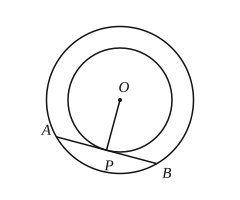
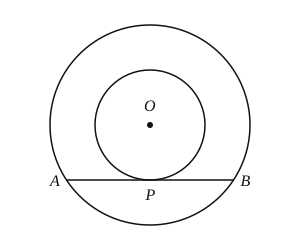
In the adjoining figure, AB is the chord of the larger circle touching the smaller circle. The centre of both the circles is O. If AB=2r and OP=r, then the radius of larger circle is :
(A)2r
(B)3r
(C)22r
(D)2r
Show answer & solution
Answer: (D) 2r
AB touches the smaller circle at P, so OP⊥AB.
The perpendicular from the centre bisects the chord: AP=22r=r
Assertion (A) : Tangents drawn at the end points of a diameter of a circle are always parallel to each other. Reason (R) : The lengths of tangents drawn to a circle from a point outside the circle are always equal.
(A)Both, Assertion (A) and Reason (R) are true and Reason (R) is correct explanation of Assertion (A).
(B)Both, Assertion (A) and Reason (R) are true but Reason (R) is not the correct explanation of Assertion (A).
(C)Assertion (A) is true but Reason (R) is false.
(D)Assertion (A) is false but Reason (R) is true.
Show answer & solution
Answer: (B) Both, Assertion (A) and Reason (R) are true but Reason (R) is not the correct explanation of Assertion (A).
A: each tangent is perpendicular to the same diameter, so the two tangents are parallel. A is true.
R is a true theorem (equal tangent lengths), but it is not the reason for A, which uses tangent ⊥ radius.
In the adjoining figure, AB is the chord of larger circle which touches the smaller circle at P. If length of AB= diameter of inner circle =2r, then the diameter of larger circle is :
(A)2r
(B)4r
(C)22r
(D)2r
Show answer & solution
Answer: (C) 22r
Inner circle radius OP=r and OP⊥AB (tangent at P).
Assertion (A) : A line drawn perpendicular to the tangent at point of contact passes through the centre of the circle. Reason (R) : Lengths of tangents drawn from external point to a circle are equal.
(A)Both, Assertion (A) and Reason (R) are true and Reason (R) is correct explanation of Assertion (A).
(B)Both, Assertion (A) and Reason (R) are true but Reason (R) is not the correct explanation of Assertion (A).
(C)Assertion (A) is true but Reason (R) is false.
(D)Assertion (A) is false but Reason (R) is true.
Show answer & solution
Answer: (B) Both, Assertion (A) and Reason (R) are true but Reason (R) is not the correct explanation of Assertion (A).
A: the radius to the point of contact is ⊥ the tangent, and there is only one perpendicular at that point, so it passes through the centre. A is true.
R is a true theorem, but A follows from tangent ⊥ radius, not from equal tangent lengths.
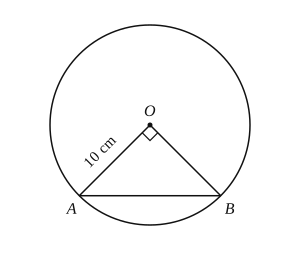
In the adjoining figure, the sum of radii of two concentric circles is 16 cm. The length of chord AB which touches the inner circle at P is 16 cm. The difference of the radii of the given circles is
(A)8 cm
(B)4 cm
(C)2 cm
(D)3 cm
Show answer & solution
Answer: (B) 4 cm
Let radii be R (outer) and r (inner). OP⊥AB and P is the midpoint of AB, so AP=8 cm.
For a circle with centre O and radius 5 cm, which of the following statements is true ? P : Distance between every pair of parallel tangents is 5 cm. Q : Distance between every pair of parallel tangents is 10 cm. R : Distance between every pair of parallel tangents must be between 5 cm and 10 cm. S : There does not exist a point outside the circle from where length of tangent is 5 cm.
(A)P
(B)Q
(C)R
(D)S
Show answer & solution
Answer: (B) Q
Parallel tangents touch the circle at the two ends of a diameter.
So the distance between them equals the diameter =2×5=10 cm. Q is true; P and R are false.
S is false: a point at distance 52 cm from O has tangent length 50−25=5 cm.
Assertion (A) : If PA and PB are tangents drawn to a circle with centre O from an external point P, then the quadrilateral OAPB is a cyclic quadrilateral. Reason (R) : In cyclic quadrilateral opposite angles are equal.
(A)Both, Assertion (A) and Reason (R) are true. Reason (R) explains Assertion (A) completely.
(B)Both, Assertion (A) and Reason (R) are true. Reason (R) does not explain Assertion (A).
(C)Assertion (A) is true but Reason (R) is false.
(D)Assertion (A) is false but Reason (R) is true.
Show answer & solution
Answer: (C) Assertion (A) is true but Reason (R) is false.
The radius is perpendicular to the tangent, so ∠OAP=∠OBP=90∘.
Then ∠OAP+∠OBP=180∘, so the other pair also adds to 180∘ and OAPB is cyclic. A is true.
In a cyclic quadrilateral, opposite angles are supplementary, not equal in general. R is false.
Assertion (A) : If the PA and PB are tangents drawn to a circle with centre O from an external point P, then the quadrilateral OAPB is a cyclic quadrilateral. Reason (R) : In a cyclic quadrilateral, opposite angles are equal.
(A)Both, Assertion (A) and Reason (R) are true. Reason (R) explains Assertion (A) completely.
(B)Both, Assertion (A) and Reason (R) are true. Reason (R) does not explain Assertion (A).
(C)Assertion (A) is true but Reason (R) is false.
(D)Assertion (A) is false but Reason (R) is true.
Show answer & solution
Answer: (C) Assertion (A) is true but Reason (R) is false.
The radius is perpendicular to the tangent, so ∠OAP=∠OBP=90∘.
Then ∠OAP+∠OBP=180∘, so the other pair also adds to 180∘ and OAPB is cyclic. A is true.
In a cyclic quadrilateral, opposite angles are supplementary, not equal in general. R is false.
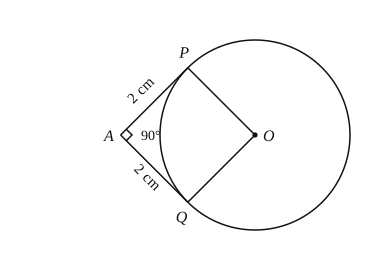
AP and AQ are tangents drawn from an external point A to a circle with centre O and inclined to each other at an angle of 90∘. If the length of each tangent is 2 cm, then the radius of the circle is :
(A)4 cm
(B)2 cm
(C)22 cm
(D)1 cm
Show answer & solution
Answer: (B) 2 cm
∠OPA=∠OQA=90∘ (radius ⊥ tangent) and ∠PAQ=90∘.
So ∠POQ=90∘ and APOQ is a rectangle with AP = AQ, i.e. a square.
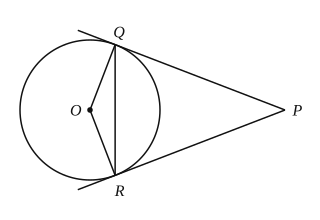
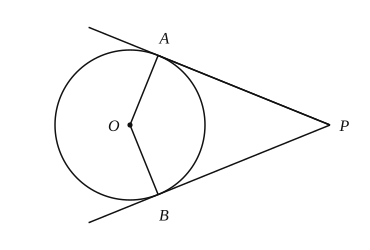
In the given figure, tangents PA and PB to the circle centred at O, from point P are perpendicular to each other. If PA = 5 cm, then length of AB is equal to
(A)5 cm
(B)52 cm
(C)25 cm
(D)10 cm
Show answer & solution
Answer: (B) 52 cm
PA = PB = 5 cm (tangents from an external point) and ∠APB=90∘.
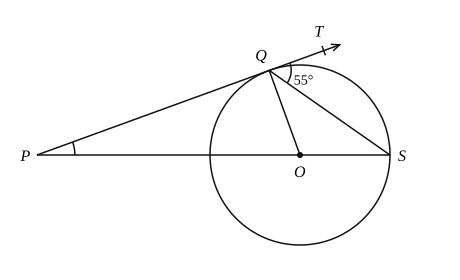
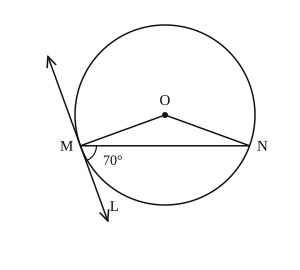
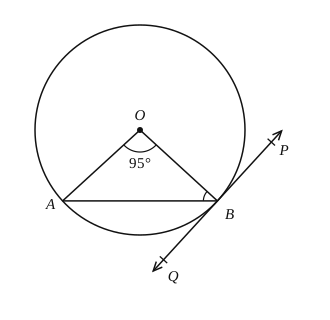
In the given figure, O is the centre of the circle. MN is the chord and the tangent ML at point M makes an angle of 70∘ with MN. The measure of ∠MON is :
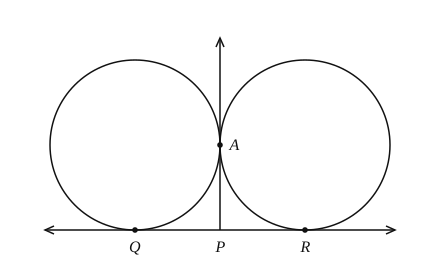
In the given figure, QR is a common tangent to the two given circles touching externally at A. The tangent at A meets QR at P. If AP = 4.2 cm, then the length of QR is :
(A)4.2 cm
(B)2.1 cm
(C)8.4 cm
(D)6.3 cm
Show answer & solution
Answer: (C) 8.4 cm
Tangents from P to the first circle: PQ = PA = 4.2 cm.
Tangents from P to the second circle: PR = PA = 4.2 cm.
Assertion (A) : A tangent to a circle is perpendicular to the radius through the point of contact. Reason (R) : The lengths of tangents drawn from the external point to a circle are equal.
(A)Both Assertion (A) and Reason (R) are true and Reason (R) is the correct explanation of Assertion (A).
(B)Both Assertion (A) and Reason (R) are true but Reason (R) is not the correct explanation of Assertion (A).
(C)Assertion (A) is true, but Reason (R) is false.
(D)Assertion (A) is false, but Reason (R) is true.
Show answer & solution
Answer: (B) Both A and R are true but R is not the correct explanation of A.
A is true: the tangent at any point of a circle is perpendicular to the radius through the point of contact.
R is true: tangents drawn from an external point to a circle are equal in length.
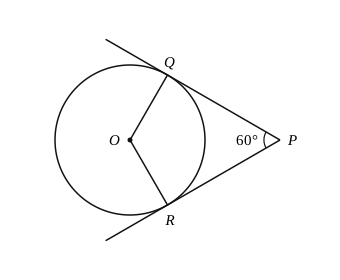
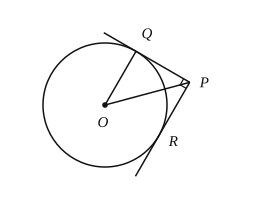
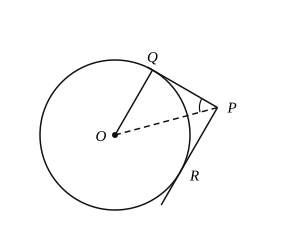
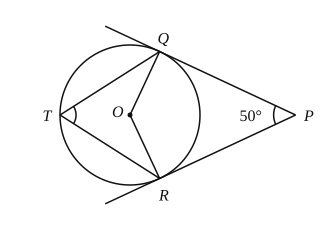
From a point P, two tangents PQ and PR are drawn to a circle with centre at O. T is a point on the major arc QR of the circle. If ∠QPR=50∘, then ∠QTR equals :
(A)50∘
(B)130∘
(C)65∘
(D)90∘
Show answer & solution
Answer: (c) 65∘
∠OQP=∠ORP=90∘ (radius ⊥ tangent).
In quadrilateral OQPR, ∠QOR=360∘−90∘−90∘−50∘=130∘
Angle at the circumference is half the angle at the centre: ∠QTR=2130∘=65∘
Assertion (A) : A tangent to a circle is perpendicular to the radius through the point of contact. Reason (R) : The lengths of tangents drawn from an external point to a circle are equal.
(A)Both Assertion (A) and Reason (R) are true and Reason (R) gives the correct explanation of Assertion (A).
(B)Both Assertion (A) and Reason (R) are true but Reason (R) does not give the correct explanation of Assertion (A).
(C)Assertion (A) is true but Reason (R) is false.
(D)Assertion (A) is false but Reason (R) is true.
Show answer & solution
Answer: (B) Both A and R are true but R does not give the correct explanation of A.
A is a standard theorem, so A is true.
R is also a standard theorem, so R is true.
R is about equal tangent lengths and does not explain why the tangent is perpendicular to the radius.
Assertion (A) : A tangent to a circle is perpendicular to the radius through the point of contact. Reason (R) : The lengths of tangents drawn from an external point to a circle are equal.
(A)Both Assertion (A) and Reason (R) are true and Reason (R) is the correct explanation of the Assertion (A).
(B)Both Assertion (A) and Reason (R) are true, but Reason (R) is not the correct explanation of the Assertion (A).
(C)Assertion (A) is true, but Reason (R) is false.
(D)Assertion (A) is false, but Reason (R) is true.
Show answer & solution
Answer: (B) Both A and R are true, but R is not the correct explanation of A.
A is a standard theorem, so A is true.
R is also a standard theorem, so R is true.
R is about tangent lengths and does not explain why the tangent is perpendicular to the radius.
Assertion (A) : If PA and PB are tangents drawn from an external point P to a circle with centre O, then the quadrilateral AOBP is cyclic. Reason (R): The angle between two tangents drawn from an external point to a circle is supplementary to the angle subtended by the line segment joining the points of contact at the centre.
(A)Both Assertion (A) and Reason (R) are true and Reason (R) is the correct explanation of the Assertion (A).
(B)Both Assertion (A) and Reason (R) are true, but Reason (R) is not the correct explanation of the Assertion (A).
(C)Assertion (A) is true, but Reason (R) is false.
(D)Assertion (A) is false, but Reason (R) is true.
Show answer & solution
Answer: (A) Both A and R are true, and R is the correct explanation of A.
∠OAP=∠OBP=90∘, so ∠APB+∠AOB=180∘. R is true.
In quadrilateral AOBP the opposite angles ∠APB and ∠AOB are supplementary, so AOBP is cyclic. A is true.
A follows directly from R, so R is the correct explanation of A.
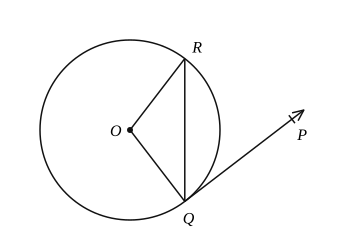
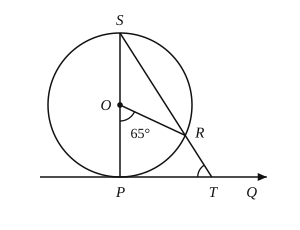
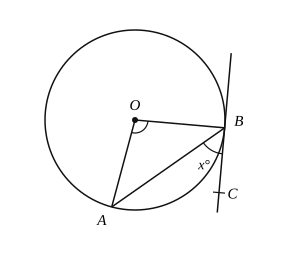
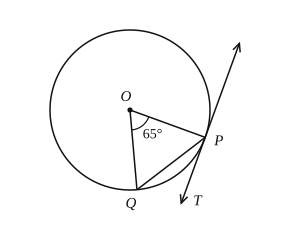
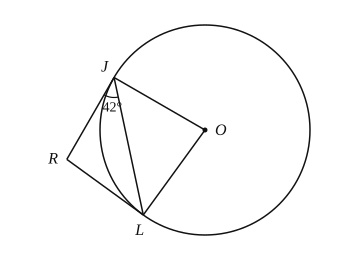
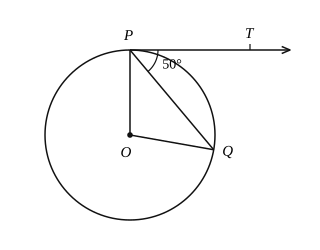
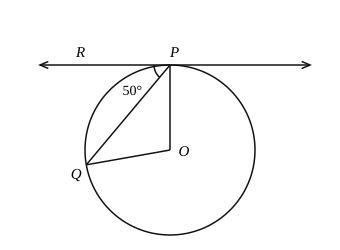
In the given figure, O is the centre of the circle and PQ is the chord. If the tangent PR at P makes an angle of 50∘ with PQ, then the measure of ∠POQ is :
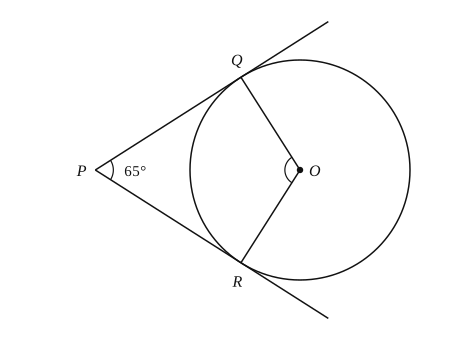
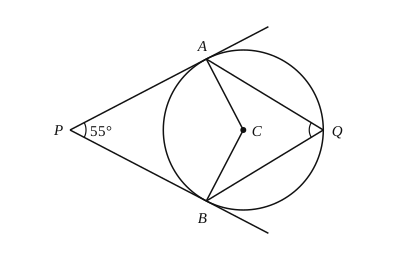
In the given figure, PA and PB are tangents from external point P to a circle with centre C and Q is any point on the circle. Then the measure of ∠AQB is
(A)6221∘
(B)125∘
(C)55∘
(D)90∘
Show answer & solution
Answer: (A) 6221∘
CA ⊥ PA and CB ⊥ PB, so in quadrilateral PACB, ∠ACB=180∘−55∘=125∘.
The angle subtended by arc AB at a point Q on the remaining part of the circle is half the angle at the centre.