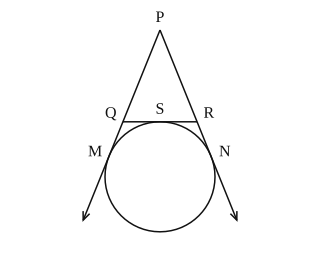
In the given figure, if a circle touches the side QR of △PQR at S and extended sides PQ and PR at M and N respectively, then prove that : PM=21(PQ+QR+PR)
Show answer & solution
Answer: Proved.
Tangents from an external point are equal: PM=PN, QM=QS, RN=RS.
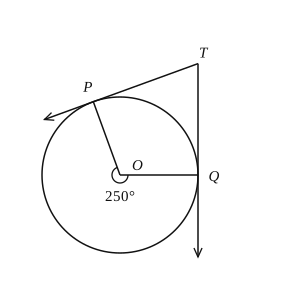
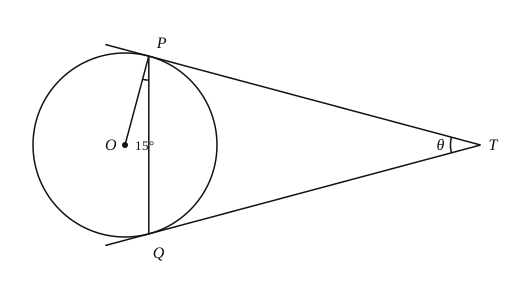
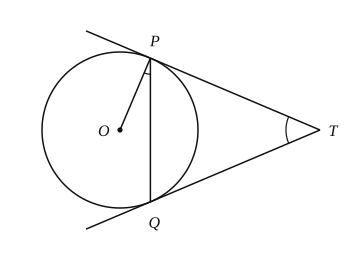
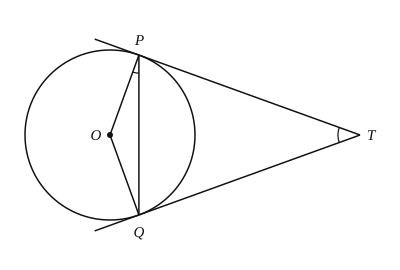
In the given figure, TP and TQ are tangents at points P and Q of the circle respectively. If reflex ∠POQ=250∘, find the measure of each angle of quadrilateral POQT.
Show answer & solution
Answer:∠POQ=110∘, ∠OPT=90∘, ∠OQT=90∘, ∠PTQ=70∘
∠POQ=360∘−250∘=110∘.
A tangent is perpendicular to the radius at the point of contact, so ∠OPT=∠OQT=90∘.
Sum of angles of quadrilateral POQT is 360∘: ∠PTQ=360∘−110∘−90∘−90∘=70∘.
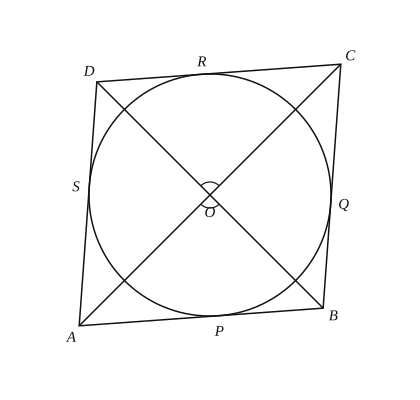
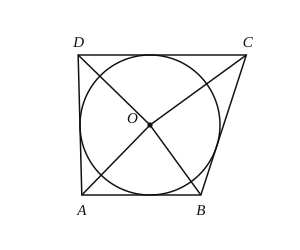
In the given figure, a circle is inscribed in a quadrilateral ABCD which touches the sides AB, BC, CD and DA at P, Q, R and S respectively. Prove that ∠AOB+∠COD=180∘.
Show answer & solution
Answer: Proved.
Join OP, OQ, OR, OS. In △OAP and △OAS: AP=AS (tangents from A), OP=OS (radii), OA common, so they are congruent (SSS) and ∠OAP=∠OAS.
Similarly OB, OC and OD bisect ∠B, ∠C and ∠D. Let ∠OAB=a, ∠OBA=b, ∠OCD=c, ∠ODC=d.
Then 2a+2b+2c+2d=∠A+∠B+∠C+∠D=360∘, so a+b+c+d=180∘.
In △AOB: ∠AOB=180∘−(a+b). In △COD: ∠COD=180∘−(c+d).
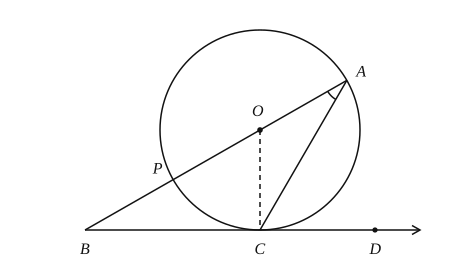
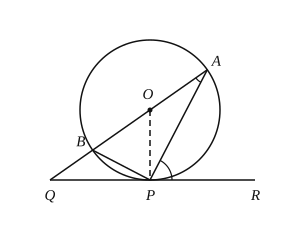
In the given figure, PC is a tangent to the circle at C. AOB is the diameter which when extended meets the tangent at P. Find ∠CBA and ∠BCO, if ∠PCA=110∘.
Show answer & solution
Answer:∠CBA=70∘, ∠BCO=70∘
∠OCP=90∘ (radius ⊥ tangent), so ∠OCA=110∘−90∘=20∘.
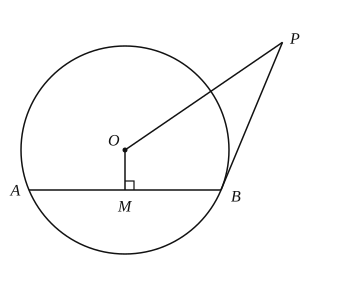
In the given figure, PB is a tangent to the circle with centre O at B. AB is a chord of the circle of length 24 cm and at a distance of 5 cm from the centre of the circle. If the length PB of the tangent is 20 cm, find the length of OP.
Show answer & solution
Answer:OP=569 cm (≈23.85 cm)
OM ⊥ AB, so M is the mid-point of AB: MB=12 cm, OM=5 cm.
In right △OMB, OB=122+52=169=13 cm (radius).
OB⊥PB (radius ⊥ tangent), so in right △OBP, OP2=OB2+PB2=169+400=569.
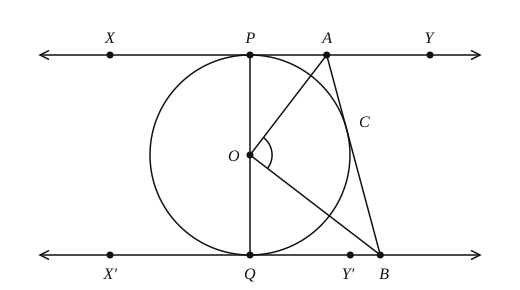
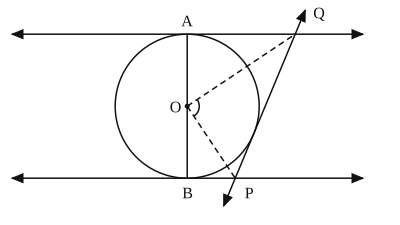
In the adjoining figure, XY and X′Y′ are parallel tangents to a circle with centre O. Another tangent AB touches the circle at C intersecting XY at A and X′Y′ at B. Prove that AB subtends right angle at the centre of the circle; or ∠AOB=90∘.
Show answer & solution
Answer: Proved.
Let XY touch the circle at P and X′Y′ at Q. Join OC.
In △OPA and △OCA: OP=OC (radii), AP=AC (tangents from A), OA common. So the triangles are congruent (SSS) and ∠OAP=∠OAC, i.e. ∠OAB=21∠PAB.
Similarly △OQB≅△OCB, so ∠OBA=21∠QBA.
XY∥X′Y′ and AB is a transversal, so ∠PAB+∠QBA=180∘ (co-interior angles).
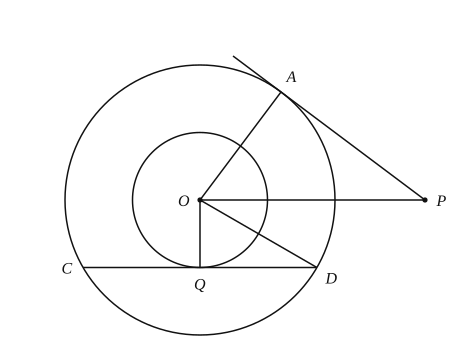
In two concentric circles, the radii are OA = r cm and OQ = 6 cm, as shown in the figure. Chord CD of larger circle is a tangent to smaller circle at Q. PA is tangent to larger circle. If PA = 16 cm and OP = 20 cm, find the length CD.
Show answer & solution
Answer: CD = 123 cm
OA⊥PA (radius is perpendicular to tangent), so OA2=OP2−PA2=400−256=144 and r=12 cm.
OQ⊥CD, and the perpendicular from the centre bisects the chord, so CQ=QD.
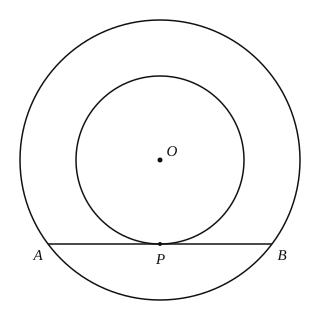
In two concentric circles, a chord of length 24 cm of larger circle touches the smaller circle, whose radius is 5 cm. Find the radius of the larger circle.
Show answer & solution
Answer: 13 cm
Let the chord AB touch the smaller circle at P. Then OP⊥AB and OP = 5 cm.
The perpendicular from the centre bisects the chord, so AP = 12 cm.
In right △OPA, OA2=OP2+AP2=25+144=169
OA = 13 cm, so the radius of the larger circle is 13 cm.
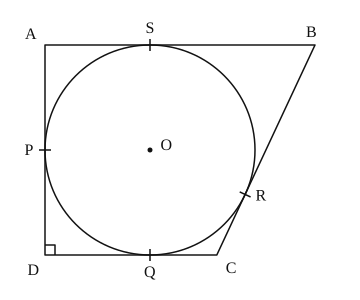
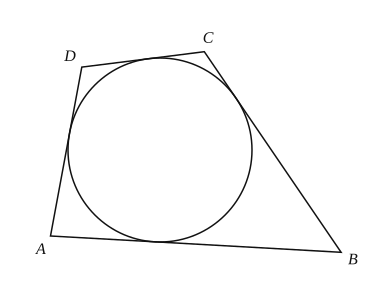
A circle with centre O and radius 8 cm is inscribed in a quadrilateral ABCD in which P, Q, R, S are the points of contact as shown. If AD is perpendicular to DC, BC = 30 cm and BS = 24 cm, then find the length DC.
Show answer & solution
Answer: DC = 14 cm
Tangents from an external point are equal: BR = BS = 24 cm.
CR = BC − BR = 30 − 24 = 6 cm, so CQ = CR = 6 cm.
In quadrilateral OPDQ, ∠D=90∘ and ∠OPD=∠OQD=90∘ (radius ⊥ tangent), and OP = OQ = 8 cm, so OPDQ is a square.
From an external point P, two tangents PA and PB are drawn to the circle with centre O. Prove that OP is the perpendicular bisector of chord AB.
Show answer & solution
Answer: Proved.
Let OP meet AB at M.
In △PAM and △PBM: PA = PB (tangents from an external point are equal), ∠APM=∠BPM (OP bisects the angle between the tangents, since △OAP≅△OBP by RHS), PM = PM (common).
So △PAM≅△PBM (SAS), giving AM = BM and ∠AMP=∠BMP.
∠AMP+∠BMP=180∘, so each is 90∘.
Hence OP is the perpendicular bisector of chord AB.
Two concentric circles with centre O are of radii 3 cm and 5 cm. Find the length of chord AB of the larger circle which touches the smaller circle at P.
Show answer & solution
Answer: AB = 8 cm
OP is a radius of the smaller circle and AB touches it at P, so OP⊥AB.
The perpendicular from the centre bisects the chord, so AP = PB.
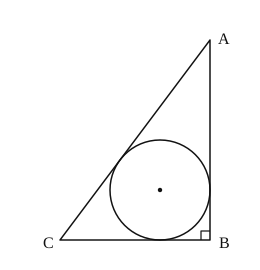
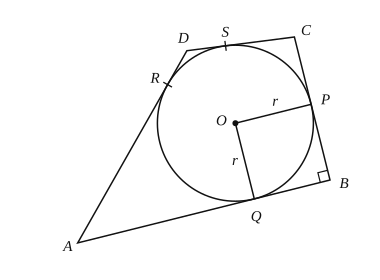
In the given figure, a circle is inscribed in a quadrilateral ABCD in which ∠B=90∘. If AD = 17 cm, AB = 20 cm and DS = 3 cm, then find the radius of the circle.
Show answer & solution
Answer: 6 cm
Tangents from an external point are equal: DR = DS = 3 cm.
AR = AD – DR = 17 – 3 = 14 cm, so AQ = AR = 14 cm.
BQ = AB – AQ = 20 – 14 = 6 cm.
In OQBP, ∠OQB=∠OPB=∠B=90∘ and BQ = BP, so OQBP is a square.
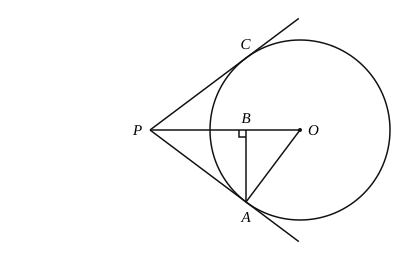
Prove that the angle between the two tangents drawn from an external point to a circle is supplementary to the angle subtended by the line-segment joining the points of contact at the centre.
Show answer & solution
Answer: Proved.
Let PA and PB be tangents from external point P to a circle with centre O, touching it at A and B.
A radius is perpendicular to the tangent at the point of contact, so ∠OAP=∠OBP=90∘.
In quadrilateral OAPB, the angles add up to 360∘:
∠APB+∠AOB+90∘+90∘=360∘
∠APB+∠AOB=180∘
Hence the angle between the tangents is supplementary to ∠AOB.
From an external point, two tangents are drawn to a circle. Prove that the line joining the external point to the centre of the circle bisects the angle between the two tangents.
Show answer & solution
Answer: Proved.
Let PA and PB be tangents from external point P to a circle with centre O, touching it at A and B. Join OA, OB and OP.
In △OAP and △OBP:
OA = OB (radii); ∠OAP=∠OBP=90∘ (radius ⊥ tangent); OP is common.
Draw a circle of radius 3 cm. Take a point P at a distance of 8 cm from the centre of the circle. Construct a pair of tangents from the point P to the circle.
Show answer & solution
Answer: Construction (see steps).
Draw a circle with centre O and radius 3 cm; mark P with OP = 8 cm
Bisect OP; let M be its midpoint
With M as centre and radius MO, draw a circle cutting the given circle at A and B
Join PA and PB; these are the required tangents (each 55≈7.4 cm long)
Draw a circle of radius 2.5 cm. From a point P lying outside the circle at a distance of 6 cm from the centre of the circle, construct tangents PA and PB to the circle.
Show answer & solution
Answer: Construction (each tangent =62−2.52=29.75≈5.45 cm)
Draw a circle with centre O and radius 2.5 cm; mark P with OP = 6 cm.
Draw the perpendicular bisector of OP; let it meet OP at M.
With M as centre and MO as radius, draw a circle cutting the given circle at A and B.
Join PA and PB; these are the required tangents.
Justification: ∠OAP=∠OBP=90∘ (angles in a semicircle), so PA and PB are tangents. Each measures 36−6.25≈5.45 cm.
Draw a circle of radius 3 cm. Take two points P and Q on one of its extended diameter each at a distance of 7 cm from its centre. Construct tangents to the circle from these two points P and Q.
Show answer & solution
Answer: Construction: two tangents from each of P and Q; each tangent is 210≈6.3 cm long.
Draw a circle with centre O and radius 3 cm. Draw a diameter and extend it both ways; mark P and Q on it with OP = OQ = 7 cm.
Bisect OP; let M be its midpoint. With M as centre and MO as radius, draw a circle cutting the given circle at A and B.
Join PA and PB: these are the tangents from P.
Repeat with the midpoint N of OQ to get points C and D; join QC and QD: these are the tangents from Q.
Justification: ∠OAP=90∘ (angle in a semicircle), so PA ⊥ OA and PA is a tangent.
Draw a circle of radius 3 cm. From a point P lying outside the circle at a distance of 6 cm from its centre, construct two tangents PA and PB to the circle.
Show answer & solution
Answer: Tangents PA and PB constructed; PA = PB = 33 cm ≈ 5.2 cm.
Draw a circle with centre O and radius 3 cm; mark P with OP = 6 cm.
Draw the perpendicular bisector of OP; let M be the midpoint of OP.
With M as centre and MO (= 3 cm) as radius, draw a circle cutting the given circle at A and B.
Join PA and PB; these are the required tangents.
Justification: ∠OAP=90∘ (angle in a semicircle), so PA is a tangent; similarly PB.