Circles: 2 marks Questions (CBSE Class 10)
40 different 2 marks questions on Circles from CBSE Class 10 Maths board exams 2022–2026, newest first.
In the given figure, AP, AQ and BC are tangents to the circle with centre O. If AB = 6 cm, AC = 7 cm and BC = 5 cm, then what is the length of AP ?
Show answer & solution
Answer: AP = 9 cm
Tangents from an external point are equal: BP = BR, CQ = CR, AP = AQ. AP + AQ = (AB + BP) + (AC + CQ) = AB + AC + BR + CR = AB + AC + BC. 2AP = 6 + 7 + 5 = 18. AP = 9 cm.
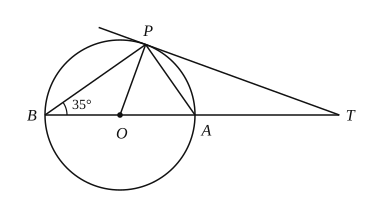
In the given figure, TP is tangent to a circle with centre O. Diameter BA when produced meets the tangent at T. If ∠ 3 5 ∘ ∠
Show answer & solution
Answer: ∠ P T A = 2 0 ∘
OB = OP (radii), so ∠ O P B = ∠ O B P = 3 5 ∘ Exterior angle: ∠ P O T = 3 5 ∘ + 3 5 ∘ = 7 0 ∘ ∠ O P T = 9 0 ∘ ⊥ In △ O P T ∠ P T A = 18 0 ∘ − 9 0 ∘ − 7 0 ∘ = 2 0 ∘
Two concentric circles are of radii 5 cm and 4 cm. Find the length of the chord of the larger circle which touches the smaller circle.
Show answer & solution
Answer: 6 cm
Let chord AB of the larger circle touch the smaller circle at P. Then O P ⊥ A B O P = 4 The perpendicular from the centre bisects the chord, so A P = P B In right △ O P A A P = 5 2 − 4 2 = 3 A B = 2 × 3 = 6
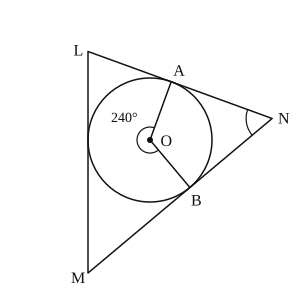
In the given figure, a circle with centre O is inscribed inside △ L M N ∠ A N B
Show answer & solution
Answer: ∠ A N B = 6 0 ∘
The reflex angle AOB is 24 0 ∘ ∠ A O B = 36 0 ∘ − 24 0 ∘ = 12 0 ∘ ∠ O A N = ∠ O B N = 9 0 ∘ ⊥ In quadrilateral OANB, ∠ A N B = 36 0 ∘ − 9 0 ∘ − 9 0 ∘ − 12 0 ∘ = 6 0 ∘
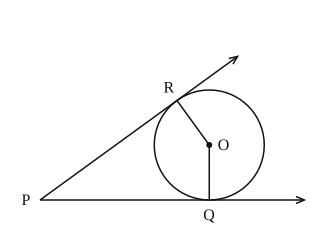
In the given figure, O is the centre of the circle. PQ and PR are tangents. Show that the quadrilateral PQOR is cyclic.
Show answer & solution
Answer: Proved.
A tangent is perpendicular to the radius at the point of contact, so ∠ O QP = 9 0 ∘ ∠ O R P = 9 0 ∘ ∠ O QP + ∠ O R P = 18 0 ∘ Sum of all angles is 36 0 ∘ ∠ QP R + ∠ QO R = 18 0 ∘ Hence PQOR is a cyclic quadrilateral.
Two concentric circles are of radii 6 cm and 10 cm. Find the length of the chord of the larger circle which touches the smaller circle.
Show answer & solution
Answer: 16 cm
Let the chord AB of the larger circle touch the smaller circle at P. Then OP ⊥ In right △ O P A A P = O A 2 − O P 2 = 100 − 36 = 8 A B = 2 × 8 = 16
Prove that the tangent drawn at any point of the circle is perpendicular to the radius through the point of contact.
Show answer & solution
Answer: Proved.
Let XY be the tangent at point P to a circle with centre O. We prove OP ⊥ Take any point Q on XY other than P. Q lies outside the circle (a tangent meets the circle only at P). So OQ > radius = OP. This holds for every point Q on XY other than P, so OP is the shortest distance from O to the line XY. The shortest segment from a point to a line is the perpendicular, so OP ⊥
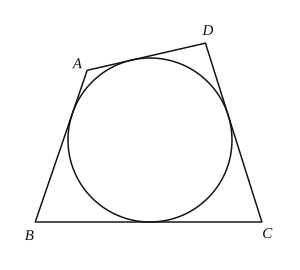
A quadrilateral circumscribes the circle as shown in the given figure. If AB = 5 cm, BC = 7 cm and CD = 6 cm, then find the length of AD.
Show answer & solution
Answer: AD = 4 cm
Tangents drawn from an external point to a circle are equal. So for a quadrilateral circumscribing a circle, AB + CD = BC + AD. 5 + 6 = 7 + A D ⇒ A D = 4
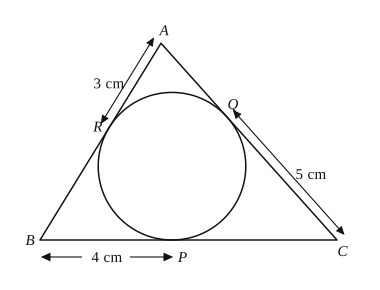
In the given figure, △ A B C △ A B C
Show answer & solution
Answer: 24 cm
Tangents from an external point to a circle are equal. AQ = AR = 3 cm, BR = BP = 4 cm, CP = CQ = 5 cm. Perimeter = AB + BC + CA = (3 + 4) + (4 + 5) + (5 + 3) = 24 cm.
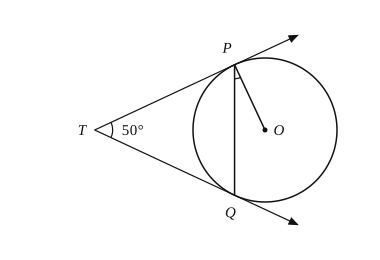
In the given figure, TP and TQ are two tangents. If ∠ P T Q = 5 0 ∘ ∠ O P Q
Show answer & solution
Answer: ∠ O P Q = 2 5 ∘
TP = TQ (tangents from an external point), so ∠ T P Q = ∠ T QP = 2 18 0 ∘ − 5 0 ∘ = 6 5 ∘ ∠ O P T = 9 0 ∘ ⊥ ∠ O P Q = 9 0 ∘ − 6 5 ∘ = 2 5 ∘
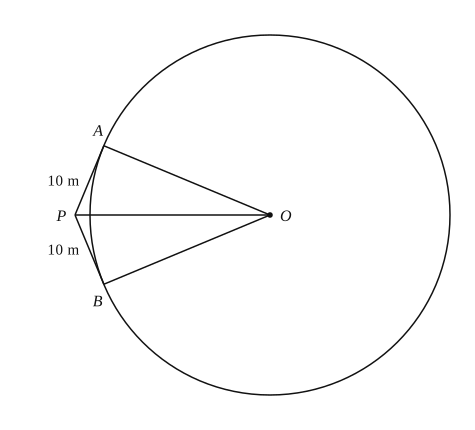
A person is standing at P 26 A B 10 P A P B
Show answer & solution
Answer: 24
O A ⊥ P A △ O A P A O A 2 = O P 2 − P A 2 = 2 6 2 − 1 0 2 = 676 − 100 = 576 O A = 24 24
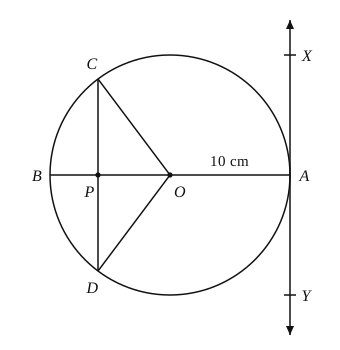
At point A on the diameter AB of a circle of radius 10 cm, tangent XAY is drawn to the circle. Find the length of the chord CD parallel to XY at a distance of 16 cm from A.
Show answer & solution
Answer: 16 cm
O A ⊥ X Y C D ∥ X Y A P = 16 O P = 16 − 10 = 6 In right △ O P C C P = O C 2 − O P 2 = 100 − 36 = 8 The perpendicular from the centre bisects the chord, so C D = 2 × 8 = 16
Prove that the tangents drawn at the ends of a diameter of a circle are parallel to each other.
Show answer & solution
Answer: Proved.
Let AB be a diameter of a circle with centre O, and let tangents PQ at A and RS at B be drawn. A tangent is perpendicular to the radius at the point of contact, so O A ⊥ P Q O B ⊥ R S Hence ∠ P A B = 9 0 ∘ ∠ A B S = 9 0 ∘ These are alternate angles made by transversal AB with PQ and RS, and they are equal. So P Q ∥ R S
XY and PQ are two tangents drawn at the end points of the diameter AB of a circle. Prove that X Y ∥ P Q
Show answer & solution
Answer: Proved.
Let O be the centre. XY touches the circle at A and PQ touches it at B. The tangent at a point is perpendicular to the radius through that point, so O A ⊥ X Y O B ⊥ P Q Since AB is a diameter, A, O, B are collinear, so A B ⊥ X Y A B ⊥ P Q Thus ∠ X A B = ∠ A B Q = 9 0 ∘ Hence X Y ∥ P Q
The length of a tangent drawn to a circle from a point A, at a distance of 10 cm from the centre of the circle, is 6 cm. Find the radius of the circle.
Show answer & solution
Answer: 8 cm
Let O be the centre and T the point of contact. OT ⊥ O A 2 = O T 2 + A T 2 100 = r 2 + 36 r 2 = 64 r = 8
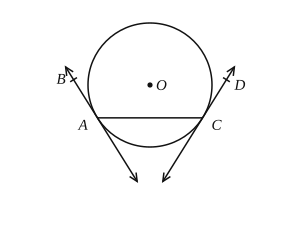
In the given figure, AB and CD are tangents to a circle centred at O. Is ∠ B A C = ∠ D C A
Show answer & solution
Answer: Yes, ∠ B A C = ∠ D C A
Join OA and OC. A tangent is perpendicular to the radius at the point of contact, so ∠ O A B = ∠ O C D = 9 0 ∘ OA = OC (radii), so ∠ O A C = ∠ O C A ∠ B A C = ∠ B A O + ∠ O A C = 9 0 ∘ + ∠ O A C ∠ D C A = ∠ D C O + ∠ O C A = 9 0 ∘ + ∠ O C A Hence ∠ B A C = ∠ D C A
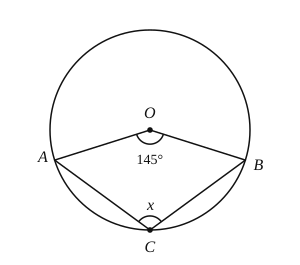
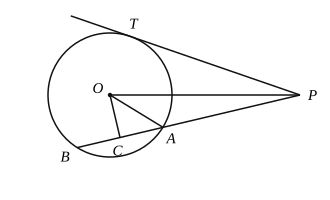
In the given figure, O is the centre of the circle. If ∠ A O B = 14 5 ∘
Show answer & solution
Answer: x = 107. 5 ∘
Arc ACB (the minor arc) subtends 14 5 ∘ ∠ A O B = 36 0 ∘ − 14 5 ∘ = 21 5 ∘ The angle at C (a point on the minor arc) is subtended by the major arc AB, and equals half the angle it subtends at the centre. x = 2 21 5 ∘ = 107. 5 ∘
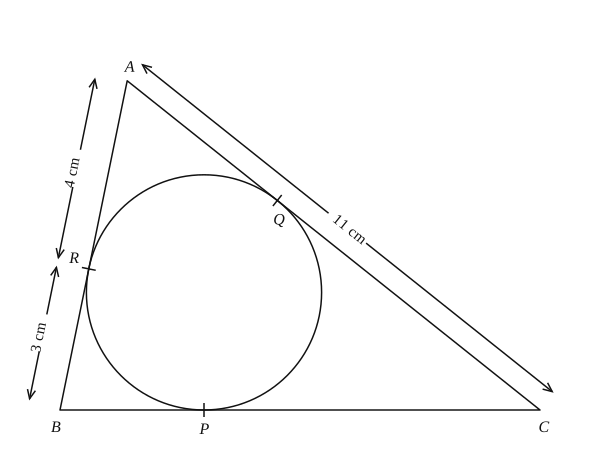
In the given figure, △ A B C
Show answer & solution
Answer: BC = 10 cm
Tangents from an external point are equal. AQ = AR = 4 cm, so CQ = AC − − CP = CQ = 7 cm and BP = BR = 3 cm. BC = BP + PC = 3 + 7 = 10 cm.
If two tangents inclined at an angle of 6 0 ∘
Show answer & solution
Let PA and PB be the tangents from P to the circle with centre O, ∠ A P B = 6 0 ∘ OP bisects ∠ A P B ∠ A P O = 3 0 ∘ ∠ O A P = 9 0 ∘ tan 3 0 ∘ = P A O A ⇒ 3 1 = P A 3 ⇒ P A = 3 3 Each tangent is 3 3
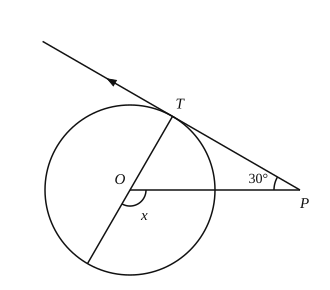
In the adjoining figure, PT is a tangent at T to the circle with centre O. If ∠ T P O = 3 0 ∘ x
Show answer & solution
Answer: x = 12 0 ∘
OT is a radius and PT is a tangent at T, so ∠ O T P = 9 0 ∘ In △ O T P ∠ T O P = 18 0 ∘ − 9 0 ∘ − 3 0 ∘ = 6 0 ∘ TO produced is a diameter, so x ∠ T O P x = 18 0 ∘ − 6 0 ∘ = 12 0 ∘
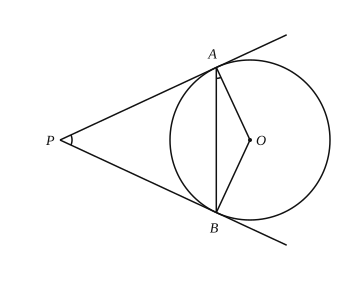
PA and PB are tangents drawn to the circle with centre O as shown in the figure.∠ A P B = 2∠ O A B
Show answer & solution
Answer: Proved.
PA = PB (tangents from an external point), so ∠ P A B = ∠ P B A In △ P A B ∠ P A B = 2 18 0 ∘ − ∠ A P B = 9 0 ∘ − 2 1 ∠ A P B ∠ O A P = 9 0 ∘ ⊥ ∠ O A B = 9 0 ∘ − ∠ P A B ∠ O A B = 9 0 ∘ − ( 9 0 ∘ − 2 1 ∠ A P B ) = 2 1 ∠ A P B Hence ∠ A P B = 2∠ O A B
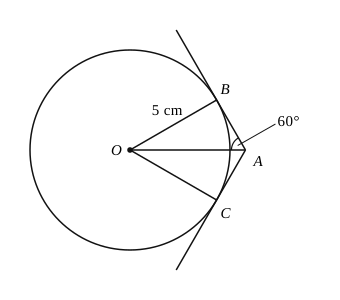
In the given figure, tangents AB and AC are drawn to a circle centred at O. If ∠ O A B = 6 0 ∘
Show answer & solution
Answer: OA
= 3 10 = 3 10 3 cm, AC
= 3 5 = 3 5 3 cm
OB ⊥ ⊥ △ O B A sin 6 0 ∘ = O A O B = 2 3 5 = 3 10 = 3 10 3 tan 6 0 ∘ = A B O B = 3 5 = 3 5 3 Tangents from an external point are equal, so AC = AB = 3 5 3
From a point P, the length of the tangent to a circle is 24 cm and the distance of P from the centre of the circle is 25 cm. Find the radius of the circle.
Show answer & solution
Answer: 7 cm
The radius is perpendicular to the tangent at the point of contact, so radius, tangent and OP form a right triangle with hypotenuse OP. r = 2 5 2 − 2 4 2 = 625 − 576 = 49 = 7
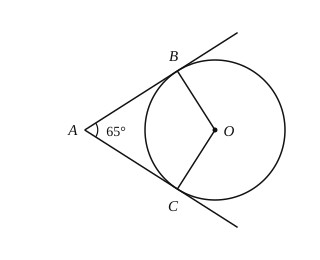
In the given figure, O is the centre of the circle. AB and AC are tangents drawn to the circle from point A. If ∠ B A C = 6 5 ∘ ∠ B O C
Show answer & solution
Answer: ∠ B O C = 11 5 ∘
∠ O B A = ∠ O C A = 9 0 ∘ In quadrilateral ABOC, ∠ B O C = 36 0 ∘ − 9 0 ∘ − 9 0 ∘ − 6 5 ∘ ∠ B O C = 11 5 ∘
In the given figure, PT is a tangent to the circle centered at O. OC is perpendicular to chord AB. Prove that P A ⋅ P B = P C 2 − A C 2
Show answer & solution
Answer: Proved.
The perpendicular from the centre to a chord bisects it, so AC = CB. From the figure, PA = PC – AC and PB = PC + CB = PC + AC. P A ⋅ P B = ( P C − A C ) ( P C + A C ) = P C 2 − A C 2 Hence proved.
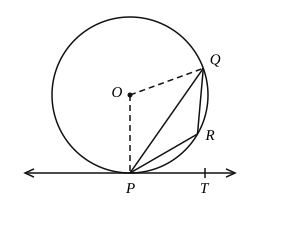
In the given figure, PQ is a chord of the circle centered at O. PT is a tangent to the circle at P. If ∠ QP T = 5 5 ∘ ∠ P R Q
Show answer & solution
Answer: ∠ P R Q = 12 5 ∘
OP ⊥ ∠ O P Q = 9 0 ∘ − 5 5 ∘ = 3 5 ∘ OP = OQ, so ∠ O QP = 3 5 ∘ ∠ P O Q = 18 0 ∘ − 7 0 ∘ = 11 0 ∘ Reflex ∠ P O Q = 36 0 ∘ − 11 0 ∘ = 25 0 ∘ R lies on the minor arc PQ, so ∠ P R Q = 2 1 × 25 0 ∘ = 12 5 ∘
Prove that the tangents drawn at the ends of a diameter of a circle are parallel.
Show answer & solution
Answer: Proved.
Let AB be a diameter of a circle with centre O, and let PQ and RS be the tangents at A and B. The tangent at any point is perpendicular to the radius through that point, so OA ⊥ ⊥ So ∠ O A P = 9 0 ∘ ∠ O B S = 9 0 ∘ These are alternate angles made by the transversal AB with PQ and RS, and they are equal. Hence PQ ∥
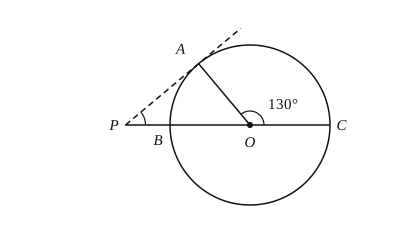
In the given figure, PA is a tangent to the circle drawn from the external point P and PBC is the secant to the circle with BC as diameter. If ∠ A O C = 13 0 ∘ ∠ A P B
Show answer & solution
Answer: ∠ A P B = 4 0 ∘
∠ A O B = 18 0 ∘ − ∠ A O C = 18 0 ∘ − 13 0 ∘ = 5 0 ∘ OA ⊥ ∠ O A P = 9 0 ∘ In △ O A P ∠ A P B = 18 0 ∘ − 9 0 ∘ − 5 0 ∘ = 4 0 ∘
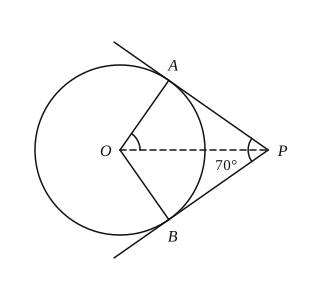
In Figure 1, if tangents PA and PB drawn from a point P to a circle with centre O, are inclined to each other at an angle of 7 0 ∘ ∠ P O A
Show answer & solution
Answer: ∠ P O A = 5 5 ∘
O A ⊥ P A ∠ O A P = 9 0 ∘ OP bisects ∠ A P B ∠ O P A = 3 5 ∘ In △ O A P ∠ P O A = 18 0 ∘ − 9 0 ∘ − 3 5 ∘ = 5 5 ∘
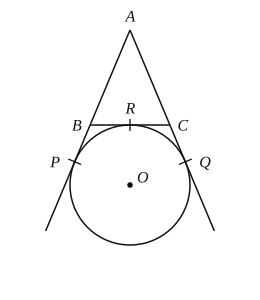
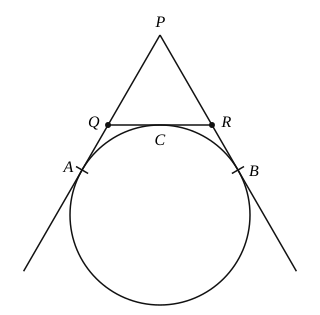
In Fig. 1, perimeter of △ P QR
Show answer & solution
Answer: PA = 10 cm
Tangents from an external point are equal: QA = QC, RB = RC, PA = PB. Perimeter of △ P QR = PQ + QA + RB + PR = PA + PB = 2PA. So 2PA = 20, hence PA = 10 cm.
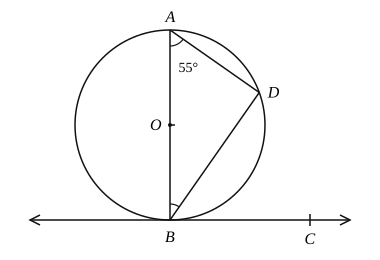
In Fig. 2, BC is tangent to the circle at point B of circle centred at O. BD is a chord of the circle so that ∠ B A D = 5 5 ∘ ∠ D B C
Show answer & solution
Answer: ∠ D B C = 5 5 ∘
AB passes through O, so AB is a diameter. ∠ A D B = 9 0 ∘ In △ A B D ∠ A B D = 18 0 ∘ − 9 0 ∘ − 5 5 ∘ = 3 5 ∘ ∠ A B C = 9 0 ∘ ⊥ ∠ D B C = 9 0 ∘ − 3 5 ∘ = 5 5 ∘
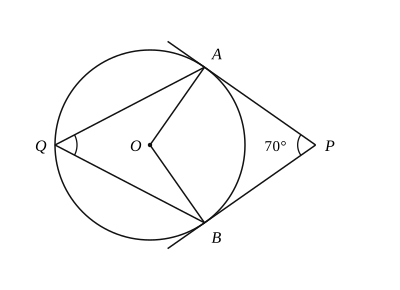
In Figure 2, PA and PB are tangents to the circle with centre at O. If ∠ A P B = 7 0 ∘ ∠ A QB
Show answer & solution
Answer: ∠ A QB = 5 5 ∘
OA ⊥ ⊥ ∠ O A P = ∠ O B P = 9 0 ∘ In quadrilateral OAPB: ∠ A O B = 36 0 ∘ − 9 0 ∘ − 9 0 ∘ − 7 0 ∘ = 11 0 ∘ Angle subtended by an arc at the centre is double the angle at a point on the remaining part of the circle. ∠ A QB = 2 1 ∠ A O B = 5 5 ∘
In Figure 1, PA and PB are tangents to the circle with centre at O. If ∠ A P B = 7 0 ∘ ∠ A QB
Show answer & solution
Answer: ∠ A QB = 5 5 ∘
OA ⊥ ⊥ ∠ O A P = ∠ O B P = 9 0 ∘ In quadrilateral OAPB: ∠ A O B = 36 0 ∘ − 9 0 ∘ − 9 0 ∘ − 7 0 ∘ = 11 0 ∘ Angle subtended by an arc at the centre is double the angle at a point on the remaining part of the circle. ∠ A QB = 2 1 ∠ A O B = 5 5 ∘
The distance between two tangents parallel to each other of a circle is 13 cm. Find the radius of the circle.
Show answer & solution
Answer: 6.5 cm
The radii to the two points of contact are perpendicular to the parallel tangents, so the two points of contact and the centre lie on one line. Hence the distance between the parallel tangents is a diameter: 2 r = 13 Radius r = 6.5
Two concentric circles are of radii 4 cm and 3 cm. Find the length of the chord of the larger circle which touches the smaller circle.
Show answer & solution
Let the chord AB of the larger circle touch the smaller circle at M; O is the common centre. OM ⊥ AM = O A 2 − O M 2 = 16 − 9 = 7 The perpendicular from the centre bisects the chord, so AB = 2 7
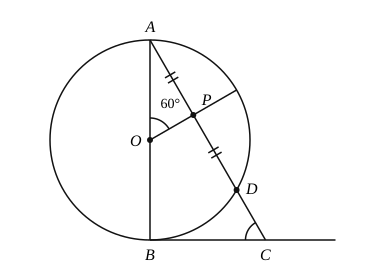
In Fig. 1, AB is diameter of a circle centered at O. BC is tangent to the circle at B. If OP bisects the chord AD and ∠ A O P = 6 0 ∘ ∠ C
Show answer & solution
Answer: m∠ C = 6 0 ∘
OP bisects chord AD, so O P ⊥ A D ∠ A P O = 9 0 ∘ In △ A P O ∠ O A P = 18 0 ∘ − 9 0 ∘ − 6 0 ∘ = 3 0 ∘ ∠ B A C = 3 0 ∘ BC is tangent at B and OB is a radius, so ∠ A B C = 9 0 ∘ In △ A B C ∠ C = 18 0 ∘ − 9 0 ∘ − 3 0 ∘ = 6 0 ∘
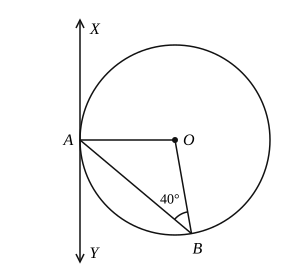
In Fig. 2, XAY is a tangent to the circle centered at O. If ∠ A B O = 4 0 ∘ ∠ B A Y ∠ A O B
Show answer & solution
Answer: m∠ B A Y = 5 0 ∘ ∠ A O B = 10 0 ∘
OA = OB (radii), so ∠ O A B = ∠ O B A = 4 0 ∘ XAY is a tangent at A, so ∠ O A Y = 9 0 ∘ ∠ B A Y = 9 0 ∘ − 4 0 ∘ = 5 0 ∘ In △ A O B ∠ A O B = 18 0 ∘ − 4 0 ∘ − 4 0 ∘ = 10 0 ∘
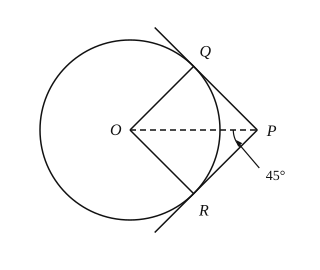
In Figure 2, PQ and PR are tangents to the circle centred at O. If ∠ 4 5 ∘
Show answer & solution
Answer: Proved.
O Q ⊥ P Q O R ⊥ P R ∠ O QP = ∠ O R P = 9 0 ∘ In △ O R P ∠ O R P = 9 0 ∘ ∠ O P R = 4 5 ∘ ∠ P O R = 4 5 ∘ O R = R P O P ∠ QP R ∠ QP R = 2 × 4 5 ∘ = 9 0 ∘ In quadrilateral O R P Q ∠ QO R = 36 0 ∘ − 9 0 ∘ − 9 0 ∘ − 9 0 ∘ = 9 0 ∘ O Q = O R P Q = P R O R = R P A quadrilateral with all sides equal and all angles 9 0 ∘ O R P Q
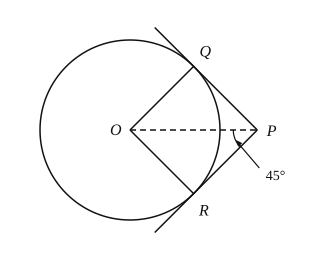
In Figure 1, PQ and PR are tangents to the circle centred at O. If ∠ 4 5 ∘
Show answer & solution
Answer: Proved.
O Q ⊥ P Q O R ⊥ P R ∠ O QP = ∠ O R P = 9 0 ∘ In △ O R P ∠ O R P = 9 0 ∘ ∠ O P R = 4 5 ∘ ∠ P O R = 4 5 ∘ O R = R P O P ∠ QP R ∠ QP R = 2 × 4 5 ∘ = 9 0 ∘ In quadrilateral O R P Q ∠ QO R = 36 0 ∘ − 9 0 ∘ − 9 0 ∘ − 9 0 ∘ = 9 0 ∘ O Q = O R P Q = P R O R = R P A quadrilateral with all sides equal and all angles 9 0 ∘ O R P Q
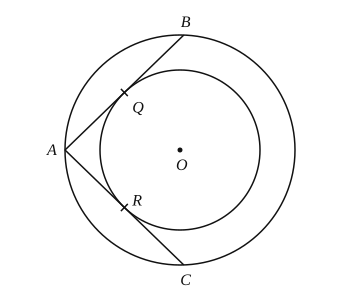
In Fig. 1, there are two concentric circles with centre O. If ARC and AQB are tangents to the smaller circle from the point A lying on the larger circle, find the length of AC, if AQ = 5 cm.
Show answer & solution
Answer: AC = 10 cm
AQ and AR are tangents from A to the smaller circle, so AR = AQ = 5 cm. AC is a chord of the larger circle touching the smaller circle at R, so O R ⊥ A C The perpendicular from the centre bisects the chord, so RC = AR = 5 cm. AC = AR + RC = 10 cm.
Practise smarter: chapter-wise revision, formula sheets and step-by-step NCERT solutions on
MonoMath CBSE →