Observe the map of Jaipur city placed on a Cartesian plane. Taking Rambagh Palace as origin, the location of some places are given below : Point A : (−4,2) Rajasthan High Court Point B : (4,−4) Birla Mandir Point C : (4,3) Heera Bagh Point D : (−5,−2) Amar Jawan Jyoti Based on the above, answer the following questions : (i) Advocate Rehana stays at Heera Bagh. How much distance she has to cover daily to go to the court and coming back home ? (1) (ii) There is a crossing on X-axis which divides AD in a certain ratio. Find the ratio. (1) (iii) (a) Is Birla Mandir equidistant from Heera Bagh and Amar Jawan Jyoti ? Justify your answer. (2) OR (b) Using section formula, show that points A, O and B are not collinear.
Show answer & solution
Answer: (i) 265 units (ii) 1 : 1 (iii) (a) No (BC = 7, BD = 85) OR (b) Shown: O does not lie on AB
(i) AC=(4+4)2+(3−2)2=65; to and fro: 265 units.
(ii) Let the point on the x-axis divide AD in ratio k : 1. y-coordinate: k+1−2k+2=0⇒k=1. Ratio 1 : 1.
(iii)(a) BC=02+72=7, BD=92+22=85. As 7=85, B is not equidistant from C and D.
(iii)(b) If O(0, 0) lies on AB, let it divide AB in ratio k : 1. x: k+14k−4=0⇒k=1.
Then y =k+1−4k+2=2−2=−1=0. No single ratio works, so A, O and B are not collinear.
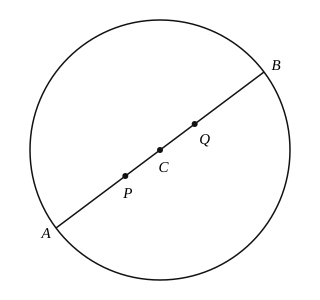
In a society, there is a circular park having two gates. The gates are placed at points A(10, 20) and B(50, 50), as shown in the figure below. Two fountains are installed at points P and Q on AB such that AP = PQ = QB. Based on the above information, answer the following questions : (i) Find the coordinates of the centre C. (1) (ii) Find the radius of the circular park. (1) (iii) (a) Find the coordinates of the point P. (2) OR (b) Find the distance of the fountain at Q from gate A. (2)
Show answer & solution
Answer: (i) C(30, 35) (ii) 25 units (iii) (a) P(370,30) OR (b) 3100 units
In the figure, AB passes through the centre C, so AB is a diameter.
(i) C is the mid-point of AB: (210+50,220+50)=(30,35).
(ii) AB=402+302=50, so radius =25 units.
(iii) (a) P divides AB in the ratio 1 : 2: P=(31×50+2×10,31×50+2×20)=(370,30).
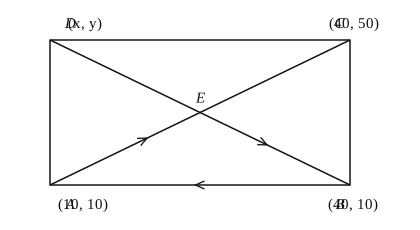
A field is in the form of a rectangle. The coordinates of the rectangular field ABCD are A(10, 10), B(40, 10), C(40, 50) and D(x, y). Anil and Anita, two friends decided to have a race. Anita started from point A and moved to point E along the diagonal AC, where E is the point of intersection of both the diagonals of ABCD. From point E, she moved to point B along the other diagonal DB and then moved back to point A along BA. While Anil started from point C and ran to point A via D along the boundary of the field. Based on the above information, answer the following questions : (i) Find the coordinates of point E. (1) (ii) Find the distance between the points B and C. (1) (iii) (a) Find the coordinates of point D and the distance BD. (2) OR (b) Find the total distance travelled by Anita. (2)
Show answer & solution
Answer: (i) E(25, 30) (ii) 40 units (iii) (a) D(10, 50), BD = 50 units OR (b) 80 units
(i) E is the mid-point of AC: E=(210+40,210+50)=(25,30).
(ii) BC =(40−40)2+(50−10)2=40 units.
(iii) (a) ABCD is a rectangle with AB horizontal and BC vertical, so D = (10, 50).
BD =(10−40)2+(50−10)2=900+1600=50 units.
OR (b) AC =302+402=50, so AE =25; diagonals of a rectangle are equal and bisect each other, so EB =25; BA =40−10=30.
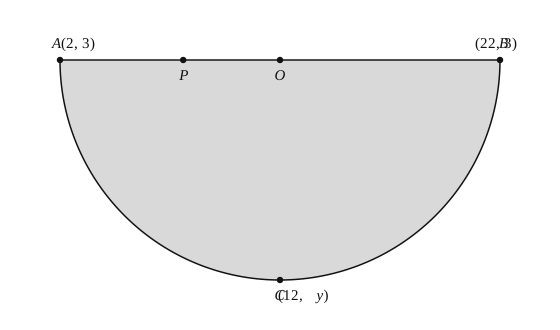
There is a semicircular park in Aman’s society. He wishes to plant saplings along the boundary of the park. There is a borewell at the centre O of the park along the diameter AB as shown in the figure below. Based on the above information, answer the following questions : (i) Find the coordinates of point O. (1) (ii) Find the radius of the semicircular park. (1) (iii) (a) One sapling is kept at point C(12, y). Find the coordinates of C. (2) OR (b) One sapling is kept at point P along AB so that PA = 31 PB. Find the coordinates of P. (2)
Show answer & solution
Answer: (i) O(12, 3) (ii) 10 units (iii) (a) C(12, −7) OR (b) P(7, 3)
A(2, 3), B(22, 3).
(i) O is the mid-point of AB: (22+22,23+3)=(12,3).
(ii) AB=22−2=20, so radius =10 units.
(iii) (a) C lies on the semicircle below AB with OC=10 and the same x-coordinate as O, so y=3−10=−7. C(12, −7).
(iii) (b) PA=31PB, so AP:PB=1:3. P=(41×22+3×2,41×3+3×3)=(7,3).
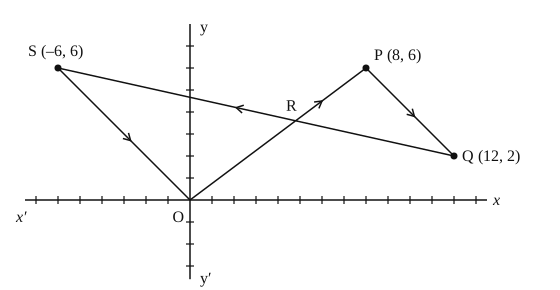
Gurveer and Arushi built a robot that can paint a path as it moves on a graph paper. Some co-ordinate of points are marked on it. It starts from (0, 0), moves to the points listed in order (in straight lines) and ends at (0, 0). Arushi entered the points P(8, 6), Q(12, 2) and S(− 6, 6) in order. The path drawn by robot is shown in the figure. Based on the above, answer the following questions : (i) Determine the distance OP. (1) (ii) QS is represented by equation 2x+9y=42. Find the co-ordinates of the point where it intersects y – axis. (1) (iii) (a) Point R(4.8, y) divides the line segment OP in a certain ratio, find the ratio. Hence, find the value of y. (2) OR (iii) (b) Using distance formula, show that OSPQ=32. (2)
Show answer & solution
Answer: (i) 10 units (ii) (0,314) (iii) (a) 3 : 2, y = 3.6 OR (b) Shown: PQ =42, OS =62
(i) OP =82+62=100=10 units.
(ii) On the y-axis x=0: 9y=42, y=314. Point (0,314).
(iii) (a) Let R divide OP in the ratio k:1. Then k+18k=4.8, so 8k=4.8k+4.8, k=1.5. Ratio =3:2.
y =53×6+2×0=3.6.
(iii) (b) PQ =(12−8)2+(2−6)2=32=42; OS =36+36=62.
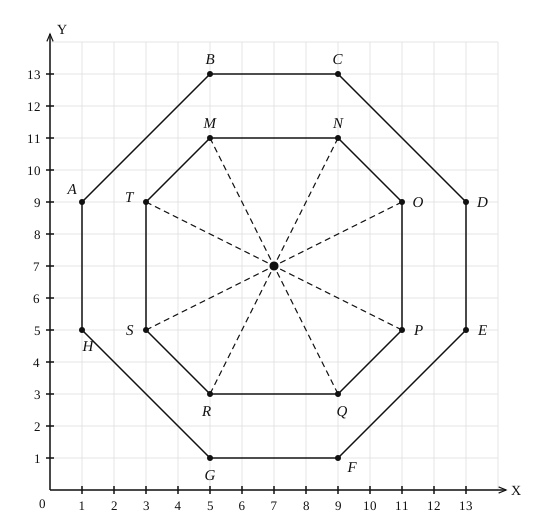
The top of a table is hexagonal in shape. On the basis of the information given above, answer the following questions : (i) Write the coordinates of A and B. (1) (ii) Write the coordinates of the mid-point of line segment joining C and D. (1) (iii) Find the distance between M and Q. (2) OR (iii) Find the coordinates of the point which divides the line segment joining M and N in the ratio 1:3 internally. (2)
Show answer & solution
Answer: (i) A(1, 9), B(5, 13) (ii) (11, 11) (iii) 45 units; OR (iii) (6, 11)
From the graph: A(1, 9), B(5, 13), C(9, 13), D(13, 9), M(5, 11), N(9, 11), Q(9, 3).
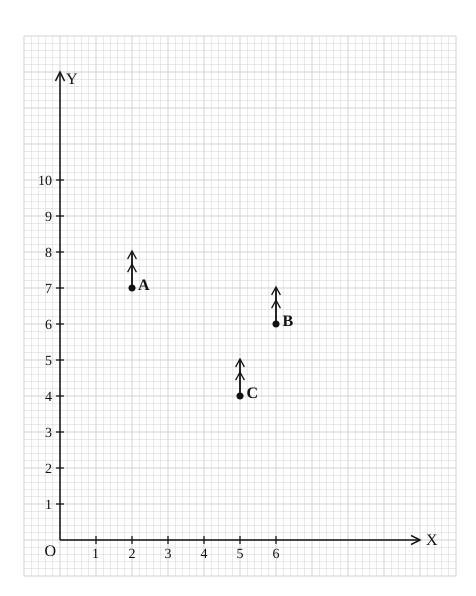
Resident Welfare Association (RWA) of Gulmohar Society in Delhi, have installed three electric poles A, B and C in the society’s common park. Despite these three poles, some parts of the park are still in the dark. So, RWA decides to have one more electric pole D in the park. The park can be modelled as a coordinate system given below. On the basis of the above information, answer the following questions : (i) What is the position of the pole C ? (1) (ii) What is the distance of the pole B from the corner O of the park ? (1) (iii) (a) Find the position of the fourth pole D so that the four points A, B, C and D form a parallelogram ABCD. (2) OR (b) Find the distance between poles A and C. (2)
Show answer & solution
Answer: (i) (5,4) (ii) 62 units (iii) (a) D(1,5) OR (b) 32 units
From the figure, A(2,7), B(6,6), C(5,4).
(i) Pole C is at (5,4).
(ii) OB=62+62=72=62 units.
(iii)(a) Diagonals of a parallelogram bisect each other, so mid-point of AC = mid-point of BD.
Mid-point of AC =(27,211). If D(x,y): 26+x=27, 26+y=211, so D=(1,5).
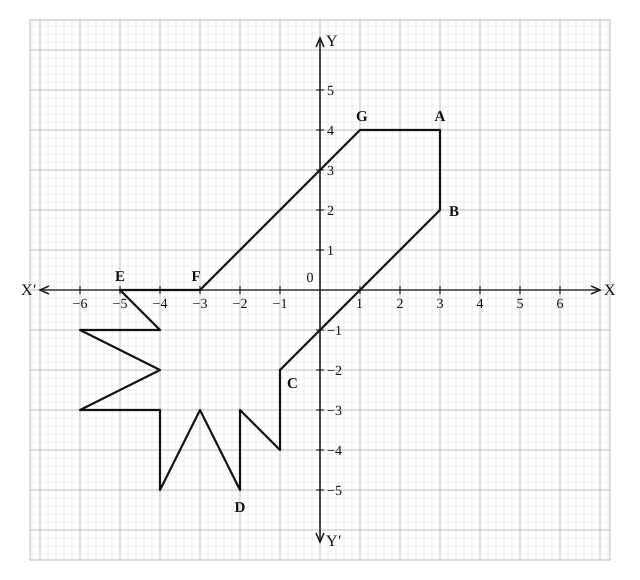
Ryan, from a very young age, was fascinated by the twinkling of stars and the vastness of space. He always dreamt of becoming an astronaut one day. So he started to sketch his own rocket designs on the graph sheet. One such design is given below : Based on the above, answer the following questions : (i) Find the mid-point of the segment joining F and G. (1) (ii) What is the distance between the points A and C ? (2) OR Find the coordinates of the point which divides the line segment joining the points A and B in the ratio 1 : 3 internally. (2) (iii) What are the coordinates of the point D ? (1)
Show answer & solution
Answer: (i) (−1, 2) (ii) 213 units; OR (3,27) (iii) (−2, −5)
From the graph: A(3, 4), B(3, 2), C(−1, −2), D(−2, −5), F(−3, 0), G(1, 4).
(i) Mid-point of FG = (2−3+1,20+4)=(−1,2).
(ii) AC = (3+1)2+(4+2)2=16+36=52=213 units.
OR: Point dividing AB in 1 : 3 = (41×3+3×3,41×2+3×4)=(3,414)=(3,27).
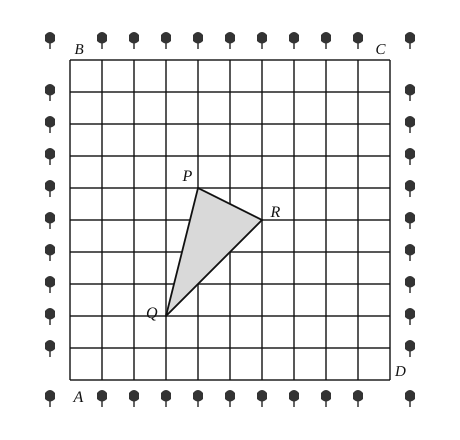
A garden is in the shape of a square. The gardener grew saplings of Ashoka tree on the boundary of the garden at the distance of 1 m from each other. He wants to decorate the garden with rose plants. He chose a triangular region inside the garden to grow rose plants. In the above situation, the gardener took help from the students of class 10. They made a chart for it which looks like the given figure. Based on the above, answer the following questions : (i) If A is taken as origin, what are the coordinates of the vertices of △PQR ? (1) (ii) (a) Find distances PQ and QR. (2) OR (b) Find the coordinates of the point which divides the line segment joining points P and R in the ratio 2 : 1 internally. (2) (iii) Find out if △PQR is an isosceles triangle. (1)
Show answer & solution
Answer: (i) P(4, 6), Q(3, 2), R(6, 5) (ii) (a) PQ = 17 m, QR = 32 m OR (b) (316,316) (iii) No, it is not isosceles
(i) Taking A as origin with AD along the x-axis and AB along the y-axis (1 unit = 1 m): P(4, 6), Q(3, 2), R(6, 5).
(ii) (a) PQ=(4−3)2+(6−2)2=17 m; QR=(6−3)2+(5−2)2=18=32 m.
(ii) (b) Point =(32×6+1×4,32×5+1×6)=(316,316).
(iii) PR=(6−4)2+(5−6)2=5. PQ, QR, PR = 17,18,5 are all different, so △PQR is not isosceles.
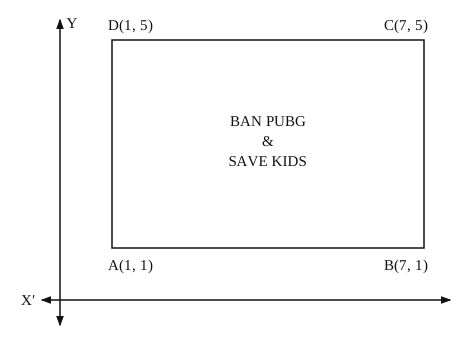
Use of mobile screen for long hours makes your eye sight weak and give you headaches. Children who are addicted to play “PUBG” can get easily stressed out. To raise social awareness about ill effects of playing PUBG, a school decided to start ‘BAN PUBG’ campaign, in which students are asked to prepare campaign board in the shape of a rectangle. One such campaign board made by class X student of the school is shown in the figure. Based on the above information, answer the following questions : (i) Find the coordinates of the point of intersection of diagonals AC and BD. (1) (ii) Find the length of the diagonal AC. (1) (iii) (a) Find the area of the campaign Board ABCD. (2) OR (b) Find the ratio of the length of side AB to the length of the diagonal AC. (2)
Show answer & solution
Answer: (i) (4,3) (ii) 213 units (iii) (a) 24 square units OR (b) 3:13
(i) Diagonals of a rectangle bisect each other; mid-point of AC =(21+7,21+5)=(4,3).
(ii) AC=(7−1)2+(5−1)2=36+16=52=213 units.
(iii) (a) AB =7−1=6, AD =5−1=4; area =6×4=24 square units.
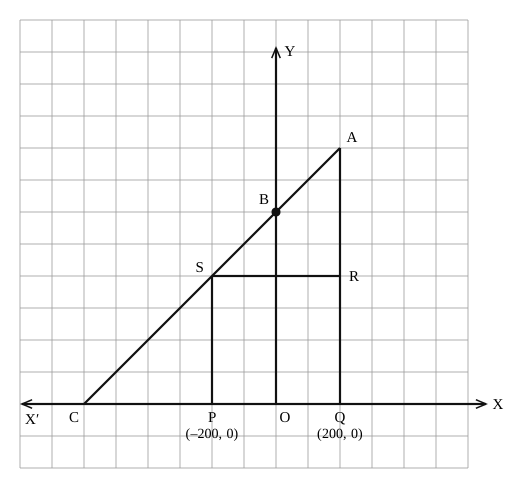
Jagdish has a field which is in the shape of a right angled triangle AQC. He wants to leave a space in the form of a square PQRS inside the field for growing wheat and the remaining for growing vegetables (as shown in the figure). In the field, there is a pole marked as O. Based on the above information, answer the following questions : (i) Taking O as origin, coordinates of P are (−200,0) and of Q are (200,0). PQRS being a square, what are the coordinates of R and S ? (1) (ii) (a) What is the area of square PQRS ? (2) OR (b) What is the length of diagonal PR in square PQRS ? (2) (iii) If S divides CA in the ratio K:1, what is the value of K, where point A is (200,800) ? (1)
Show answer & solution
Answer: (i) R(200,400), S(−200,400) (ii) (a) 160000 sq units OR (b) 4002 units (iii) K = 1
(i) Side PQ =200−(−200)=400, so R =(200,400) and S =(−200,400).
(ii) (a) Area =4002=160000 sq units
(ii) (b) PR=(200+200)2+(400−0)2=2×4002=4002 units
(iii) C lies on the x-axis, so C =(c,0). S divides CA in K : 1, so its y-coordinate is K+1K×800+1×0=400
800K=400K+400⇒K=1
(Check with the figure: C =(−600,0), and the x-coordinate K+1200K−600=−200 also gives K = 1.)