Coordinate Geometry: 1 mark Questions (CBSE Class 10)
97 different 1 mark questions on Coordinate Geometry from CBSE Class 10 Maths board exams 2022–2026, newest first.
The distance between the points (– 4, 2) and (1, 0) is :
(A) 13 (B) 3 units(C) 9 units(D) 29 Show answer & solution
Distance = ( 1 + 4 ) 2 + ( 0 − 2 ) 2 = 25 + 4 = 29
The distance between the points (– 5, 1) and (2, 2) is :
(A) 2 5 (B) 10 (C) 5 2 (D) 3 2 Show answer & solution
Distance = ( 2 + 5 ) 2 + ( 2 − 1 ) 2 = 49 + 1 = 50 = 5 2
The distance between the points (– 1, 2 2 2
(A) 5 (B) 11 (C) 13 (D) 7 Show answer & solution
Distance = ( 2 + 1 ) 2 + ( 2 − 2 2 ) 2 = 9 + 2 = 11
The distance between the points ( − 2 , 5 ) ( 5 , − 2 )
(A) 7 2 (B) 14(C) 2 7 (D) 7Show answer & solution
d = ( 5 − ( − 2 ) ) 2 + ( − 2 − 5 ) 2 = 49 + 49 = 98 = 7 2
The distance between the points ( − 4 , 5 ) ( − 1 , 2 )
(A) 5(B) 3 2 (C) 6(D) 2 3 Show answer & solution
d = ( − 1 + 4 ) 2 + ( 2 − 5 ) 2 = 9 + 9 = 18 = 3 2
The mid-point of the line segment joining the points ( 5 , − 4 ) ( 6 , 4 )
(A) x (B) y (C) origin(D) neither x y Show answer & solution
Answer: (A) x
Mid-point = ( 2 5 + 6 , 2 − 4 + 4 ) = ( 2 11 , 0 ) Its y x
The distance of the point A(4a, 3a) from x-axis is :
(A) 3a(B) − 3 a (C) 4a(D) − 4 a Show answer & solution
Answer: (A) 3a
The distance of a point from the x-axis is the absolute value of its y-coordinate. So the distance is 3a (taking a > 0).
If the distance between the points (4, p) and (1, 0) is 5, then p is equal to :
(A) ± 4 (B) 4(C) − 4 (D) 0Show answer & solution
Answer: (A) ± 4
( 4 − 1 ) 2 + ( p − 0 ) 2 = 5 2 9 + p 2 = 25 p 2 = 16 p = ± 4
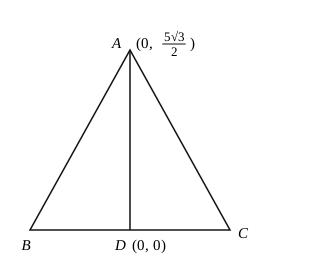
In the given figure, Δ ( 0 , 2 5 3 )
(A) (– 5, 0), (5, 0)(B) ( − 2 5 , 0 ) , ( 2 5 , 0 ) (C) (– 10, 0), (10, 0)(D) ( − 5 3 , 0 ) , ( 5 3 , 0 ) Show answer & solution
Answer: (B) ( − 2 5 , 0 ) , ( 2 5 , 0 )
AD = 2 5 3 Height = 2 3 × = 5 D is the midpoint of BC on the x-axis, so BD = DC = 2 5 B( − 2 5 , 0 ) ( 2 5 , 0 )
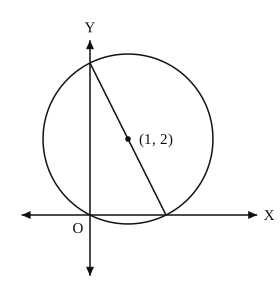
In the given figure, a circle is centred at (1, 2). The diameter of the circle is
(A) 4(B) 2 2 (C) 5 (D) 2 5 Show answer & solution
The circle passes through the origin O(0, 0). Radius = ( 1 − 0 ) 2 + ( 2 − 0 ) 2 = 5 Diameter = 2 5
The distance between the points ( a cos θ + b sin θ , 0 ) ( 0 , a sin θ − b cos θ )
(A) a 2 + b 2 (B) a 2 − b 2 (C) a 2 − b 2 (D) a 2 + b 2 Show answer & solution
d 2 = ( a cos θ + b sin θ ) 2 + ( a sin θ − b cos θ ) 2 = a 2 ( cos 2 θ + sin 2 θ ) + b 2 ( sin 2 θ + cos 2 θ ) + 2 ab sin θ cos θ − 2 ab sin θ cos θ = a 2 + b 2 d = a 2 + b 2
A circle centred at ( − 1 , 2 )
(A) 2 2 (B) 2 (C) 26 (D) 1Show answer & solution
Radius = ( 0 + 1 ) 2 + ( 3 − 2 ) 2 = 2
The line segment joining the points P ( − 4 , − 2 ) Q ( 10 , 4 )
(A) 2 : 5(B) 1 : 2(C) 2 : 1(D) 5 : 2Show answer & solution
Answer: (A) 2 : 5
Let the y-axis divide PQ in the ratio k : 1 The point of division has x-coordinate k + 1 10 k − 4 10 k − 4 = 0 k = 5 2 Ratio = 2 : 5
For a point ( 3 , − 5 ) −
(A) − 8 (B) − 2 (C) 2(D) 8Show answer & solution
Answer: (D) 8
Abscissa = 3, ordinate = − 5 Abscissa − = 3 − ( − 5 ) = 8
The mid-point of a line segment divides the line segment in the ratio :
(A) 1 : 2(B) 2 : 1(C) 1 : 1(D) 2 1 Show answer & solution
Answer: (C) 1 : 1
The mid-point is equidistant from both ends, so it divides the segment in the ratio 1 : 1.
The distance of a point P ( 3 , − 7 )
(A) 3(B) 7(C) − 7 (D) 58 Show answer & solution
Answer: (A) 3
The distance of a point ( x , y ) ∣ x ∣ ∣3∣ = 3
For a point X ( a , b ) ( b > a > 0 ) −
(A) a − b (B) b − a (C) a 2 − b 2 (D) b 2 − a 2 Show answer & solution
Answer: (B) b − a
Distance of ( a , b ) = b = a Required value = b − a
The distance of the point (2, 3) from the origin is :
(A) 2 (B) 3 (C) 5 (D) 13 Show answer & solution
Distance = 2 2 + 3 2 = 4 + 9 = 13
The mid-point of the line segment joining points (1, 3) and (1, − 3
(A) at the origin(B) in the second quadrant(C) on x-axis(D) on y-axisShow answer & solution
Answer: (C) on x-axis
Mid-point = ( 2 1 + 1 , 2 3 + ( − 3 ) ) = ( 1 , 0 ) Its y-coordinate is 0, so it lies on the x-axis.
If point ( 1 , 2 ) ( 3 , 5 ) ( 2 a , b ) ( a , b ) =
(A) ( − 1 , − 1 ) (B) ( − 2 1 , − 2 1 ) (C) ( − 2 1 , − 1 ) (D) ( − 1 , − 2 1 ) Show answer & solution
Answer: (C) ( − 2 1 , − 1 )
Mid-point: 2 3 + 2 a = 1 2 5 + b = 2 3 + 2 a = 2 ⇒ a = − 2 1 5 + b = 4 ⇒ b = − 1
The distance of point ( − 3 , 4 )
(A) − 3 (B) 3(C) 4(D) 5Show answer & solution
Answer: (B) 3
Distance of a point ( x , y ) ∣ x ∣ ∣ − 3∣ = 3
If point ( 1 , 2 ) ( 3 , 5 ) ( 2 p , q ) 1 : 1 ( p , q )
(A) ( − 2 1 , − 1 ) (B) ( − 2 1 , − 2 1 ) (C) ( − 1 , − 1 ) (D) ( − 1 , − 2 1 ) Show answer & solution
Answer: (A) ( − 2 1 , − 1 )
Ratio 1 : 1 ( 1 , 2 ) 2 3 + 2 p = 1 ⇒ 2 p = − 1 ⇒ p = − 2 1 2 5 + q = 2 ⇒ q = − 1
If point ( a , 2 b ) ( 3 , 5 ) ( − 1 , − 1 ) ( a , b )
(A) ( 1 , 2 ) (B) ( 2 , 2 ) (C) ( 2 , 1 ) (D) ( 1 , 1 ) Show answer & solution
Answer: (D) ( 1 , 1 )
Mid-point = ( 2 3 + ( − 1 ) , 2 5 + ( − 1 ) ) = ( 1 , 2 ) So a = 1 2 b = 2 ⇒ b = 1 ( a , b ) = ( 1 , 1 )
The distance between the points ( − 6 , 9 ) ( 2 , 7 )
(A) 2 17 (B) 4 17 (C) 2 5 (D) 2 15 Show answer & solution
Distance = ( 2 + 6 ) 2 + ( 7 − 9 ) 2 = 64 + 4 = 68 68 = 2 17
The distance between the points ( 2 , − 7 ) ( − 2 , − 1 )
(A) 10(B) 2 13 (C) 8(D) 4 13 Show answer & solution
Distance = ( − 2 − 2 ) 2 + ( − 1 + 7 ) 2 = 16 + 36 = 52 = 2 13
The distance between the points (2, 3) and (–2, –3) is
(A) 4 13 (B) 40 (C) 2 13 (D) 5Show answer & solution
Distance = ( 2 − ( − 2 ) ) 2 + ( 3 − ( − 3 ) ) 2 = 16 + 36 = 52 52 = 2 13
The point (x
(A) 1 : 3(B) 2 : 1(C) 1 : 1(D) 1 : 2Show answer & solution
Answer: (D) 1 : 2
Let the ratio be k : 1 y-coordinate: k + 1 k ( − 10 ) + 1 ( 5 ) = 0 − 10 k + 5 = 0 k = 2 1 Ratio = 2 1 : 1 = 1 : 2
If the distance between the points (3, 0) and (2, y) is 5
(A) 2, –2(B) 2, 0(C) 2, 1(D) –2, 0Show answer & solution
Answer: (A) 2, –2
( 3 − 2 ) 2 + ( 0 − y ) 2 = ( 5 ) 2 1 + y 2 = 5 y 2 = 4 y = 2 − 2
ABCD is a rectangle with its vertices at (2, − 2 − 2
(A) 4 2 (B) 6 2 (C) 4 26 (D) 2 26 Show answer & solution
Diagonal AC joins (2, − 2 AC = ( 4 − 2 ) 2 + ( 8 + 2 ) 2 = 4 + 100 = 104 = 2 26
The mid-point of the line segment joining the points P ( − 4 , 5 ) Q ( 4 , 6 )
(A) x-axis(B) y-axis(C) origin(D) neither x-axis nor y-axisShow answer & solution
Answer: (B) y-axis
Mid-point = ( 2 − 4 + 4 , 2 5 + 6 ) = ( 0 , 2 11 ) Its x-coordinate is 0
The end points of a diameter of circle are ( 2 , 4 ) ( − 3 , − 1 )
(A) 2 5 2 (B) 5 2 (C) 3 2 (D) ± 2 5 2 Show answer & solution
Diameter = ( 2 + 3 ) 2 + ( 4 + 1 ) 2 = 25 + 25 = 5 2 Radius = 2 5 2
The coordinates of the end points of a diameter of a circle are ( 5 , − 2 ) ( 5 , 2 )
(A) ± 2 (B) ± 4 (C) 4(D) 2Show answer & solution
Answer: (D) 2
Diameter = ( 5 − 5 ) 2 + ( 2 − ( − 2 ) ) 2 = 16 = 4 Radius = 2 4 = 2
The points ( − 5 , 0 ) ( 5 , 0 ) ( 0 , 4 )
(A) right-angled triangle(B) isosceles triangle(C) equilateral triangle(D) scalene triangleShow answer & solution
Answer: (B) isosceles triangle
Let A ( − 5 , 0 ) B ( 5 , 0 ) C ( 0 , 4 ) A B = 10 A C = 25 + 16 = 41 B C = 25 + 16 = 41 A C = B C = A B 41 + 41 = 100 41 + 100 = 41 The triangle is isosceles
The perimeter of the triangle formed by the vertices ( 0 , 0 ) ( 2 , 0 ) ( 0 , 2 )
(A) 4 units(B) 6 units(C) 6 2 (D) ( 4 + 2 2 ) Show answer & solution
Answer: (D)
( 4 + 2 2 ) units
Sides: from ( 0 , 0 ) ( 2 , 0 ) ( 0 , 0 ) ( 0 , 2 ) From ( 2 , 0 ) ( 0 , 2 ) 4 + 4 = 2 2 Perimeter = 2 + 2 + 2 2 = ( 4 + 2 2 )
The line represented by 4 x + 6 y = 1
(A) ( 2 , 3 ) (B) ( 3 , 2 ) (C) ( 2 , 0 ) (D) ( 0 , 3 ) Show answer & solution
Answer: (A) ( 2 , 3 )
On the x-axis y = 0 x = 4 P ( 4 , 0 ) On the y-axis x = 0 y = 6 Q ( 0 , 6 ) Mid-point = ( 2 4 + 0 , 2 0 + 6 ) = ( 2 , 3 )
Two of the vertices of △ P QR P ( − 1 , 5 ) Q ( 5 , 2 ) 2 : 1
(A) ( 3 , − 3 ) (B) ( 5 , 5 ) (C) ( 3 , 3 ) (D) ( 5 , 1 ) Show answer & solution
Answer: (C) ( 3 , 3 )
Using the section formula with m : n = 2 : 1 x = 3 2 ( 5 ) + 1 ( − 1 ) = 3 9 = 3 y = 3 2 ( 2 ) + 1 ( 5 ) = 3 9 = 3 The point is ( 3 , 3 )
AOBC is a rectangle whose three vertices are A ( 0 , 2 ) O ( 0 , 0 ) B ( 4 , 0 )
(A) 36(B) 20(C) 16(D) 4Show answer & solution
Answer: (B) 20
Diagonal AB joins A ( 0 , 2 ) B ( 4 , 0 ) A B 2 = ( 4 − 0 ) 2 + ( 0 − 2 ) 2 = 16 + 4 = 20
If the mid-point of the line segment joining the points ( a , 4 ) ( 2 , 2 b ) ( 2 , 6 ) ( a + b )
(A) 6(B) 7(C) 8(D) 16Show answer & solution
Answer: (A) 6
2 a + 2 = 2 a = 2 2 4 + 2 b = 6 b = 4 a + b = 6
The distance of the point ( 4 , 0 )
(A) 4 units(B) 16 units(C) 0 units(D) 4 2 Show answer & solution
Answer: (C) 0 units
The distance of a point ( x , y ) ∣ y ∣ For ( 4 , 0 )
The distance of a point A from x
(A) ( 1 , 3 ) (B) ( − 3 , − 3 ) (C) ( − 3 , 3 ) (D) ( 3 , 1 ) Show answer & solution
Answer: (D) ( 3 , 1 )
Distance of ( x , y ) x ∣ y ∣ ∣ y ∣ = 3 ( 1 , 3 ) ( − 3 , − 3 ) ( − 3 , 3 ) ∣ y ∣ = 3 ( 3 , 1 ) ∣ y ∣ = 1
The distance of which of the following points from origin is less than 5 units ?
(A) ( 3 , 4 ) (B) ( 2 , 6 ) (C) ( − 3 , − 4 ) (D) ( 1 , 4 ) Show answer & solution
Answer: (D) ( 1 , 4 )
Distance from origin = x 2 + y 2 ( 3 , 4 ) ( 2 , 6 ) 40 ( − 3 , − 4 ) ( 1 , 4 ) 17 < 5
The distance of point P ( 1 , − 1 ) x
(A) 1(B) − 1 (C) 0(D) 2 Show answer & solution
Answer: (A) 1
Distance of ( x , y ) x = ∣ y ∣ = ∣ − 1∣ = 1
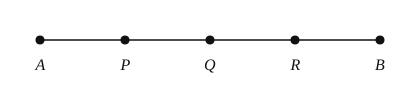
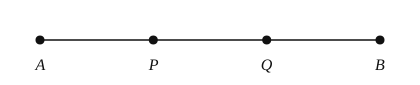
In the figure given below, points P, Q, R divides the line segment AB in four equal parts.
(A) 1 : 3(B) 2 : 3(C) 1 : 2(D) 1 : 1Show answer & solution
Answer: (C) 1 : 2
Let each part be k P Q = k QB = QR + R B = 2 k P Q : QB = 1 : 2
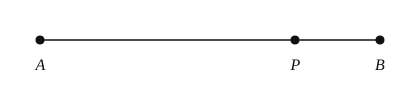
The point P divides the line segment AB in the ratio 3 : 1 as shown below :P B A B
(A) 3(B) 4 1 (C) 4(D) 3 1 Show answer & solution
Answer: (C) 4
A P : P B = 3 : 1 A P = 3 k P B = k A B = 4 k P B A B = k 4 k = 4
In the following figure, P and Q are points of trisection of line segment AB :P B A B =
(A) 1(B) 1.5(C) 3 2 (D) 2Show answer & solution
Answer: (B) 1.5
A P = P Q = QB = k A B = 3 k P B = 2 k P B A B = 2 k 3 k = 1.5
The distance of the point A ( − 3 , − 4 ) x
(A) 3(B) 4(C) 5(D) 7Show answer & solution
Answer: (B) 4
Distance of a point ( x , y ) x ∣ y ∣ For A ( − 3 , − 4 ) = ∣ − 4∣ = 4
The distance of point ( a , − b ) x
(A) a(B) − a (C) b(D) − b Show answer & solution
Answer: (C) b
Distance of a point ( x , y ) x ∣ y ∣ For ( a , − b ) = ∣ − b ∣ = ∣ b ∣ b b > 0
The distance of point P ( 3 a , 4 a ) y
(A) 3a(B) − 3 a (C) 4a(D) − 4 a Show answer & solution
Answer: (A) 3a
Distance of a point ( x , y ) y ∣ x ∣ For P ( 3 a , 4 a ) = ∣3 a ∣ 3 a a > 0
The distance between the points ( 2 , − 3 ) ( − 2 , 3 )
(A) 2 13 (B) 5 units(C) 13 2 (D) 10 unitsShow answer & solution
Distance = ( 2 + 2 ) 2 + ( − 3 − 3 ) 2 = 16 + 36 = 52 = 2 13
The diameter of a circle is of length 6 cm. If one end of the diameter is ( − 4 , 0 )
(A) (0, 2)(B) (6, 0)(C) (2, 0)(D) (4, 0)Show answer & solution
Answer: (C) (2, 0)
The other end is ( x , 0 ) ∣ x − ( − 4 ) ∣ = 6 So x = 2 x = − 10 ( 2 , 0 )
The mid-point of the line segment joining the points ( − 1 , 3 ) ( 8 , 2 3 )
(A) ( 2 7 , − 4 3 ) (B) ( 2 7 , 2 9 ) (C) ( 2 9 , − 4 3 ) (D) ( 2 7 , 4 9 ) Show answer & solution
Answer: (D) ( 2 7 , 4 9 )
Mid-point = ( 2 − 1 + 8 , 2 3 + 2 3 ) = ( 2 7 , 4 9 )
The distance of the point (5, 4) from the origin is
(A) 41(B) 41 (C) 3(D) 9Show answer & solution
Distance = 5 2 + 4 2 = 25 + 16 = 41
Assertion (A) : The point (0, 4) lies on y – axis.x
(A) Both Assertion (A) and Reason (R) are correct and Reason (R) is the correct explanation of Assertion (A).(B) Both Assertion (A) and Reason (R) are correct but Reason (R) is not the correct explanation of Assertion (A).(C) Assertion (A) is true, but Reason (R) is false.(D) Assertion (A) is false, but Reason (R) is true.Show answer & solution
Answer: (A) Both Assertion (A) and Reason (R) are correct and Reason (R) is the correct explanation of Assertion (A).
Every point on the y-axis has x The point (0, 4) has x R explains A. Answer: (A)
The distance of the point (3, 4) from the origin is
(A) 25(B) 5(C) 7(D) 1Show answer & solution
Answer: (B) 5
Distance = 3 2 + 4 2 = 25 = 5
The distance between the points A ( − 1 , 5 ) B ( 6 , − 2 )
(A) 2 7 (B) 7 2 (C) 49(D) 14Show answer & solution
A B = ( 6 + 1 ) 2 + ( − 2 − 5 ) 2 = 49 + 49 A B = 98 = 7 2
Assertion (A) : The distance of P ( a , b ) a 2 + b 2 A ( x 1 , y 1 ) B ( x 2 , y 2 ) ( x 2 − x 1 ) 2 + ( y 2 − y 1 ) 2
(A) Both Assertion (A) and Reason (R) are true. Reason (R) is the correct explanation of Assertion (A).(B) Both Assertion (A) and Reason (R) are true. Reason (R) is not the correct explanation of Assertion (A).(C) Assertion (A) is true, but Reason (R) is false.(D) Assertion (A) is false, but Reason (R) is true.Show answer & solution
Answer: (D) Assertion (A) is false, but Reason (R) is true.
By the distance formula (R is true), O P = ( a − 0 ) 2 + ( b − 0 ) 2 = a 2 + b 2 This is not a 2 + b 2
The distance between the points A ( 5 , − 4 ) B ( 4 , − 5 )
(A) 2 (B) 2 units(C) 1 unit(D) 9 2 Show answer & solution
A B = ( 4 − 5 ) 2 + ( − 5 + 4 ) 2 = 1 + 1 A B = 2
If the distances of the point P ( x , y )
(A) x + y = 0 (B) x = y + 1 (C) y = x + 1 (D) x = y Show answer & solution
Answer: (D) x = y
( x − 1 ) 2 + y 2 = x 2 + ( y − 1 ) 2 − 2 x + 1 = − 2 y + 1 x = y
The distance between the points ( 2 , − 1 ) ( − 1 , − 5 )
(A) 15 units(B) 5 units(C) 25 units(D) 41 unitsShow answer & solution
Answer: (B) 5 units
Distance = ( − 1 − 2 ) 2 + ( − 5 + 1 ) 2 = 9 + 16 = 25 = 5
If C ( 1 , − 1 ) A ( 4 , x ) B ( − 2 , 4 ) x
(A) 5 (B) − 5 (C) 6 (D) − 6 Show answer & solution
Answer: (D) − 6
Mid-point of AB has y-coordinate 2 x + 4 2 x + 4 = − 1 ⇒ x + 4 = − 2 ⇒ x = − 6
The distance of the point ( 4 , 5 )
(A) 5(B) 4(C) 9(D) 1Show answer & solution
Answer: (A) 5
The distance of a point from the x-axis is the absolute value of its y-coordinate. So the distance is 5.
The midpoint of the line segment joining the points ( − 6 , − 4 ) ( 0 , 4 )
(A) ( − 6 , 0 ) (B) ( − 3 , 0 ) (C) ( − 6 , 8 ) (D) ( − 6 , 4 ) Show answer & solution
Answer: (B) ( − 3 , 0 )
Mid-point = ( 2 − 6 + 0 , 2 − 4 + 4 ) = ( − 3 , 0 )
The mid-point of the line segment AB joining A ( − 2 , 8 ) B ( − 6 , 4 )
(A) (2, 6)(B) ( − 4 , 12 ) (C) ( − 4 , 6 ) (D) ( 4 , − 6 ) Show answer & solution
Answer: (C) ( − 4 , 6 )
Mid-point = ( 2 − 2 + ( − 6 ) , 2 8 + 4 ) = ( − 4 , 6 )
AD is a median of △ A B C ( 5 , − 6 ) ( 6 , 4 ) ( 0 , 0 )
(A) 68 (B) 2 15 (C) 101 (D) 10 unitsShow answer & solution
D is the mid-point of BC: D = ( 2 6 + 0 , 2 4 + 0 ) = ( 3 , 2 ) A D = ( 5 − 3 ) 2 + ( − 6 − 2 ) 2 = 4 + 64 = 68
If the distance between the points ( 3 , − 5 ) ( x , − 5 ) x
(A) 12 , − 18 (B) − 12 , 18 (C) 18, 5(D) − 9 , − 12 Show answer & solution
Answer: (B) − 12 , 18
Distance = ( x − 3 ) 2 + 0 2 = ∣ x − 3∣ = 15 So x − 3 = ± 15 x = 18 x = − 12
The centre of a circle is at ( 2 , 0 ) ( 6 , 0 )
(A) (0, 0)(B) (4, 0)(C) ( − 2 , 0 ) (D) ( − 6 , 0 ) Show answer & solution
Answer: (C) ( − 2 , 0 )
The centre is the mid-point of the diameter. Let the other end be ( x , y ) 2 6 + x = 2 x = − 2 2 0 + y = 0 y = 0 Other end = ( − 2 , 0 )
Point P divides the line segment joining the points A(4, − 5
(A) ( 2 5 , 2 − 3 ) (B) ( 7 11 , 0 ) (C) ( 7 13 , 0 ) (D) ( 0 , 7 13 ) Show answer & solution
Answer: (C) ( 7 13 , 0 )
By the section formula with m 1 : m 2 = 5 : 2 x = 5 + 2 5 ( 1 ) + 2 ( 4 ) = 7 13 y = 7 5 ( 2 ) + 2 ( − 5 ) = 7 0 = 0 So P is ( 7 13 , 0 )
XOYZ is a rectangle with vertices X(− 3 x
(A) 5 units(B) 5 (C) x 2 + y 2 (D) 4 unitsShow answer & solution
Answer: (A) 5 units
The diagonals of a rectangle are equal, so each diagonal = XY. X Y = ( 0 + 3 ) 2 + ( 4 − 0 ) 2 = 9 + 16 = 5
The distance between the points ( a cos θ , − a sin θ ) ( a sin θ , a cos θ )
(A) a(B) a 2 (C) 0(D) 2aShow answer & solution
d 2 = ( a sin θ − a cos θ ) 2 + ( a cos θ + a sin θ ) 2 = a 2 [( sin θ − cos θ ) 2 + ( sin θ + cos θ ) 2 ] = a 2 × 2 ( sin 2 θ + cos 2 θ ) = 2 a 2 d = a 2
Assertion (A) : The point which divides the line segment joining the points A (1, 2) and B(− 1 ( 3 − 1 , 3 5 ) x 1 y 1 x 2 y 2 m 1 : m 2 ( m 1 + m 2 m 1 x 2 + m 2 x 1 , m 1 + m 2 m 1 y 2 + m 2 y 1 )
(A) Both Assertion (A) and Reason (R) are true and Reason (R) is the correct explanation of the Assertion (A).(B) Both Assertion (A) and Reason (R) are true, but Reason (R) is not the correct explanation of the Assertion (A).(C) Assertion (A) is true, but Reason (R) is false.(D) Assertion (A) is false, but Reason (R) is true.Show answer & solution
Answer: (D) Assertion (A) is false, but Reason (R) is true.
Reason is the section formula, so R is true. Using it with m 1 : m 2 = 1 : 2 x = 3 1 ( − 1 ) + 2 ( 1 ) = 3 1 y = 3 1 ( 1 ) + 2 ( 2 ) = 3 5 The point is ( 3 1 , 3 5 ) ( 3 − 1 , 3 5 ) Answer: (D).
The fourth vertex D of a parallelogram ABCD whose three vertices are A(− 2
(A) (0, 1)(B) (0, − 1 (C) (− 1 (D) (1, 0)Show answer & solution
Answer: (B) (0, − 1
Diagonals of a parallelogram bisect each other, so midpoint of AC = midpoint of BD. Midpoint of AC = ( 2 − 2 + 8 , 2 3 + 3 ) = ( 3 , 3 ) 2 6 + x = 3 x = 0 2 7 + y = 3 y = − 1 D = (0, − 1
Assertion (A) : Mid-point of a line segment divides the line segment in the ratio 1 : 1.− 3 − 5 − 2
(A) Both Assertion (A) and Reason (R) are true and Reason (R) is the correct explanation of the Assertion (A).(B) Both Assertion (A) and Reason (R) are true, but Reason (R) is not the correct explanation of the Assertion (A).(C) Assertion (A) is true, but Reason (R) is false.(D) Assertion (A) is false, but Reason (R) is true.Show answer & solution
Answer: (C) Assertion (A) is true, but Reason (R) is false.
Assertion: the mid-point is equidistant from both ends, so the ratio is 1 : 1. True. Reason: let the ratio be m : n m + n m ( − 2 ) + n ( − 5 ) = − 3 − 2 m − 5 n = − 3 m − 3 n m = 2 n A is true, R is false.
The distance between the points ( 3 , 0 ) ( 0 , − 3 )
(A) 2 3 (B) 6 units(C) 3 units(D) 3 2 Show answer & solution
Distance = ( 0 − 3 ) 2 + ( − 3 − 0 ) 2 = 9 + 9 = 18 = 3 2
The distance between the points ( 2 − 5 , 7 ) ( 2 − 1 , 7 )
(A) 3(B) 2(C) 4(D) 9Show answer & solution
Answer: (B) 2
Both points have the same y-coordinate 7, so the distance is the difference of the x-coordinates. Distance = − 2 1 − ( − 2 5 ) = 2 4 = 2
In what ratio does x-axis divide the line segment joining the points A ( 2 , − 3 ) B ( 5 , 6 )
(A) 2 : 3(B) 2 : 1(C) 3 : 4(D) 1 : 2Show answer & solution
Answer: (d) 1 : 2
Let the x-axis divide AB in the ratio k : 1. y-coordinate of the point = k + 1 6 k − 3 = 0 6 k = 3 k = 2 1 Ratio = 1 : 2
y-axis divides the line segment joining the points ( − 6 , 2 ) ( 2 , − 6 )
(A) 1 : 3(B) 3 : 2(C) 3 : 1(D) 2 : 3Show answer & solution
Answer: (c) 3 : 1
Let the y-axis divide the segment in the ratio k : 1. x-coordinate of the point = k + 1 2 k − 6 = 0 2k = 6, so k = 3 Ratio = 3 : 1
The distance between the points A(0, 6) and B(−
(A) 6 units(B) 2 6 (C) 2 13 (D) 13 2 Show answer & solution
AB = ( − 6 − 0 ) 2 + ( 2 − 6 ) 2 = 36 + 16 = 52 52 = 2 13
The distance between the points (6, 2) and (−
(A) 6 2 (B) 12 units(C) 2 6 (D) 6 unitsShow answer & solution
Answer: (B) 12 units
Distance = ( 6 − ( − 6 ) ) 2 + ( 2 − 2 ) 2 = 144 = 12
The distance of the point (5, 0) from the origin is
(A) 0(B) 5(C) 5 (D) 5 2 Show answer & solution
Answer: (B) 5
Distance = ( 5 − 0 ) 2 + ( 0 − 0 ) 2 = 25 = 5
If (2, 4) is the mid-point of the line-segment joining (6, 3) and (a, 5), then the value of a is
(A) 2(B) 4(C) − 4 (D) − 2 Show answer & solution
Answer: (D) − 2
2 6 + a = 2 6 + a = 4 a = − 2 (Check: 2 3 + 5 = 4
Distance of the point (6, 5) from the y-axis is
(A) 6 units(B) 5 units(C) 61 (D) 0 unitShow answer & solution
Answer: (A) 6 units
The distance of a point from the y-axis is the absolute value of its x-coordinate. Distance = 6 units.
In what ratio, does x-axis divide the line segment joining the points A(3, 6) and B(–12, –3) ?
(A) 1 : 2(B) 1 : 4(C) 4 : 1(D) 2 : 1Show answer & solution
Answer: (D) 2 : 1
Let the x-axis divide AB in the ratio k : 1. y-coordinate of the point = k + 1 k ( − 3 ) + 1 ( 6 ) = 0 − 3 k + 6 = 0 k = 2 Ratio = 2 : 1
The distance between the points ( 0 , 2 5 ) ( − 2 5 , 0 )
(A) 2 10 (B) 4 10 (C) 2 20 (D) 0Show answer & solution
Distance = ( − 2 5 − 0 ) 2 + ( 0 − 2 5 ) 2 = 20 + 20 = 40 = 2 10
Assertion (A) : Point P(0, 2) is the point of intersection of y-axis with the line 3 x + 2 y = 4
(A) Both Assertion (A) and Reason (R) are true and Reason (R) is the correct explanation of Assertion (A).(B) Both Assertion (A) and Reason (R) are true but Reason (R) is not the correct explanation of Assertion (A).(C) Assertion (A) is true but Reason (R) is false.(D) Assertion (A) is false but Reason (R) is true.Show answer & solution
Answer: (B) Both A and R are true but R is not the correct explanation of A.
On the y-axis x = 0, so 2 y = 4 Distance of (0, 2) from the x-axis = |y| = 2 units. R is true. R does not explain why (0, 2) lies on the line, so R is not the correct explanation of A.
The end-points of a diameter of a circle are (2, 4) and (–3, –1). The radius of the circle is
(A) 2 5 (B) 2 5 5 (C) 2 5 2 (D) 5 2 Show answer & solution
Diameter = ( 2 + 3 ) 2 + ( 4 + 1 ) 2 = 50 = 5 2 Radius = 2 5 2 = 2 5 2
The coordinates of the vertex A of a rectangle ABCD whose three vertices are given as B(0, 0), C(3, 0) and D(0, 4) are :
(A) (4, 0)(B) (0, 3)(C) (3, 4)(D) (4, 3)Show answer & solution
Answer: (C) (3, 4)
BC lies along the x-axis and BD along the y-axis, so the right angle at B is between BC and BD. The fourth vertex A is opposite B, so the diagonals are AB and CD and they bisect each other. Midpoint of CD = ( 2 3 , 2 ) = ( 2 × 2 3 − 0 , 2 × 2 − 0 ) = ( 3 , 4 )
The area of the triangle formed by the line a x + b y = 1
(A) ab (B) 2 1 ab (C) 4 1 ab (D) 2 ab Show answer & solution
Answer: (B) 2 1 ab
The line meets the x-axis at ( a , 0 ) ( 0 , b ) The triangle with the origin is right-angled with legs a b Area = 2 1 ab
The ratio in which the x-axis divides the line segment joining the points ( − 2 , 3 ) ( 6 , − 7 )
(A) 1 : 3(B) 3 : 7(C) 7 : 3(D) 1 : 2Show answer & solution
Answer: (B) 3 : 7
Let the ratio be k : 1 k + 1 − 7 k + 3 = 0 ⇒ k = 7 3 Ratio = 3 : 7
The distance of the point ( − 1 , 7 )
(A) − 1 (B) 7(C) 6(D) 50 Show answer & solution
Answer: (B) 7
Distance of a point ( x , y ) ∣ y ∣ For ( − 1 , 7 ) ∣7∣ = 7
The distance of the point ( − 6 , 8 )
(A) 6(B) − 6 (C) 8(D) 10Show answer & solution
Answer: (D) 10
Distance = ( − 6 ) 2 + 8 2 = 36 + 64 = 100 = 10
The points ( − 4 , 0 ) ( 4 , 0 ) ( 0 , 3 )
(A) right triangle(B) isosceles triangle(C) equilateral triangle(D) scalene triangleShow answer & solution
Answer: (B) isosceles triangle
Let A( − 4 , 0 ) ( 4 , 0 ) ( 0 , 3 ) AB = 8, AC = 16 + 9 = 5 = 16 + 9 = 5 Two sides are equal (and 5 2 + 5 2 = 8 2
The distance between the points P ( − 3 11 , 5 ) Q ( − 3 2 , 5 )
(A) 6 units(B) 4 units(C) 2 units(D) 3 unitsShow answer & solution
Answer: (D) 3 units
Both points have y-coordinate 5, so PQ = − 3 2 − ( − 3 11 ) = 3 9 = 3
Assertion (A) : If the points A(4, 3) and B(x, 5) lie on a circle with centre O(2, 3), then the value of x is 2.
(A) Both Assertion (A) and Reason (R) are true and Reason (R) is the correct explanation of the Assertion (A).(B) Both Assertion (A) and Reason (R) are true, but Reason (R) is not the correct explanation of the Assertion (A).(C) Assertion (A) is true, but Reason (R) is false.(D) Assertion (A) is false, but Reason (R) is true.Show answer & solution
Answer: (C) Assertion (A) is true, but Reason (R) is false.
OA = ( 4 − 2 ) 2 + 0 2 = 2 OB = OA: ( x − 2 ) 2 + ( 5 − 3 ) 2 = 4 ( x − 2 ) 2 = 0 The centre is the mid-point only of a diameter, not of every chord. R is false.
If end points of a diameter of a circle are ( − 5 , 4 ) ( 1 , 0 )
(A) 2 13 (B) 13 (C) 4 2 (D) 2 2 Show answer & solution
Diameter = ( 1 + 5 ) 2 + ( 0 − 4 ) 2 = 36 + 16 = 52 = 2 13 Radius = 13
The distance of the point (– 6, 8) from x-axis is
(A) 6 units(B) – 6 units(C) 8 units(D) 10 unitsShow answer & solution
Answer: (C) 8 units
The distance of a point (x, y) from the x-axis is |y|. For (–6, 8) it is 8 units.
The distance of the point (– 4, 3) from y-axis is
(A) – 4(B) 4(C) 3(D) 5Show answer & solution
Answer: (B) 4
The distance of a point (x, y) from the y-axis is |x|. For (–4, 3) it is 4 units.
The distance between the points (0, 5) and (–3, 1) is :
(A) 8 units(B) 5 units(C) 3 units(D) 25 unitsShow answer & solution
Answer: (B) 5 units
Distance = ( − 3 − 0 ) 2 + ( 1 − 5 ) 2 = 9 + 16 = 5
Practise smarter: chapter-wise revision, formula sheets and step-by-step NCERT solutions on
MonoMath CBSE →