The vertices of a rhombus ABCD are A(– 3, – 4), B(5, – 3), C(1, 4) and D(– 7, 3). Find the length of both the diagonals. Hence, find area of the rhombus ABCD.
Show answer & solution
Answer: AC = 45 units, BD = 65 units, area = 60 sq. units
The line segment joining the points A (– 5, 1) and B (7, 6) is trisected at the points P and Q such that P is nearer to A. If P lies on the line x + y = k, then find the value of k.
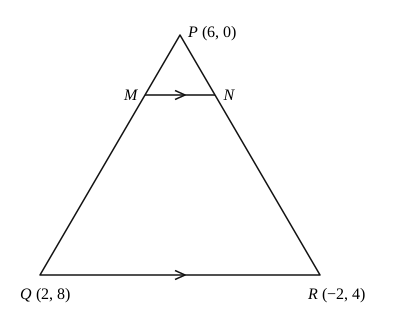
Points P(6, 0), Q(2, 8) and R(−2, 4) are vertices of △PQR. It is given that MN ∥ QR such that MQPM=31. Using distance formula and ratio formula, show that QRMN=41.
Show answer & solution
Answer: Proved: M(5, 2), N(4, 1), MN =2, QR =42, so QRMN=41.
M divides PQ in 1 : 3: M=(41×2+3×6,41×8+3×0)=(5,2)
Parthi and Alisha found a treasure that is exactly on the straight line joining their locations. Parthi's location is at point (−6,−5) and Alisha's location is at point (10,11). The distance from the treasure to Parthi's location is three times that of the distance to Alisha's location. Find the coordinates of the location of the treasure.
Show answer & solution
Answer:(6,7)
Let P(−6,−5), A(10,11) and treasure T on PA with TP=3TA.
So T divides PA internally in the ratio PT:TA=3:1.
The three vertices of a rhombus PQRS are P(2, -3), Q(6, 5) and R(-2, 1). Find the coordinates of the fourth vertex S and coordinates of the point where both the diagonals PR and QS intersect.
Show answer & solution
Answer: S(-6, -7); diagonals intersect at (0, -1)
Diagonals of a rhombus bisect each other.
Mid-point of PR =(22−2,2−3+1)=(0,−1); this is the point of intersection.
Let S = (x, y). Mid-point of QS = (0, -1): 26+x=0, 25+y=−1.
A point P divides the line segment joining the points A(– 3, 5) and B(7, – 4) in a certain ratio. If the point P lies on the line y = 2x, then find the ratio AP : PB and coordinates of point P.
Show answer & solution
Answer: AP : PB = 11 : 18; P(2923,2946)
Let AP : PB =k:1
P =(k+17k−3,k+1−4k+5)
P lies on y=2x: −4k+5=2(7k−3), so 18k=11, k=1811
AP : PB =11:18
P =(2911×7+18×(−3),2911×(−4)+18×5)=(2923,2946)
Prove that the point P dividing the line segment joining the points A(−1,7) and B(4,−3) in the ratio 3 : 2, lies on the line x−3y=−1. Also find length of PA and PB.
Show answer & solution
Answer: P(2, 1) lies on the line; PA = 35 units, PB = 25 units
P=(3+23(4)+2(−1),3+23(−3)+2(7))=(2,1)
Check: x−3y=2−3=−1. So P lies on the line x−3y=−1.
If points A(−5,y), B(2,−2), C(8,4) and D(x,5) taken in order, form a parallelogram ABCD, then find the values of x and y. Hence, find lengths of sides of the parallelogram.
Show answer & solution
Answer:x=1, y=−1; AB = CD = 52 units, BC = AD = 62 units
Diagonals of a parallelogram bisect each other, so the mid-points of AC and BD coincide.
Mid-point of AC =(2−5+8,2y+4); mid-point of BD =(22+x,2−2+5).
P(x,y), Q(−2,−3) and R(2,3) are the vertices of a right triangle PQR right angled at P. Find the relationship between x and y. Hence, find all possible values of x for which y=2.
Find a relation between x and y such that P(x,y) is equidistant from the points A(3,5) and B(7,1). Hence, write the coordinates of the points on x-axis and y-axis which are equidistant from points A and B.
If the points A(6,1), B(p,2), C(9,4) and D(7,q) are the vertices of a parallelogram ABCD, then find the values of p and q. Hence, check whether ABCD is a rectangle or not.
Show answer & solution
Answer:p=8, q=3; ABCD is not a rectangle
Diagonals of a parallelogram bisect each other: midpoint of AC = midpoint of BD.
Midpoint of AC =(215,25); midpoint of BD =(2p+7,22+q)
p+7=15⇒p=8; 2+q=5⇒q=3
AC=32+32=32; BD=(7−8)2+(3−2)2=2
Diagonals are not equal, so ABCD is not a rectangle.
ABCD is a rectangle formed by the points A(−1,−1), B(−1,6), C(3,6) and D(3,−1). P, Q, R and S are mid–points of sides AB, BC, CD and DA respectively. Show that diagonals of the quadrilateral PQRS bisect each other.
Show answer & solution
Answer: Mid-points of PR and QS are both (1,25), so the diagonals bisect each other.
P (mid-point of AB) =(−1,25), Q (mid-point of BC) =(1,6).
R (mid-point of CD) =(3,25), S (mid-point of DA) =(1,−1).
Mid-point of PR =(2−1+3,25)=(1,25).
Mid-point of QS =(21+1,26−1)=(1,25).
The diagonals PR and QS have the same mid-point, so they bisect each other.
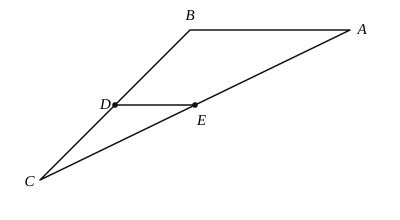
In the given figure, in △ABC points D and E are mid-points of sides BC and AC respectively. If given vertices are A(4, − 2), B(2, − 2) and C(− 6, − 7), then verify the result DE = 21 AB.
If (–5, 3) and (5, 3) are two vertices of an equilateral triangle, then find co-ordinates of the third vertex, given that origin lies inside the triangle. (Take 3=1.7)
Show answer & solution
Answer: (0, –5.5)
Let A(–5, 3), B(5, 3); AB = 10.
The third vertex C is equidistant from A and B, so it lies on x = 0: C(0, y).
AC2=25+(y−3)2=100, so (y−3)2=75, y=3±53.
Origin is inside the triangle, so C is below AB: y=3−53=3−8.5=−5.5.