Coordinate Geometry: 2 marks Questions (CBSE Class 10)
57 different 2 marks questions on Coordinate Geometry from CBSE Class 10 Maths board exams 2022–2026, newest first.
A (– 2, 3) and B (4, 1) are end points of the diameter of a semi-circle. The semi-circle intersects y-axis at point P. Find the co-ordinates of the point P.
Show answer & solution
Answer: P(0, 5) or P(0, – 1)
Centre = midpoint of AB = (1, 2); radius = ( 4 − 1 ) 2 + ( 1 − 2 ) 2 = 10 Let P = (0, y). Then ( 0 − 1 ) 2 + ( y − 2 ) 2 = 10 ( y − 2 ) 2 = 9 ⇒ y = 5 y = − 1 So P is (0, 5) or (0, – 1), depending on which side of AB the semi-circle lies.
The vertices of a △ A B C
Show answer & solution
Answer: P( 5 3 , 5 11 )
D is the midpoint of BC: D = ( 2 2 + 4 , 2 − 3 + 5 ) = ( 3 , 1 ) P divides AD in the ratio 2 : 3. P = ( 5 2 ( 3 ) + 3 ( − 1 ) , 5 2 ( 1 ) + 3 ( 3 ) ) = ( 5 3 , 5 11 )
If A(a, 0), B(1, 1) and C(0, b) form a triangle, right angled at B when joined, then establish a relation between a and b.
Show answer & solution
Answer: a + b = 2
Right angle at B, so A B 2 + B C 2 = A C 2 A B 2 = ( 1 − a ) 2 + 1 B C 2 = 1 + ( b − 1 ) 2 A C 2 = a 2 + b 2 1 − 2 a + a 2 + 1 + 1 + b 2 − 2 b + 1 = a 2 + b 2 4 − 2 a − 2 b = 0 a + b = 2
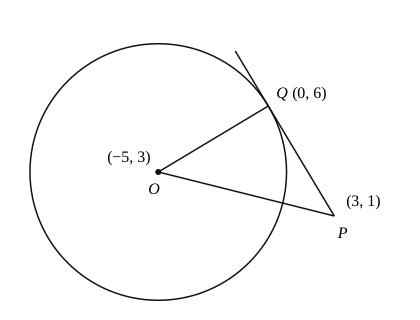
In the given figure, PQ is a tangent to a circle with centre O(−5, 3). If coordinates of P and Q are (3, 1) and (0, 6) respectively, then using distance formula, show that PQ ⊥
Show answer & solution
Answer: Proved: O Q 2 + P Q 2 = 34 + 34 = 68 = O P 2 ∠ O QP = 9 0 ∘
O Q 2 = ( 0 + 5 ) 2 + ( 6 − 3 ) 2 = 25 + 9 = 34 P Q 2 = ( 3 − 0 ) 2 + ( 1 − 6 ) 2 = 9 + 25 = 34 O P 2 = ( 3 + 5 ) 2 + ( 1 − 3 ) 2 = 64 + 4 = 68 O Q 2 + P Q 2 = O P 2 ∠ O QP = 9 0 ∘ ⊥
The coordinates of the centre of a circle are ( x − 7 , 2 x ) x ( − 9 , 11 ) 5 2
Show answer & solution
Answer: x = 3 x = 5
Distance of ( − 9 , 11 ) ( x − 7 + 9 ) 2 + ( 2 x − 11 ) 2 = ( 5 2 ) 2 = 50 ( x + 2 ) 2 + ( 2 x − 11 ) 2 = 50 x 2 + 4 x + 4 + 4 x 2 − 44 x + 121 = 50 5 x 2 − 40 x + 75 = 0 x 2 − 8 x + 15 = 0 ( x − 3 ) ( x − 5 ) = 0 x = 3 x = 5
Do the points P ( 1 , 0 ) ( − 5 , 0 ) ( − 2 , 5 )
Show answer & solution
Answer: Yes; an isosceles triangle (
P R = QR = 34 ,
P Q = 6 ).
P Q = ( 1 + 5 ) 2 + 0 2 = 6 QR = ( − 2 + 5 ) 2 + ( 5 − 0 ) 2 = 9 + 25 = 34 P R = ( − 2 − 1 ) 2 + ( 5 − 0 ) 2 = 9 + 25 = 34 The sum of any two sides exceeds the third (e.g. 2 34 > 6 x Since QR = P R
If the points A(4, 5), B(m, 6), C(4, 3) and D(1, n) taken in this order are the vertices of a parallelogram ABCD, then find the values of m and n.
Show answer & solution
Answer: m = 7, n = 2
The diagonals of a parallelogram bisect each other, so mid-point of AC = mid-point of BD. Mid-point of AC = ( 2 4 + 4 , 2 5 + 3 ) = ( 4 , 4 ) Mid-point of BD = ( 2 m + 1 , 2 6 + n ) 2 m + 1 = 4 ⇒ m = 7 2 6 + n = 4 ⇒ n = 2
If the distance between the points (4, p) and (1, 0) is 5, what is the value of p ?
Show answer & solution
Answer: p = ± 4
By the distance formula, ( 4 − 1 ) 2 + ( p − 0 ) 2 = 5 2 9 + p 2 = 25 p 2 = 16 p = 4 p = − 4
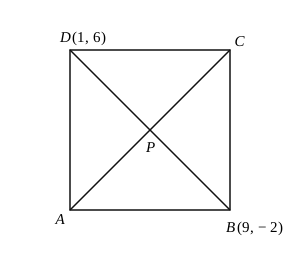
Diagonals AC and BD of square ABCD intersect at P. Coordinates of points B and D are (9, – 2) and (1, 6) respectively.
Show answer & solution
Answer: (i) P(5, 2) (ii) 8 units
(i) Diagonals of a square bisect each other, so P is the midpoint of BD P = ( 2 9 + 1 , 2 − 2 + 6 ) = ( 5 , 2 ) (ii) BD = ( 9 − 1 ) 2 + ( − 2 − 6 ) 2 = 128 = 8 2 Diagonal = 2 × = 2 8 2 = 8
Find the coordinates of a point on the line x + y = 5
Show answer & solution
Answer: ( − 2 3 , 2 13 )
Let the point be ( x , y ) ( x − 6 ) 2 + ( y − 4 ) 2 = ( x − 5 ) 2 + ( y − 2 ) 2 − 12 x + 36 − 8 y + 16 = − 10 x + 25 − 4 y + 4 2 x + 4 y = 23 With y = 5 − x 2 x + 20 − 4 x = 23 x = − 2 3 y = 2 13 Point: ( − 2 3 , 2 13 )
Vertices of a right triangle ABC with ∠ B = 9 0 ∘ A ( 3 , 4 ) B ( 1 , 1 ) C ( − 8 , 7 )
Show answer & solution
Answer: tan A = 3
A B = ( 3 − 1 ) 2 + ( 4 − 1 ) 2 = 4 + 9 = 13 B C = ( 1 + 8 ) 2 + ( 1 − 7 ) 2 = 81 + 36 = 117 = 3 13 In right △ A B C ∠ B = 9 0 ∘ tan A = A B B C = 13 3 13 = 3
Using distance formula, prove that the points A ( 2 , 3 ) B ( − 7 , 0 ) C ( − 1 , 2 )
Show answer & solution
Answer: Proved.
A B = ( 2 + 7 ) 2 + ( 3 − 0 ) 2 = 81 + 9 = 90 = 3 10 B C = ( − 1 + 7 ) 2 + ( 2 − 0 ) 2 = 36 + 4 = 40 = 2 10 A C = ( 2 + 1 ) 2 + ( 3 − 2 ) 2 = 9 + 1 = 10 B C + C A = 2 10 + 10 = 3 10 = A B Hence A, B, C are collinear (C lies between A and B).
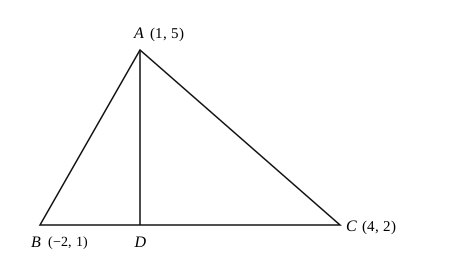
In the given figure, point D divides the side BC of △ A B C
Show answer & solution
Answer: AD =
3 130 units (≈ 3.80 units)
From the figure: A ( 1 , 5 ) B ( − 2 , 1 ) C ( 4 , 2 ) D = ( 1 + 2 1 ( 4 ) + 2 ( − 2 ) , 1 + 2 1 ( 2 ) + 2 ( 1 ) ) = ( 0 , 3 4 ) A D = ( 1 − 0 ) 2 + ( 5 − 3 4 ) 2 = 1 + 9 121 = 9 130 = 3 130
Point P( x , 0 ) ( 2 , 8 ) ( − 3 , − 5 ) x
Show answer & solution
Answer: 8 : 5; x = − 13 14
Let P divide the segment in the ratio k : 1 y k + 1 − 5 k + 8 = 0 k = 5 8 x = 8 + 5 8 × ( − 3 ) + 5 × 2 = 13 − 24 + 10 = − 13 14
Find the ratio in which point P ( − 1 , m ) ( 2 , 5 ) ( − 5 , − 2 ) m
Show answer & solution
Answer: 3 : 4; m = 2
Let P divide AB in the ratio k : 1 x k + 1 − 5 k + 2 = − 1 − 5 k + 2 = − k − 1 k = 4 3 m = 3 + 4 3 × ( − 2 ) + 4 × 5 = 7 14 = 2
Find the ratio in which the segment joining the points ( 2 , − 5 ) ( 5 , 3 ) x x
Show answer & solution
Answer: 5 : 3; ( 8 31 , 0 )
Let the x k : 1 ( x , 0 ) k + 1 3 k − 5 = 0 k = 3 5 x = 5 + 3 5 × 5 + 3 × 2 = 8 31 ( 8 31 , 0 )
Find the coordinates of the points of trisection of line segment joining the points (–4, 1) and (6, 5).
Show answer & solution
Answer: ( − 3 2 , 3 7 ) ( 3 8 , 3 11 )
Let A(–4, 1), B(6, 5). The points of trisection divide AB in the ratios 1 : 2 and 2 : 1. For 1 : 2: ( 3 1 × 6 + 2 × ( − 4 ) , 3 1 × 5 + 2 × 1 ) = ( − 3 2 , 3 7 ) For 2 : 1: ( 3 2 × 6 + 1 × ( − 4 ) , 3 2 × 5 + 1 × 1 ) = ( 3 8 , 3 11 )
Using distance formula, prove that the points (1, 5), (2, 3) and (3, 1) are collinear.
Show answer & solution
Answer: Proved.
Let A(1, 5), B(2, 3), C(3, 1). A B = 1 2 + ( − 2 ) 2 = 5 B C = 1 2 + ( − 2 ) 2 = 5 A C = 2 2 + ( − 4 ) 2 = 20 = 2 5 A B + B C = 2 5 = A C
Establish a relation between x x
Show answer & solution
Answer: 10 x + 8 y = 61 10 x + 8 y − 61 = 0
Let P(x P A 2 = P B 2 ( x + 2 ) 2 + ( y − 5 ) 2 = ( x − 3 ) 2 + ( y − 9 ) 2 x 2 + 4 x + 4 + y 2 − 10 y + 25 = x 2 − 6 x + 9 + y 2 − 18 y + 81 4 x − 10 y + 29 = − 6 x − 18 y + 90 10 x + 8 y − 61 = 0
Using distance formula, show that the points (–1, 3), (6, 2) and (3, –1) are vertices of a right-angled triangle.
Show answer & solution
Answer: Proved (right angle at (3, –1)).
Let A(–1, 3), B(6, 2), C(3, –1). A B 2 = ( 6 + 1 ) 2 + ( 2 − 3 ) 2 = 49 + 1 = 50 B C 2 = ( 3 − 6 ) 2 + ( − 1 − 2 ) 2 = 9 + 9 = 18 A C 2 = ( 3 + 1 ) 2 + ( − 1 − 3 ) 2 = 16 + 16 = 32 B C 2 + A C 2 = 18 + 32 = 50 = A B 2 △ A B C
The coordinates of the centre of a circle are ( 2 a , a − 7 ) ( 11 , − 9 ) 10 2
Show answer & solution
Answer: a = 3 a = 5
Radius = 5 2 2 = 50 Distance from centre ( 2 a , a − 7 ) ( 11 , − 9 ) ( 11 − 2 a ) 2 + ( − 9 − a + 7 ) 2 = 50 ( 11 − 2 a ) 2 + ( a + 2 ) 2 = 50 121 − 44 a + 4 a 2 + a 2 + 4 a + 4 = 50 5 a 2 − 40 a + 75 = 0 a 2 − 8 a + 15 = 0 ( a − 3 ) ( a − 5 ) = 0 a = 3 a = 5
Find the length of the median through the vertex B △ A B C A ( 9 , − 2 ) B ( − 3 , 7 ) C ( − 1 , 10 )
Show answer & solution
The median through B B D A C D = ( 2 9 + ( − 1 ) , 2 − 2 + 10 ) = ( 4 , 4 ) B D = ( 4 + 3 ) 2 + ( 4 − 7 ) 2 = 49 + 9 = 58
Find the coordinates of the point C which lies on the line AB produced such that A C = 2 B C ( − 1 , 7 ) ( 4 , − 3 )
Show answer & solution
Answer: C ( 9 , − 13 )
C lies on AB produced beyond B and A C = 2 B C A B = A C − B C = B C Let C = ( x , y ) 2 − 1 + x = 4 2 7 + y = − 3 x = 9 y = − 13 C = ( 9 , − 13 )
The coordinates of the end points of the line segment AB are A ( − 2 , − 2 ) B ( 2 , − 4 ) B P = 7 4 A B
Show answer & solution
Answer: P ( − 7 2 , − 7 20 )
B P = 7 4 A B ⇒ A P = 7 3 A B A P : P B = 3 : 4 x = 7 3 ( 2 ) + 4 ( − 2 ) = − 7 2 y = 7 3 ( − 4 ) + 4 ( − 2 ) = − 7 20 P ( − 7 2 , − 7 20 )
Prove that abscissa of a point P which is equidistant from points with coordinates A ( 7 , 1 ) B ( 3 , 5 )
Show answer & solution
Answer: Proved.
Let P ( x , y ) P A = P B ⇒ P A 2 = P B 2 ( x − 7 ) 2 + ( y − 1 ) 2 = ( x − 3 ) 2 + ( y − 5 ) 2 − 14 x + 49 − 2 y + 1 = − 6 x + 9 − 10 y + 25 − 8 x + 8 y + 16 = 0 ⇒ x − y = 2 So x = y + 2
If Q ( 0 , 2 ) P ( 5 , − 3 ) R ( x , 7 ) x
Show answer & solution
Answer: x = ± 5
QP = QR Q P 2 = Q R 2 Q P 2 = ( 5 − 0 ) 2 + ( − 3 − 2 ) 2 = 25 + 25 = 50 Q R 2 = ( x − 0 ) 2 + ( 7 − 2 ) 2 = x 2 + 25 x 2 + 25 = 50 x 2 = 25 x = ± 5
If A ( 1 , 1 ) B ( 7 , 9 )
Show answer & solution
Answer: (4, 5)
The centre is the mid-point of the diameter AB. Centre = ( 2 1 + 7 , 2 1 + 9 ) = ( 4 , 5 )
Find the ratio in which the Y-axis divides the line segment joining the points A ( 5 , − 6 ) B ( − 1 , − 4 )
Show answer & solution
Answer: Ratio 5 : 1; point of intersection ( 0 , − 3 13 )
Let the Y-axis divide AB in the ratio k : 1 ( k + 1 − k + 5 , k + 1 − 4 k − 6 ) On the Y-axis the x-coordinate is 0, so − k + 5 = 0 k = 5 = 5 : 1 y-coordinate = 6 − 20 − 6 = − 3 13 Point of intersection = ( 0 , − 3 13 )
Find a point which is equidistant from the points A ( − 1 , 5 ) B ( 2 , 1 )
Show answer & solution
Answer: For example ( 2 1 , 3 ) 6 x − 8 y + 21 = 0
The mid-point of AB is equidistant from A and B: ( 2 − 1 + 2 , 2 5 + 1 ) = ( 2 1 , 3 ) In general P ( x , y ) ( x + 1 ) 2 + ( y − 5 ) 2 = ( x − 2 ) 2 + ( y − 1 ) 2 This simplifies to 6 x − 8 y + 21 = 0 Every point on this line works, so there are infinitely many such points.
Point P ( x , y ) A ( − 1 , 3 ) B ( 9 , 8 ) A P : P B = k : 1 x = y
Show answer & solution
Answer: k = 4
By the section formula, x = k + 1 9 k − 1 y = k + 1 8 k + 3 x = y 9 k − 1 = 8 k + 3 k = 4 Check: P = (7, 7).
Find the ratio in which the point ( 3 , y ) ( − 2 , − 5 ) ( 6 , 3 )
Show answer & solution
Answer: Ratio 5 : 3 y = 0
Let the point divide the segment in the ratio k : 1 x-coordinate: k + 1 6 k − 2 = 3 6 k − 2 = 3 k + 3 k = 3 5 So the ratio is 5 : 3 y = 5 + 3 5 × 3 + 3 × ( − 5 ) = 8 15 − 15 = 0
Find a point on y-axis which is equidistant from the points A ( 6 , 5 ) B ( − 4 , 3 )
Show answer & solution
Answer: ( 0 , 9 )
Let the point be P ( 0 , y ) P A 2 = P B 2 36 + ( y − 5 ) 2 = 16 + ( y − 3 ) 2 36 + y 2 − 10 y + 25 = 16 + y 2 − 6 y + 9 61 − 10 y = 25 − 6 y 4 y = 36 y = 9 The point is ( 0 , 9 )
Find the type of triangle ABC formed whose vertices are A(1, 0), B(− 5 − 2
Show answer & solution
Answer: Isosceles triangle (AC = BC =
34 units, AB = 6 units)
A B = ( − 5 − 1 ) 2 + 0 2 = 6 B C = ( − 2 + 5 ) 2 + ( 5 − 0 ) 2 = 9 + 25 = 34 A C = ( − 2 − 1 ) 2 + ( 5 − 0 ) 2 = 9 + 25 = 34 BC = AC, so △ A B C (Also A C 2 + B C 2 = 68 = 36 = A B 2
In what ratio is the line segment joining the points ( 3 , − 5 ) ( − 1 , 6 ) y = x
Show answer & solution
Answer: 8 : 7
Let the point dividing the segment in the ratio k : 1 ( k + 1 − k + 3 , k + 1 6 k − 5 ) It lies on y = x − k + 3 = 6 k − 5 7 k = 8 k = 7 8 The ratio is 8 : 7.
A(3, 0), B(6, 4) and C(− 1
Show answer & solution
E is the mid-point of AC: E = ( 2 3 − 1 , 2 0 + 3 ) = ( 1 , 2 3 ) B E = ( 6 − 1 ) 2 + ( 4 − 2 3 ) 2 = 25 + 4 25 = 4 125 = 2 5 5
The vertices of a △ A B C − 2 − 6
Show answer & solution
Answer: BD
= 2 145 units (about 6.02 units)
D is the mid-point of AC: D = ( 2 − 2 + 1 , 2 4 − 6 ) = ( − 2 1 , − 1 ) B D = ( 4 + 2 1 ) 2 + ( 3 + 1 ) 2 = 4 81 + 16 = 4 145 = 2 145
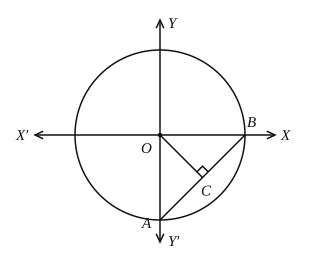
In the given figure, a circle centred at origin O has radius 7 cm, OC is median of △ O A B
Show answer & solution
Answer: OC
= 2 7 2 cm (about 4.95 cm)
From the figure, A lies on the negative y-axis and B on the positive x-axis, on the circle of radius 7: A(0, − 7 C is the mid-point of AB: C = ( 2 7 , − 2 7 ) O C = ( 2 7 ) 2 + ( 2 7 ) 2 = 2 7 2 = 2 7 2 ≈ 4.95
Find a relation between x x
Show answer & solution
Answer: x − y = 2
PA = PB, so P A 2 = P B 2 ( x − 7 ) 2 + ( y − 1 ) 2 = ( x − 3 ) 2 + ( y − 5 ) 2 x 2 − 14 x + 49 + y 2 − 2 y + 1 = x 2 − 6 x + 9 + y 2 − 10 y + 25 − 14 x − 2 y + 50 = − 6 x − 10 y + 34 ⇒ − 8 x + 8 y + 16 = 0 So x − y = 2
Points A(− 1 − 3 y
Show answer & solution
Answer: y = − 1
O is the mid-point of diameter AB. Mid-point of AB = ( 2 − 1 + 5 , 2 y + 7 ) = ( 2 , 2 y + 7 ) So 2 y + 7 = − 3 y ⇒ y + 7 = − 6 y ⇒ y = − 1 Then O = (2, 3) and A = (− 1 − 1 Radius OA = ( 2 + 1 ) 2 + ( 3 + 1 ) 2 = 9 + 16 = 5
Find the ratio in which the point P(–4, 6) divides the line segment joining the points A(–6, 10) and B(3, –8).
Show answer & solution
Answer: 2 : 7
Let P divide AB in the ratio k : 1 x-coordinate: k + 1 3 k − 6 = − 4 ⇒ 3 k − 6 = − 4 k − 4 ⇒ k = 7 2 Check y: 7 2 + 1 − 8 × 7 2 + 10 = 9/7 54/7 = 6 So P divides AB in the ratio 2 : 7.
Prove that the points (3, 0), (6, 4) and (–1, 3) are the vertices of an isosceles triangle.
Show answer & solution
Answer: Proved.
Let A(3, 0), B(6, 4), C(–1, 3). A B = 3 2 + 4 2 = 5 A C = ( − 4 ) 2 + 3 2 = 5 B C = ( − 7 ) 2 + ( − 1 ) 2 = 50 = 5 2 AB = AC (and the points are not collinear since A B + A C = 10 = 5 2
Find the coordinates of the point which divides the line segment joining the points ( 7 , − 1 ) ( − 3 , 4 )
Show answer & solution
Answer: (3, 1)
Using the section formula with m : n = 2 : 3 x = 2 + 3 2 ( − 3 ) + 3 ( 7 ) = 5 − 6 + 21 = 3 y = 2 + 3 2 ( 4 ) + 3 ( − 1 ) = 5 8 − 3 = 1 The point is (3, 1).
Find the value(s) of y for which the distance between the points A(3, − 1
Show answer & solution
Answer: y = 5 y = − 7
A B 2 = ( 11 − 3 ) 2 + ( y + 1 ) 2 = 100 64 + ( y + 1 ) 2 = 100 ( y + 1 ) 2 = 36 y + 1 = ± 6 y = 5 y = − 7
Find the value(s) of ‘x’ so that PQ = QR, where the coordinates of P, Q and R are ( 6 , − 1 ) ( 1 , 3 ) ( x , 8 )
Show answer & solution
Answer: x = 5 or x = − 3
P Q 2 = ( 1 − 6 ) 2 + ( 3 + 1 ) 2 = 25 + 16 = 41 Q R 2 = ( x − 1 ) 2 + ( 8 − 3 ) 2 = ( x − 1 ) 2 + 25 PQ = QR gives ( x − 1 ) 2 + 25 = 41 ( x − 1 ) 2 = 16 x − 1 = ± 4 − 3
The vertices of a triangle are ( − 2 , 0 ) ( 2 , 3 ) ( 1 , − 3 )
Show answer & solution
Answer: Scalene
Let A(−2, 0), B(2, 3), C(1, −3). A B = 4 2 + 3 2 = 5 B C = ( − 1 ) 2 + ( − 6 ) 2 = 37 C A = ( − 3 ) 2 + 3 2 = 18 = 3 2 All three sides are different, so the triangle is scalene.
Find the coordinates of the point which divides the join of A ( − 1 , 7 ) ( 4 , − 3 )
Show answer & solution
Answer: ( 1 , 3 )
By the section formula with m : n = 2 : 3 x = 5 2 ( 4 ) + 3 ( − 1 ) = 5 5 = 1 y = 5 2 ( − 3 ) + 3 ( 7 ) = 5 15 = 3 The point is ( 1 , 3 )
If the points A ( 2 , 3 ) ( − 5 , 6 ) ( 6 , 7 ) ( p , 4 ) p
Show answer & solution
Answer: p = 13
Diagonals of a parallelogram bisect each other, so the mid-points of AC and BD coincide. Mid-point of AC = ( 2 2 + 6 , 2 3 + 7 ) = ( 4 , 5 ) Mid-point of BD = ( 2 − 5 + p , 2 6 + 4 ) = ( 2 p − 5 , 5 ) 2 p − 5 = 4 ⇒ p = 13
Show that A(1, 2), B(5, 4), C(3, 8) and D(−
Show answer & solution
Answer: Proved.
AB = 4 2 + 2 2 = 20 = ( − 4 ) 2 + ( − 2 ) 2 = 20 BC = ( − 2 ) 2 + 4 2 = 20 = 2 2 + ( − 4 ) 2 = 20 Both pairs of opposite sides are equal (AB = CD and BC = DA), so ABCD is a parallelogram. (Check: midpoint of AC = (2, 5) = midpoint of BD, so the diagonals bisect each other.)
Show that the points A(3, 0), B(6, 4) and C(−
Show answer & solution
Answer: Proved.
A B 2 = ( 6 − 3 ) 2 + ( 4 − 0 ) 2 = 25 A C 2 = ( − 1 − 3 ) 2 + ( 3 − 0 ) 2 = 25 B C 2 = ( − 1 − 6 ) 2 + ( 3 − 4 ) 2 = 50 A B 2 + A C 2 = 50 = B C 2
Show that the points ( − 2 , 3 ) ( 8 , 3 ) ( 6 , 7 )
Show answer & solution
Answer: Proved.
Let A( − 2 , 3 ) ( 8 , 3 ) ( 6 , 7 ) A B 2 = 1 0 2 + 0 2 = 100 B C 2 = ( − 2 ) 2 + 4 2 = 20 A C 2 = 8 2 + 4 2 = 80 B C 2 + A C 2 = 20 + 80 = 100 = A B 2
The line segment joining the points A ( 4 , − 5 ) B ( 4 , 5 )
Show answer & solution
Answer: P(4, − 1
AP : AB = 2 : 5, so AP : PB = 2 : 3. x = 5 2 × 4 + 3 × 4 = 4 y = 5 2 × 5 + 3 × ( − 5 ) = 5 − 5 = − 1 P is (4, − 1
Point P(x, y) is equidistant from points A(5, 1) and B(1, 5). Prove that x = y.
Show answer & solution
Answer: Proved.
PA = PB, so P A 2 = P B 2 ( x − 5 ) 2 + ( y − 1 ) 2 = ( x − 1 ) 2 + ( y − 5 ) 2 x 2 − 10 x + 25 + y 2 − 2 y + 1 = x 2 − 2 x + 1 + y 2 − 10 y + 25 − 10 x − 2 y = − 2 x − 10 y − 8 x = − 8 y Hence x = y.
Find the ratio in which y-axis divides the line segment joining the points ( 5 , − 6 ) ( − 1 , − 4 )
Show answer & solution
Answer: 5 : 1 (point of division ( 0 , − 3 13 )
Let the y-axis divide the segment in the ratio k : 1. The point has x-coordinate 0. k + 1 k ( − 1 ) + 1 ( 5 ) = 0 Ratio = 5 : 1. y-coordinate = 6 5 ( − 4 ) + 1 ( − 6 ) = − 3 13
Find the ratio in which line y = x ( 6 , − 3 ) ( 1 , 6 )
Show answer & solution
Answer: 9 : 5
Let the line divide the segment in the ratio k : 1. Point of division = ( k + 1 k + 6 , k + 1 6 k − 3 ) It lies on y = x 6 k − 3 = k + 6 5 k = 9 k = 5 9 Ratio = 9 : 5 (point of division ( 14 39 , 14 39 )
A line intersects y-axis and x-axis at point P and Q, respectively. If R(2, 5) is the mid-point of line segment PQ, then find the coordinates of P and Q.
Show answer & solution
Answer: P(0, 10) and Q(4, 0)
Let P = (0, b) on the y-axis and Q = (a, 0) on the x-axis. Mid-point of PQ = ( 2 a , 2 b ) = ( 2 , 5 ) So a = 4 and b = 10. P = (0, 10), Q = (4, 0).
Find the points on the x
Show answer & solution
Answer: (17, 0) and (5, 0)
Let the point be P(x, 0). P A 2 = ( x − 11 ) 2 + ( 0 + 8 ) 2 = 100 ( x − 11 ) 2 = 36 x − 11 = ± 6 x = 17 or x = 5. The points are (17, 0) and (5, 0).
Find the ratio in which the y-axis divides the line segment joining the points (5, – 6) and (–1, – 4).
Show answer & solution
Answer: 5 : 1
Let the y-axis divide the segment in the ratio k : 1 at (0, y). x-coordinate: k + 1 k ( − 1 ) + 1 ( 5 ) = 0 − k + 5 = 0 Ratio = 5 : 1
Practise smarter: chapter-wise revision, formula sheets and step-by-step NCERT solutions on
MonoMath CBSE →