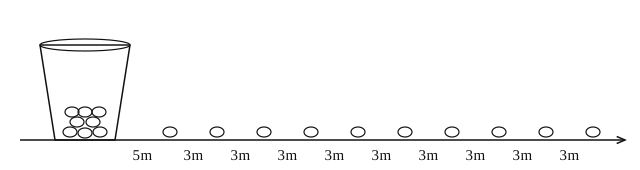
In a potato race, a bucket is placed at the starting point, which is 5 m from the first potato. The other potatoes are arranged 3 m apart in a straight line, with a total of 10 potatoes, as shown in the figure : A competitor starts from the bucket, picks up the nearest potato, runs back to the bucket to drop it in, then returns to pick up the next potato. This process continues until all the potatoes are in the bucket. Based on the above information, answer the following questions : (i) What is the distance covered to pick up the first potato and drop it in bucket ? (1) (ii) What is the distance covered to pick up the second potato and drop it in bucket ? (1) (iii) (a) What is the total distance the competitor has to run ? (2) OR (iii) (b) If average speed of competitor is 5 m/s, then find the average time taken by competitor to put all the potatoes in the bucket. (2)
Show answer & solution
Answer: (i) 10 m (ii) 16 m (iii) (a) 370 m OR (b) 74 s
The potatoes are 5 m, 8 m, 11 m, ..., from the bucket; the 10th is 5+9×3=32 m away.
(i) Distance = 2×5=10 m.
(ii) Distance = 2×8=16 m.
The round-trip distances 10, 16, 22, ... form an AP with a=10, d=6, n=10.
Your elder brother wants to buy a car and plans to take a loan from a bank for his car. He repays his total loan of ₹ 1,18,000 by paying every month, starting with the first instalment of ₹ 1,000 and he increases the instalment by ₹ 100 every month. Based on the information given above, answer the following questions : (i) Find the amount paid by him in the 30th instalment. (1) (ii) If the total number of instalments is 40, what is the amount paid in the last instalment ? (1) (iii) (a) What amount does he still have to pay after the 30th instalment ? (2) OR (iii) (b) Find the ratio of the tenth instalment to the last instalment. (2)
Show answer & solution
Answer: (i) ₹ 3,900 (ii) ₹ 4,900 (iii) (a) ₹ 44,500 OR (b) 19 : 49
Instalments form an A.P. with a = 1000, d = 100.
(i) a30=1000+29×100=3900, i.e. ₹ 3,900
(ii) a40=1000+39×100=4900, i.e. ₹ 4,900
(iii)(a) S30=230[2(1000)+29(100)]=15×4900=73500
Amount still to pay = 118000 - 73500 = ₹ 44,500
(iii)(b) a10=1000+9×100=1900; last instalment = 4900
‘Kolam’ is a decorative art which is made with rice flour in South Indian States. It is drawn on grid pattern of dots. One such art work is shown below. Observe the given figure carefully. There are 4 dots in first square, 8 dots in second square, 12 dots in third square and so on. Based on the above, answer the following questions : (i) Show that number of dots given above form an A.P. Write the first term and common difference. (1) (ii) Write nth term of the A.P. formed. (1) (iii) (a) The pattern is expanded on a large ground. If total 220 dots are used, then find the number of squares formed. (2) OR (b) Is it possible to complete n number of squares using 100 dots ? If yes, then find the value of n.
Show answer & solution
Answer: (i) 4, 8, 12, ... is an A.P. with a = 4, d = 4 (ii) an=4n (iii) (a) 10 squares OR (b) No
(i) 8 − 4 = 12 − 8 = 4, a constant difference, so 4, 8, 12, ... is an A.P. with a = 4, d = 4.
(ii) an=4+(n−1)4=4n
(iii)(a) Sn=2n[8+4(n−1)]=2n(n+1)=220
n2+n−110=0⇒(n+11)(n−10)=0⇒n=10 squares
(iii)(b) 2n(n+1)=100⇒n2+n−50=0
D=1+200=201 is not a perfect square, so n is not a natural number. Not possible.
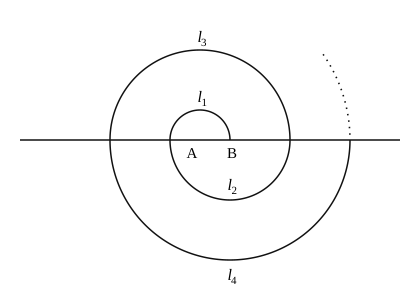
In a garden, saplings of rose flowers were planted at equal intervals to form a spiral pattern. The spiral is made up of successive semicircles, with centres alternatively at A and B, starting with centre at A, of radii 50 cm, 100 cm, 150 cm, ....... as shown in the figure given below. Spiral 1 has 10 flowers, Spiral 2 has 20 flowers, Spiral 3 has 30 flowers and so on. Based on the above information, answer the following questions : (i) What is the radius of the 13th spiral ? (1) (ii) If the radius of the nth spiral is 500 cm, find the value of n. (1) (iii) (a) Find the total number of saplings till the 11th spiral. (2) OR (b) Till which spiral, will there be a total of 450 saplings ? (2)
Show answer & solution
Answer: (i) 650 cm (ii) n=10 (iii) (a) 660 OR (b) 9th spiral
Radii form an AP: 50, 100, 150, ... with a=50, d=50; flowers form an AP 10, 20, 30, ...
(i) a13=50+12×50=650 cm.
(ii) 50+(n−1)50=500, so 50n=500 and n=10.
(iii) (a) S11=211[2×10+10×10]=211×120=660.
(iii) (b) 2n[20+(n−1)10]=450⇒5n(n+1)=450⇒n2+n−90=0⇒(n+10)(n−9)=0, so n=9.
A woman borrowed ₹ 10,00,000 from her friend and promised to return the borrowed money in monthly instalments beginning from the next month. After one month, she returned ₹ 10,000, the next month she returned ₹ 15,000, the third month she returned ₹ 20,000 and so on, thereby increasing the monthly instalment uniformly. Based on the above information, answer the following questions : (i) Find the amount of instalment paid in the tenth month. (1) (ii) In which instalment did she pay ₹ 40,000 ? (1) (iii) (a) If she returned ₹ 11,50,000 in all, how many instalments did she pay ? (2) OR (b) By which instalment has she returned a total amount of ₹ 3,25,000 ? (2)
Show answer & solution
Answer: (i) ₹ 55,000 (ii) 7th instalment (iii) (a) 20 instalments OR (b) by the 10th instalment
Instalments form an AP with a=10000, d=5000.
(i) a10=10000+9×5000=55000, i.e. ₹ 55,000.
(ii) 10000+(n−1)5000=40000⇒n−1=6⇒n=7: the 7th instalment.
(iii) (a) Sn=2n[20000+(n−1)5000]=1150000.
n(15000+5000n)=2300000⇒n2+3n−460=0⇒(n+23)(n−20)=0, so n=20 instalments.
OR (b) 2n[20000+(n−1)5000]=325000⇒n(15000+5000n)=650000.
n2+3n−130=0⇒(n+13)(n−10)=0, so n=10: by the 10th instalment.
In a society, a yoga instructor was hired to train the people of the society to live a healthy lifestyle. Yoga sessions were held daily from 5 p.m. to 7 p.m. in the society park. On day one, 5 people joined the yoga session, on day two, 3 more people joined, on day three, another 3 people joined and in this manner every next day, 3 more people kept on joining. Based on the given information, answer the following questions : (i) On which day did 59 people join the yoga session ? (1) (ii) How many people joined the yoga session on the 31st day ? (1) (iii) (a) The yoga instructor was paid ₹100 for each person attending the yoga session. On which day would he earn ₹5,000 ? (2) OR (b) What was the total amount earned by the yoga instructor in 16 days ? (2)
Show answer & solution
Answer: (i) 19th day (ii) 95 (iii) (a) 16th day OR (b) ₹44,000
Number of people on day n forms an AP: 5, 8, 11, ... with a=5, d=3, so an=3n+2.
(i) 5+(n−1)×3=59⇒n−1=18⇒n=19. On the 19th day.
(ii) a31=5+30×3=95 people.
(iii) (a) ₹5,000 ÷ ₹100 = 50 people. 5+(n−1)×3=50⇒n=16. On the 16th day.
(iii) (b) Total attendance in 16 days =216(2×5+15×3)=8×55=440. Amount =440×₹100=₹44,000.
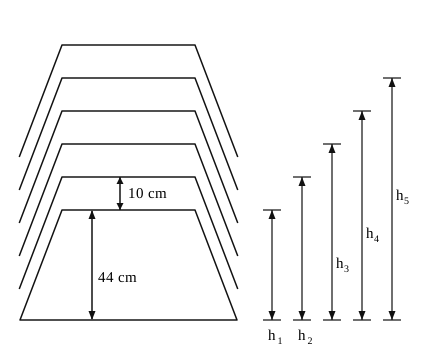
A tent house owner provides furniture on rent. He stacks chairs in his shop to save space. In the diagram, the height of seat of chair from ground is represented by h1, h2, h3, .... The height of first seat is 44 cm from ground level and gap between every two seats is 10 cm. (i) Write the values of h1, h2, h3, h4 and h5 in this order only. (1) (ii) Show that the above values form an A.P. Write its first term and common difference. (1) (iii) (a) If chairs can be stacked up to the maximum height of 160 cm, then find the maximum number of chairs in a stack. (2) OR (iii) (b) Is it possible to stack 15 chairs if maximum height of the stack can not be more than 180 cm ? Justify your answer. (2)
Show answer & solution
Answer: (i) 44, 54, 64, 74, 84 (cm) (ii) Yes, the common difference is constant (10 cm); first term = 44, common difference = 10 (iii) (a) 12 chairs OR (b) No, h15=184 cm > 180 cm
(i) h1=44, h2=54, h3=64, h4=74, h5=84 (in cm).
(ii) Each term exceeds the previous one by 10, a constant, so they form an A.P. with a=44, d=10.
(iii) (a) hn=44+(n−1)×10≤160 gives n−1≤11.6, so n≤12.6.
Maximum number of chairs =12 (seat height 154 cm; the 13th would be at 164 cm).
(iii) (b) h15=44+14×10=184 cm, which is more than 180 cm.
A school is organizing a charity run to raise funds for a local hospital. The run is planned as a series of rounds around a track, with each round being 300 metres. To make the event more challenging and engaging, the organizers decide to increase the distance of each subsequent round by 50 metres. For example, the second round will be 350 metres, the third round will be 400 metres and so on. The total number of rounds planned is 10. Based on the information given above, answer the following questions : (i) Write the fourth, fifth and sixth term of the Arithmetic Progression so formed. (1) (ii) Determine the distance of the 8th round. (1) (iii) (a) Find the total distance run after completing all 10 rounds. (2) OR (iii) (b) If a runner completes only the first 6 rounds, what is the total distance run by the runner ? (2)
Show answer & solution
Answer: (i) 450 m, 500 m, 550 m (ii) 650 m (iii) (a) 5250 m OR (iii) (b) 2550 m
AP: a=300, d=50.
(i) a4=300+3(50)=450, a5=500, a6=550 (metres).
(ii) a8=300+7(50)=650 m.
(iii) (a) S10=210[2(300)+9(50)]=5(600+450)=5250 m.
(iii) (b) S6=26[2(300)+5(50)]=3(600+250)=2550 m.
Cable cars at hill stations are one of the major tourist attractions. On a hill station, the length of cable car ride from base point to top most point on the hill is 5000 m. Poles are installed at equal intervals on the way to provide support to the cables on which car moves. The distance of first pole from base point is 200 m and subsequent poles are installed at equal interval of 150 m. Further, the distance of last pole from the top is 300 m. Based on above information, answer the following questions using Arithmetic Progression : (i) Find the distance of 10th pole from the base. (1) (ii) Find the distance between 15th pole and 25th pole. (1) (iii) (a) Find the time taken by cable car to reach 15th pole from the top if it is moving at the speed of 5m/sec and coming from top. (2) OR (iii) (b) Find the total number of poles installed along the entire journey. (2)
Show answer & solution
Answer: (i) 1550 m (ii) 1500 m (iii) (a) 480 seconds (8 minutes) OR (iii) (b) 31
Distances of poles from base: 200, 350, 500, ... AP with a=200, d=150
(i) a10=200+9×150=1550 m
(ii) a25−a15=10×150=1500 m
(iii)(b) Last pole is at 5000−300=4700 m: 200+(n−1)150=4700⇒n−1=30⇒n=31 poles
(iii)(a) Counting from the top, the poles are at 300, 450, 600, ... m from the top (a=300, d=150).
15th pole from top is at 300+14×150=2400 m from the top
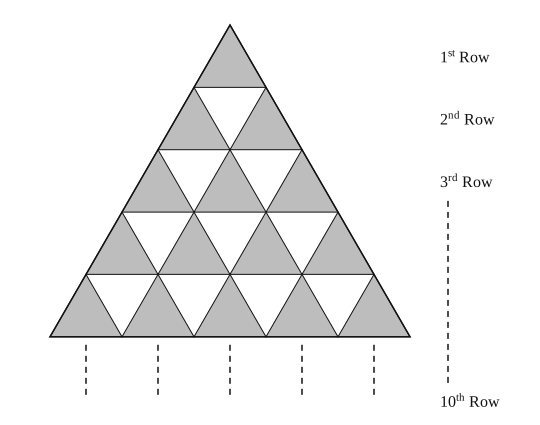
In an equilateral triangle of side 10 cm, equilateral triangles of side 1 cm are formed as shown in the figure below, such that there is one triangle in the first row, three triangles in the second row, five triangles in the third row and so on. Based on given information, answer the following questions using Arithmetic Progression. (i) How many triangles will be there in bottom most row ? (1) (ii) How many triangles will be there in fourth row from the bottom ? (1) (iii) (a) Find the total number of triangles of side 1 cm each till 8th row. (2) OR (iii) (b) How many more number of triangles are there from 5th row to 10th row than in first 4 rows ? Show working. (2)
Show answer & solution
Answer: (i) 19 (ii) 13 (iii)(a) 64 OR (iii)(b) 68
Rows form an A.P. 1, 3, 5, ... with a=1, d=2; there are 10 rows.
(i) a10=1+9×2=19
(ii) Fourth row from the bottom is the 7th row: a7=1+6×2=13
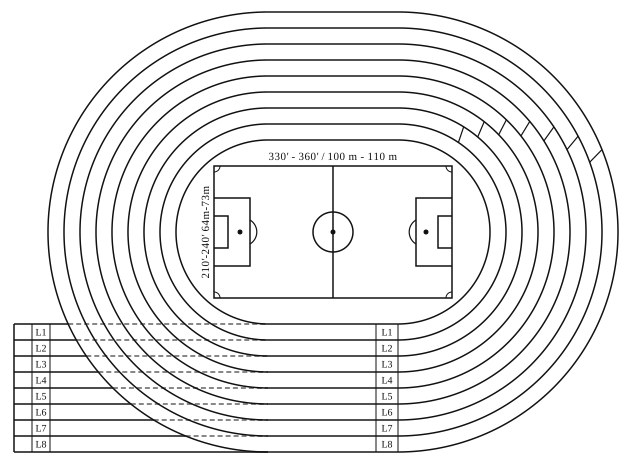
In order to organise, Annual Sports Day, a school prepared an eight lane running track with an integrated football field inside the track area as shown below : The length of innermost lane of the track is 400 m and each subsequent lane is 7.6 m longer than the preceding lane. Based on given information, answer the following questions, using concept of Arithmetic Progression. (i) What is the length of the 6th lane ? (1) (ii) How long is the 8th lane than that of 4th lane ? (1) (iii) (a) While practicing for a race, a student took one round each in first six lanes. Find the total distance covered by the student. (2) OR (iii) (b) A student took one round each in lane 4 to lane 8. Find the total distance covered by the student. (2)
Show answer & solution
Answer: (i) 438 m (ii) 30.4 m (iii) (a) 2514 m OR (iii) (b) 2190 m
a=400, d=7.6
(i) a6=400+5×7.6=438 m
(ii) a8−a4=4d=4×7.6=30.4 m
(iii) (a) S6=26[2×400+5×7.6]=3×838=2514 m
(iii) (b) a4=422.8, a8=453.2; sum of 5 lanes =25(422.8+453.2)=25×876=2190 m
Saving money is a good habit and it should be inculcated in children right from the beginning. Rehan’s mother brought a piggy bank for Rehan and puts one ₹ 5 coin of her savings in the piggy bank on the first day. She increases his savings by one ₹ 5 coin daily. Based on the above information, answer the following questions : (i) How many coins were added to the piggy bank on 8th day ? (1) (ii) How much money will be there in the piggy bank after 8 days ? (1) (iii) If the piggy bank can hold one hundred twenty ₹ 5 coins in all, find the number of days she can contribute to put ₹ 5 coins into it. (2) OR (iii) Find the total money saved, when the piggy bank is full. (2)
Show answer & solution
Answer: (i) 8 coins (ii) ₹ 180 (iii) 15 days; OR (iii) ₹ 600
Coins added each day: 1, 2, 3, ... form an AP with a=1, d=1.
(i) a8=1+7×1=8 coins
(ii) Coins after 8 days =28(2+7)=36; money =36×5=₹180
(iii) 2n(2+(n−1))=120⇒n(n+1)=240⇒n=15 days
OR (iii) Full piggy bank holds 120 coins, so money =120×5=₹600
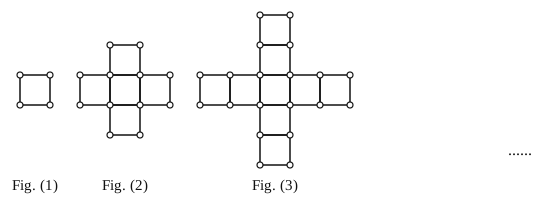
While preparing for a competitive examination, Akbar came across a match-stick pattern based question. The pattern is given below : Based on the above information, answer the following questions : (i) Write first term and common difference of the A.P. formed by number of squares in each figure. (1) (ii) Write first term and common difference of the A.P. formed by number of sticks used in each figure. (1) (iii) How many squares are there in Fig. (10) ? Also, write the number of sticks used in Fig. (10). (2) OR If 88 sticks are used to make mth figure (Fig. (m)), find the value of m. How many squares are formed in this figure ? (2)
Show answer & solution
Answer: (i) a=1, d=4 (ii) a=4, d=12 (iii) 37 squares, 112 sticks; OR m=8, 29 squares
(i) Squares: 1, 5, 9, ... so a=1, d=4.
(ii) Sticks: 4, 16, 28, ... (each new square adds 3 sticks) so a=4, d=12.
(iii) Squares in Fig. 10 =1+9×4=37; sticks =4+9×12=112.
Sumant's mother started a new shoe shop. To display the shoes, she put 3 pairs of shoes in the 1st row, 5 pairs in the 2nd row, 7 pairs in the 3rd row and so on. Based on the above information, answer the following questions : (i) How many pairs of shoes are displayed in the 6th row ? (1) (ii) What is the difference of pairs of shoes in the 1st row and the 6th row ? (1) (iii) (a) Find the total number of pairs of shoes displayed in the first 15 rows. (2) OR (b) If the pairs of shoes displayed in the 4th row are 'on sale' at price of ₹ 500 for each pair, then find the total amount (money) earned by Sumant's mother if all shoes displayed in the 4th row are sold out. (2)
Show answer & solution
Answer: (i) 13 (ii) 10 (iii) (a) 255 OR (b) ₹ 4,500
Treasure Hunt is an exciting and adventurous game where participants follow a series of clues/numbers/maps to discover hidden treasures. Players engage in a thrilling quest, solving puzzles and riddles to unveil the location of the coveted prize. While playing a treasure hunt game, some clues (numbers) are hidden in various spots collectively forming an A.P. If the number on the nth spot is 20+4n, then answer the following questions to help the players in spotting the clues : (i) Which number is on first spot ? (1) (ii) Which spot is numbered as 112 ? (2) OR What is the sum of all the numbers on the first 10 spots ? (2) (iii) Which number is on the (n−2)th spot ? (1)
Show answer & solution
Answer: (i) 24 (ii) 23rd spot; OR 420 (iii) 4n+12
an=20+4n, so the A.P. is 24, 28, 32, ... with a=24, d=4.
(i) a1=20+4=24.
(ii) 20+4n=112 gives 4n=92, so n=23: the 23rd spot.
Aahana being a plant lover decides to convert her balcony into beautiful garden full of plants. She bought few plants with pots for her balcony. She placed the pots in such a way that number of pots in the first row is 2, second row is 5, third row is 8 and so on. Based on the above information, answer the following questions : (i) Find the number of pots placed in the 10th row. (1) (ii) Find the difference in the number of pots placed in 5th row and 2nd row. (1) (iii) If Aahana wants to place 100 pots in total, then find the total number of rows formed in the arrangement. (2) OR (iii) If Aahana has sufficient space for 12 rows, then how many total number of pots are placed by her with the same arrangement ? (2)
Show answer & solution
Answer: (i) 29 (ii) 9 (iii) 8 rows; OR (iii) 222 pots
The numbers of pots 2, 5, 8, ... form an A.P. with a=2, d=3.
Do you know old clothes which are thrown as waste not only fill the landfill site but also produce very harmful greenhouse gas. So, it is very important that we reuse old clothes in whatever way we can. The picture given below on the right, shows a footmat (rug) made out of old t-shirts yarn. Observing the picture, you will notice that a number of stitches in circular rows are making a pattern : 6, 12, 18, 24, ... Based on the above information, answer the following questions : (a) Check whether the given pattern forms an AP. If yes, find the common difference and the next term of the AP. (2) (b) Write the nth term of the AP. Hence, find the number of stitches in the 10th circular row. (2)
Show answer & solution
Answer: (a) Yes, it is an AP; common difference 6, next term 30 (b) an=6n; 60 stitches
(a) 12−6=18−12=24−18=6, so the pattern is an AP with d=6
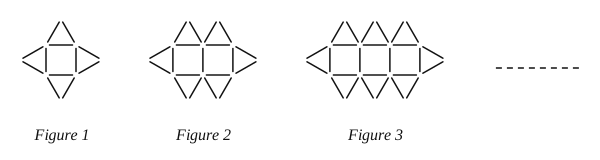
In Mathematics, relations can be expressed in various ways. The matchstick patterns are based on linear relations. Different strategies can be used to calculate the number of matchsticks used in different figures. One such pattern is shown below. Observe the pattern and answer the following questions using Arithmetic Progression : (a) Write the AP for the number of triangles used in the figures. Also, write the nth term of this AP. (2) (b) Which figure has 61 matchsticks ? (2)
Show answer & solution
Answer: (a) 4, 6, 8, ...; an=2n+2 (b) Figure 8
(a) Triangles: Figure 1 has 4, Figure 2 has 6, Figure 3 has 8, so the AP is 4, 6, 8, ...