MonoMath CBSE
CBSE Maths › Class 10 PYQs › 2026

CBSE Class 10 Maths Basic 2026 Question Paper 430/5/3 with Solutions

All 44 questions from the CBSE Class 10 Mathematics Basic board paper, Set 430/5/3 (2026), with answers and step-by-step solutions. Total 80 marks. Tap “Show answer & solution” under any question.

Set 430/4/1Set 430/4/2Set 430/4/3Set 430/5/1Set 430/5/2Set 430/5/3
Q11 markMCQPolynomials

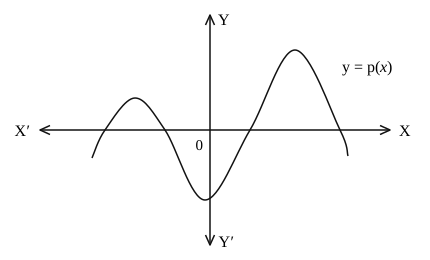
The graph of a polynomial is shown here. The number of zeroes of the polynomial is

Diagram for CBSE 2026 Class 10 Maths question 1
  1. (A)5
  2. (B)1
  3. (C)0
  4. (D)4
Show answer & solution
Answer: (D) 4
  1. The number of zeroes equals the number of points where the graph meets the x-axis.
  2. The graph cuts the x-axis at 4 points, so p(x) has 4 zeroes.
Q21 markMCQProbability

Three coins are tossed together. The probability of getting exactly two tails is

  1. (A)
  2. (B)
  3. (C)
  4. (D)1
Show answer & solution
Answer: (C)
  1. Total outcomes = 8.
  2. Exactly two tails: HTT, THT, TTH, i.e. 3 outcomes.
  3. Probability
Q31 markMCQProbability

A bag contains some red and some white balls. A ball is drawn at random from the bag. If the probability of getting a red ball is , then the probability of getting a white ball is

  1. (A)
  2. (B)
  3. (C)
  4. (D)
Show answer & solution
Answer: (B)
  1. The ball is either red or white.
  2. P(white)

The total surface area of a solid cone of radius 7 cm and slant height 25 cm, is

  1. (A)724 cm
  2. (B)704 cm
  3. (C)550 cm
  4. (D)616 cm
Show answer & solution
Answer: (B) 704 cm
  1. TSA
  2. cm

The length of a pendulum is 70 cm and it describes an arc of length 88 cm when swings. The angle subtended by the arc at the centre is

  1. (A)
  2. (B)
  3. (C)
  4. (D)
Show answer & solution
Answer: (C)
  1. Arc length

The distance between the points and is

  1. (A)
  2. (B)14
  3. (C)
  4. (D)7
Show answer & solution
Answer: (A)
Also asked in: 2026 Basic 430/5/1
Q71 markMCQReal Numbers

is

  1. (A)a prime number.
  2. (B)multiple of 17.
  3. (C)a composite number.
  4. (D)an odd number.
Show answer & solution
Answer: (C) a composite number.
  1. It has factors 11 and 222 besides 1 and itself, so it is composite.
  2. 2442 is even (not odd) and 2442 = 17 × 143 + 11, so it is not a multiple of 17.
Q81 markMCQCircles

PQ is tangent to a circle at a point P on the circle. The number of tangents which can be drawn to the circle parallel to PQ, is

  1. (A)2
  2. (B)1
  3. (C)many
  4. (D)zero
Show answer & solution
Answer: (B) 1
  1. Tangents parallel to a given direction touch the circle at the two ends of a diameter.
  2. One of them is PQ itself (at P); the only other one is the tangent at the end of the diameter through P.
  3. So exactly 1 tangent can be drawn parallel to PQ.

If are in A.P., then the value of is

  1. (A)14
  2. (B)
  3. (C)
  4. (D)
Show answer & solution
Answer: (C)
  1. For an A.P., .
Also asked in: 2026 Basic 430/5/1

The roots of the quadratic equation are

  1. (A)real and equal
  2. (B)not real
  3. (C)real and negative of each other
  4. (D)rational numbers
Show answer & solution
Answer: (B) not real
  1. Here , , .
  2. .
  3. So the roots are not real.
Q111 markMCQCircles

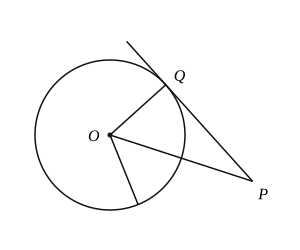
PQ is tangent to the circle with centre O such that OP = 2OQ. is

Diagram for CBSE 2026 Class 10 Maths question 11
  1. (A)
  2. (B)
  3. (C)
  4. (D)
Show answer & solution
Answer: (D)
  1. OQ is a radius and PQ a tangent at Q, so .

If value of is , then equals

  1. (A)
  2. (B)
  3. (C)
  4. (D)
Show answer & solution
Answer: (A)
  1. , so
Also asked in: 2026 Basic 430/5/1
Q131 markMCQProbability

A card is drawn from a well-shuffled deck of 52 playing cards. The probability of getting a queen of spade is

  1. (A)
  2. (B)
  3. (C)0
  4. (D)
Show answer & solution
Answer: (B)
  1. There is only one queen of spades in the deck.
  2. Probability
Q141 markMCQTriangles

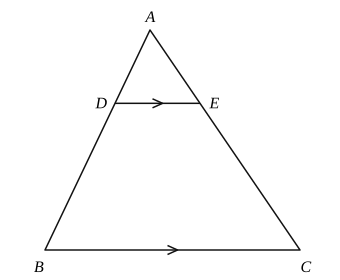
In the given figure, DE BC.
If AD : AB = 1 : 3 and AE = 2.5 cm, then AC equals

Diagram for CBSE 2026 Class 10 Maths question 14
  1. (A)7.5 cm
  2. (B)5 cm
  3. (C)10 cm
  4. (D)2.5 cm
Show answer & solution
Answer: (A) 7.5 cm
  1. Since DE BC, (BPT).
  2. , so AC = 7.5 cm.

If term of an A.P. is 4 and its term is zero, then its first term is

  1. (A)
  2. (B)
  3. (C)56
  4. (D)48
Show answer & solution
Answer: (C) 56

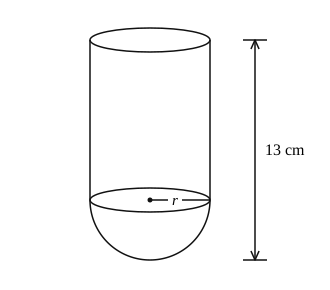
A cylinder of radius is surmounted on a hemisphere of same radius. If total height of the object is 13 cm, then its inner surface area is

Diagram for CBSE 2026 Class 10 Maths question 16
  1. (A)
  2. (B)
  3. (C)
  4. (D)
Show answer & solution
Answer: (D)
  1. Height of the cylindrical part .
  2. Inner surface area curved surface of cylinder curved surface of hemisphere .
Q171 markMCQPolynomials

The value of k for which sum of the zeroes of the polynomial is 2, is

  1. (A)2
  2. (B)
  3. (C)
  4. (D)6
Show answer & solution
Answer: (D) 6
  1. Sum of zeroes
  2. , so
Also asked in: 2026 Basic 430/5/1
Q181 markMCQTriangles

Which of the following statements is not always true ?

  1. (A)Two circles are similar.
  2. (B)Two isosceles right triangles are similar.
  3. (C)Two rectangles are similar.
  4. (D)Two equilateral triangles are similar.
Show answer & solution
Answer: (C) Two rectangles are similar.
  1. All circles, all isosceles right triangles (angles 45°, 45°, 90°) and all equilateral triangles have the same shape, so they are always similar.
  2. Two rectangles have equal angles, but their sides need not be in the same ratio (e.g. 1 × 2 and 1 × 3).
  3. So 'Two rectangles are similar' is not always true.
Q191 markAssertion–ReasonIntroduction to Trigonometry

Assertion (A) : For an acute angle , is always less than 1.
Reason (R) : In a right-angled triangle, hypotenuse is the longest side and .

  1. (A)Both, Assertion (A) and Reason (R) are true and Reason (R) is the correct explanation of the Assertion (A).
  2. (B)Both, Assertion (A) and Reason (R) are true, but Reason (R) is not the correct explanation of the Assertion (A).
  3. (C)Assertion (A) is true, but Reason (R) is false.
  4. (D)Assertion (A) is false, but Reason (R) is true.
Show answer & solution
Answer: (A) Both (A) and (R) are true and (R) is the correct explanation of (A).
  1. In a right-angled triangle the hypotenuse is the longest side, so Base < Hypotenuse. R is true.
  2. Hence for an acute angle , . A is true and follows from R.
Q201 markAssertion–ReasonStatistics

Assertion (A) : Median of a data is the value of , where N represents sum of all frequencies.
Reason (R) : Median divides the whole distribution in two equal parts.

  1. (A)Both, Assertion (A) and Reason (R) are true and Reason (R) is the correct explanation of the Assertion (A).
  2. (B)Both, Assertion (A) and Reason (R) are true, but Reason (R) is not the correct explanation of the Assertion (A).
  3. (C)Assertion (A) is true, but Reason (R) is false.
  4. (D)Assertion (A) is false, but Reason (R) is true.
Show answer & solution
Answer: (D) Assertion (A) is false, but Reason (R) is true.
  1. only tells us the position used to locate the median (median class); the median is the value of the observation there, not itself. A is false.
  2. The median is the middle value, which divides the distribution into two equal parts. R is true.
Q212 marksVery Short AnswerProbability

Find the probability that a number selected at random from the numbers 30, 31, 32, 33, ....., 60 is (i) a prime number (ii) a multiple of 6.

Show answer & solution
Answer: (i) (ii)
  1. Total numbers from 30 to 60 = 31.
  2. (i) Primes: 31, 37, 41, 43, 47, 53, 59, i.e. 7. P = 7/31.
  3. (ii) Multiples of 6: 30, 36, 42, 48, 54, 60, i.e. 6. P = 6/31.
OR
Q21 (OR) (OR)2 marksVery Short AnswerProbability

Slips of letters of the word ‘BACKGROUND’ are put in a bowl and thoroughly mixed. One slip is picked up at random. Find the probability that picked up slip’s letter is (i) a vowel (ii) present in the word ‘BALL’.

Show answer & solution
Answer: (i) (ii)
  1. BACKGROUND has 10 letters: B, A, C, K, G, R, O, U, N, D.
  2. (i) Vowels: A, O, U, i.e. 3. P = 3/10.
  3. (ii) Letters also in 'BALL': B and A, i.e. 2 slips. P = 2/10 = 1/5.
Q222 marksVery Short AnswerTriangles

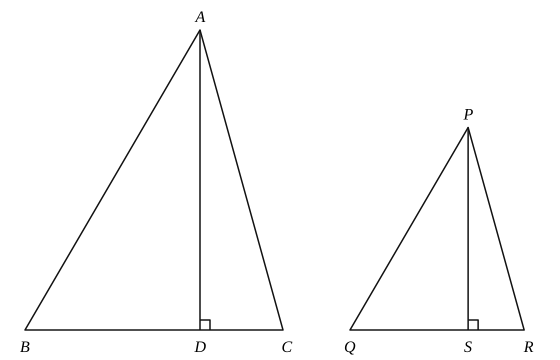
In the given figure, two triangles ABC and PQR are shown such that and . If AD BC and PS QR, then prove that (i) (ii) AD QS = BD PS.

Diagram for CBSE 2026 Class 10 Maths question 22
Show answer & solution
Answer: (i) Proved. (ii) Proved.
  1. In and , and , so (angle sum property).
  2. (i) In and : and .
  3. So (AA).
  4. (ii) Hence , i.e. AD QS = BD PS.
Q232 marksVery Short AnswerReal Numbers

Find the H.C.F. and L.C.M. of 408 and 312.

Show answer & solution
Answer: H.C.F. = 24, L.C.M. = 5304
  1. H.C.F.
  2. L.C.M.
Q242 marksVery Short AnswerIntroduction to Trigonometry

If and , then find the value of .

Show answer & solution
Answer: (i.e. )
  1. gives ; gives .
Also asked in: 2026 Basic 430/5/1
OR
Q24 (OR) (OR)2 marksVery Short AnswerIntroduction to Trigonometry

Evaluate :

Show answer & solution
Answer:
  1. , ,
  2. Value
Also asked in: 2026 Basic 430/5/1
Q252 marksVery Short AnswerCoordinate Geometry

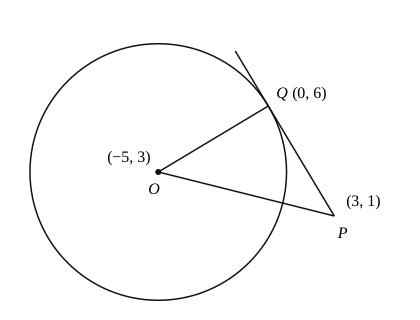
In the given figure, PQ is a tangent to a circle with centre O(−5, 3). If coordinates of P and Q are (3, 1) and (0, 6) respectively, then using distance formula, show that PQ OQ.

Diagram for CBSE 2026 Class 10 Maths question 25
Show answer & solution
Answer: Proved: , so .
  1. , so by the converse of Pythagoras theorem , i.e. PQ OQ.
Q263 marksShort AnswerPolynomials

If are zeroes of the polynomial , then form a quadratic polynomial whose zeroes are and .

Show answer & solution
Answer: (or any non-zero multiple of it)
  1. ,
  2. Sum
  3. Product
  4. Polynomial: ; taking ,
Also asked in: 2026 Basic 430/5/1
OR
Q26 (OR) (OR)3 marksShort AnswerPolynomials

Find the zeroes of the polynomial and verify the relationship between its zeroes and the coefficients.

Show answer & solution
Answer: Zeroes: and ; relationship verified.
  1. Zeroes: and
  2. Sum
  3. Product . Verified.
Also asked in: 2026 Basic 430/5/1
Q273 marksShort AnswerArithmetic Progressions

The and term of an A.P. are 13 and 25 respectively. Find its term.

Show answer & solution
Answer: 53
  1. a + 3d = 13 and a + 9d = 25.
  2. Subtracting: 6d = 12, so d = 2 and a = 7.
OR
Q27 (OR) (OR)3 marksShort AnswerArithmetic Progressions

From 232 to 540, find the number of multiples of 3.

Show answer & solution
Answer: 103
  1. The first multiple of 3 after 232 is 234 and the last is 540.
  2. 234, 237, ..., 540 is an A.P. with a = 234, d = 3.
Q283 marksShort AnswerAreas Related to Circles

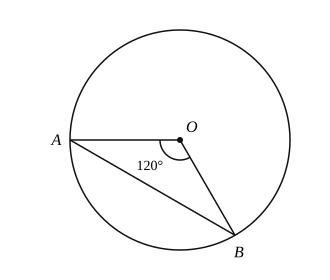
Chord AB of a circle subtends an angle of at the centre O of the circle. Find the length of arc AB, if radius of the circle is 21 cm.

Diagram for CBSE 2026 Class 10 Maths question 28
Show answer & solution
Answer: 44 cm
  1. Arc length
  2. cm
Q293 marksShort AnswerCoordinate Geometry

Determine the ratio in which the line divides the line segment joining the points (1, 3) and (2, 5).

Show answer & solution
Answer: 1 : 3 (internally)
  1. Let the line divide the segment in the ratio k : 1. The point is .
  2. It lies on :
  3. Ratio 1 : 3 (the point is ).
Q303 marksShort AnswerReal Numbers

Prove that is an irrational number.

Show answer & solution
Answer: Proved.
  1. Suppose is rational. Then , where a, b are co-prime integers and .
  2. Squaring, , so 2 divides and hence 2 divides a.
  3. Let . Then , i.e. , so 2 divides b.
  4. So 2 is a common factor of a and b, contradicting that they are co-prime.
  5. Hence is irrational.
Q313 marksShort AnswerIntroduction to Trigonometry

Prove that : .

Show answer & solution
Answer: Proved.
  1. LHS
  2. RHS
  3. LHS = RHS. Proved.
Q325 marksLong AnswerStatistics

Find the missing frequencies p and q in the following frequency distribution, when sum of frequencies is 40 and mean is 19 :

Class0-55-1010-1515-2020-2525-3030-35
Frequency256p10q4
Show answer & solution
Answer: p = 7, q = 6
  1. Sum of frequencies: 2 + 5 + 6 + p + 10 + q + 4 = 40, so p + q = 13.
  2. Class marks: 2.5, 7.5, 12.5, 17.5, 22.5, 27.5, 32.5.
  3. Mean
  4. Using : ,
Q335 marksLong AnswerQuadratic Equations

ABCD is a rectangle of dimensions 80 cm 60 cm. Another rectangle PQRS is drawn inside ABCD leaving space of equal width cm along the edges of ABCD. If area PQRS is half of the area ABCD, then find the value of .

Show answer & solution
Answer:
  1. Dimensions of PQRS: cm and cm.
  2. , so or
  3. makes negative, so .
OR
Q33 (OR) (OR)5 marksLong AnswerQuadratic Equations

A train covers a distance of 90 km at a uniform speed. Had the speed been 15 km/h more, it would have taken 30 minutes less for the same journey. Find the original speed of the train.

Show answer & solution
Answer: 45 km/h
  1. Let the original speed be x km/h.
  2. Speed cannot be negative, so x = 45 km/h.

Two poles of equal heights are standing opposite each other on either side of the road, which is 80 m wide. From a point between them on the road, the angles of elevation of the top of the poles are and respectively. Find the height of the poles and the distance of the point from the poles.

Show answer & solution
Answer: Height m ( m); the point is 20 m from one pole and 60 m from the other.
  1. Let each pole have height h m and let the point be x m from the pole whose top is seen at 60°; it is (80 − x) m from the other pole.
  2. m; distances are 20 m and 60 m.
Q355 marksLong AnswerTriangles

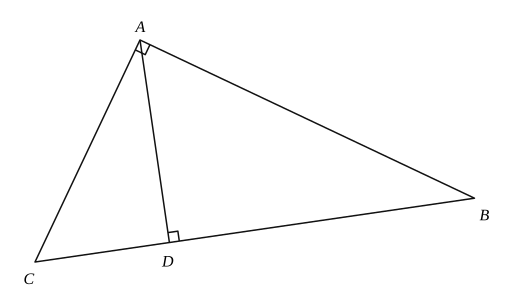
In the given figure, is right angled triangle with . AD is perpendicular to BC.
Prove that :
(i)
(ii)
(iii) Find the area of when DB = 9 cm and DC = 16 cm.

Diagram for CBSE 2026 Class 10 Maths question 35
Show answer & solution
Answer: (i) Proved. (ii) Proved. (iii) 150 cm
  1. (i) In and : .
  2. (since ).
  3. So (AA).
  4. (ii) Corresponding sides are proportional: , so .
  5. (iii) , so DA = 12 cm; BC = 9 + 16 = 25 cm.
  6. Area of cm
OR
Q35 (OR) (OR)5 marksLong AnswerTriangles

If a line is drawn parallel to one side of a triangle to intersect the other two sides in distinct points, then prove that the other two sides are divided in the same ratio.

Show answer & solution
Answer: Proved.
  1. Given: In , DE BC with D on AB and E on AC. To prove: .
  2. Construction: join BE and CD; draw EN ⊥ AB and DM ⊥ AC.
  3. ar(ADE) and ar(BDE) , so .
  4. Similarly, .
  5. Triangles BDE and DEC are on the same base DE and between the same parallels DE and BC, so ar(BDE) = ar(DEC).
  6. Hence .
Q364 marksCase StudySurface Areas and Volumes

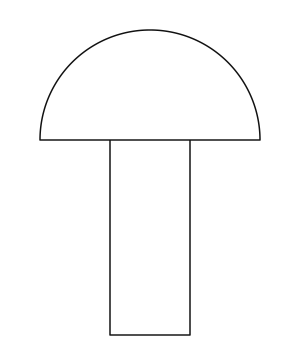
There are many varieties of mushrooms available in the world. One such mushroom ‘Amanita muscaria’ has a upper part which is like red cap (hemispherical) and lower part is like white stem (cylinderical).
The hemispherical cap’s radius = 3 cm and cylindrical stem is 2 cm high with diameter 1.4 cm. Considering mushroom a solid object, answer the following questions :
(i) What is the total height of a mushroom ?
(ii) Find the volume of the stem.
(iii) (a) Determine the volume of 7 such mushrooms.
OR (b) Find the total surface area of 7 such mushrooms.

Diagram for CBSE 2026 Class 10 Maths question 36
Show answer & solution
Answer: (i) 5 cm (ii) 3.08 cm (iii) (a) 417.56 cm OR (b) 655.6 cm
  1. (i) Total height = radius of cap + height of stem = 3 + 2 = 5 cm.
  2. (ii) Stem radius = 0.7 cm. Volume cm
  3. (iii)(a) Volume of cap cm
  4. Volume of 7 mushrooms cm
  5. (iii)(b) Surface of one mushroom = curved surface of cap + flat underside of cap not covered by stem + curved surface of stem + base of stem
  6. cm
  7. For 7 mushrooms: cm
Q374 marksCase StudyCircles

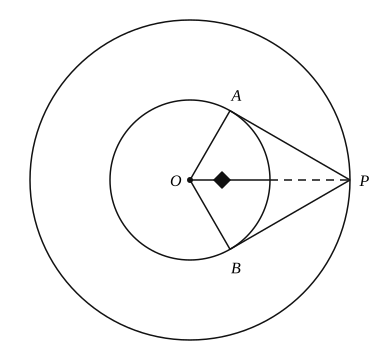
In a circular museum hall of radius 14 m, some statues are displayed. Statues are kept inside the inner concentric circle of radius 7 m. One such statue lying in sector OAB, is fenced along line segments OA, AP, PB and BO where P is a point on outer circle.
Based on above information, answer the following questions :
(i) Find . (1)
(ii) Prove that . (1)
(iii) (a) Find the length of fencing required to protect the statue. (Take = 1.73) (2)
OR (b) Find area of quadrilateral OAPB. (Take = 1.73)

Diagram for CBSE 2026 Class 10 Maths question 37
Show answer & solution
Answer: (i) (ii) Proved (iii) (a) 38.22 m OR (b) 84.77 m
  1. (i) PA is a tangent to the inner circle, so . OA = 7 m, OP = 14 m.
  2. , so .
  3. (ii) In and : OA = OB (radii), PA = PB (tangents from an external point), OP is common. So (SSS).
  4. (iii)(a) m = PB
  5. Fencing m
  6. (iii)(b) Area of OAPB m

Seema daily goes to a park to exercise on machines available there. When Seema spent 15 minutes on exercise bicycle and 30 minutes on double cross walker, she received a message of burning 435 calories on her fitness watch. When she spent 30 minutes on exercise bicycle and 40 minutes on double cross walker, she received a message of burning 690 calories.
To find the number of calories burned per minute on each machine, answer the following :
(i) Represent the above situation in terms of a pair of linear equations in two variables.
(ii) Show that the equations have unique solution.
(iii) (a) Solve both equations to find the values of the variables using elimination method.
OR (b) Solve both equations to find the values of the variables using substitution method.

Show answer & solution
Answer: (i) and , i.e. and , where x and y are calories burned per minute on the exercise bicycle and the double cross walker (ii) , so a unique solution (iii) , (by either method)
  1. (i) Let x and y be the calories burned per minute on the exercise bicycle and the double cross walker.
  2. ;
  3. (ii) For and : , ; these are unequal, so the pair has a unique solution.
  4. (iii)(a) Elimination: multiply by 2: . Subtract from : . Then , .
  5. (iii)(b) Substitution: ; , .
  6. So 11 calories per minute on the exercise bicycle and 9 calories per minute on the double cross walker.
← 2026 Basic 430/5/2 2025 Standard 30/1/1 →
Practise smarter: chapter-wise revision, formula sheets and step-by-step NCERT solutions on MonoMath CBSE →