CBSE Class 10 Maths Basic 2026 Question Paper 430/5/2 with Solutions
All 44 questions from the CBSE Class 10 Mathematics Basic board paper, Set 430/5/2 (2026),
with answers and step-by-step solutions. Total 80 marks. Tap “Show answer & solution” under any question.
A bag contains some red and some white balls. A ball is drawn at random from the bag. If the probability of getting a red ball is 72, then the probability of getting a white ball is
Assertion (A) : Median of a data is the value of 2N, where N represents sum of all frequencies. Reason (R) : Median divides the whole distribution in two equal parts.
(A)Both, Assertion (A) and Reason (R) are true and Reason (R) is the correct explanation of the Assertion (A).
(B)Both, Assertion (A) and Reason (R) are true, but Reason (R) is not the correct explanation of the Assertion (A).
(C)Assertion (A) is true, but Reason (R) is false.
(D)Assertion (A) is false, but Reason (R) is true.
Show answer & solution
Answer: (D) Assertion (A) is false, but Reason (R) is true.
2N only tells us the position used to locate the median (median class); the median is the value of the observation there, not 2N itself. A is false.
The median is the middle value, which divides the distribution into two equal parts. R is true.
Assertion (A) : For an acute angle θ, cosθ is always less than 1. Reason (R) : In a right-angled triangle, hypotenuse is the longest side and cosθ=HypotenuseBase.
(A)Both, Assertion (A) and Reason (R) are true and Reason (R) is the correct explanation of the Assertion (A).
(B)Both, Assertion (A) and Reason (R) are true, but Reason (R) is not the correct explanation of the Assertion (A).
(C)Assertion (A) is true, but Reason (R) is false.
(D)Assertion (A) is false, but Reason (R) is true.
Show answer & solution
Answer: (A) Both (A) and (R) are true and (R) is the correct explanation of (A).
In a right-angled triangle the hypotenuse is the longest side, so Base < Hypotenuse. R is true.
Hence for an acute angle θ, cosθ=HypotenuseBase<1. A is true and follows from R.
Slips of letters of the word ‘BACKGROUND’ are put in a bowl and thoroughly mixed. One slip is picked up at random. Find the probability that picked up slip’s letter is (i) a vowel (ii) present in the word ‘BALL’.
Show answer & solution
Answer: (i) 103 (ii) 51
BACKGROUND has 10 letters: B, A, C, K, G, R, O, U, N, D.
(i) Vowels: A, O, U, i.e. 3. P = 3/10.
(ii) Letters also in 'BALL': B and A, i.e. 2 slips. P = 2/10 = 1/5.
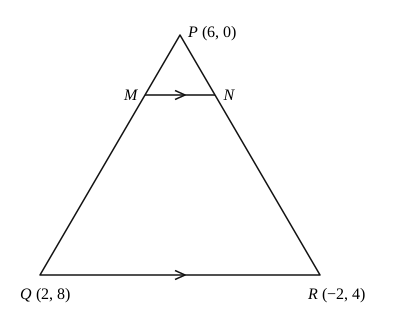
Points P(6, 0), Q(2, 8) and R(−2, 4) are vertices of △PQR. It is given that MN ∥ QR such that MQPM=31. Using distance formula and ratio formula, show that QRMN=41.
Show answer & solution
Answer: Proved: M(5, 2), N(4, 1), MN =2, QR =42, so QRMN=41.
M divides PQ in 1 : 3: M=(41×2+3×6,41×8+3×0)=(5,2)
Two poles of equal heights are standing opposite each other on either side of the road, which is 80 m wide. From a point between them on the road, the angles of elevation of the top of the poles are 60∘ and 30∘ respectively. Find the height of the poles and the distance of the point from the poles.
Show answer & solution
Answer: Height =203 m (≈34.64 m); the point is 20 m from one pole and 60 m from the other.
Let each pole have height h m and let the point be x m from the pole whose top is seen at 60°; it is (80 − x) m from the other pole.
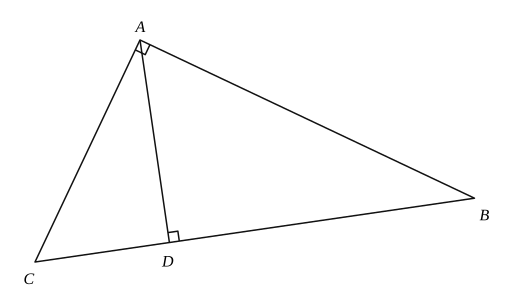
In the given figure, △ABC is right angled triangle with ∠A=90∘. AD is perpendicular to BC. Prove that : (i) △DBA∼△DAC (ii) DA2=DB×DC (iii) Find the area of △ABC when DB = 9 cm and DC = 16 cm.
Show answer & solution
Answer: (i) Proved. (ii) Proved. (iii) 150 cm2
(i) In △DBA and △DAC: ∠ADB=∠CDA=90∘.
∠DBA=90∘−∠DAB=∠DAC (since ∠DAB+∠DAC=90∘).
So △DBA∼△DAC (AA).
(ii) Corresponding sides are proportional: DADB=DCDA, so DA2=DB×DC.
(iii) DA2=9×16=144, so DA = 12 cm; BC = 9 + 16 = 25 cm.
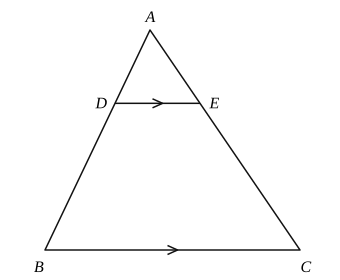
If a line is drawn parallel to one side of a triangle to intersect the other two sides in distinct points, then prove that the other two sides are divided in the same ratio.
Show answer & solution
Answer: Proved.
Given: In △ABC, DE ∥ BC with D on AB and E on AC. To prove: DBAD=ECAE.
Construction: join BE and CD; draw EN ⊥ AB and DM ⊥ AC.
ar(ADE) =21×AD×EN and ar(BDE) =21×DB×EN, so ar(BDE)ar(ADE)=DBAD.
Similarly, ar(DEC)ar(ADE)=ECAE.
Triangles BDE and DEC are on the same base DE and between the same parallels DE and BC, so ar(BDE) = ar(DEC).
ABCD is a rectangle of dimensions 80 cm × 60 cm. Another rectangle PQRS is drawn inside ABCD leaving space of equal width x cm along the edges of ABCD. If area PQRS is half of the area ABCD, then find the value of x.
A train covers a distance of 90 km at a uniform speed. Had the speed been 15 km/h more, it would have taken 30 minutes less for the same journey. Find the original speed of the train.
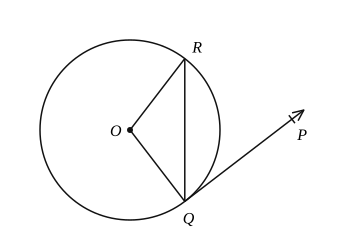
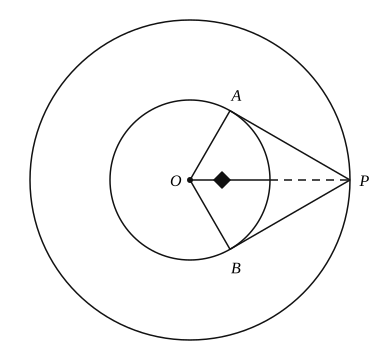
In a circular museum hall of radius 14 m, some statues are displayed. Statues are kept inside the inner concentric circle of radius 7 m. One such statue lying in sector OAB, is fenced along line segments OA, AP, PB and BO where P is a point on outer circle. Based on above information, answer the following questions : (i) Find m∠AOP. (1) (ii) Prove that △OAP≅△OBP. (1) (iii) (a) Find the length of fencing required to protect the statue. (Take 3 = 1.73) (2) OR (b) Find area of quadrilateral OAPB. (Take 3 = 1.73)
Show answer & solution
Answer: (i) 60∘ (ii) Proved (iii) (a) 38.22 m OR (b) 84.77 m2
(i) PA is a tangent to the inner circle, so ∠OAP=90∘. OA = 7 m, OP = 14 m.
cos∠AOP=OPOA=147=21, so ∠AOP=60∘.
(ii) In △OAP and △OBP: OA = OB (radii), PA = PB (tangents from an external point), OP is common. So △OAP≅△OBP (SSS).
(iii)(a) AP=142−72=147=73 m = PB
Fencing =OA+AP+PB+BO=7+73+73+7=14+143=14+24.22=38.22 m
(iii)(b) Area of OAPB =2×21×OA×AP=7×73=493=49×1.73=84.77 m2
Seema daily goes to a park to exercise on machines available there. When Seema spent 15 minutes on exercise bicycle and 30 minutes on double cross walker, she received a message of burning 435 calories on her fitness watch. When she spent 30 minutes on exercise bicycle and 40 minutes on double cross walker, she received a message of burning 690 calories. To find the number of calories burned per minute on each machine, answer the following : (i) Represent the above situation in terms of a pair of linear equations in two variables. (ii) Show that the equations have unique solution. (iii) (a) Solve both equations to find the values of the variables using elimination method. OR (b) Solve both equations to find the values of the variables using substitution method.
Show answer & solution
Answer: (i) 15x+30y=435 and 30x+40y=690, i.e. x+2y=29 and 3x+4y=69, where x and y are calories burned per minute on the exercise bicycle and the double cross walker (ii) a2a1=31=b2b1=21, so a unique solution (iii) x=11, y=9 (by either method)
(i) Let x and y be the calories burned per minute on the exercise bicycle and the double cross walker.
15x+30y=435⇒x+2y=29; 30x+40y=690⇒3x+4y=69
(ii) For x+2y=29 and 3x+4y=69: a2a1=31, b2b1=42=21; these are unequal, so the pair has a unique solution.
(iii)(a) Elimination: multiply x+2y=29 by 2: 2x+4y=58. Subtract from 3x+4y=69: x=11. Then 2y=29−11=18, y=9.
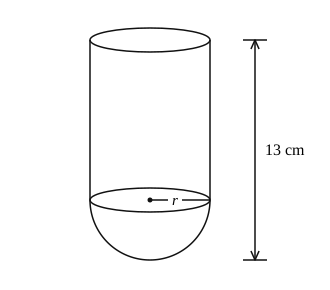
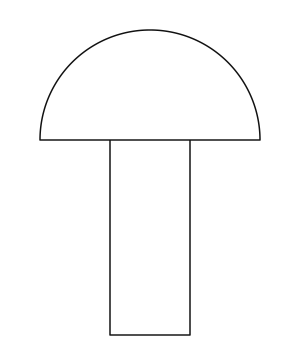
There are many varieties of mushrooms available in the world. One such mushroom ‘Amanita muscaria’ has a upper part which is like red cap (hemispherical) and lower part is like white stem (cylinderical). The hemispherical cap’s radius = 3 cm and cylindrical stem is 2 cm high with diameter 1.4 cm. Considering mushroom a solid object, answer the following questions : (i) What is the total height of a mushroom ? (ii) Find the volume of the stem. (iii) (a) Determine the volume of 7 such mushrooms. OR (b) Find the total surface area of 7 such mushrooms.
Show answer & solution
Answer: (i) 5 cm (ii) 3.08 cm3 (iii) (a) 417.56 cm3 OR (b) 655.6 cm2
(i) Total height = radius of cap + height of stem = 3 + 2 = 5 cm.
(ii) Stem radius = 0.7 cm. Volume =πr2h=722×0.7×0.7×2=3.08 cm3
(iii)(a) Volume of cap =32πR3=32×722×27=7396 cm3
Volume of 7 mushrooms =7×(7396+3.08)=396+21.56=417.56 cm3
(iii)(b) Surface of one mushroom = curved surface of cap (2πR2) + flat underside of cap not covered by stem (πR2−πr2) + curved surface of stem (2πrh) + base of stem (πr2)=3πR2+2πrh