Two dice are rolled together. Find the probability that (i) in the obtained outcomes one number is twice the another. (ii) both the numbers obtained are greater than 4.
Show answer & solution
Answer: (i) 61 (ii) 91
Total outcomes = 36.
(i) Favourable: (1, 2), (2, 1), (2, 4), (4, 2), (3, 6), (6, 3), i.e. 6 outcomes; P = 366=61.
(ii) Both numbers from {5, 6}: (5, 5), (5, 6), (6, 5), (6, 6), i.e. 4 outcomes; P = 364=91.
Two dice of different colours are thrown at the same time. Write down all the possible outcomes. What is the probability that : (i) same number appears on both the dice ? (ii) different number appears on both the dice ?
Show answer & solution
Answer: 36 outcomes; (i) 61 (ii) 65
Outcomes are ordered pairs (a,b) with a,b∈{1,2,3,4,5,6}: (1, 1), (1, 2), ..., (6, 6), i.e. 6×6=36 outcomes.
(i) Same number: (1, 1), (2, 2), (3, 3), (4, 4), (5, 5), (6, 6), i.e. 6 outcomes. P = 366=61.
(ii) Different numbers: 36−6=30 outcomes. P = 3630=65.
Two different coins are tossed simultaneously. What is the probability of getting : (i) at least one head ? (ii) at most one tail ? (iii) a head and a tail ?
Two dice are thrown at the same time. Determine the probability that the (i) sum of the numbers on the two dice is 5, and (ii) difference of the numbers on the two dice is 3.
Show answer & solution
Answer: (i) 91 (ii) 61
Total outcomes = 36.
(i) Sum 5: (1, 4), (2, 3), (3, 2), (4, 1), i.e. 4 outcomes. P =364=91
(ii) Difference 3: (1, 4), (4, 1), (2, 5), (5, 2), (3, 6), (6, 3), i.e. 6 outcomes. P =366=61
A bag contains 30 balls out of which ‘m’ number of balls are blue in colour. (i) Find the probability that a ball drawn at random from the bag is not blue. (ii) If 6 more blue balls are added in the bag, then the probability of drawing a blue ball will be 45 times the probability of drawing a blue ball in the first case. Find the value of m.
A lot consists of 200 pens of which 180 are good and the rest are defective. A customer will buy a pen if it is not defective. The shopkeeper draws a pen at random and gives it to the customer. What is the probability that the customer will not buy it ? Another lot of 100 pens containing 80 good pens is mixed with the previous lot of 200 pens. The shopkeeper now draws one pen at random from the entire lot and gives it to the customer. What is the probability that the customer will buy the pen ?
Show answer & solution
Answer:101; 1513
Defective pens in the first lot =200−180=20.
P(customer will not buy) =20020=101.
After mixing: total pens =300, good pens =180+80=260.
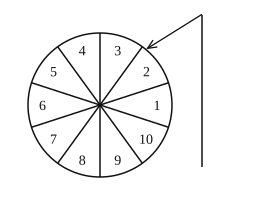
A game of chance consists of spinning a wheel which comes to rest at one of the numbers from 1 to 10 (as shown in the given figure) with equal probabilities. What is the probability that the wheel stops at (i) a prime number greater than 2 ? (ii) an odd number less than 9 ? (iii) a multiple of 4 ?
Show answer & solution
Answer: (i) 103 (ii) 52 (iii) 51
Total equally likely outcomes = 10.
(i) Primes greater than 2: 3, 5, 7. P =103.
(ii) Odd numbers less than 9: 1, 3, 5, 7. P =104=52.
A box contains 6 blue, 4 white and 8 red marbles. A marble is drawn at random from this box. Find the probability that the marble so drawn is : (i) white (ii) white or red (iii) not red
Two dice are rolled together. Find the probability of getting : (i) a multiple of 2 on one and a multiple of 3 on the other die. (ii) the product of two numbers on the top of the two dice is a perfect square number.
Show answer & solution
Answer: (i) 3611 (ii) 92
Total outcomes =36.
(i) Multiples of 2: 2, 4, 6. Multiples of 3: 3, 6.
First die a multiple of 2 and second a multiple of 3: 3×2=6 outcomes: (2,3), (2,6), (4,3), (4,6), (6,3), (6,6).
First die a multiple of 3 and second a multiple of 2: 6 outcomes: (3,2), (3,4), (3,6), (6,2), (6,4), (6,6).
(6,6) is counted twice, so favourable outcomes =6+6−1=11. P=3611.
(ii) Product is a perfect square: (1,1), (2,2), (3,3), (4,4), (5,5), (6,6), (1,4), (4,1), i.e. 8 outcomes.
If 65% of the population has black eyes, 25% have brown eyes and the remaining have blue eyes, what is the probability that a person selected at random has : (a) blue eyes ? (b) brown or black eyes ?
All face cards of spades are removed from a pack of 52 playing cards and the remaining pack is shuffled well. A card is then drawn at random from the remaining pack. Find the probability of getting : (a) a face card (b) an ace or a jack
Show answer & solution
Answer: (a) 499 (b) 71
Face cards of spades (J, Q, K) removed: 52−3=49 cards remain.
(a) Face cards left =12−3=9, so P=499.
(b) Aces =4, jacks left =3; favourable =7, so P=497=71.
All the kings and queens are removed from a deck of 52 playing cards. Remaining cards are well shuffled and then a card is drawn at random. Find the probability that the drawn card is (a) an ace of hearts (b) a black card (c) a jack of spades
One card is drawn at random from a well-shuffled deck of 52 playing cards. Find the probability that the card drawn is : (i) a red king. (ii) not a black card. (iii) an ace of hearts.
Show answer & solution
Answer: (i) 261 (ii) 21 (iii) 521
Total outcomes = 52.
(i) Red kings = 2, so P=522=261.
(ii) Cards that are not black = 26 red cards, so P=5226=21.
From a well-shuffled deck of 52 playing cards, all black queens and red kings are removed. One card is selected at random from the remaining cards. Find the probability that the selected card is : (i) an ace. (ii) a jack of red colour. (iii) a king of spade.
Show answer & solution
Answer: (i) 121 (ii) 241 (iii) 481
Removed cards: 2 black queens and 2 red kings, so 52 − 4 = 48 cards remain.
(i) All 4 aces remain: P=484=121.
(ii) Red jacks = 2: P=482=241.
(iii) The king of spades remains (only red kings were removed): P=481.
A box contains 90 discs which are numbered 1 to 90. If one disc is drawn at random from the box, find the probability that it bears a : (i) 2-digit number less than 40. (ii) number divisible by 5 and greater than 50. (iii) a perfect square number.
Show answer & solution
Answer: (i) 31 (ii) 454 (iii) 101
Total outcomes = 90.
(i) 2-digit numbers less than 40 are 10 to 39: 30 numbers. P = 9030=31.
(ii) Multiples of 5 greater than 50: 55, 60, 65, 70, 75, 80, 85, 90 (8 numbers). P = 908=454.
Three unbiased coins are tossed simultaneously. Find the probability of getting : (i) at least one head. (ii) exactly one tail. (iii) two heads and one tail.
A jar contains 54 marbles, each of which is blue, green or white. The probability of selecting a blue marble at random from the jar is 31, and the probability of selecting a green marble at random is 94. How many white marbles does this jar contain ?