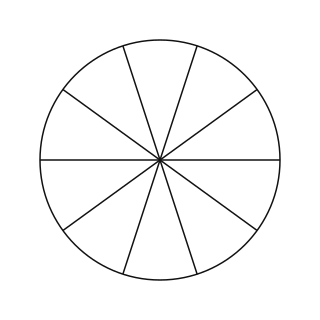
A brooch is crafted from silver wire in the shape of a circle with a diameter of 35 cm. The wire is also used to create 5 diameters, dividing the circle into 10 equal sectors as shown in figure. Based on the above information, answer the following questions : (i) What is the radius of circle ? (1) (ii) What is the circumference of the brooch ? (1) (iii) (a) What is the total length of silver wire required ? (2) OR (iii) (b) What is the area of each sector of the brooch ? (2)
Show answer & solution
Answer: (i) 17.5 cm (ii) 110 cm (iii) (a) 285 cm OR (b) 96.25 cm2
(i) Radius =235=17.5 cm.
(ii) Circumference =πd=722×35=110 cm.
(iii) (a) Wire = circumference + 5 diameters =110+5×35=285 cm.
(iii) (b) Each sector has central angle 36∘, i.e. 101 of the circle.
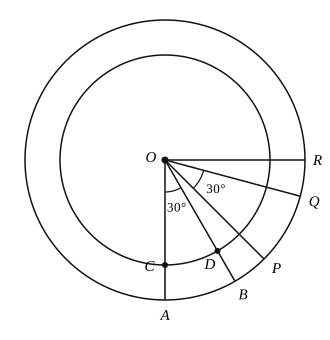
A farmer has put up a decorative windmill in his farm in which there are eight blades of equal width and equally placed in a circular arrangement. A circular wire goes through them. The diagram shows two blades OAB and OPQ in a quarter circle with centre O. ∠AOB=∠POQ=30∘, OA = 28 cm, OC = 21 cm. O is the centre of both the circles. (i) Determine the measure of ∠BOP. (1) (ii) Find length of arc CD. (1) (iii) (a) Find the area of region CABD. (2) OR (iii) (b) Find perimeter of region CABD. (2)
Show answer & solution
Answer: (i) 15∘ (ii) 11 cm (iii) (a) 6539 cm2≈89.83 cm2 OR (b) 3119 cm ≈39.67 cm
(i) The quarter circle AOR is 90∘; the two blades take 30∘+30∘=60∘. The blades are equally placed, so the remaining 30∘ is shared equally by ∠BOP and ∠QOR: ∠BOP=15∘ (check: 8 blades of 30∘ and 8 equal gaps of 15∘ make 360∘).
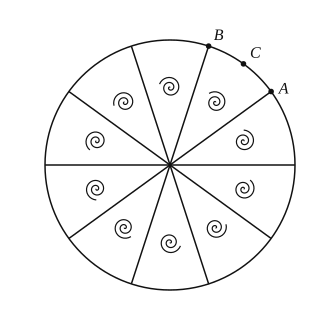
A brooch is a decorative piece often worn on clothing like jackets, blouses or dresses to add elegance. Made from precious metals and decorated with gemstones, brooches come in many shapes and designs. One such brooch is made with silver wire in the form of a circle with diameter 35 mm. The wire is also used in making 5 diameters which divide the circle into 10 equal sectors as shown in the figure. Based on the above given information, answer the following questions : (i) Find the central angle of each sector. (1) (ii) Find the length of the arc ACB. (1) (iii) (a) Find the area of each sector of the brooch. (2) OR (iii) (b) Find the total length of the silver wire used. (2)
Show answer & solution
Answer: (i) 36∘ (ii) 11 mm (iii) (a) 96.25 mm2 OR (iii) (b) 285 mm
Radius r=235=17.5 mm; circumference =2×722×17.5=110 mm.
(i) Central angle of each sector =10360∘=36∘.
(ii) Arc ACB is the arc of one sector: length =36036×110=11 mm.
(iii) (a) Area of each sector =36036×722×(17.5)2=101×962.5=96.25 mm2.
(iii) (b) Wire = circumference +5 diameters =110+5×35=110+175=285 mm.
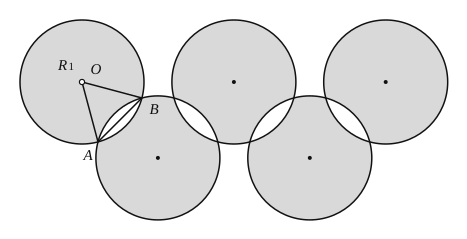
The Olympic symbol comprising five interlocking rings represents the union of the five continents of the world and the meeting of athletes from all over the world at the Olympic games. In order to spread awareness about Olympic games, students of Class-X took part in various activities organised by the school. One such group of students made 5 circular rings in the school lawn with the help of ropes. Each circular ring required 44 m of rope. Also, in the shaded regions as shown in the figure, students made rangoli showcasing various sports and games. It is given that △OAB is an equilateral triangle and all unshaded regions are congruent. Based on above information, answer the following questions : (i) Find the radius of each circular ring. (1) (ii) What is the measure of ∠AOB ? (1) (iii) (a) Find the area of shaded region R1. (2) OR (iii) (b) Find the length of rope around the unshaded regions. (2)
Show answer & solution
Answer: (i) 7 m (ii) 60∘ (iii) (a) (3308+2493) m2≈145.1 m2 OR (iii) (b) 3176 m ≈58.67 m
(i) 2πr=44⇒r=44×447=7 m
(ii) △OAB is equilateral, so ∠AOB=60∘
(iii)(a) Each unshaded region (lens) is made of two congruent segments with chord AB = 7 m subtending 60∘.
Segment area =36060×722×49−43×49=377−4493
Lens area =3154−2493
R1 = circle − lens =154−3154+2493=3308+2493≈102.67+42.44=145.1 m2
(iii)(b) Each lens is bounded by two arcs of 60∘: length =2×36060×44=344 m
There are 4 unshaded regions: total =4×344=3176≈58.67 m
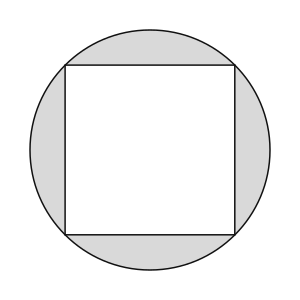
A farmer has a circular piece of land. He wishes to construct his house in the form of largest possible square within the land as shown below. The radius of circular piece of land is 35 m. Based on given information, answer the following questions : (i) Find the length of wire needed to fence the entire land. (1) (ii) Find the length of each side of the square land on which house will be constructed. (1) (iii) (a) The farmer wishes to grow grass on the shaded region around the house. Find the cost of growing the grass at the rate of ₹ 50 per square metre. (2) OR (iii) (b) Find the ratio of area of land on which house is built to remaining area of circular piece of land. (2)
Show answer & solution
Answer: (i) 220 m (ii) 352 m (iii)(a) ₹ 70000 OR (iii)(b) 7 : 4
(i) Length of wire =2πr=2×722×35=220 m
(ii) Diagonal of square = diameter = 70 m, so side =270=352 m
(iii)(a) Area of circle =722×352=3850 m2; area of square =(352)2=2450 m2
Shaded area =3850−2450=1400 m2; cost =1400×50= ₹ 70000
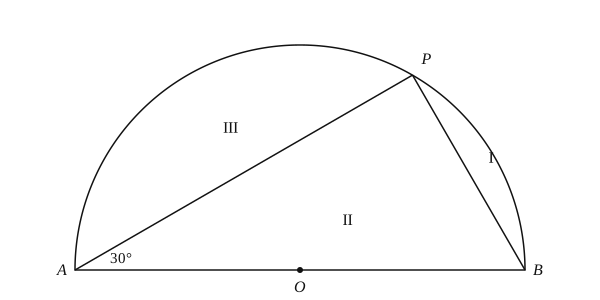
Anurag purchased a farmhouse which is in the form of a semicircle of diameter 70 m. He divides it into three parts by taking a point P on the semicircle in such a way that ∠PAB=30∘ as shown in the following figure, where O is the centre of semicircle. In part I, he planted saplings of Mango tree, in part II, he grew tomatoes and in part III, he grew oranges. Based on given information, answer the following questions. (i) What is the measure of ∠POA ? (1) (ii) Find the length of wire needed to fence entire piece of land. (1) (iii) (a) Find the area of region in which saplings of Mango tree are planted. (2) OR (iii) (b) Find the length of wire needed to fence the region III. (2)
Show answer & solution
Answer: (i) 120∘ (ii) 180 m (iii) (a) (31925−412253) m2≈111.24 m2 OR (iii) (b) (3220+353) m ≈133.96 m
(i) ∠POB=2∠PAB=60∘ (angle at centre), so ∠POA=180∘−60∘=120∘.
(ii) r=35 m. Fence = semicircular arc + diameter =722×35+70=110+70=180 m.
(iii) (a) Part I is the segment cut off by chord PB, with ∠POB=60∘.
Sector area =36060×722×352=31925≈641.67 m2
△POB is equilateral: area =43×352=412253≈530.43 m2
Area of part I ≈641.67−530.43=111.24 m2
(iii) (b) Region III is bounded by chord AP and arc AP, with ∠AOP=120∘.
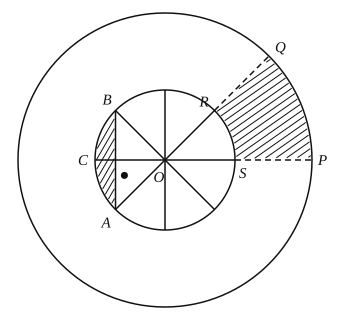
NSS (National Service Scheme) aims to connect the students to the community and to involve them in problem solving process. NSS symbol is based on the ‘Rath’ wheel of the Konark Sun Temple situated in Odisha. The wheel signifies the progress cycle of life. The diagramatic representation of the symbol is given below : Observe the figure given above. The diameters of inner circle are equally placed. Given that OP = 21 cm, OS = 10 cm. Based on the above information, answer the following questions : (i) Find m∠ROS. (1) (ii) Find the perimeter of sector OPQ. (1) (iii) Find the area of shaded region PQRS. (2) OR Find the area of shaded region ACB i.e. the segment ACB. (2)
Show answer & solution
Answer: (i) 45∘ (ii) 58.5 cm (iii) 283751≈133.96 cm2; OR 7200≈28.57 cm2
(i) Four equally placed diameters make 8 equal angles: ∠ROS=8360∘=45∘.
(ii) Arc PQ =36045×2×722×21=16.5 cm; perimeter =21+21+16.5=58.5 cm.
(iii) Area PQRS =36045×722×(212−102)=81×722×341=283751≈133.96 cm2.
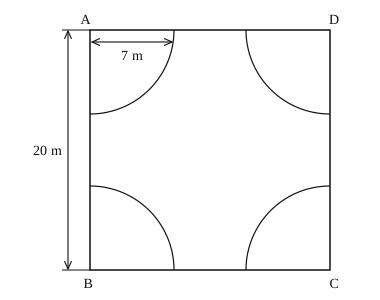
A stable owner has four horses. He usually tie these horses with 7 m long rope to pegs at each corner of a square shaped grass field of 20 m length, to graze in his farm. But tying with rope sometimes results in injuries to his horses, so he decided to build fence around the area so that each horse can graze. Based on the above, answer the following questions : (i) Find the area of the square shaped grass field. (1) (ii) Find the area of the total field in which these horses can graze. (2) OR If the length of the rope of each horse is increased from 7 m to 10 m, find the area grazed by one horse. (Use π = 3.14) (2) (iii) What is area of the field that is left ungrazed, if the length of the rope of each horse is 7 cm ? (1)
Show answer & solution
Answer: (i) 400 m2 (ii) 154 m2; OR 78.5 m2 (iii) 399.9846 m2 as printed (7 cm); 246 m2 if the rope is 7 m
(i) Area of the square = 20×20=400 m2.
(ii) Each horse grazes a quadrant of radius 7 m; four quadrants make one full circle: 722×72=154 m2.
OR: Area grazed by one horse = 41×3.14×102=78.5 m2.
(iii) With a 7 cm = 0.07 m rope, grazed area = 722×0.072=0.0154 m2, so ungrazed area = 400−0.0154=399.9846 m2.
If the rope is 7 m (as in the passage), ungrazed area = 400−154=246 m2.
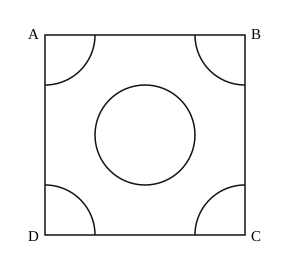
Interschool Rangoli Competition was organized by one of the reputed schools of Odissa. The theme of the Rangoli Competition was Diwali celebrations where students were supposed to make mathematical designs. Students from various schools participated and made beautiful Rangoli designs. One such design is given below. Rangoli is in the shape of square marked as ABCD, side of square being 40 cm. At each corner of a square, a quadrant of circle of radius 10 cm is drawn (in which diyas are kept). Also a circle of diameter 20 cm is drawn inside the square. (i) What is the area of square ABCD ? (1) (ii) Find the area of the circle. (1) (iii) If the circle and the four quadrants are cut off from the square ABCD and removed, then find the area of remaining portion of square ABCD. (2) OR (iii) Find the combined area of 4 quadrants and the circle, removed. (2)
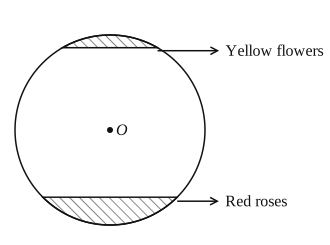
Flower beds look beautiful growing in gardens. One such circular park of radius ‘r’ m, has two segments with flowers. One segment which subtends an angle of 90∘ at the centre is full of red roses, while the other segment with central angle 60∘ is full of yellow coloured flowers. [See figure] It is given that the combined area of the two segments (of flowers) is 25632 sq m. Based on the above, answer the following questions : (i) Write an equation representing the total area of the two segments in terms of ‘r’. (1) (ii) Find the value of ‘r’. (1) (iii) (a) Find the area of the segment with red roses. (2) OR (iii) (b) Find the area of the segment with yellow flowers. (2)
Show answer & solution
Answer: (i) 36090πr2+36060πr2=25632 (ii) r = 14 m (iii) (a) 154 m2 OR (iii) (b) 10232 m2
The given total works out only if the flower regions are taken as the regions with central angles 90∘ and 60∘ (sector areas), which is the intended reading.
(i) 36090πr2+36060πr2=25632, i.e. 125πr2=3770
(ii) 125×722×r2=3770, so r2=3×110770×84=196 and r = 14 m
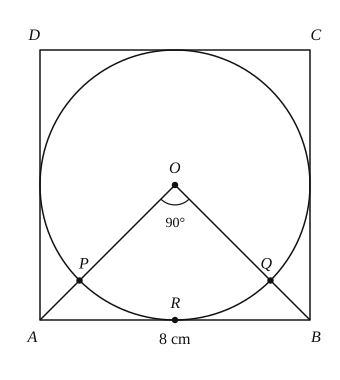
For the inauguration of ‘Earth day’ week in a school, badges were given to volunteers. Organisers purchased these badges from an NGO, who made these badges in the form of a circle inscribed in a square of side 8 cm. O is the centre of the circle and ∠AOB=90∘ : Based on the above information, answer the following questions : (i) What is the area of square ABCD ? (1) (ii) What is the length of diagonal AC of square ABCD ? (1) (iii) Find the area of sector OPRQO. (2) OR (iii) Find the area of remaining part of square ABCD when area of circle is excluded. (2)
Show answer & solution
Answer: (i) 64 cm2 (ii) 82 cm (iii) 788 cm2≈12.57 cm2 OR (iii) 796 cm2≈13.71 cm2
(i) Area =8×8=64 cm2.
(ii) AC=82+82=82 cm.
(iii) Radius of circle =28=4 cm, angle =90∘. Area of sector =36090×722×42=788≈12.57 cm2.
OR (iii) Area of circle =722×16=7352 cm2. Remaining area =64−7352=796≈13.71 cm2.
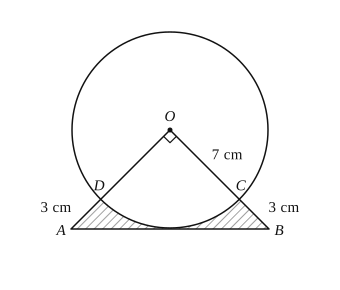
In an annual day function of a school, the organizers wanted to give a cash prize along with a memento to their best students. Each memento is made as shown in the figure and its base ABCD is shown from the front side. The rate of silver plating is ₹ 20 per cm². Based on the above, answer the following questions : (i) What is the area of the quadrant ODCO ? (1) (ii) Find the area of △AOB. (1) (iii) (a) What is the total cost of silver plating the shaded part ABCD ? (2) OR (iii) (b) What is the length of arc CD ? (2)
Show answer & solution
Answer: (i) 38.5 cm² (ii) 50 cm² (iii) (a) ₹ 230 OR (b) 11 cm
(i) Area of quadrant =41×722×72=38.5 cm²
(ii) OA = OB = 7 + 3 = 10 cm and ∠AOB=90∘, so area =21×10×10=50 cm²
(iii)(a) Shaded area =50−38.5=11.5 cm²; cost =11.5×20=₹230
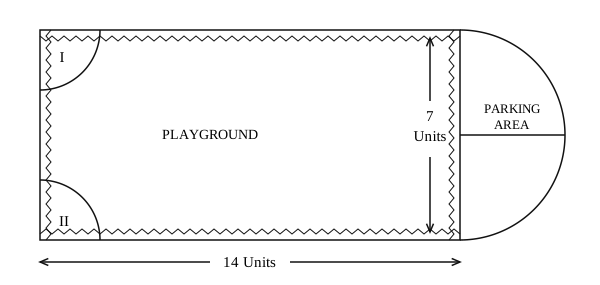
Governing council of a local public development authority of Dehradun decided to build an adventurous playground on the top of a hill, which will have adequate space for parking. After survey, it was decided to build rectangular playground, with a semi-circular area allotted for parking at one end of the playground. The length and breadth of the rectangular playground are 14 units and 7 units, respectively. There are two quadrants of radius 2 units on one side for special seats. Based on the above information, answer the following questions : (i) What is the total perimeter of the parking area ? (1) (ii) (a) What is the total area of parking and the two quadrants ? (2) OR (b) What is the ratio of area of playground to the area of parking area ? (2) (iii) Find the cost of fencing the playground and parking area at the rate of ₹ 2 per unit. (1)
Show answer & solution
Answer: (i) 18 units (ii) (a) 28715≈25.54 sq units OR (b) 56 : 11 (iii) ₹92
Parking area is a semicircle of diameter 7 units, radius 27 units.
(i) Perimeter =πr+2r=722×27+7=11+7=18 units
(ii) (a) Parking area =21×722×449=477=19.25 sq units
Two quadrants =2×41×722×22=744≈6.29 sq units
Total =477+744=28715≈25.54 sq units
(ii) (b) Playground area =14×7=98; ratio =98:477=392:77=56:11
(iii) Outer boundary =14+7+14+11=46 units (the side shared with the parking area is not fenced)