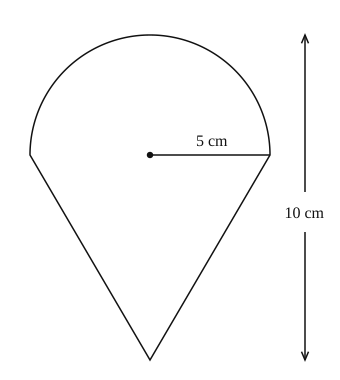
A toy is in the form of a cone surmounted on a hemisphere. The cone and hemisphere have the same radii. The height of the conical part of the toy is equal to the diameter of its base. If the radius of the conical part is 5 cm, find the volume of the toy.
A cubical block is surmounted by a hemisphere of radius 3.5 cm. What is the smallest possible length of the edge of the cube so that the hemisphere can totally lie on the cube ? Find the total surface area of the solid so formed.
Show answer & solution
Answer: Edge = 7 cm; total surface area = 332.5 cm²
The base of the hemisphere (diameter 7 cm) must fit on a face, so the smallest edge is 7 cm.
TSA = surface of cube − base of hemisphere + CSA of hemisphere =6a2−πr2+2πr2=6a2+πr2.
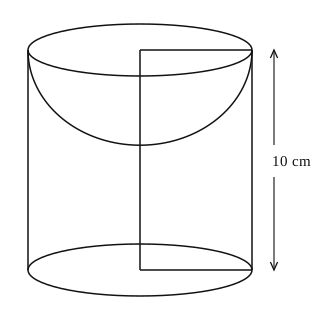
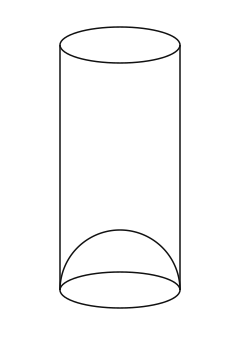
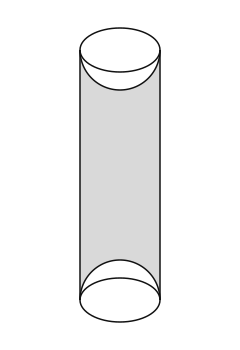
A wooden article was made by scooping out a hemisphere (of same diameter) from one end of a solid cylinder as shown in the given figure. If the height of the cylinder is 10 cm and the diameter of the cylinder is 14 cm, find the total surface area of the remaining wooden article. (Use π=722)
Show answer & solution
Answer: 902 cm2
Radius r = 7 cm, height h = 10 cm.
TSA = curved surface of cylinder + area of the bottom base + inner curved surface of hemisphere.
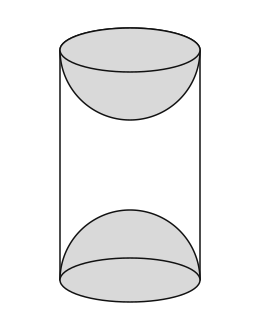
A hemispherical depression is scooped out from the top face of a wooden cubical block of side 14 cm. If the diameter of the hemisphere is equal to the side of the cube, find the total surface area of the remaining solid block. (Use π=722)
Show answer & solution
Answer: 1330 cm2
Side of cube a = 14 cm; radius of hemisphere r = 7 cm.
TSA = surface area of cube – area of circular top removed + inner curved surface of hemisphere.
A spherical glass vessel has a cylindrical neck which is 7 cm long and 2 cm in diameter. The diameter of the spherical part is 14 cm. Find the capacity of the entire glass vessel. (Use π=722)
Show answer & solution
Answer:34378 cm3 (about 1459.33 cm3)
Sphere: radius R = 7 cm. Volume =34×722×73=34×22×49=34312 cm3.
Neck (cylinder): radius r = 1 cm, h = 7 cm. Volume =722×12×7=22 cm3.
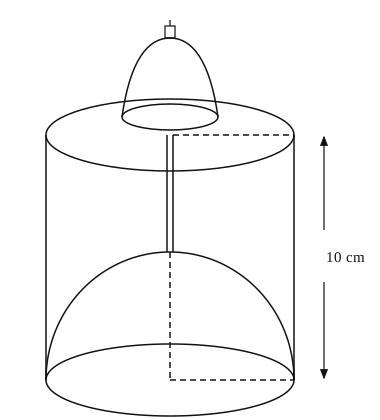
A perfume bottle is in the form of a cylinder but the bottom of the bottle has a hemispherical raised portion to reduce the capacity of the bottle. The inner diameter of the bottle is 5 cm and the height of the bottle is 10 cm. Find the capacity of the perfume bottle in mL. (Use π=3.14 and 1 cm3 = 1 mL)
Show answer & solution
Answer:≈163.54 mL
Radius r=2.5 cm, height h=10 cm.
Volume of cylinder =πr2h=3.14×6.25×10=196.25cm3.
Volume of hemisphere =32πr3=32×3.14×15.625≈32.71cm3.
From a solid wooden cylinder of height 10 cm and radius 14 cm, a cylinder of radius 7 cm and height 5 cm is scooped out to form a cavity inside the solid cylinder. Find the total surface area of the remaining solid.
Show answer & solution
Answer: 2332 cm2
The cavity is cut from one circular face, so that face loses a circle of radius 7 cm but the cavity floor adds an equal circle back.
TSA = curved surface of big cylinder + 2 circular faces of big cylinder + curved surface of cavity.
Curved surface of big cylinder =2πRh=2×722×14×10=880cm2.
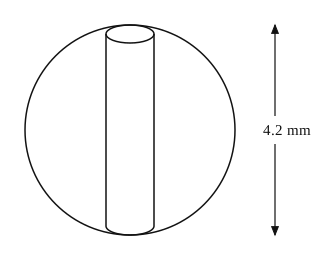
A necklace is made up of wooden beads. Each bead is in the form of a sphere of diameter 4.2 mm. A cylinder is hollowed out from each bead. If the radius of the cylinder is 1 mm, find the volume of wood left in each bead.
Show answer & solution
Answer: 25.608 mm3
Radius of sphere R=2.1 mm; the cylinder has radius r=1 mm and, as in the figure, height h=4.2 mm.
Volume of sphere =34πR3=34×722×2.1×2.1×2.1=38.808mm3.
A vessel is in the form of an inverted cone. Its height is 8 cm and the radius of its top, which is open, is 5 cm. It is filled with water up to the brim. When lead shots, each of which is a sphere of radius 0.5 cm, are dropped into the vessel, one-fourth of the water flows out. Find the number of lead shots dropped in the vessel.
Show answer & solution
Answer: 100
Volume of cone =31πr2h=31π(5)2(8)=3200π cm3.
Water that flows out =41×3200π=350π cm3 = total volume of lead shots.
A solid toy is in the form of a hemisphere surmounted by a right circular cone. The height of the cone is 2 cm and the diameter of the base is 4 cm. Determine the volume of the toy. Also, find the surface area of the toy. (Take π=3.14)
Show answer & solution
Answer: Volume =8π=25.12 cm3; surface area =4π(2+2)≈42.88 cm2
Radius of hemisphere = radius of cone =r=2 cm; height of cone h=2 cm.
A wooden cubical die is formed by forming hemispherical depressions on each face of the cube such that face 1 has one depression, face 2 has two depressions and so on. The sum of number of hemispherical depressions on opposite faces is always 7. If the edge of the cubical die measures 5 cm and each hemispherical depression is of diameter 1.4 cm, find the total surface area of the die so formed.
Show answer & solution
Answer:182.34 cm2
Total depressions =1+2+3+4+5+6=21; radius r=0.7 cm
Each depression removes a circle of area πr2 and adds a hemispherical surface 2πr2: net gain πr2
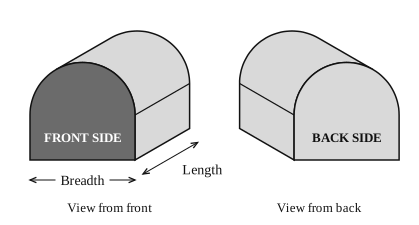
In order to provide shelter to flood victims, a shed was constructed using tin sheets which is in the form of cuboid surmounted by a half cylinder as shown below : The length, breadth and height of cuboidal portion are 10 m, 7 m and 3 m respectively. The diameter of the cylindrical portion is 7 m. Find the cost of tin sheets required to make the shed at the rate of ₹ 70 per square metre, given that the shed is open from the front side and closed from the back side.
Show answer & solution
Answer: ₹ 14,717.50 (tin sheet area 210.25 m2)
Radius of half cylinder r=3.5 m, its length =10 m
Two side walls of cuboid =2×10×3=60 m2
Back wall (rectangular part) =7×3=21 m2
Curved roof =πrl=722×3.5×10=110 m2
Back semicircular part =21πr2=21×722×3.5×3.5=19.25 m2
Total =60+21+110+19.25=210.25 m2 (front open, floor not covered)
A bat manufacturing company made a huge bat for charity and got it signed by world cup winning team. The dimensions of the bat which is in the form of a cuboid with a cylindrical handle at the top are as follows : length = 2 m, width = 0.5 m, thickness = 0.1 m diameter of cylindrical part = 0.1 m height of cylindrical part = 0.7 m Find the volume of wood used in the bat. Also, find the total surface area of the wooden bat.
Show answer & solution
Answer: Volume =0.1055 m3; total surface area =2.72 m2
Cuboid volume =2×0.5×0.1=0.1 m3
Cylinder: r=0.05 m, h=0.7 m; volume =722×0.05×0.05×0.7=0.0055 m3
Volume of wood =0.1+0.0055=0.1055 m3
TSA of cuboid =2(2×0.5+0.5×0.1+2×0.1)=2(1.25)=2.5 m2
The handle's base covers a circle on the cuboid but its top circle adds the same area, so only the curved surface is extra.
Curved surface of cylinder =2×722×0.05×0.7=0.22 m2
From one of the faces of a solid wooden cube of side 14 cm, maximum number of hemispheres of diameter 1.4 cm are scooped out. Find the total number of hemispheres that can be scooped out. Also, find the total surface area of the remaining solid.
Show answer & solution
Answer: 100 hemispheres; total surface area =1330 cm2
Along one edge: 1.414=10 hemispheres, so on one face 10×10=100 hemispheres.
Radius r=0.7 cm.
Surface area of cube =6×142=1176 cm2
Each hemisphere removes a circle πr2 and adds a curved surface 2πr2: net gain πr2=722×0.49=1.54 cm2
Total surface area =1176+100×1.54=1176+154=1330 cm2
From a solid cylinder of height 24 cm and radius 5 cm, two cones of height 12 cm and radius 5 cm are hollowed out. Find the volume and surface area of the remaining solid.
Show answer & solution
Answer: Volume =400π=78800≈1257.14 cm3; surface area =370π=78140≈1162.86 cm2
From one face of a solid cube of side 14 cm, the largest possible cone is carved out. Find the volume and surface area of the remaining solid. (Use π=722,5=2.2)
Show answer & solution
Answer: Volume =36076≈2025.33 cm3; surface area =1360.8 cm2
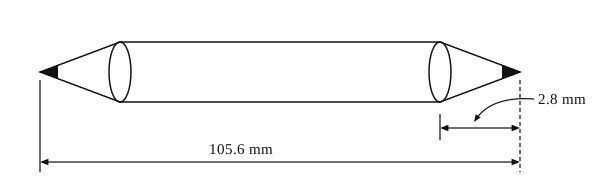
On the day of her examination, Riya sharpened her pencil from both ends as shown below : The diameter of the cylindrical and conical part of the pencil is 4.2 mm. If the height of each conical part is 2.8 mm and length of entire pencil is 105.6 mm, find the total surface area of the pencil.
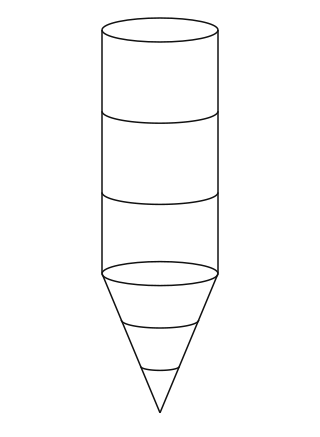
Fermentation tanks are designed in the form of cylinder mounted on a cone as shown below : The total height of the tank is 3.3 m and height of conical part is 1.2 m. The diameter of the cylindrical as well as conical part is 1 m. Find the capacity of the tank. If the level of liquid in the tank is 0.7 m from the top, find the surface area of the tank in contact with liquid.
Show answer & solution
Answer: Capacity =2855 m3≈1.96 m3; surface area in contact =70451 m2≈6.44 m2
r=0.5 m; cone height h=1.2 m; cylinder height H=3.3−1.2=2.1 m
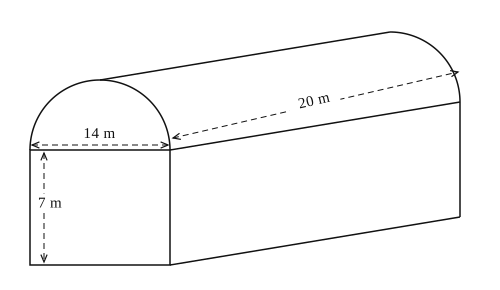
A textile industry runs in a shed. This shed is in the shape of a cuboid surmounted by a half cylinder. If the base of the industry is of dimensions 14 m × 20 m and the height of the cuboidal portion is 7 m, find the volume of air that the industry can hold. Further, suppose the machinery in the industry occupies a total space of 400 m3. Then, how much space is left in the industry ?
Show answer & solution
Answer: Volume of air = 3500 m3; space left = 3100 m3
Volume of cuboid =14×20×7=1960 m3
Half cylinder: radius =7 m, length =20 m. Volume =21×722×7×7×20=1540 m3
From a solid cylinder of height 8 cm and radius 6 cm, a conical cavity of the same height and same radius is carved out. Find the total surface area of the remaining solid. (Take π=3.14)
Show answer & solution
Answer: 602.88 cm2
Slant height of cone l=82+62=10 cm
TSA = curved surface of cylinder + top circular face + curved surface of cone
A solid is in the shape of a cone surmounted on a hemisphere with both their diameters being equal to 7 cm and the height of the cone is equal to its radius. Find the volume of the solid.
A toy is in the form of a cone of radius 7 cm mounted on a hemisphere of same radius. The total height of the toy is 31 cm. Find the surface area of the toy.
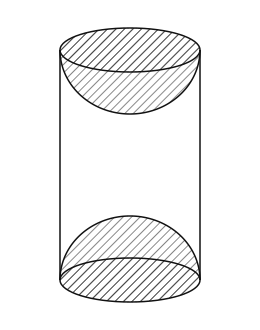
A wooden article was made by scooping out a hemisphere from each end of a solid cylinder. If the height of the cylinder is 15 cm and its base is of radius 4.2 cm, then find the total surface area of the article.
Show answer & solution
Answer: 617.76 cm2
TSA = CSA of cylinder + 2 × CSA of hemisphere.
CSA of cylinder =2πrh=2×722×4.2×15=396 cm2.
2 × CSA of hemisphere =2×2πr2=4×722×4.2×4.2=221.76 cm2.
A vessel is in the form of a hollow hemisphere mounted by a hollow cylinder. The diameter of the hemisphere is 14 cm and the total height of the vessel is 13 cm. Find the inner surface area and the volume of the vessel.
Show answer & solution
Answer: Inner surface area = 572 cm2; volume =34928≈1642.67cm3
Radius r=7 cm; height of cylinder h=13−7=6 cm.
Inner surface area =2πr2+2πrh=2πr(r+h)=2×722×7×13=572cm2.
A solid iron pole consists of a solid cylinder of height 200 cm and base diameter 28 cm, which is surmounted by another cylinder of height 50 cm and radius 7 cm. Find the mass of the pole, given that 1 cm3 of iron has approximately 8 g mass.
Show answer & solution
Answer: 1047200 g = 1047.2 kg
Lower cylinder: r=14 cm, h=200 cm; volume = 722×142×200=123200 cm3.
Upper cylinder: r=7 cm, h=50 cm; volume = 722×72×50=7700 cm3.
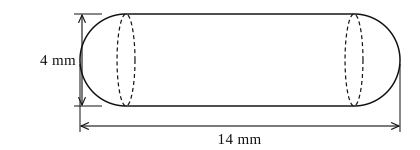
A medicine capsule is in the shape of a cylinder with two hemispheres stuck to each of its ends. The length of the entire capsule is 14 mm and the diameter of the capsule is 4 mm, find its surface area. Also, find its volume.
Show answer & solution
Answer: Surface area = 176 mm2; volume = 213344≈159.24 mm3
Radius r=2 mm; length of the cylindrical part = 14−2−2=10 mm.
Surface area = 2πrh+2×2πr2=2π(2)(10)+4π(2)2=40π+16π=56π.
A wooden article was made by scooping out a hemisphere from each end of a solid cylinder, as shown in the figure. If the height of the cylinder is 5.8 cm and its base is of radius 2.1 cm, find the total surface area of the article.
Show answer & solution
Answer: 132 cm²
TSA = CSA of cylinder + 2 × CSA of hemisphere =2πrh+2(2πr2)=2πr(h+2r).
A tent is in the shape of a cylinder, surmounted by a conical top. If the height and diameter of the cylindrical part are 3.5 m and 6 m, and slant height of the top is 4.2 m, find the area of canvas used for making the tent. Also, find the cost of canvas of the tent at the rate of ₹ 500 per m2.
Show answer & solution
Answer: 105.6 m²; ₹ 52,800
Radius r=3 m, cylinder height h=3.5 m, slant height l=4.2 m.
Canvas = CSA of cylinder + CSA of cone =2πrh+πrl=πr(2h+l).
A juice seller was serving his customers using glasses as shown in the figure. The inner diameter of the cylindrical glass was 5.6 cm, but the bottom of the glass had a hemispherical raised portion which reduced the capacity of the glass. If the height of the glass was 10 cm, find the apparent capacity and the actual capacity of the glass.
A vessel is in the form of a hemispherical bowl surmounted by a hollow cylinder of same diameter. The diameter of the hemispherical bowl is 14 cm and the total height of the vessel is 13 cm. Find the inner surface area of the vessel. Also, find the volume of the vessel.
The sum of the radius of the base and height of a solid right-circular cylinder is 37 cm. If the total surface area of the solid cylinder is 1628 cm², find the volume of the cylinder.
A heap of rice is in the form of a cone of base diameter 24 m and height 27 m. Find the volume of rice. How much canvas cloth is required to just cover the heap ?
Show answer & solution
Answer: Volume = 528 m³; canvas required = 73300 m² ≈ 471.43 m²
Radius r=12 m, height h=27 m.
Volume =31πr2h=31×722×144×27=528 m³
Slant height l=r2+h2=144+449=4625=225 m
Canvas needed = curved surface area =πrl=722×12×225=73300≈471.43 m²
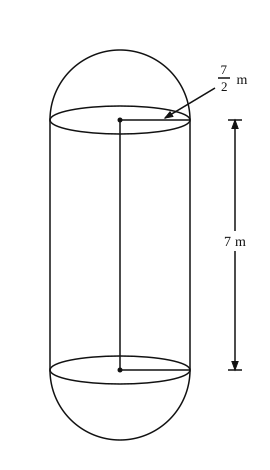
The boilers are used in thermal power plants to store water and then used to produce steam. One such boiler consists of a cylindrical part in middle and two hemispherical parts at its both ends. Length of the cylindrical part is 7m and radius of cylindrical part is 27 m. Find the total surface area and the volume of the boiler. Also, find the ratio of the volume of cylindrical part to the volume of one hemispherical part.
Show answer & solution
Answer: TSA =308 m2; volume =62695≈449.17 m3; ratio =3:1
r=27 m, h=7 m.
TSA = CSA of cylinder + 2 × CSA of hemisphere =2πrh+4πr2.
=2×722×27×7+4×722×449=154+154=308 m2.
Volume of cylinder =πr2h=722×449×7=2539 m3.
Volume of two hemispheres =34πr3=34×722×8343=3539 m3.
A solid is in the shape of a cone standing on a hemisphere with both their diameters being equal to 1 cm and the height of the cone is equal to its radius. Find the volume of the solid. [Use π=3.14]
Show answer & solution
Answer: 0.3925 cm3 (about 0.39 cm3)
Radius r=21=0.5 cm; height of cone h=r=0.5 cm.
Volume of cone =31πr2h=31πr3; volume of hemisphere =32πr3.
Volume of solid =31πr3+32πr3=πr3=3.14×0.125=0.3925 cm3.
A student was asked to make a model shaped like a cylinder with two cones attached to its ends by using a thin aluminium sheet. The diameter of the model is 3 cm and its total length is 12 cm. If each cone has a height of 2 cm, find the volume of air contained in the model.
Show answer & solution
Answer: 66 cm³
Radius r=1.5 cm. Each cone has height 2 cm, so cylinder length =12−2−2=8 cm.
From a solid cylinder of height 20 cm and diameter 12 cm, a conical cavity of height 8 cm and radius 6 cm is hallowed out. Find the total surface area of the remaining solid.
Show answer & solution
Answer: 1056 cm²
Cylinder: r=6 cm, h=20 cm. Cone: r=6 cm, h=8 cm, slant height l=62+82=10 cm.
The cavity is cut from one end, so the remaining solid has: curved surface of cylinder + one base + curved surface of cone.
A wooden article was made by scooping out a hemisphere from each end of a solid cylinder, as shown in the figure. If the height of the cylinder is 10 cm and its base is of radius 3.5 cm, find the total surface area of the article.
Show answer & solution
Answer: 374 cm²
r=3.5 cm, h=10 cm
TSA = CSA of cylinder + CSA of two hemispheres =2πrh+2(2πr2)
A solid is in the shape of a right-circular cone surmounted on a hemisphere, the radius of each of them being 7 cm and the height of the cone is equal to its diameter. Find the volume of the solid.
Show answer & solution
Answer:143731 cm3 (about 1437.33 cm3)
r = 7 cm, height of cone h = 14 cm.
Volume of cone =31πr2h=31×722×49×14=32156 cm3
Volume of hemisphere =32πr3=32×722×343=32156 cm3
A solid is in the shape of a right-circular cone surmounted on a hemisphere, the radius of each of them being 3.5 cm and the total height of the solid is 9.5 cm. Find the volume of the solid.
Show answer & solution
Answer:16665 cm3 (about 166.83 cm3)
r = 3.5 cm; height of cone h = 9.5 – 3.5 = 6 cm.
Volume of cone =31πr2h=31×722×3.5×3.5×6=77 cm3
Volume of hemisphere =32πr3=32×722×3.53=6539=8965 cm3