Assertion (A) : The surface area of the cuboid formed by joining two cubes of sides 4 cm each, end-to-end, is 160 cm2. Reason (R): The surface area of a cuboid of dimensions l×b×h is (lb+bh+hl).
(A)Both Assertion (A) and Reason (R) are true and Reason (R) is the correct explanation of the Assertion (A).
(B)Both Assertion (A) and Reason (R) are true, but Reason (R) is not the correct explanation of the Assertion (A).
(C)Assertion (A) is true, but Reason (R) is false.
(D)Assertion (A) is false, but Reason (R) is true.
Show answer & solution
Answer: (C) Assertion (A) is true, but Reason (R) is false.
The cuboid formed is 8 cm × 4 cm × 4 cm.
Surface area =2(lb+bh+hl)=2(32+16+32)=160cm2, so A is true.
The surface area of a cuboid is 2(lb+bh+hl), not (lb+bh+hl), so R is false.
An ice-cream cone of radius r and height h is completely filled by two spherical scoopes of ice-cream. If radius of each spherical scoop is 2r, then h : 2r equals
(A)1 : 8
(B)1 : 2
(C)1 : 1
(D)2 : 1
Show answer & solution
Answer: (B) 1 : 2
Volume of cone = volume of two scoops: 31πr2h=2×34π(2r)3=31πr3
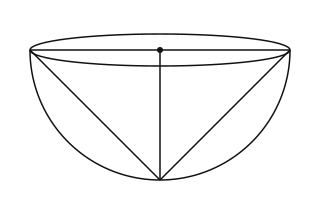
A conical cavity of maximum volume is carved out from a wooden solid hemisphere of radius 10 cm. Curved surface area of the cavity carved out is (use π=3.14)
(A)3142cm2
(B)314 cm2
(C)33140cm2
(D)31402cm2
Show answer & solution
Answer: (A) 3142cm2
The largest cone has radius r=10 cm and height h=10 cm (radius of hemisphere).
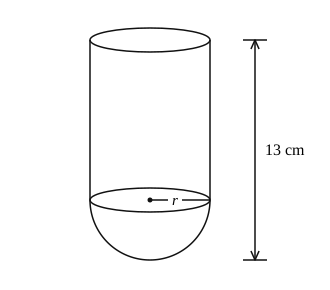
Assertion (A) : When a hemisphere of same radius (r) is carved out from one side of a solid wooden cylinder, the total surface area of remaining solid is increased by 2πr2. Reason (R) : Curved surface area of hemisphere is 2πr2.
(A)Both Assertion (A) and Reason (R) are true and Reason (R) is the correct explanation of the Assertion (A).
(B)Both Assertion (A) and Reason (R) are true, but Reason (R) is not the correct explanation of the Assertion (A).
(C)Assertion (A) is true, but Reason (R) is false.
(D)Assertion (A) is false, but Reason (R) is true.
Show answer & solution
Answer: (D) Assertion (A) is false, but Reason (R) is true.
Carving out removes one circular face of area πr2 and adds the hemisphere's curved surface 2πr2.
Net increase =2πr2−πr2=πr2, not 2πr2, so A is false.
The volume of air in a hollow cylinder is 450 cm3. A cone of same height and radius as that of cylinder is kept inside it. The volume of empty space in the cylinder is
Assertion (A) : If we join two hemispheres of same radius along their bases, then we get a sphere. Reason (R) : Total Surface Area of a sphere of radius r is 3πr2.
(A)Both Assertion (A) and Reason (R) are true and Reason (R) is the correct explanation of the Assertion (A).
(B)Both Assertion (A) and Reason (R) are true, but Reason (R) is not the correct explanation of the Assertion (A).
(C)Assertion (A) is true, but Reason (R) is false.
(D)Assertion (A) is false, but Reason (R) is true.
Show answer & solution
Answer: (C) Assertion (A) is true, but Reason (R) is false.
Two hemispheres of the same radius joined along their circular bases form a complete sphere. Assertion is true.
The surface area of a sphere of radius r is 4πr2, not 3πr2 (3πr2 is the total surface area of a solid hemisphere). Reason is false.
On the top face of the wooden cube of side 7 cm, hemispherical depressions of radius 0.35 cm are to be formed by taking out the wood. The maximum number of depressions that can be formed is :
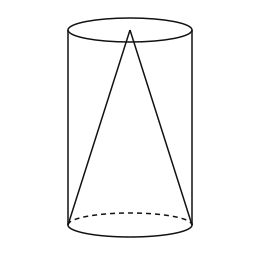
If a cone of greatest possible volume is hollowed out from a solid wooden cylinder, then the ratio of the volume of remaining wood to the volume of cone hollowed out is
(A)1 : 1
(B)1 : 3
(C)2 : 1
(D)3 : 1
Show answer & solution
Answer: (C) 2 : 1
The largest cone has the same radius r and height h as the cylinder.
Assertion (A) : Two cubes each of edge length 10 cm are joined together. The total surface area of newly formed cuboid is 1200 cm2. Reason (R) : Area of each surface of a cube of side 10 cm is 100 cm2.
(A)Both Assertion (A) and Reason (R) are true. Reason (R) is the correct explanation of Assertion (A).
(B)Both Assertion (A) and Reason (R) are true. Reason (R) does not give correct explanation of (A).
(C)Assertion (A) is true but Reason (R) is not true.
(D)Assertion (A) is not true but Reason (R) is true.
Show answer & solution
Answer: (D) Assertion (A) is not true but Reason (R) is true.
R: each face is 10×10=100 cm2, so R is true.
The cuboid formed is 20 cm × 10 cm × 10 cm. It has 10 faces of the cubes exposed (two faces are hidden at the join).
TSA =10×100=1000 cm2, not 1200 cm2. So A is false.
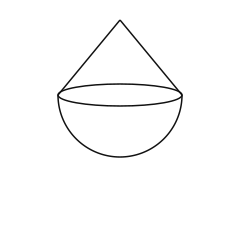
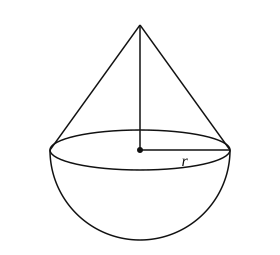
A solid is of the form of a cone of radius ‘r’ surmounted on a hemisphere of the same radius. If the height of the cone is the same as the diameter of its base, then the volume of the solid is :
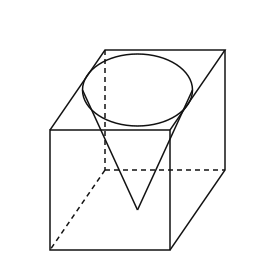
Assertion (A) : The surface area of largest sphere that can be inscribed in a hollow cube of side ‘a’ cm is πa2 cm2. Reason (R) : The surface area of a sphere of radius ‘r’ is 34πr3.
(A)Both Assertion (A) and Reason (R) are true and Reason (R) is the correct explanation of the Assertion (A).
(B)Both Assertion (A) and Reason (R) are true, but Reason (R) is not the correct explanation of the Assertion (A).
(C)Assertion (A) is true, but Reason (R) is false.
(D)Assertion (A) is false, but Reason (R) is true.
Show answer & solution
Answer: (C) Assertion (A) is true, but Reason (R) is false.
The largest sphere has diameter a, so r=2a.
Surface area =4π(2a)2=πa2 cm2, so A is true.
34πr3 is the volume of a sphere, not its surface area (4πr2), so R is false.