Pair of Linear Equations in Two Variables: 1 mark Questions (CBSE Class 10)
68 different 1 mark questions on Pair of Linear Equations in Two Variables from CBSE Class 10 Maths board exams 2022–2026, newest first.
If a pair of linear equations in two variables is represented by two coincident lines, then the pair of equations has :
(A) a unique solution(B) two solutions(C) no solution(D) an infinite number of solutionsShow answer & solution
Answer: (D) an infinite number of solutions
Coincident lines have every point in common. Every common point is a solution, so the pair has infinitely many solutions.
If the pair of linear equations : a 1 x + b 1 y + c 1 = 0 a 2 x + b 2 y + c 2 = 0
(A) a 2 a 1 = b 2 b 1 (B) a 2 a 1 = b 2 b 1 = c 2 c 1 (C) a 2 a 1 = b 2 b 1 = c 2 c 1 (D) a 2 a 1 = b 2 b 1 = c 2 c 1 Show answer & solution
Answer: (D) a 2 a 1 = b 2 b 1 = c 2 c 1
A consistent and dependent pair represents coincident lines. For coincident lines, a 2 a 1 = b 2 b 1 = c 2 c 1
The pair of linear equations 2 3 x + 3 5 y = 7 9 x + 10 y = 14
(A) consistent(B) inconsistent(C) consistent with one solution(D) consistent with many solutionsShow answer & solution
Answer: (B) inconsistent
Multiplying the first equation by 6: 9 x + 10 y = 42 Compare with 9 x + 10 y = 14 9 9 = 10 10 = 14 42 The lines are parallel, so the pair is inconsistent.
Equation of another line parallel to the line represented by 2 x − 6 y = 7
(A) y = 3 x − 7 (B) 2 x = 9 − 6 y (C) x − 3 y = 7 (D) x = 2 7 − 3 y Show answer & solution
Answer: (C) x − 3 y = 7
Parallel lines need a 2 a 1 = b 2 b 1 = c 2 c 1 For x − 3 y = 7 2 x − 6 y = 7 2 1 = − 6 − 3 = 2 1 7 7 = 1 = 2 1 (A) is 3 x − y = 7 2 x + 6 y = 9 2 x + 6 y = 7
Equation of a line coincident with 2.5 x − 2 y = 3
(A) 5 x − 4 y = 3 (B) 5 x − 4 y + 6 = 0 (C) 15 x − 12 y − 3 = 0 (D) 5 x − 4 y − 6 = 0 Show answer & solution
Answer: (D) 5 x − 4 y − 6 = 0
Multiply 2.5 x − 2 y = 3 5 x − 4 y = 6 5 x − 4 y − 6 = 0 Coincident lines need a 2 a 1 = b 2 b 1 = c 2 c 1
The value of k for which the system of linear equations 2 x + 3 y = 5 2 x + k y = 7
(A) 4 3 (B) 3 4 (C) 3 1 (D) 3Show answer & solution
Answer: (B) 3 4
Inconsistent: a 2 a 1 = b 2 b 1 = c 2 c 1 2 1/2 = k 1/3 ⇒ 4 1 = 3 k 1 ⇒ k = 3 4 Check: c 2 c 1 = 7 5 = 4 1
The value of k for which the system of linear equations k x − y − 2 = 0 6 x − 2 y − 3 = 0
(A) 2 1 (B) 3(C) 4(D) Not existShow answer & solution
Answer: (D) Not exist
Infinitely many solutions need a 2 a 1 = b 2 b 1 = c 2 c 1 b 2 b 1 = − 2 − 1 = 2 1 c 2 c 1 = − 3 − 2 = 3 2 Since b 2 b 1 = c 2 c 1 Such k does not exist.
Assertion (A): The system of linear equations 3 x − 5 y + 7 = 0 − 6 x + 10 y + 14 = 0
(A) Both Assertion (A) and Reason (R) are true and Reason (R) is the correct explanation of the Assertion (A).(B) Both Assertion (A) and Reason (R) are true, but Reason (R) is not the correct explanation of the Assertion (A).(C) Assertion (A) is true, but Reason (R) is false.(D) Assertion (A) is false, but Reason (R) is true.Show answer & solution
Answer: (C) Assertion (A) is true, but Reason (R) is false.
a 2 a 1 = − 6 3 = − 2 1 b 2 b 1 = 10 − 5 = − 2 1 c 2 c 1 = 14 7 = 2 1 a 2 a 1 = b 2 b 1 = c 2 c 1 If there is no unique solution, the lines may be parallel or coincident (infinitely many solutions). So R is false.
Assertion (A) : The value of p for which the system of equations 4 x + p y + 8 = 0 2 x + 2 y + 2 = 0 a 1 x + b 1 y = c 1 a 2 x + b 2 y = c 2 a 2 a 1 = b 2 b 1 = c 2 c 1
(A) Both Assertion (A) and Reason (R) are true and Reason (R) is the correct explanation of Assertion (A).(B) Both Assertion (A) and Reason (R) are true, but Reason (R) is not the correct explanation of Assertion (A).(C) Assertion (A) is true, but Reason (R) is false.(D) Assertion (A) is false, but Reason (R) is true.Show answer & solution
Answer: (D) Assertion (A) is false, but Reason (R) is true.
For p = 4 a 2 a 1 = 2 4 = 2 b 2 b 1 = 2 4 = 2 c 2 c 1 = 2 8 = 4 Since a 2 a 1 = b 2 b 1 = c 2 c 1 R is the standard condition for infinitely many solutions, so R is true.
If (0, 0) is the solution of the equation x + y = c − 1 c
(A) 0 (B) 1 (C) − 1 (D) any real numberShow answer & solution
Answer: (B) 1
Put x = 0 y = 0 0 + 0 = c − 1 So c = 1
The number of solutions of the system of equations x = 3 y = − 1
(A) 0 (B) 1 (C) 2 (D) InfiniteShow answer & solution
Answer: (B) 1
x = 3 y = − 1 They intersect at exactly one point (3, − 1
The number of solutions of the system of equations x = a x = b ( a = b )
(A) 0 (B) 1 (C) 2 (D) InfiniteShow answer & solution
Answer: (A) 0
x = a x = b Parallel lines never meet, so there is no solution.
For what value(s) of k k x + 2 y = 3 2 x + y = 5
(A) k (B) k = 8 (C) k = 4 (D) k = 4 Show answer & solution
Answer: (C) k = 4
For a unique solution, a 2 a 1 = b 2 b 1 2 k = 1 2 k = 4
For what value(s) of k k x + 2 y = 3 2 x + y = 5
(A) k (B) k = 2 (C) k = 4 (D) k = 4 Show answer & solution
Answer: (D) k = 4
For no solution: a 2 a 1 = b 2 b 1 = c 2 c 1 2 k = 1 2 ⇒ k = 4 Check: 1 2 = 5 3 k = 4
The system of linear equations given by x = a y = b
(A) Consistent with a unique solution.(B) Consistent with infinitely many solutions.(C) Consistent with two solutions.(D) Inconsistent.Show answer & solution
Answer: (A) Consistent with a unique solution.
x = a y = b These lines are perpendicular and meet at exactly one point ( a , b ) So the system is consistent with a unique solution.
The value of m 14 x + m y = 20 − 3 x + 2 y = 16
(A) − 14 3 (B) − 3 7 (C) − 3 28 (D) − 28 3 Show answer & solution
Answer: (C) − 3 28
For parallel lines, a 2 a 1 = b 2 b 1 = c 2 c 1 − 3 14 = 2 m m = − 3 28 Check: c 2 c 1 = 16 20 = − 3 14
The line 2 x − 3 y = 6 x
(A) (0, − 2 (B) (0, 3)(C) (− 2 (D) (3, 0)Show answer & solution
Answer: (D) (3, 0)
On the x y = 0 2 x = 6 x = 3
The value of k for which the system of equations 3 x − 7 y = 1 k x + 14 y = 6
(A) − 6 (B) 3 2 (C) 6(D) 2 − 3 Show answer & solution
Answer: (A) − 6
Inconsistent when k 3 = 14 − 7 = 6 1 k 3 = − 2 1 k = − 6 − 2 1 = 6 1
The point (3, − m x − y = 11
(A) 3(B) − 2 (C) 8(D) 2Show answer & solution
Answer: (D) 2
Substitute x = 3 y = − 5 3 m + 5 = 11 3 m = 6 m = 2
If x = 1 y = 2 2 x − 3 y + a = 0 2 x + 3 y − b = 0
(A) a = 2 b (B) 2 a = b (C) a + 2 b = 0 (D) 2 a + b = 0 Show answer & solution
Answer: (B) 2 a = b
Put x = 1 , y = 2 2 x − 3 y + a = 0 2 − 6 + a = 0 a = 4 Put x = 1 , y = 2 2 x + 3 y − b = 0 2 + 6 − b = 0 b = 8 Hence b = 2 a 2 a = b
The line represented by the equation x − y = 0
(A) parallel to x-axis(B) parallel to y-axis(C) passing through the origin(D) passing through the point ( 3 , 2 ) Show answer & solution
Answer: (C) passing through the origin
At x = 0 y = 0 ( 0 , 0 ) x − y = 0 The line y = x ( 3 , 2 )
The equation of a line parallel to the x-axis and at a distance of 3 units below x-axis is :
(A) x = 3 (B) x = − 3 (C) y = − 3 (D) y = 3 Show answer & solution
Answer: (C) y = − 3
A line parallel to the x-axis has equation y = c 3 units below the x-axis means c = − 3 y = − 3
Assertion (A) : The pair of linear equations p x + 3 y + 59 = 0 2 x + 6 y + 118 = 0 p = 1 p x + 3 y + 19 = 0 2 x + 6 y + 157 = 0 p = 1
(A) Both Assertion (A) and Reason (R) are true and Reason (R) is the correct explanation of the Assertion (A).(B) Both Assertion (A) and Reason (R) are true, but Reason (R) is not the correct explanation of the Assertion (A).(C) Assertion (A) is true, but Reason (R) is false.(D) Assertion (A) is false, but Reason (R) is true.Show answer & solution
Answer: (B) Both Assertion (A) and Reason (R) are true, but Reason (R) is not the correct explanation of the Assertion (A).
A: with p = 1 2 1 = 6 3 = 118 59 = 2 1 R: unique solution needs 2 p = 6 3 p = 1 R is about a different pair and the unique-solution condition, so it does not explain A
The equation of a line parallel to y-axis and at a distance of 5 units to the right of y-axis is :
(A) x = 5 (B) x = − 5 (C) y = 5 (D) y = − 5 Show answer & solution
Answer: (A) x = 5
A line parallel to the y-axis has equation x = c 5 units to the right of the y-axis means c = 5 x = 5
The value of 'k' for which the system of linear equations 6 x + y = 3 k 36 x + 6 y = 3
(A) 6(B) 6 1 (C) 2 1 (D) 3 1 Show answer & solution
Answer: (B) 6 1
For infinitely many solutions, a 2 a 1 = b 2 b 1 = c 2 c 1 36 6 = 6 1 = 3 3 k So k = 6 1
A system of two linear equations in two variables is inconsistent, if the lines in the graph are :
(A) coincident(B) parallel(C) intersecting at one point(D) intersecting at right anglesShow answer & solution
Answer: (B) parallel
An inconsistent system has no solution. Two lines have no common point only when they are parallel (distinct).
The value of 'p p x + 3 y = p − 3 12 x + p y = p
(A) − 6 (B) 6 (C) ± 6 (D) Any real number except ± 6 Show answer & solution
Answer: (B) 6 only
Infinitely many solutions: 12 p = p 3 = p p − 3 12 p = p 3 ⇒ p 2 = 36 ⇒ p = ± 6 p 3 = p p − 3 ⇒ p − 3 = 3 ⇒ p = 6 So p = 6 12 6 = 6 3 = 6 3
The system of equations 2 x + 1 = 0 3 y − 5 = 0
(A) unique solution(B) two solutions(C) no solution(D) infinite number of solutionsShow answer & solution
Answer: (A) unique solution
2 x + 1 = 0 ⇒ x = − 2 1 y 3 y − 5 = 0 ⇒ y = 3 5 x The lines intersect at exactly one point ( − 2 1 , 3 5 )
The system of equations x + 5 = 0 2 x − 1 = 0
(A) No solution(B) Unique solution(C) Two solutions(D) Infinite solutionsShow answer & solution
Answer: (A) No solution
x + 5 = 0 ⇒ x = − 5 2 x − 1 = 0 ⇒ x = 2 1 Both are lines parallel to the y No value of x
The system of equations y + a = 0 2 x = b
(A) No solution(B) ( − a , 2 b ) (C) ( 2 b , − a ) (D) Infinite solutionsShow answer & solution
Answer: (C) ( 2 b , − a )
y + a = 0 ⇒ y = − a 2 x = b ⇒ x = 2 b The lines are perpendicular to each other and meet at exactly one point ( 2 b , − a )
The value of k 5 x + 2 y − 7 = 0 2 x + k y + 1 = 0
(A) 5(B) 5 4 (C) 4 5 (D) 2 5 Show answer & solution
Answer: (B) 5 4
No solution when a 2 a 1 = b 2 b 1 = c 2 c 1 2 5 = k 2 k = 5 4 Check: c 2 c 1 = 1 − 7 = − 7 = 2 5
The value of ‘k’ for which the pair of linear equations x + y − 4 = 0 2 x + k y − 8 = 0
(A) k = 2 (B) k = − 2 (C) k = 2 (D) k = − 2 Show answer & solution
Answer: (C) k = 2
For infinitely many solutions, a 2 a 1 = b 2 b 1 = c 2 c 1 2 1 = k 1 = − 8 − 4 So k = 2
The graph of a pair of linear equations a 1 x + b 1 y = c 1 a 2 x + b 2 y = c 2 x
(A) a 2 a 1 = b 2 b 1 (B) a 2 a 1 = b 2 b 1 = c 2 c 1 (C) a 2 a 1 = b 2 b 1 = c 2 c 1 (D) a 2 a 1 = b 2 b 1 = c 2 c 1 Show answer & solution
Answer: (D) a 2 a 1 = b 2 b 1 = c 2 c 1
Lines are parallel when the pair is inconsistent. This happens when a 2 a 1 = b 2 b 1 = c 2 c 1
The value of ‘p’ for which the pair of equations − 2 x + 3 y − 9 = 0 4 x + p y + 7 = 0
(A) p = 6 (B) p = 6 (C) p = − 6 (D) p = − 6 Show answer & solution
Answer: (D) p = − 6
Unique solution needs a 2 a 1 = b 2 b 1 4 − 2 = p 3 ⇒ − 2 p = 12 ⇒ p = − 6
The lines represented by linear equations x = a y = b ( a = b )
(A) intersecting at (a, b).(B) intersecting at (b, a).(C) parallel.(D) coincident.Show answer & solution
Answer: (A) intersecting at (a, b).
x = a y = b They meet at the point whose x-coordinate is a b ( a , b )
Assertion (A): The pair of linear equations 5 x + 2 y + 6 = 0 7 x + 6 y + 18 = 0 a 1 x + b 1 y + c 1 = 0 a 2 x + b 2 y + c 2 = 0 a 2 a 1 = b 2 b 1 = c 2 c 1
(A) Both Assertion (A) and Reason (R) are true and Reason (R) is the correct explanation of Assertion (A).(B) Both Assertion (A) and Reason (R) are true, but Reason (R) is not the correct explanation of Assertion (A).(C) Assertion (A) is true, but Reason (R) is false.(D) Assertion (A) is false, but Reason (R) is true.Show answer & solution
Answer: (D) Assertion (A) is false, but Reason (R) is true.
a 2 a 1 = 7 5 b 2 b 1 = 6 2 = 3 1 Since 7 5 = 3 1 R is the correct condition for infinitely many solutions, so R is true. Answer (D).
The pair of linear equations 2 k x + 5 y = 7 6 x + 5 y = 11
(A) k = 3 (B) k = − 3 (C) k = 3 1 (D) k = − 3 1 Show answer & solution
Answer: (A) k = 3
For a unique solution, a 2 a 1 = b 2 b 1 6 2 k = 5 5 2 k = 6 Hence k = 3
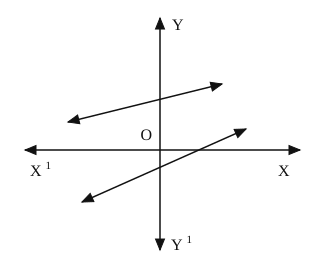
In the given figure, graphs of two linear equations are shown. The pair of these linear equations is :
(A) consistent with unique solution.(B) consistent with infinitely many solutions.(C) inconsistent.(D) inconsistent but can be made consistent by extending these lines.Show answer & solution
Answer: (A) consistent with unique solution.
The two lines in the figure have different slopes, so they are not parallel. Non-parallel lines intersect in exactly one point (here, when extended to the left). Hence the pair is consistent with a unique solution.
The value of k for which the system of equations 3 x − y + 8 = 0 6 x − k y + 16 = 0
(A) − 2 (B) 2(C) 2 1 (D) − 2 1 Show answer & solution
Answer: (B) 2
For infinitely many solutions, a 2 a 1 = b 2 b 1 = c 2 c 1 6 3 = − k − 1 = 16 8 k 1 = 2 1 k = 2
The pair of linear equations x + 2 y + 5 = 0 − 3 x = 6 y − 1
(A) unique solution(B) exactly two solutions(C) infinitely many solutions(D) no solutionShow answer & solution
Answer: (D) no solution
Write both in standard form: x + 2 y + 5 = 0 3 x + 6 y − 1 = 0 a 2 a 1 = 3 1 b 2 b 1 = 6 2 = 3 1 c 2 c 1 = − 1 5 = − 5 a 2 a 1 = b 2 b 1 = c 2 c 1 The pair has no solution.
If a pair of linear equations in two variables is consistent, then the lines represented by the two equations are :
(A) always intersecting(B) parallel(C) always coincident(D) intersecting or coincidentShow answer & solution
Answer: (D) intersecting or coincident
A consistent pair has at least one solution. Intersecting lines give exactly one solution and coincident lines give infinitely many; parallel lines give none. So the lines are intersecting or coincident.
If a x + b y = a 2 − b 2 b x + a y = 0 x + y
(A) a 2 − b 2 (B) a + b (C) a − b (D) a 2 + b 2 Show answer & solution
Answer: (C) a − b
Add the two equations: ( a + b ) x + ( a + b ) y = a 2 − b 2 ( a + b ) ( x + y ) = ( a + b ) ( a − b ) Divide by a + b x + y = a − b
Two lines are given to be parallel. The equation of one of these lines is 5 x − 3 y = 2
(A) − 15 x − 9 y = 5 (B) 15 x + 9 y = 5 (C) 9 x − 15 y = 6 (D) − 15 x + 9 y = 5 Show answer & solution
Answer: (D) − 15 x + 9 y = 5
For parallel lines, a 2 a 1 = b 2 b 1 = c 2 c 1 With − 15 x + 9 y = 5 − 15 5 = − 3 1 9 − 3 = − 3 1 5 2 = − 3 1 So − 15 x + 9 y = 5 5 x − 3 y = 2 a 2 a 1 = b 2 b 1
The pair of linear equations y = 0 and y = − 7
(A) exactly one solution(B) two solutions(C) infinitely many solutions(D) no solutionShow answer & solution
Answer: (D) no solution
y = 0 is the x-axis and y = − 7 Parallel distinct lines never meet. So the pair has no solution.
Which out of the following type of straight lines will be represented by the system of equations 3 x + 4 y = 5 6 x + 8 y = 7
(A) Parallel(B) Intersecting(C) Coincident(D) Perpendicular to each otherShow answer & solution
Answer: (A) Parallel
a 2 a 1 = 6 3 = 2 1 b 2 b 1 = 8 4 = 2 1 c 2 c 1 = 7 5 a 2 a 1 = b 2 b 1 = c 2 c 1
The larger of two supplementary angles exceeds the smaller by 18 degrees. What is the measure of larger angle ?
(A) 8 1 ∘ (B) 9 9 ∘ (C) 3 6 ∘ (D) 5 4 ∘ Show answer & solution
Answer: (B) 9 9 ∘
Let the larger angle be x y x + y = 180 x − y = 18 Adding: 2 x = 198 x = 9 9 ∘
Assertion (A) : The system of linear equations 3 x + 5 y − 4 = 0 15 x + 25 y − 25 = 0 a 1 x + b 1 y + c 1 = 0 a 2 x + b 2 y + c 2 = 0 a 2 a 1 = b 2 b 1 = c 2 c 1
(A) Both Assertion (A) and Reason (R) are true and Reason (R) is the correct explanation of Assertion (A).(B) Both Assertion (A) and Reason (R) are true but Reason (R) is not the correct explanation of Assertion (A).(C) Assertion (A) is true, but Reason (R) is false.(D) Assertion (A) is false, but Reason (R) is true.Show answer & solution
Answer: (A) Both A and R are true and R is the correct explanation of A.
R is the standard condition for no solution, so R is true. For A: a 2 a 1 = 15 3 = 5 1 b 2 b 1 = 25 5 = 5 1 c 2 c 1 = − 25 − 4 = 25 4 5 1 = 5 1 = 25 4 A follows from the condition in R, so R correctly explains A.
The pair of linear equations x + 2 y − 5 = 0 2 x − 4 y + 6 = 0
(A) is inconsistent(B) is consistent with many solutions(C) is consistent with a unique solution(D) is consistent with two solutionsShow answer & solution
Answer: (c) is consistent with a unique solution
a 2 a 1 = 2 1 b 2 b 1 = − 4 2 = − 2 1 Since a 2 a 1 = b 2 b 1 The pair is consistent with a unique solution.
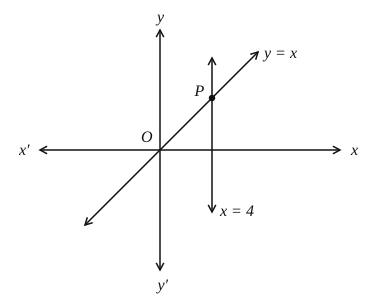
The lines represented by the linear equations y = x x = 4
(A) (4, 0)(B) (4, 4)(C) (0, 4)(D) ( − 4 , 4 ) Show answer & solution
Answer: (b) (4, 4)
At P, x = 4. Since P lies on y = x, y = 4. P = (4, 4)
The pair of linear equations x + 2 y + 5 = 0 − 3 x − 6 y + 1 = 0
(A) a unique solution(B) exactly two solutions(C) infinitely many solutions(D) no solutionShow answer & solution
Answer: (D) no solution
a 2 a 1 = − 3 1 b 2 b 1 = − 6 2 = − 3 1 c 2 c 1 = 1 5 = 5 a 2 a 1 = b 2 b 1 = c 2 c 1
If the pair of linear equations x − y = 1 x + k y = 5 x = 2 y = 1 k
(A) − 2 (B) − 3 (C) 3(D) 4Show answer & solution
Answer: (C) 3
Put x = 2 y = 1 x + k y = 5 2 + k = 5 So k = 3
The value of k for which the equations 3 x − y + 8 = 0 6 x − k y + 16 = 0
(A) 2 1 (B) − 2 1 (C) 2(D) − 2 Show answer & solution
Answer: (C) 2
For coincident lines: 6 3 = − k − 1 = 16 8 k 1 = 2 1 ⇒ k = 2
If the lines represented by equations 3 x + 2 m y = 2 2 x + 5 y + 1 = 0
(A) 5 2 (B) − 4 5 (C) 2 3 (D) 4 15 Show answer & solution
Answer: (D) 4 15
Write the lines as 3 x + 2 m y − 2 = 0 2 x + 5 y + 1 = 0 For parallel lines, 2 3 = 5 2 m = 1 − 2 4 m = 15 m = 4 15
The value of k, if (6, k) lies on the line represented by x − 3 y + 6 = 0
(A) − 4 (B) 12(C) − 12 (D) 4Show answer & solution
Answer: (D) 4
Put x = 6 y = k 6 − 3 k + 6 = 0 3 k = 12 k = 4
The value of ‘k’ for which the system of equations k x + 2 y = 5 3 x + 4 y = 1
(A) k = 2 3 (B) k = 2 3 (C) k = 3 2 (D) k = 15 Show answer & solution
Answer: (A) k = 2 3
No solution when a 2 a 1 = b 2 b 1 = c 2 c 1 3 k = 4 2 k = 2 3 4 2 = 1 5 So k = 2 3
The value of ‘p’ if (–2, p) lies on the line represented by the equation 2 x − 3 y + 7 = 0
(A) − 2 13 (B) 2 13 (C) − 1 (D) 1Show answer & solution
Answer: (D) 1
Put x = − 2 y = p 2 ( − 2 ) − 3 p + 7 = 0 3 − 3 p = 0 p = 1
The value of k for which the pair of equations k x = y + 2 6 x = 2 y + 3
(A) is k = 3(B) does not exist(C) is k = –3(D) is k = 4Show answer & solution
Answer: (B) does not exist
Write the equations as k x − y − 2 = 0 6 x − 2 y − 3 = 0 For infinitely many solutions: 6 k = − 2 − 1 = − 3 − 2 But − 2 − 1 = 2 1 − 3 − 2 = 3 2 So no value of k works.
If the pair of equations 3 x − y + 8 = 0 6 x − r y + 16 = 0
(A) − 2 1 (B) 2 1 (C) − 2 (D) 2 Show answer & solution
Answer: (D) 2
For coincident lines a 2 a 1 = b 2 b 1 = c 2 c 1 6 3 = − r − 1 = 16 8 = 2 1 r 1 = 2 1 r = 2
The pair of equations x = a y = b
(A) parallel(B) intersecting at (b, a)(C) coincident(D) intersecting at (a, b)Show answer & solution
Answer: (D) intersecting at (a, b)
x = a y = b They are perpendicular and meet at the point ( a , b )
If 2 x + 3 y = 15 3 x + 2 y = 25 x − y
(A) − 10 (B) 8(C) 10(D) − 8 Show answer & solution
Answer: (C) 10
Subtract the first equation from the second: ( 3 x + 2 y ) − ( 2 x + 3 y ) = 25 − 15 x − y = 10
The pair of linear equations 2 x = 5 y + 6 15 y = 6 x − 18
(A) intersecting(B) parallel(C) coincident(D) either intersecting or parallelShow answer & solution
Answer: (C) coincident
Write as 2 x − 5 y − 6 = 0 6 x − 15 y − 18 = 0 a 2 a 1 = 6 2 = 3 1 b 2 b 1 = − 15 − 5 = 3 1 c 2 c 1 = − 18 − 6 = 3 1 All three ratios are equal, so the lines are coincident.
The pair of equations a x + 2 y = 9 3 x + b y = 18
(A) a = b (B) 3 a = 2 b (C) 2 a = 3 b (D) ab = 6 Show answer & solution
Answer: (D) ab = 6
For parallel lines, a 2 a 1 = b 2 b 1 = c 2 c 1 3 a = b 2 = 18 9 3 a = b 2 ab = 6 3 a = 2 1
The solution of the pair of equations x + y = a + b a x − b y = a 2 − b 2
(A) x = b, y = a(B) x = − a (C) x = a, y = b(D) x = a, y = − b Show answer & solution
Answer: (C) x = a, y = b
Multiply the first equation by b: b x + b y = ab + b 2 Add to the second: ( a + b ) x = a 2 + ab = a ( a + b ) a + b = 0 Then y = (a + b) – a = b. Check: a ⋅ a − b ⋅ b = a 2 − b 2
The point of intersection of the line represented by 3 x − y = 3
(A) (0, –3)(B) (0, 3)(C) (2, 0)(D) (–2, 0)Show answer & solution
Answer: (A) (0, –3)
On the y-axis, x = 0 3 ( 0 ) − y = 3 y = − 3 The point is (0, –3).
3 chairs and 1 table cost ₹ 900; whereas 5 chairs and 3 tables cost ₹ 2,100. If the cost of 1 chair is ₹ x and the cost of 1 table is ₹ y, then the situation can be represented algebraically as
(A) 3 x + y = 900 3 x + 5 y = 2100 (B) x + 3 y = 900 3 x + 5 y = 2100 (C) 3 x + y = 900 5 x + 3 y = 2100 (D) x + 3 y = 900 5 x + 3 y = 2100 Show answer & solution
Answer: (C) 3 x + y = 900 5 x + 3 y = 2100
3 chairs and 1 table: 3 x + y = 900 5 chairs and 3 tables: 5 x + 3 y = 2100
The coordinates of the point where the line 2 y = 4 x + 5 x
(A) ( 0 , 4 − 5 ) (B) ( 0 , 2 5 ) (C) ( 4 − 5 , 0 ) (D) ( 2 − 5 , 0 ) Show answer & solution
Answer: (C) ( 4 − 5 , 0 )
On the x-axis, y = 0. 0 = 4 x + 5 x = − 4 5 The point is ( 4 − 5 , 0 )
The point of intersection of the line represented by 3 x − y = 3
(A) (0, –3)(B) (0, 3)(C) (2, 0)(D) (–2, 0)Show answer & solution
Answer: (A) (0, –3)
On the y-axis, x = 0 3 ( 0 ) − y = 3 y = − 3 The point is (0, –3).
The condition for the system of linear equations a x + b y = c l x + m y = n
(A) am = b l (B) a l = bm (C) a l = bm (D) am = b l Show answer & solution
Answer: (A) am = b l
Unique solution when l a = m b This gives am = b l
Practise smarter: chapter-wise revision, formula sheets and step-by-step NCERT solutions on
MonoMath CBSE →