Real Numbers: 1 mark Questions (CBSE Class 10)
104 different 1 mark questions on Real Numbers from CBSE Class 10 Maths board exams 2022–2026, newest first.
If HCF (850, 325) is 25, then LCM (850, 325) is :
(A) 442(B) 11050(C) 8450(D) 2210Show answer & solution
Answer: (B) 11050
HCF × LCM = product of the numbers. LCM = 25 850 × 325 = 850 × 13 = 11050
7 × 29 × 23 + 1 is :
(A) a prime number.(B) divisible by 23.(C) an odd number.(D) a composite number.Show answer & solution
Answer: (D) a composite number.
7 × 29 × 23 = 4669 4670 is even, so it has factors other than 1 and itself. Hence it is a composite number.
Assertion (A) : 4 n 4 n
(A) Both, Assertion (A) and Reason (R) are true and Reason (R) is correct explanation of Assertion (A).(B) Both, Assertion (A) and Reason (R) are true, but Reason (R) is not correct explanation for Assertion (A).(C) Assertion (A) is true, but Reason (R) is false.(D) Assertion (A) is false, but Reason (R) is true.Show answer & solution
Answer: (A) Both, Assertion (A) and Reason (R) are true and Reason (R) is correct explanation of Assertion (A).
A number ending in 0 must have both 2 and 5 as prime factors. 4 n = 2 2 n So A is true, R is true and R explains A.
HCF of two consecutive natural numbers is :
(A) 2(B) 1(C) 0(D) smaller numberShow answer & solution
Answer: (B) 1
Any common factor of n and n + 1 also divides their difference, 1. So the HCF is 1.
7 × 11 × 13 + 5
(A) a prime number.(B) an odd number.(C) a composite number.(D) a multiple of 5.Show answer & solution
Answer: (C) a composite number.
7 × 11 × 13 = 1001 1001 + 5 = 1006 1006 = 2 × 503 It is even (not odd) and does not end in 0 or 5 (not a multiple of 5). Hence it is a composite number.
17 × 11 × 13 + 11
(A) a prime number.(B) multiple of 17.(C) a composite number.(D) an odd number.Show answer & solution
Answer: (C) a composite number.
17 × 11 × 13 + 11 = 11 ( 17 × 13 + 1 ) = 11 × 222 = 2442 It has factors 11 and 222 besides 1 and itself, so it is composite. 2442 is even (not odd) and 2442 = 17 × 143 + 11, so it is not a multiple of 17.
The HCF of 960 and 432 is :
(A) 48(B) 54(C) 72(D) 36Show answer & solution
Answer: (A) 48
960 = 2 6 × 3 × 5 432 = 2 4 × 3 3 HCF = product of the smallest powers of common primes = 2 4 × 3 = 48
The natural number 2 is :
(A) a prime number(B) a composite number(C) prime as well as composite(D) neither prime nor compositeShow answer & solution
Answer: (A) a prime number
2 has exactly two factors, 1 and 2. So 2 is a prime number (the only even prime).
For any natural number n 6 n
(A) 0(B) 6(C) 3(D) 2Show answer & solution
Answer: (B) 6
6 1 = 6 6 2 = 36 6 3 = 216 Any power of a number ending in 6 also ends in 6, since 6 × 6 = 36 So 6 n
The LCM of 960 and 240 is :
(A) 960(B) 240(C) 60(D) 15Show answer & solution
Answer: (A) 960
Since 960 = 4 × 240 So the smallest common multiple of 960 and 240 is 960 itself.
The natural number 1 is :
(A) a prime number.(B) a composite number.(C) prime as well as composite.(D) neither prime nor composite.Show answer & solution
Answer: (D) neither prime nor composite.
A prime number has exactly two factors and a composite number has more than two factors. 1 has only one factor (itself), so it is neither prime nor composite.
For any natural number n, 5 n
(A) 0(B) 5(C) 3(D) 2Show answer & solution
Answer: (B) 5
5 1 = 5 5 2 = 25 5 3 = 125 Every power of 5 ends with the digit 5.
There are two sections A and B of Grade X. There are 28 students in Section A and 30 students in Section B. What is the minimum number of books you will acquire for the class library so that they can be distributed equally among students of Section A or Section B ?
(A) 144(B) 2(C) 420(D) 272Show answer & solution
Answer: (C) 420
The required number is the LCM of 28 and 30. 28 = 2 2 × 7 30 = 2 × 3 × 5 LCM = 2 2 × 3 × 5 × 7 = 420
( 3 × 11 × 13 + 3 )
(A) a prime number(B) divisible by 13(C) a composite number(D) an odd numberShow answer & solution
Answer: (C) a composite number
3 × 11 × 13 + 3 = 3 ( 11 × 13 + 1 ) = 3 × 144 = 432 It has factors other than 1 and itself, so it is composite (432 is even and 432 = 13 × 33 + 3
Assertion (A) : ( 3 + 5 )
(A) Both Assertion (A) and Reason (R) are true and Reason (R) is the correct explanation of the Assertion (A).(B) Both Assertion (A) and Reason (R) are true, but Reason (R) is not the correct explanation of Assertion (A).(C) Assertion (A) is true, but Reason (R) is false.(D) Assertion (A) is false, but Reason (R) is true.Show answer & solution
Answer: (C) A is true, but R is false.
If 3 + 5 = r 5 = r 2 − 2 r 3 + 3 3 = 2 r r 2 − 2 R is false: e.g. 2 + ( − 2 ) = 0
Assertion (A): H.C.F. ( 36 m 2 , 18 m ) = 18 m
(A) Both Assertion (A) and Reason (R) are true and Reason (R) is the correct explanation of the Assertion (A).(B) Both Assertion (A) and Reason (R) are true, but Reason (R) is not the correct explanation of the Assertion (A).(C) Assertion (A) is true, but Reason (R) is false.(D) Assertion (A) is false, but Reason (R) is true.Show answer & solution
Answer: (B) Both Assertion (A) and Reason (R) are true, but Reason (R) is not the correct explanation of the Assertion (A).
36 m 2 = 2 2 × 3 2 × m 2 18 m = 2 × 3 2 × m HCF = 2 × 3 2 × m = 18 m 36 m 2 The HCF divides both numbers, so it cannot exceed the smaller one. R is true. But R does not explain why the HCF here equals 18m; that follows from 18m being a factor of 36 m 2
If the HCF of two positive integers a b
(A) a + b (B) a (C) b (D) ab Show answer & solution
Answer: (D) ab
HCF × LCM = product of the numbers. 1 × LCM = ab = ab
The number 3 + 2
(A) a rational number(B) an irrational number(C) an integer(D) a natural numberShow answer & solution
Answer: (B) an irrational number
2 The sum of a rational number (3) and an irrational number is irrational, so 3 + 2
Assertion (A) : For any two natural numbers a and b, the HCF of a and b is a factor of the LCM of a and b.
(A) Both Assertion (A) and Reason (R) are true and Reason (R) is the correct explanation of Assertion (A).(B) Both Assertion (A) and Reason (R) are true, but Reason (R) is not the correct explanation of Assertion (A).(C) Assertion (A) is true, but Reason (R) is false.(D) Assertion (A) is false, but Reason (R) is true.Show answer & solution
Answer: (A) Both Assertion (A) and Reason (R) are true and Reason (R) is the correct explanation of Assertion (A).
R is true: the HCF is a common factor, so it divides both numbers. The HCF divides a a This follows directly from R, so R correctly explains A.
3 3 − 3
(A) a rational number(B) an irrational number(C) an integer(D) a natural numberShow answer & solution
Answer: (B) an irrational number
3 3 − 3 = 1 − 3 3 = 1 − 3 1 is rational and 3 1 − 3
( 2 + 2 ) 2
(A) a rational number(B) an irrational number(C) an integer(D) a natural numberShow answer & solution
Answer: (B) an irrational number
( 2 + 2 ) 2 = 4 + 4 2 + 2 = 6 + 4 2 4 2
The value of (HCF – LCM) for the two numbers 3 and 5 is :
(A) 2 (B) 4 (C) 14 (D) − 14 Show answer & solution
Answer: (D) − 14
3 and 5 are both prime, so HCF = 1 and LCM = 3 × 5 = 15 HCF – LCM = 1 − 15 = − 14
The number 2 n n
(A) 4 (B) 6 (C) 2 (D) 0 Show answer & solution
Answer: (D) 0
A number ending in 0 is divisible by 10, so it must have both 2 and 5 as prime factors. The only prime factor of 2 n 2 n (Its last digits cycle 2, 4, 8, 6.)
Assertion (A) : The prime numbers which divide 36 also divide 6.p 2
(A) Both Assertion (A) and Reason (R) are true and Reason (R) is the correct explanation of Assertion (A).(B) Both Assertion (A) and Reason (R) are true, but Reason (R) is not the correct explanation of Assertion (A).(C) Assertion (A) is true, but Reason (R) is false.(D) Assertion (A) is false, but Reason (R) is true.Show answer & solution
Answer: (C) Assertion (A) is true, but Reason (R) is false.
36 = 2 2 × 3 2 R is false as stated: for example, 4 divides 2 2 = 4 p 2 p 2 The true result is: if a prime divides a 2 So A is true and R is false.
The number 3 n n
(A) 1 (B) 3 (C) 5 (D) 7 Show answer & solution
Answer: (C) 5
A number ending in 5 is divisible by 5, so 5 would have to be a prime factor. The only prime factor of 3 n 3 n (Its last digits cycle 3, 9, 7, 1.)
If the number a n n
(A) 2 (B) 4 (C) 6 (D) 8 Show answer & solution
Answer: (C) 6
Last digits of powers: 2 → 2, 4, 8, 6; 4 → 4, 6; 6 → 6, 6, 6, ...; 8 → 8, 4, 2, 6. Only 6 n So a = 6.
If p = 2 3 × 3 2 × 5 q = 2 2 × 3 3 p q
(A) 2 3 × 3 3 (B) 2 2 × 3 2 (C) 2 2 × 3 2 × 5 (D) 2 3 × 3 3 × 5 Show answer & solution
Answer: (D) 2 3 × 3 3 × 5
LCM = product of the highest powers of all prime factors. Highest powers: 2 3 3 3 5 LCM = 2 3 × 3 3 × 5
3 n n
(A) 3(B) 5(C) 7(D) 9Show answer & solution
Answer: (B) 5
The only prime factor of 3 n A number ending in 5 must be divisible by 5, so 3 n (The last digits of 3 n
A prime number has :
(A) exactly two prime factors(B) exactly one prime factor(C) at least one prime factor(D) at least two prime factorsShow answer & solution
Answer: (B) exactly one prime factor
A prime number p p 1 is not prime, so its only prime factor is p Hence a prime number has exactly one prime factor.
If HCF ( x , 20 ) = 2 ( x , 20 ) = 60 x
(A) 3(B) 6(C) 20(D) 10Show answer & solution
Answer: (B) 6
HCF × LCM = product of the two numbers. 2 × 60 = 20 x x = 20 120 = 6
The LCM of two numbers is 3600. Which of the following can not be their HCF ?
(A) 600(B) 400(C) 500(D) 150Show answer & solution
Answer: (C) 500
The HCF of two numbers always divides their LCM. 3600 ÷ 600 = 6 3600 ÷ 400 = 9 3600 ÷ 150 = 24 3600 ÷ 500 = 7.2 So 500 can not be the HCF.
( 2 − 5 3 ) 2
(A) a negative integer(B) an irrational number(C) a rational number(D) a positive integerShow answer & solution
Answer: (B) an irrational number
( 2 − 5 3 ) 2 = 4 − 20 3 + 75 = 79 − 20 3 3 20 3 79 − 20 3
2 ( 2 − 1 )
(A) an integer(B) a rational number(C) an irrational number(D) equal to 1Show answer & solution
Answer: (C) an irrational number
2 ( 2 − 1 ) = 2 − 2 2 2 − 2
Assertion (A) : ( a + b ) ⋅ ( a − b )
(A) Both Assertion (A) and Reason (R) are true and Reason (R) is correct explanation of Assertion (A).(B) Both Assertion (A) and Reason (R) are true, but Reason (R) is not correct explanation for Assertion (A).(C) Assertion (A) is true, but Reason (R) is false.(D) Assertion (A) is false, but Reason (R) is true.Show answer & solution
Answer: (C) Assertion (A) is true, but Reason (R) is false.
( a + b ) ( a − b ) = a 2 − b R is false: e.g. 2 × 3 = 6
If HCF ( 98 , 28 ) = m LCM ( 98 , 28 ) = n n − 7 m
(A) 0 (B) 28 (C) 98 (D) 198 Show answer & solution
Answer: (C) 98
98 = 2 × 7 2 28 = 2 2 × 7 m = HCF = 2 × 7 = 14 n = LCM = 2 2 × 7 2 = 196 n − 7 m = 196 − 98 = 98
If ( − 1 ) n + ( − 1 ) 8 = 0 n
(A) any positive integer(B) any negative integer(C) any odd number(D) any even numberShow answer & solution
Answer: (C) any odd number
( − 1 ) 8 = 1 ( − 1 ) n = − 1 ( − 1 ) n = − 1 n
Which of the following is a rational number between 3 5
(A) 1.4142387954012 … (B) 2.32 6 (C) π (D) 1.857142 Show answer & solution
Answer: (D) 1.857142
3 ≈ 1.732 5 ≈ 2.236 (A) is non-terminating and non-repeating, so it is irrational (and less than 3 (B) 2.32 6 5 (C) π (D) 1.857142 1.732 < 1.857142 < 2.236
The greatest number which divides 70 125 5 8
(A) 13 (B) 65 (C) 875 (D) 1750 Show answer & solution
Answer: (A) 13
The required number divides 70 − 5 = 65 125 − 8 = 117 65 = 5 × 13 117 = 3 2 × 13 HCF ( 65 , 117 ) = 13
The least number which is a perfect square and is divisible by each of 16, 20 and 50, is :
(A) 1200(B) 100(C) 3600(D) 2400Show answer & solution
Answer: (C) 3600
16 = 2 4 20 = 2 2 × 5 50 = 2 × 5 2 LCM = 2 4 × 5 2 = 400 2 0 2 So the true least such number is 400, which is not among the options. Checking the options: 1200 and 2400 are not perfect squares; 100 is not divisible by 16; 3600 = 6 0 2 So the intended option is 3600
The sum of the exponents of prime factors in the prime factorisation of 4004 is :
(A) 5(B) 4(C) 3(D) 2Show answer & solution
Answer: (A) 5
4004 = 4 × 1001 = 2 2 × 7 × 11 × 13 Sum of exponents = 2 + 1 + 1 + 1 = 5
The HCF of 40, 110 and 360 is :
(A) 40(B) 110(C) 360(D) 10Show answer & solution
Answer: (D) 10
40 = 2 3 × 5 110 = 2 × 5 × 11 360 = 2 3 × 3 2 × 5 HCF = 2 × 5 = 10
If 1080 = 2 p × 3 q × 5 ( p − q )
(A) 6(B) − 1 (C) 1(D) 0Show answer & solution
Answer: (D) 0
1080 = 8 × 135 = 2 3 × 27 × 5 = 2 3 × 3 3 × 5 p = 3 q = 3 p − q = 0
If a b = 32 a b b ab
(A) 72(B) 5 10 (C) 2 10 (D) 5 12 Show answer & solution
Answer: (B) 5 10
32 = 2 5 a = 2 b = 5 ab = 10 b ab = 5 10 (The trivial pair a = 32 b = 1 1 32 = 1
If x y p x y
(A) p = 35 x (B) p = 4 y (C) p = 8 x (D) p = 16 y Show answer & solution
Answer: (A) p = 35 x
x = LCM ( 4 , 6 , 8 ) = 2 3 × 3 = 24 y = LCM ( 3 , 5 , 7 ) = 105 p = LCM ( 24 , 105 ) = 2 3 × 3 × 5 × 7 = 840 840 = 35 × 24 p = 35 x
If x = a b 3 y = a 3 b a b [ HCF ( x , y ) − LCM ( x , y )]
(A) 1 − a 3 b 3 (B) ab ( 1 − ab ) (C) ab − a 4 b 4 (D) ab ( 1 − ab ) ( 1 + ab ) Show answer & solution
Answer: (D) ab ( 1 − ab ) ( 1 + ab )
x = a × b 3 y = a 3 × b HCF = ab = a 3 b 3 HCF − = ab − a 3 b 3 = ab ( 1 − a 2 b 2 ) = ab ( 1 − ab ) ( 1 + ab )
( 1 + 3 ) 2 − ( 1 − 3 ) 2
(A) a positive rational number.(B) a negative integer.(C) a positive irrational number.(D) a negative irrational number.Show answer & solution
Answer: (C) a positive irrational number
( 1 + 3 ) 2 = 4 + 2 3 ( 1 − 3 ) 2 = 4 − 2 3 Difference = 4 3
Assertion (A) : 4 n n x x n n
(A) Both, Assertion (A) and Reason (R) are true and Reason (R) is correct explanation of Assertion (A).(B) Both, Assertion (A) and Reason (R) are true but Reason (R) is not the correct explanation of Assertion (A).(C) Assertion (A) is true but Reason (R) is false.(D) Assertion (A) is false but Reason (R) is true.Show answer & solution
Answer: (D) Assertion (A) is false but Reason (R) is true.
4 n = 2 2 n If 2 and 5 are prime factors of x 10 ∣ x 10 ∣ x n x n
Assertion (A) : Unit digit of 3 n n 3 n n
(A) Both, Assertion (A) and Reason (R) are true and Reason (R) is correct explanation of Assertion (A).(B) Both, Assertion (A) and Reason (R) are true but Reason (R) is not the correct explanation of Assertion (A).(C) Assertion (A) is true but Reason (R) is false.(D) Assertion (A) is false but Reason (R) is true.Show answer & solution
Answer: (A) Both, Assertion (A) and Reason (R) are true and Reason (R) is correct explanation of Assertion (A).
3 n A number with an even unit digit is divisible by 2. Since 2 does not divide 3 n
( 3 + 2 ) 2 + ( 3 − 2 ) 2
(A) positive rational number(B) negative rational number(C) positive irrational number(D) negative irrational numberShow answer & solution
Answer: (A) positive rational number
( 3 + 2 ) 2 = 3 + 4 3 + 4 = 7 + 4 3 ( 3 − 2 ) 2 = 3 − 4 3 + 4 = 7 − 4 3 Sum = 14
Let x = a 2 b 3 c n y = a 3 b m c 2 a , b , c x y a 3 b 4 c 3 m + n
(A) 10(B) 7(C) 6(D) 5Show answer & solution
Answer: (B) 7
LCM takes the highest power of each prime. Power of b max ( 3 , m ) = 4 ⇒ m = 4 Power of c max ( n , 2 ) = 3 ⇒ n = 3 m + n = 7
For any prime number p p a 2 a p
(A) a (B) a 2 1 (C) a 2 3 (D) a 8 1 Show answer & solution
Answer: (A) a
Theorem: if a prime p a 2 a p a Hence p a
Let a = p 2 q 3 r n b = p 3 q m r 2 p , q , r a b p 3 q 4 r 3 3 n − 2 m
(A) − 1 (B) 1(C) 3(D) − 3 Show answer & solution
Answer: (B) 1
LCM takes the highest power of each prime. Power of q max ( 3 , m ) = 4 ⇒ m = 4 Power of r max ( n , 2 ) = 3 ⇒ n = 3 3 n − 2 m = 9 − 8 = 1
Let p = x 2 y 3 z n q = x 3 y m z 2 x , y , z ( p , q ) = x 3 y 4 z 3 ( 2 m + 3 n )
(A) 18(B) 17(C) 15(D) 14Show answer & solution
Answer: (B) 17
LCM takes the highest power of each prime. Power of y max ( 3 , m ) = 4 ⇒ m = 4 Power of z max ( n , 2 ) = 3 ⇒ n = 3 2 m + 3 n = 8 + 9 = 17
0.4
(A) natural number(B) integer(C) rational number(D) irrational numberShow answer & solution
Answer: (D) irrational number
0.4 = 10 4 = 5 2 0.4 = 5 2 = 5 10 10 5 10
Which of the following cannot be the unit digit of 8 n n
(A) 4(B) 2(C) 0(D) 6Show answer & solution
Answer: (C) 0
Unit digits of 8 1 , 8 2 , 8 3 , 8 4 For the unit digit to be 0, 8 n = 2 3 n So 0 can never be the unit digit.
Assertion (A) : For any two prime numbers p q p + q ×
(A) Both Assertion (A) and Reason (R) are true and Reason (R) is correct explanation of Assertion (A).(B) Both Assertion (A) and Reason (R) are true, but Reason (R) is not the correct explanation of Assertion (A).(C) Assertion (A) is true, but Reason (R) is false.(D) Assertion (A) is false, but Reason (R) is true.Show answer & solution
Answer: (D) Assertion (A) is false, but Reason (R) is true.
For distinct primes p q = 1 = pq p + q = 6 = 5 HCF × =
Assertion (A) : For two prime numbers x y x < y ( x , y ) = x ( x , y ) = y ( x , y ) ≤ ( x , y ) x y
(A) Both Assertion (A) and Reason (R) are true and Reason (R) is correct explanation of Assertion (A).(B) Both Assertion (A) and Reason (R) are true, but Reason (R) is not the correct explanation of Assertion (A).(C) Assertion (A) is true, but Reason (R) is false.(D) Assertion (A) is false, but Reason (R) is true.Show answer & solution
Answer: (D) Assertion (A) is false, but Reason (R) is true.
For two distinct primes x y = 1 = x y = 1 = 2 = 6 = 3 HCF divides both numbers and LCM is a multiple of both, so HCF ≤
Assertion (A) : For two odd prime numbers x y x = y ( 2 x , 4 y ) = 4 x y ( x , y ) ( x , y )
(A) Both Assertion (A) and Reason (R) are true and Reason (R) is correct explanation of Assertion (A).(B) Both Assertion (A) and Reason (R) are true, but Reason (R) is not the correct explanation of Assertion (A).(C) Assertion (A) is true, but Reason (R) is false.(D) Assertion (A) is false, but Reason (R) is true.Show answer & solution
Answer: (B) Both Assertion (A) and Reason (R) are true, but Reason (R) is not the correct explanation of Assertion (A).
2 x = 2 × x 4 y = 2 2 × y x y LCM = 2 2 × x × y = 4 x y HCF divides both numbers, and LCM is a multiple of both, so LCM is a multiple of HCF. R is true. A follows from prime factorisation, not from R, so R is not the correct explanation of A.
LCM (850, 500) is :
(A) 850 × 50 (B) 17 × 500 (C) 17 × 5 2 × 2 2 (D) 17 × 5 3 × 2 Show answer & solution
Answer: (B) 17 × 500
850 = 2 × 5 2 × 17 500 = 2 2 × 5 3 LCM = 2 2 × 5 3 × 17 = 8500 17 × 500 = 8500
HCF (132, 77) is :
(A) 11(B) 77(C) 22(D) 44Show answer & solution
Answer: (A) 11
132 = 2 2 × 3 × 11 77 = 7 × 11 HCF = 11
The HCF of smallest 2 – digit number and the smallest composite number is :
(A) 2(B) 20(C) 40(D) 4Show answer & solution
Answer: (A) 2
Smallest 2-digit number = 10 and smallest composite number = 4. 10 = 2 × 5 4 = 2 2 HCF = 2.
If n is any natural number, then which of the following numbers ends with digit 0 ?
(A) ( 3 × 2 ) n (B) ( 5 × 2 ) n (C) ( 6 × 2 ) n (D) ( 4 × 2 ) n Show answer & solution
Answer: (B) ( 5 × 2 ) n
A number ends with 0 only if its prime factorisation contains both 2 and 5. ( 5 × 2 ) n = 1 0 n The others have no factor 5.
Assertion (A) : 2 ( 5 − 2 )
(A) Both Assertion (A) and Reason (R) are true. Reason (R) is the correct explanation of Assertion (A).(B) Both Assertion (A) and Reason (R) are true. Reason (R) is not the correct explanation of Assertion (A).(C) Assertion (A) is true, but Reason (R) is false.(D) Assertion (A) is false, but Reason (R) is true.Show answer & solution
Answer: (C) Assertion (A) is true, but Reason (R) is false.
2 ( 5 − 2 ) = 5 2 − 2 5 2 2 × 2 = 2
If 1080 = 2 x × 3 y × 5 ( x − y )
(A) 6 (B) − 1 (C) 1 (D) 0 Show answer & solution
Answer: (D) 0
1080 = 8 × 135 = 2 3 × 27 × 5 = 2 3 × 3 3 × 5 So x = 3 y = 3 x − y = 0
If 2800 = 2 x × 5 y × 7 ( x + y )
(A) 5(B) 4(C) 8(D) 6Show answer & solution
Answer: (D) 6
2800 = 28 × 100 = 2 2 × 7 × 2 2 × 5 2 = 2 4 × 5 2 × 7 So x = 4 y = 2 x + y = 6
HCF ×
(A) 12(B) 120(C) 1200(D) 40Show answer & solution
Answer: (C) 1200
For two numbers, HCF × HCF × = 40 × 30 = 1200
Prime factorisation of 424 is :
(A) 2 × 53 × 4 (B) 2 × 53 × 2 (C) 2 3 × 53 (D) 2 4 × 53 Show answer & solution
Answer: (C) 2 3 × 53
424 = 2 × 212 = 2 × 2 × 106 = 2 × 2 × 2 × 53 53 is prime, so 424 = 2 3 × 53
If x is a whole number, then 8 x
(A) 6(B) 4(C) 2(D) 0Show answer & solution
Answer: (D) 0
For x ≥ 1 8 x For x = 0 8 0 = 1 So the exception is x = 0
Prime factorisation of 882 is :
(A) 2 2 × 3 2 × 7 (B) 2 3 × 3 × 7 2 (C) 2 × 3 2 × 7 2 (D) 2 2 × 3 3 × 7 Show answer & solution
Answer: (C) 2 × 3 2 × 7 2
882 = 2 × 441 = 2 × 9 × 49 882 = 2 × 3 2 × 7 2
If two positive integers p q p = 18 a 2 b 4 q = 20 a 3 b 2 a b ( p , q )
(A) 2 a 2 b 2 (B) 180 a 2 b 2 (C) 12 a 2 b 2 (D) 180 a 3 b 4 Show answer & solution
Answer: (D) 180 a 3 b 4
p = 2 × 3 2 × a 2 b 4 q = 2 2 × 5 × a 3 b 2 LCM takes the highest power of each prime factor: 2 2 × 3 2 × 5 × a 3 b 4 = 180 a 3 b 4
If the HCF (2520, 6600) = 40 and LCM (2520, 6600) = 252 × k
(A) 1650(B) 1600(C) 165(D) 1625Show answer & solution
Answer: (A) 1650
HCF × 40 × 252 k = 2520 × 6600 k = 40 × 252 2520 × 6600 = 10 × 165 = 1650
If a = 2 2 × 3 x b = 2 2 × 3 × 5 c = 2 2 × 3 × 7 x
(A) 1(B) 2(C) 3(D) 0Show answer & solution
Answer: (C) 3
3780 = 2 2 × 3 3 × 5 × 7 LCM (a, b, c) = 2 2 × 3 x × 5 × 7 x ≥ 1 Comparing the powers of 3: 3 x = 3 3 x = 3
Given HCF (2520, 6600) = 40, LCM (2520, 6600) = 252 × k
(A) 1650(B) 1600(C) 165(D) 1625Show answer & solution
Answer: (A) 1650
HCF × 40 × 252 k = 2520 × 6600 k = 40 × 252 2520 × 6600 = 10 × 165 = 1650
A pair of irrational numbers whose product is a rational number is :
(A) ( 16 , 4 ) (B) ( 5 , 2 ) (C) ( 3 , 27 ) (D) ( 36 , 2 ) Show answer & solution
16 = 4 4 = 2 36 = 6 5 × 2 = 10 3 27 = 3 3 3 × 27 = 81 = 9
The smallest irrational number by which 20
(A) 20 (B) 2 (C) 5(D) 5 Show answer & solution
20 = 2 5 2 5 × 5 = 10 5 is not irrational, 20 × 2 = 2 10 5 < 20 So the smallest such irrational number is 5
The HCF of two numbers 65 and 104 is 13. If LCM of 65 and 104 is 40 x x
(A) 5(B) 13(C) 40(D) 8Show answer & solution
Answer: (B) 13
HCF × LCM = 13 65 × 104 = 520 40 x = 520 x = 13
If 3825 = 3 x × 5 y × 1 7 z x + y − 2 z
(A) 0(B) 1(C) 2(D) 3Show answer & solution
Answer: (C) 2
3825 = 3 × 1275 = 3 2 × 425 = 3 2 × 5 2 × 17 So x = 2 y = 2 z = 1 x + y − 2 z = 2 + 2 − 2 = 2
The greatest number which divides 281 and 1249, leaving remainder 5 and 7 respectively, is :
(A) 23(B) 276(C) 138(D) 69Show answer & solution
Answer: (C) 138
The number divides 281 − 5 = 276 1249 − 7 = 1242 276 = 2 2 × 3 × 23 1242 = 2 × 3 3 × 23 HCF = 2 × 3 × 23 = 138
The LCM of three numbers 28, 44, 132 is :
(A) 258(B) 231(C) 462(D) 924Show answer & solution
Answer: (D) 924
28 = 2 2 × 7 44 = 2 2 × 11 132 = 2 2 × 3 × 11 LCM = 2 2 × 3 × 7 × 11 = 924
If the product of two co-prime numbers is 553, then their HCF is :
(A) 1(B) 553(C) 7(D) 79Show answer & solution
Answer: (A) 1
Co-prime numbers have no common factor other than 1, so their HCF is 1.
If the prime factorisation of 2520 is 2 3 × 3 a × b × 7 a + 2 b
(A) 12(B) 10(C) 9(D) 7Show answer & solution
Answer: (A) 12
2520 = 2 3 × 315 = 2 3 × 3 2 × 5 × 7 So a = 2 b = 5 a + 2 b = 2 + 10 = 12
The LCM of the smallest prime number and the smallest odd composite number is :
(A) 10(B) 6(C) 9(D) 18Show answer & solution
Answer: (D) 18
Smallest prime number = 2; smallest odd composite number = 9. 2 9 = 3 2 = 2 × 9 = 18
The prime factorisation of natural number 288 is
(A) 2 4 × 3 3 (B) 2 4 × 3 2 (C) 2 5 × 3 2 (D) 2 5 × 3 1 Show answer & solution
Answer: (C) 2 5 × 3 2
288 = 2 × 144 = 2 × 2 × 72 = 2 × 2 × 2 × 36 36 = 2 × 2 × 3 × 3 So 288 = 2 5 × 3 2
The prime factorisation of 432 is :
(A) 2 3 × 3 4 (B) 2 4 × 3 3 (C) 2 3 × 3 3 (D) 2 4 × 3 4 Show answer & solution
Answer: (B) 2 4 × 3 3
432 = 2 × 216 = 2 × 2 × 108 = 2 × 2 × 2 × 54 = 2 × 2 × 2 × 2 × 27 27 = 3 3 So 432 = 2 4 × 3 3
The prime factorisation of 1728 is
(A) 2 5 × 3 3 (B) 2 5 × 3 4 (C) 2 6 × 3 3 (D) 2 6 × 3 2 Show answer & solution
Answer: (C) 2 6 × 3 3
1728 = 2 × 864 = 2 2 × 432 = 2 3 × 216 = 2 4 × 108 = 2 5 × 54 = 2 6 × 27 27 = 3 3 So 1728 = 2 6 × 3 3
If the HCF of 360 and 64 is 8, then their LCM is :
(A) 2480(B) 2780(C) 512(D) 2880Show answer & solution
Answer: (d) 2880
HCF × LCM = 8 360 × 64 = 360 × 8 = 2880
If the HCF of 72 and 234 is 18, then the LCM (72, 234) is :
(A) 936(B) 836(C) 324(D) 234Show answer & solution
Answer: (a) 936
LCM = 18 72 × 234 = 4 × 234 = 936
(HCF ×
(A) 10(B) 280(C) 2800(D) 70Show answer & solution
Answer: (C) 2800
For two numbers, HCF × 70 × 40 = 2800
The number ( 5 − 3 5 + 5 )
(A) an integer(B) a rational number(C) an irrational number(D) a whole numberShow answer & solution
Answer: (C) an irrational number
5 − 3 5 + 5 = 5 − 2 5 Since 5 2 5 5 − 2 5
(HCF ×
(A) 2100(B) 21(C) 210(D) 70Show answer & solution
Answer: (A) 2100
For two numbers, HCF × 30 × 70 = 2100
LCM of ( 2 3 × 3 × 5 ) ( 2 4 × 5 × 7 )
(A) 40(B) 560(C) 1680(D) 1120Show answer & solution
Answer: (C) 1680
LCM = product of the highest powers of all prime factors. LCM = 2 4 × 3 × 5 × 7 = 16 × 105 = 1680
HCF of ( 3 4 × 2 2 × 7 3 ) ( 3 2 × 5 × 7 )
(A) 630(B) 63(C) 729(D) 567Show answer & solution
Answer: (B) 63
HCF = product of the smallest powers of the common prime factors. Common primes are 3 and 7: HCF = 3 2 × 7 = 63
If HCF (72, 120) = 24, then LCM (72, 120) is
(A) 72(B) 120(C) 360(D) 9640Show answer & solution
Answer: (C) 360
HCF × LCM = 24 72 × 120 = 360
The prime factorisation of the number 2304 is
(A) 2 8 × 3 2 (B) 2 7 × 3 3 (C) 2 8 × 3 1 (D) 2 7 × 3 2 Show answer & solution
Answer: (A) 2 8 × 3 2
2304 = 2 × 1152 = 2 2 × 576 = ⋯ = 2 8 × 9 So 2304 = 2 8 × 3 2 256 × 9 = 2304
If n is a natural number, then 8 n
(A) 0(B) 2(C) 4(D) 6Show answer & solution
Answer: (A) 0
8 n = 2 3 n A number ending in 0 must have both 2 and 5 as prime factors, so 8 n (Its last digits cycle 8, 4, 2, 6.)
The HCF of the smallest 2-digit number and the smallest composite number is
(A) 4(B) 20(C) 2(D) 10Show answer & solution
Answer: (C) 2
Smallest 2-digit number = 10; smallest composite number = 4. 10 = 2 × 5 4 = 2 2 = 2
The prime factorisation of the number 5488 is
(A) 2 3 × 7 3 (B) 2 4 × 7 3 (C) 2 4 × 7 4 (D) 2 3 × 7 4 Show answer & solution
Answer: (B) 2 4 × 7 3
5488 = 2 × 2744 = 2 2 × 1372 = 2 3 × 686 = 2 4 × 343 343 = 7 3 5488 = 2 4 × 7 3
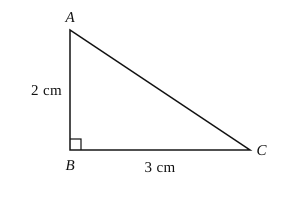
Assertion (A) : The perimeter of △ A B C
(A) Both Assertion (A) and Reason (R) are true and Reason (R) is the correct explanation of Assertion (A).(B) Both Assertion (A) and Reason (R) are true but Reason (R) is not the correct explanation of Assertion (A).(C) Assertion (A) is true but Reason (R) is false.(D) Assertion (A) is false but Reason (R) is true.Show answer & solution
Answer: (D) A is false but R is true.
∠ B = 9 0 ∘ A C = 2 2 + 3 2 = 13 Perimeter = 2 + 3 + 13 = 5 + 13 If a, b are rational, a 2 + b 2
If ‘p’ and ‘q’ are natural numbers and ‘p’ is the multiple of ‘q’, then what is the HCF of ‘p’ and ‘q’ ?
(A) pq (B) p (C) q (D) p + q Show answer & solution
Answer: (C) q
Since p q q p q No number larger than q q = q
If ‘n’ is a natural number, then which of the following numbers end with zero ?
(A) ( 3 × 2 ) n (B) ( 2 × 5 ) n (C) ( 6 × 2 ) n (D) ( 5 × 3 ) n Show answer & solution
Answer: (B) ( 2 × 5 ) n
A number ends with zero only if its prime factorisation contains both 2 and 5. Only ( 2 × 5 ) n = 2 n × 5 n = 1 0 n
The ratio of HCF to LCM of the least composite number and the least prime number is :
(A) 1:2(B) 2:1(C) 1:1(D) 1:3Show answer & solution
Answer: (A) 1:2
Least composite number = 4, least prime number = 2. HCF(4, 2) = 2 and LCM(4, 2) = 4. HCF : LCM = 2 : 4 = 1 : 2
Assertion (A) : The number 5 n
(A) Both Assertion (A) and Reason (R) are true and Reason (R) is the correct explanation of the Assertion (A).(B) Both Assertion (A) and Reason (R) are true, but Reason (R) is not the correct explanation of the Assertion (A).(C) Assertion (A) is true, but Reason (R) is false.(D) Assertion (A) is false, but Reason (R) is true.Show answer & solution
Answer: (C) Assertion (A) is true, but Reason (R) is false.
To end in 0 a number must have both 2 and 5 as prime factors. 5 n The prime factorisation of 5 is just 5; 1 is not a prime factor. So R, as stated, is false (and it does not explain A anyway).
If p 2 = 50 32
(A) whole number(B) integer(C) rational number(D) irrational numberShow answer & solution
Answer: (C) rational number
p 2 = 50 32 = 25 16 p = ± 5 4
The LCM of smallest 2-digit number and smallest composite number is
(A) 12(B) 4(C) 20(D) 40Show answer & solution
Answer: (C) 20
Smallest 2-digit number = 10 = 2 × 5 = 2 2 LCM = 2 2 × 5 = 20
Practise smarter: chapter-wise revision, formula sheets and step-by-step NCERT solutions on
MonoMath CBSE →